What is Legal Tech, and How Is It Changing the Legal Industry? — from startup.info

Excerpt:

Legal technology is a branch of technological innovation that targets and affects the legal sector specifically. The considerable pace of new invention in tech sectors – bolstered by government investment in UK-based innovation and growth – has highlighted some avenues of innovation that could change the face of the legal profession, streamlining judicial processes and helping firms during discovery.

However, in concert with the rapid pace of new technology that benefits legal practise, the technology’s legal implications are also being raised. With a technological landscape that has far outstripped the remit of conventional law, demand for technology lawyers has increased to enable businesses and lawmakers to navigate new tech possibilities.

Four Important Technology Trends for Law Firms in 2022 — from jdsupra.com

Excerpt:

It is easy to say (two years now into the pandemic) that COVID-19 changed the legal profession forever. After a massive shift in 2020 and 2021 to working and conducting court proceedings remotely, with the help of many remote technologies, many legal professionals may wonder what lies ahead from a technology standpoint. After such a dramatic shift, are there even more disruptions to embrace?

The answer is yes! The world turns, technology keeps evolving, and so too will the legal services industry. Below are predictions of technology trends that will continue to be important in 2022 and help shape the industry in the years ahead.

With RemoteDepo™ by U.S. Legal Support, everyone can participate in a remote deposition and interact as if they were in the same conference room. With an internet connection and webcam-equipped device, you can communicate in realtime, observe witness body language and seamlessly facilitate questioning.

Depositions. Virtually. Anywhere. Keep your discovery schedule on track with our secure video conference solution for remote depositions, arbitrations, hearings and other proceedings – RemoteDepo™.

How Legal AI Technology Adoption Leads to Real-World Results — from jdsupra.com

Excerpt:

Contracting is just one area where in-house lawyers and legal ops professionals are seeing real-world results by implementing AI. As innovation continues to disrupt the legal tech world, AI is being introduced into nearly every aspect of practice and business. But now, AI has evolved beyond a buzzword to provide meaningful – and impactful – results.

Ironclad’s New Connect Tool ‘Cuts Contracting Time By 40% — from artificiallawyer.com

Excerpt:

CLM Ironclad has launched a new tool called Connect, which creates a centralised view of the contracting process for all parties and, they claim, can reduce contract completion times by over 40% – which is a lot whether you are a busy inhouser, or a law firmer on the billable hour.

The new capability allows you to store all communications about a deal in one place, ‘even attachments and months-long email threads’ and allows you to keep everyone involved in negotiating a contract ‘in the loop’.


Math worksheets for the learning process — from intelligenthq.com

Excerpt:

If you want to master the subject of mathematics, constant practice of various topics is a must. To ensure that you have the proper grasp of all the topics of the subject, solving worksheets for math is one of the best techniques. Worksheets for math facilitate the stepwise mechanism which enhances the learning process and helps students identify their mistakes. Once they can recognize what their mistakes are, they can work on improving them. Worksheets for math also have visual problems that help in the visualization process of students and make their analyzing and strategic capability high. Take worksheets for math from Cuemath and excel in math.

Also see:

Master Math with Cuemath's live, online-based classes


Also relevant/see:

In New Math Proofs, Artificial Intelligence Plays to Win — from quantamagazine.org; with thanks to Alec Lazarescu on Twitter for this resource
A new computer program fashioned after artificial intelligence systems like AlphaGo has solved several open problems in combinatorics and graph theory.


Universities reimagine teaching labs for a virtual future — from edtechmagazine.com by Renee Morad
Schools are replacing take-home lab kits with more advanced virtual options that allow students to access industry-grade equipment.

Excerpt:

Soon after, engineering professors at Morgan State began using more advanced virtual lab options, which allowed students to access industry-grade lab equipment. The students could use an oscilloscope, a digital multimeter, a power supply and a function generator. The students logged on remotely to a cloud-based platform and followed the instructor’s video feed to get real-time guidance and feedback.

As the global pandemic forced professors and department chairs to adapt to a new learning frontier, it shined a spotlight on new methods to remotely replicate the in-person lab experience. It shifted the university lab from a traditional learning center to a futuristic innovation hub.

From DSC:
Also interesting here, see:

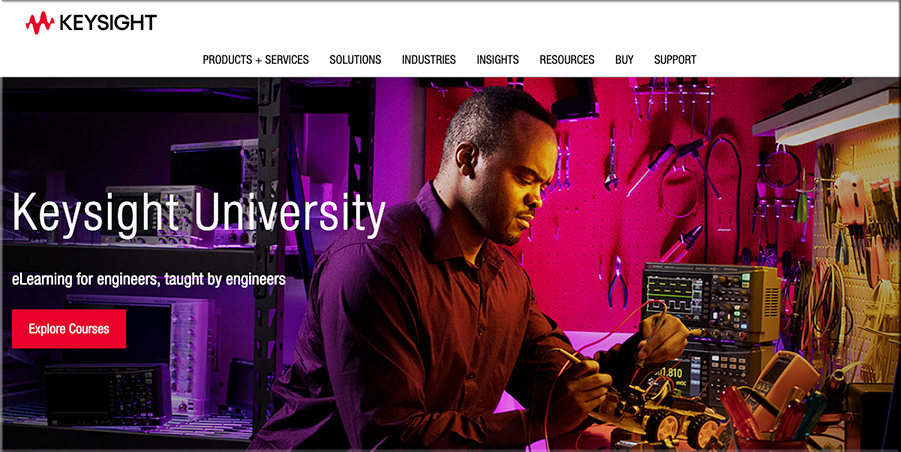
Keysight University courses will advance your knowledge of precision digital and RF measurement approaches, the latest industry standards, compliance, power, and more.

Also relevant here, see:

  • U San Diego Nursing Students to Learn Clinical Skills in VR — from campustechnology.com by Rhea Kelly
    Excerpt:
    The University of San Diego is rolling out virtual reality technology in its nursing curriculum to help prepare students for real-world clinical scenarios. The VR tools will enable students to learn and practice clinical skills in a low-risk setting, as well as reduce their anxiety when interacting with live patients, according to a news announcement.
 

Where’s the upskilling and reskilling market headed? — from edtechreview.in by Priyanka Gupta
Upskilling and Reskilling are the new buzzwords in the edtech industry and corporate learning. With times changing at light speed, unlearning and relearning have become the norm.

Excerpt:

To understand more about the reskilling and Upskilling market, read further about:

  • The Need of Upskilling and Reskilling
  • Workforce Shift and The Upcoming Trends
  • The Key Element in the Future of Upskilling
  • The Challenges Ahead

Life of Technical Skills
Technical skills change rapidly. The industry standards for technologies and processes shift more quickly than any education system can turn out leaders. A survey by Prudential reveals that only 46% of working professionals think their skills will make them competitive in the coming ten years. Unless the skill providers speed up their initiatives or programs’ design, development and deployment, organisations and professionals will struggle to find relevancy in jobs and employees relating to skill levels with the dynamic nature of technology and related jobs. 


A group of workers are shown paving a new highway in this image.

From DSC:
What are the cognitive “highways” within our minds?

I’ve been thinking a lot about highways recently. Not because it’s construction season (quite yet) here in Michigan (USA), but because I’ve been reflecting upon how many of us build cognitive highways within our minds. The highways that I’m referring to are our well-trodden routes of thinking that we quickly default/resort to. Such well-trodden pathways in our minds get built over time…as we build our habits and/or our ways of thinking about things. Sometimes these routes get built without our even recognizing that new construction zones are already in place.

Those involved with cognitive psychology will connect instantly with what I’m saying here. Those who have studied memory, retrieval practice, how people learn, etc. will know what I’m referring to. 

But instead of a teaching and learning related origin, I got to thinking about this topic due to some recent faith-based conversations instead. These conversations revolved around such questions as:

  • What makes our old selves different from our new selves? (2 Corinthians 5:17)
  • What does it mean to be transformed by the “renewing of our minds?” (Romans 12:2)
  • When a Christian says, “Keep your eyes on Christ” — what does that really mean and look like (practically speaking)?

For me, at least a part of the answers to those questions has to do with what’s occupying my thought life. I don’t know what it means to keep my eyes on Christ, as I can’t see Him. But I do understand what it means to keep my thoughts on what Christ said and/or did…or on the kinds of things that Philippians 4:8 suggests that we think about. No wonder that we often hear the encouragement to be in the Word…as I think that new cognitive highways get created in our minds as we read the Bible. That is, we begin to look at things differently. We take on different perspectives.

The ramifications of this idea are huge:

  • We can’t replace an old highway by ourselves. It takes others to help us out…to teach us new ways of thinking.
  • We sometimes have to unlearn some things. It took time to learn our original perspective on those things, and it will likely be a process for new learning to occur and replace the former way of thinking about those topics.
  • This idea relates to addictions as well. It takes time for addicts to build up their habits/cravings…and it takes time to replace those habits/cravings with more positive ones. One — or one’s family, partner/significant other, and friends — should not expect instant change. Change takes time, and therefore patience and grace are required. This goes for the teachers/faculty members, coaches, principals, pastors, policemen/women, judges, etc. that a person may interact with as well over time. (Hmmm…come to think of it, it sounds like some other relationships may be involved here at times also. Certainly, God knows that He needs to be patient with us — often, He has no choice. Our spouses know this as well and we know that about them too.)
  • Christians, who also struggle with addictions and go to the hospital er…the church rather, take time to change their thoughts, habits, and perspectives. Just as the rebuilding of a physical highway takes time, so it takes time to build new highways (patterns of thinking and responses) in our minds. So the former/old highways may still be around for a while yet, but the new ones are being built and getting stronger every day.
  • Sometimes we need to re-route certain thoughts. Or I suppose another way to think about this is to use the metaphor of “changing the tapes” being played in our minds. Like old cassette tapes, we need to reject some tapes/messages and insert some new ones.

What are the cognitive highways within your own mind? How can you be patient with others (that you want to see change occur within) inside of your own life?

Anyway, thanks for reading this posting. May you and yours be blessed on this day. Have a great week and weekend!


Addendum on 3/31/22…also relevant, see:

I Analyzed 13 TED Talks on Improving Your Memory— Here’s the Quintessence — from learntrepreneurs.com by Eva Keiffenheim
How you can make the most out of your brain.

Excerpt:

In her talk, brain researcher and professor Lara Boyds explains what science currently knows about neuroplasticity. In essence, your brain can change in three ways.

Change 1 — Increase chemical signalling
Your brain works by sending chemicals signals from cell to cell, so-called neurons. This transfer triggers actions and reactions. To support learning your brain can increase the concentration of these signals between your neurons. Chemical signalling is related to your short-term memory.

Change 2 — Alter the physical structure
During learning, the connections between neurons change. In the first change, your brain’s structure stays the same. Here, your brain’s physical structure changes?—?which takes more time. That’s why altering the physical structure influences your long-term memory.

For example, research shows that London taxi cab drivers who actually have to memorize a map of London to get their taxicab license have larger brain regions devoted to spatial or mapping memories.

Change 3 — Alter brain function
This one is crucial (and will also be mentioned in the following talks). When you use a brain region, it becomes more and more accessible. Whenever you access a specific memory, it becomes easier and easier to use again.

But Boyd’s talk doesn’t stop here. She further explores what limits or facilitates neuroplasticity. She researches how people can recover from brain damages such as a stroke and developed therapies that prime or prepare the brain to learn?—?including simulation, exercise and robotics.

Her research is also helpful for healthy brains?—?here are the two most important lessons:

The primary driver of change in your brain is your behaviour.

There is no one size fits all approach to learning.


World Nature Photography Awards 2021 Winners — from worldnaturephotographyawards.com

Two enormous elephants with massive tusks fighting each other

Amazing Pictures of the Nazaré Wave — from fubiz.net

An amazing picture of a Nazare wave


Pink Peonies Burst with Life in Hyperrealistic Oil Paintings by Maria Marta Morelli — from thisiscolossal.com by Maria Marta Morelli

Pink Peonies Burst with Life in Hyperrealistic Oil Painting by Maria Marta Morelli


Vibrant Paper Strips Swirl into Energetic Circles of Scales and Feathers by Lisa Lloyd — from thisiscolossal.com by Lisa Lloyd


From DSC:
The above items make me exclaim, “Glory to God in the highest!” He’s an amazing, detail-oriented designer and artist! I’m grateful that He gave us the ability to be creative as well — thank you LORD for making us in your image. Genesis 1:26-27

I’m going to borrow the idea of taking the world ART from the world EARTH:

Only the LORD can paint a canvas like this!


Instructional Design 3.0: Designing The Learner’s Journey - Part 1 -- by Dr. Michael Allen

Instructional Design 3.0: Designing The Learner’s Journey – Part 1 — from blog.alleninteractions.com by Michael Allen

Excerpts:

We’ve made important strides in instructional design over the last couple of decades and now we’re about to take one more momentous step.

We’ve gone from focusing almost exclusively on content, its clarity, logical sequencing, comprehensiveness, accuracy, and so forth (all important, of course), to focusing on the learner’s experience, making it Meaningful, Memorable, and Motivational (again, all critical). While pulling these essential components together, it seems we’re still missing something, perhaps the most important component of all. Let’s think what that might be.

I’ll address some of the techniques for designing from the perspective of the Learner’s Journey in subsequent blogs. But let’s start with this simple and powerful idea: reverse the process. Start defining how you want to address the whole of the learner, including the individual’s feelings, attitudes, and current skills. Don’t do this as a tack-on that you’ll do if you somehow get the time.

    • Start with thinking about learners as emotive and cognitive persons first. 
    • Then create context-situated challenges and give learners the opportunity to show what they can do and request help as they may feel they need to.
    • And finally, when you’ve created these structures, you’ll find you’ve already got a great framework in which to insert, fully develop, and refine your content.

Let’s make every learner’s journey a fascinating and enriching experience, from beginning to end.


Edtech Companies Tap AI For More Personalized Learning — from kidscreen.com by Zeenya Shah
AI is shaping the future of digital learning as parents—daunted by online schooling—turn to tech companies for help. Are they ready?

Excerpt:

A report from research institute The Learning Counsel found that US families spent 25% more on curriculum resources and networks in 2020 than they did in 2019, for a cumulative spend of US$35.8 billion.

It’s a growing market opportunity, and ed-tech companies using AI-assisted adaptive learning technology may be well-poised to make the most out of this heightened demand for personalized education.


With Few Details But Big Ideas, Sec. Cardona Pushes Total Reimagining of Education — from edsurge.com by Emily Tate

Excerpt:

In the last two years, while schools experienced more disruption and strain than in almost any other time in recent memory, education leaders have been broadcasting one message, loud and clear and often: Education cannot go back to normal. This moment presents a chance to move forward, not go back. The upheaval of the pandemic can be an opportunity for positive change, if we let it.

As the weather warms and COVID cases plummet and classrooms return to full capacity, the moment of truth is near. And during a keynote panel at the SXSW EDU conference in Austin, Texas, on Wednesday, Education Secretary Miguel Cardona made sure to drill home the message to the hundreds of educators seated before him.


Best from the brightest: Key ideas & insights for L&P Professionals — from tier1performance.com by Will Thalheimer; with thanks to Christy Tucker for this resource
Gather your learning and performance team together, share conversations with your friends in the field—this trove of gold from 2021 is the bedrock for our evolving and improving work in 2022.

To help fight our FOMO (fear of missing out), I’ve asked 48 thought leaders in the L&P field to share their favorite content from 2021—stuff they created or were involved in, ideas they think are critically important to folks like you and me as L&P professionals. They shared articles, blog posts, podcast episodes, videos, and eLearnings. They also shared their recommendations for other thought leaders and other content—and the most important trends impacting our work for 2022.

I looked at every one of their recommendations and I am blown away by the insights you’ll find in the content shared below. This is a formidable treasure trove from some of the best minds in our field.

Will Thalheimer


Best Cameras for Vlogging in 2022 — from futurism.com

Excerpt:

Whether you’re looking for a camera to start your journey to internet stardom, or would just like to improve your video quality, this list of the best cameras for vlogging will not only capture you as you ham it up, but produce some seriously crisp content that you won’t have to patch up in editing.

Sony - ZV-1 20.1-Megapixel Digital Camera for Content Creators and Vloggers - Black

Also see:

The Best Vlogging Cameras and Gear — updated in May 2021 — from nytimes.com (Wirecutter) by Geoffrey Morrison and Phil RyanU


How sponsorship can help women in tech advance — from mckinsey.com

Excerpt:

While women earn about half of science and engineering degrees, they make up less than 20 percent of people employed in these fields. And for many who choose this career path, they are commonly the only person of their gender in a room.

This International Women’s Day, we’re looking at one workplace element that can help reverse those trends for women in tech: connecting with a sponsor who creates opportunities for them and advocates for their advancement.

Women in Tech: Breaking Bias in the Workplace — from technative.io

Excerpt:

However, as important having a mentor is, it is imperative to have strong decision making power of your own. Future Processing’s Mleczko suggests women take control of their lives actively: “You are the only one who can decide about your life and your future. Do not let your dreams go just because other people say you are not capable of something. Some things need time, so be patient but do not resign. Everyone started at the very beginning.”

Inclusive Hiring in Tech: How to Write More Inclusive Job Descriptions — by Jill Bender


Addendums on 3/17/22:


Tapping the Potential of Learning Through Play in STEAM Programs — from techlearning.com by Ray Bendici
Encouraging purposeful play through tools such as LEGO Education to engage students and improve STEAM learning outcomes

Excerpt:

We know children thrive through play, but did you know that learning through play is a powerful research-backed strategy to boost student engagement in the classroom?

“When students are playing, they’re unlocking their natural curiosity and finding their joy in learning,” said Dr. Jenny Nash, Head of Education Impact, US, for LEGO Education, during a recent virtual Tech & Learning roundtable discussion. “And when students learn in a purposeful, hands-on way it builds their confidence, and lessons can really become more motivating and meaningful. Purposeful play is rooted in pedagogical approaches, such as project-based learning, and it’s really known to increase student learning outcomes.”


10 ways to improve students’ long-term learning — from ditchthattextbook.com

Research has a lot to say about improving students’ long-term memory. Here are 10 ideas you can use in class.

Also relevant/see:

Busting The Myth of Learning Styles — from techlearning.com by Erik Ofgang
The idea that different students have different learning styles pervades education, but cognitive scientists say there is no evidence learning styles exist.


Hybrid learning for hybrid jobs: Reskilling for the digital age — from chieflearningofficer.com by David Porcaro
Just as “hybrid jobs” have become “jobs,” the old definition of “hybrid learning” that mixes in-person and online experiences is fast becoming just “learning.” It’s incumbent on employers, training providers and learners themselves to ensure that as we navigate that shift, we’re building a more meaningful and productive learning experience in the process.

What would happen if we reimagined hybrid learning as “learning that equips workers for hybrid jobs,” and built a new approach from there? That’s the question we’ve been working to answer at General Assembly, where our work with employers across a range of fields — from the tech industry to retail and manufacturing — has helped us understand what it takes for learners to be successful in the digital age. Our learning philosophy focuses on four key goals, which could form the building blocks of a new definition of hybrid learning.

Also relevant/see:

Leveraging experiential learning in a hybrid world — from chieflearningofficer.com by George Hallenbeck
The disruption brought on by the shift to hybrid work provides excellent opportunities for experiential learning. By balancing intentionality with support and maximizing the quantity, quality and diversity of learning experiences, both organizations and individual leaders can adapt and thrive in this new era of work.

 
© 2025 | Daniel Christian