From DSC:
When I saw the recent article below out at mlive.com, I couldn’t help but recall the words that our daughter just said the other day — that they had yet another day of standardized testing to do that day. (She works in a public school system here in Michigan.) In fact, she said that the relaying of new content had already ended a while ago and the last two months of the year were being allocated for reviewing what had already been covered and then taking these standardized tests. I’m guessing that neither students nor the teachers and other teaching/support-related staff were all that excited about that agenda.

In such cases, I’m guessing that the love of learning goes right out the window — as does the love of teaching. All of this is to:

  • assuage the legislators in our state’s capitol — especially to see how Michigan is stacking up in the comparison game with other states
  • give bragging rights to administrators in the comparison game as they compare their school district to other districts in Michigan
  • give the realtors and communities reasons for the increased prices of their houses (in a different but related comparison game)

Am I oversimplifying this? Most likely. But it still bothers me nonetheless.

These are the 50 highest rated Michigan high schools in the new U.S. News rankings — from mlive.com by Martin Slagter

Excerpt:

Three Michigan high schools are once again rated among the top 100 best high schools in the country in the latest U.S. News & World Report best high school rankings released on Tuesday, April 26.

Rankings are based on several weighted factors, including college readiness (30%), college curriculum breadth (10%), state assessment proficiency (20%), state assessment performance (20%), underserved student performance (10%) and graduation rate (10%). The data used is from the 2019-20 school year.

While the six ranking indicators that determined each school’s rank were the same as those used in the three prior years, U.S. News adjusted its calculation of these measures to account for the impact the COVID-19 pandemic had on schools in the 2019-2020 school year.

Also relevant from mlive.com, see:


The AR Roundup: April 2022 — from linkedin.com by Tom Emrich

Excerpts:

Every month I round up what you may have missed in Augmented Reality including the latest stats, funding news and launch announcements and more. Here is what happened in augmented reality between April 1-30, 2022.


Education Needs a Reset. We Can Start by Listening to Our Teachers. — from edsurge.com by Elissa Vanaver

Excerpts:

What too few politicians and parents are talking about, though, is the dire state of the career pipeline for teachers, the ones we’ll be depending on to lead the post-pandemic learning recovery in our classrooms over the next few years—not to mention for the next generation.

Valuing teachers is the systemic path to centering students. In order to move the needle, we must go beyond what teachers need to do to address root causes that require cultural and systemic change. Here are a few things it will take:

  1. Understanding that teaching and learning are inherently relational and the power relationships have on student and teacher success.
  2. Centering the joy of learning and making classrooms a place students and teachers want to be.
  3. Creating an empowered teaching culture to advocate for children and encouraging creativity that optimizes engagement.
  4. Fostering culturally responsive methods through continuous mentoring by exceptional, experienced educators.
  5. Developing partnerships with quality teacher preparation programs for coherent and supportive career pathways.

From DSC:
When I used to work in customer service and also in technical support at Baxter Healthcare, I always thought that management should be listening closely to those employees who were on the front lines — i.e., those of us who were in regular contact with Baxter’s customers. Similarly, the teachers are on the front lines within education. We need to give them a huge say in what happens in the future of the preK-12 learning ecosystems. We also need the students’ voices to be heard big time.

Also popular last month from edsure.com, see:


12 examples of artificial intelligence in everyday life — from itproportal.com by Christopher Oldman

Excerpt:

4. Plagiarism
The college students’ (or is it professor’s?) nightmare. Whether you are a content manager or a teacher grading essays, you have the same problem – the internet makes plagiarism easier.

There is a nigh unlimited amount of information and data out there, and less-than-scrupulous students and employees will readily take advantage of that.

Indeed, no human could compare and contrast somebody’s essay with all the data out there. AIs are a whole different beast.

They can sift through an insane amount of information, compare it with the relevant text, and see if there is a match or not.

Furthermore, thanks to advancement and growth in this area, some tools can actually check sources in foreign languages, as well as images and audio.

Intel calls its AI that detects student emotions a teaching tool. Others call it ‘morally reprehensible.’ — from protocol.com by Kate Kaye
Virtual school software startup Classroom Technologies will test the controversial “emotion AI” technology.

Excerpts:

But Intel and Classroom Technologies, which sells virtual school software called Class, think there might be a better way. The companies have partnered to integrate an AI-based technology developed by Intel with Class, which runs on top of Zoom. Intel claims its system can detect whether students are bored, distracted or confused by assessing their facial expressions and how they’re interacting with educational content.

But critics argue that it is not possible to accurately determine whether someone is feeling bored, confused, happy or sad based on their facial expressions or other external signals.

The classroom is just one arena where controversial “emotion AI” is finding its way into everyday tech products and generating investor interest. It’s also seeping into delivery and passenger vehicles and virtual sales and customer service software.

MIT’s FutureMakers programs help kids get their minds around — and hands on — AI — from news.mit.edu by Kim Patch
The programs are designed to foster an understanding of how artificial intelligence technologies work, including their social implications.

Excerpt:

During one-week, themed FutureMakers Workshops organized around key topics related to AI, students learn how AI technologies work, including social implications, then build something that uses AI.

“AI is shaping our behaviors, it’s shaping the way we think, it’s shaping the way we learn, and a lot of people aren’t even aware of that,” says Breazeal. “People now need to be AI literate given how AI is rapidly changing digital literacy and digital citizenship.”

AI can now kill those annoying cookie pop-ups — from thenextweb.com by Thomas Macaulay
The notifications have been put on notice

Excerpt:

After years of suffering this digital torture, a new AI tool has finally offered hope of an escape.

Named CookieEnforcer, the system was created by researchers from Google and the University of Wisconsin-Madison.

The system was created to stop cookies from manipulating people into making website-friendly choices that put their privacy at risk. Yet it could also end the constant hassle of navigating the notices.

Using machine learning to improve student success in higher education — from mckinsey.com
Deploying machine learning and advanced analytics thoughtfully and to their full potential may support improvements in student access, success, and the overall student experience.

Excerpt:

Yet higher education is still in the early stages of data capability building. With universities facing many challenges (such as financial pressures, the demographic cliff, and an uptick in student mental-health issues) and a variety of opportunities (including reaching adult learners and scaling online learning), expanding use of advanced analytics and machine learning may prove beneficial.

Below, we share some of the most promising use cases for advanced analytics in higher education to show how universities are capitalizing on those opportunities to overcome current challenges, both enabling access for many more students and improving the student experience.

Artificial intelligence (AI): 7 roles to prioritize now — from enterprisersproject.com by Marc Lewis
Which artificial intelligence (AI) jobs are hottest now? Consider these seven AI/ML roles to prioritize in your organization

Excerpt:

Rather than a Great Resignation, this would suggest a Great Reallocation of the workforce. As a global search consultant, we are seeing this precipitous shift in positions, with great demand for skills in artificial intelligence and machine learning (AI/ML).

With that in mind, here are seven artificial intelligence (AI)-related roles to consider prioritizing right now as the workforce reallocates talent to new jobs that drive economic value for leading companies…

4 ways AI will be a great teaching assistant — from thetechedvocate.org by Matthew Lynch


Become a Wi-Fi wizard — from advisorator.com by Jared Newman; or see this page

Excerpt:

Wi-Fi is fundamentally at odds, then, with my desire to answer questions with specific recommendations. The best I can do is walk you through how I diagnose Wi-Fi problems myself. That way, you can make better decisions on whether (and how) to upgrade your own gear.

In this guide:

  • Size up the problem
  • Know your router
  • Try some smaller fixes
  • Extenders: a last resort
  • Picking a new Wi-Fi router
  • Deciphering Wi-Fi jargon


This Week’s Awesome Tech Stories From Around the Web (Through April 30) — from singularityhub.com by Singularity Hub Staff

Topics include:

  • Computing
  • Robotics
  • Nanotechnology
  • Technology
  • Gadgets
  • Space
  • AI
  • AR


You Can Now Ask Google to Remove Personal Info From Searches — from lifewire.com by Rob Rich
But that won’t remove the information at its source

Excerpt:

Google is taking a more active role in stopping the spread of sensitive and personal information by allowing you to request its removal from searches.

The new policy applies to what Google refers to as personally identifiable information (PII), such as details that could be used for identity theft or more direct harm. Info like bank account or credit card numbers, medical records, personal contact details, social security numbers, and so on. Whether or not it acts on these requests is discretionary, however.

Also relevant/see:


The Future Is Here: Assistive Technology for Learning Disabilities — from studycorgi.com; with thanks to Alysson Webb for this resource

Excerpt:

Equal learning and personal development opportunities help ensure everyone reaches their highest potential. However, it is important to look at comparable needs. People with learning disabilities can require individual or additional services from a school program. According to the National Center of Educational Statistics, in 2019 – 2020, 14% (7.3 million) of children from 3 to 21 received special education services in the US. One-third of them had various learning disabilities that required specific assistance and tools.

Table of Contents

  1. What Is a Learning Disability?
  2. Assistive Technology (AT) in the Classroom
  3. AT for Learning Disabilities: Benefits & Tools
  4. References
 

Remote court transcription technology enables virtual court appearances — from abajournal.com by Nicole Black

Excerpts:

That’s why it’s imperative to make certain remote options are available for all aspects of legal work since doing so is the only way to guarantee the justice system doesn’t come to a grinding halt. One way to prevent that is to take advantage of the virtual deposition transcription tools I discussed in last month’s column. In that article, I provided an overview of virtual deposition transcription products and services that rely on videoconferencing tools and software platforms to facilitate remote depositions.

Another way business continuity has been maintained since March 2020 is via virtual court proceedings. Remote court appearances are now more common since courts periodically shifted to partial or fully remote operations throughout the pandemic. Many judges have become accustomed to and appreciate the convenience of virtual court proceedings, and many expect them to continue even after the pandemic ends.

Because all signs point to the continuation of virtual court proceedings, I promised in last month’s article that I would focus on remote court proceeding options in this column. These include software platforms and artificial intelligence language-processing tools that facilitate remote court proceedings.

Nicole’s article mentioned the following vendor/product:

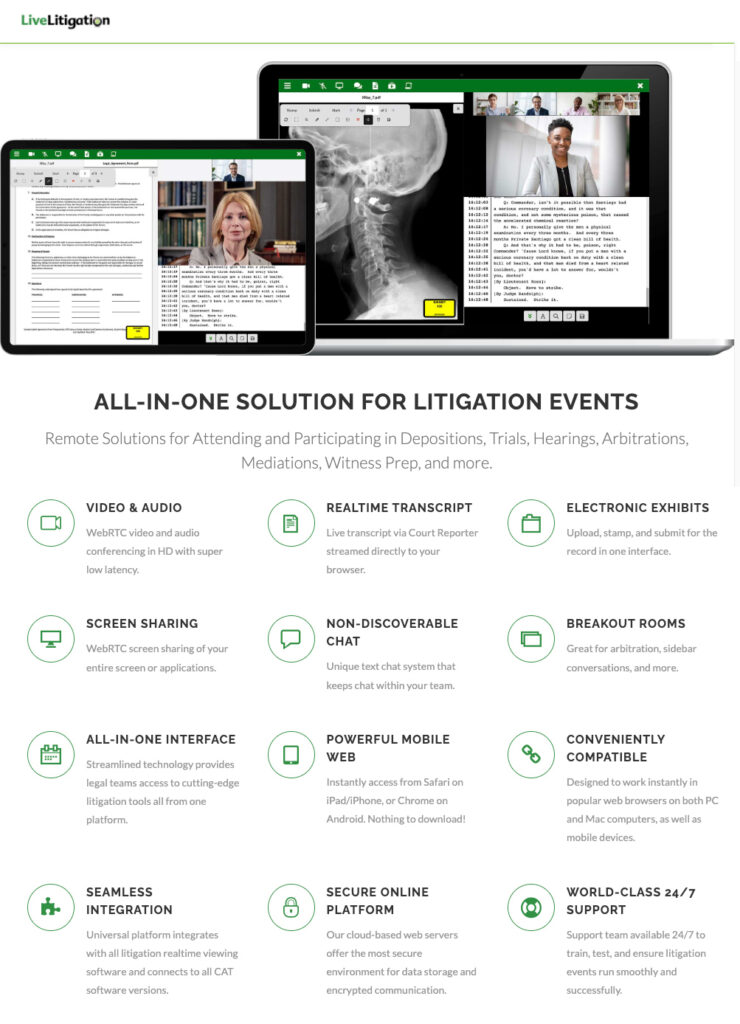
Live Litigation -- Remote Solutions for Attending and Participating in Depositions, Trials, Hearings, Arbitrations, Mediations, Witness Prep, and more.


The rise of alternative credentials in hiring — from shrm.org; with thanks to Ryan Craig for this resource
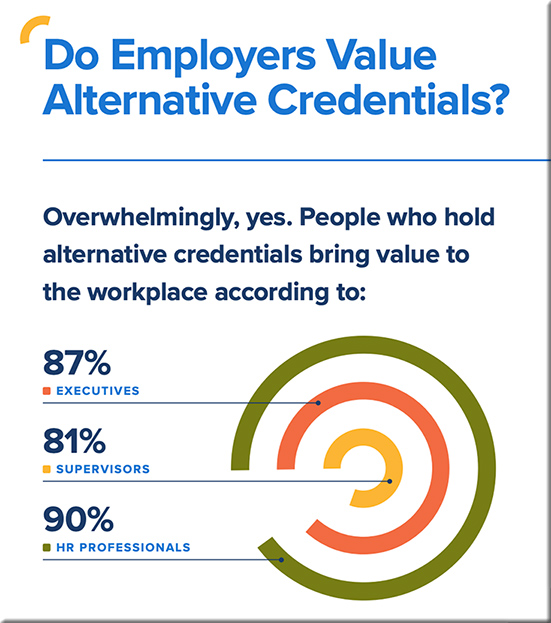
Increasingly, U.S. workers are turning to alternative credentials as a way to enhance and demonstrate skills and work readiness. But can certifications, badges and apprenticeships stand in for traditional education and work experience when seeking a new job?

Excerpts:

Alternative credentials can be defined as any microcredential, industry or professional certification, acknowledgment of apprenticeship (registered or nonregistered), or badging that indicates one’s competencies and skills within a particular field. Alternative credentials do not include traditional academic degrees or required occupational licensures.

However, one potential barrier to employers’ wider recognition of alternative credentials is actually a technical one. Automated applicant tracking systems (ATS) frequently don’t pick up on them, because often there is still no standard approach to collecting this information as systems do for traditional education and work experience. Only one-third of HR professionals whose organizations use automated prescreening say this prescreening even recognizes alternative credentials. Such inconsistency offers a clear direction for both HR and the providers of applicant screening tools to improve the ways alternative credentials are captured in the application process.


Grandpa Creates Hologram Twin For Future Grandkids Using VR — from vrscout.com by Kyle Melnick
Not even death will stop this tech-savvy grandfather from meeting his great-grandchildren.

“I think it is a wonderful way to preserve my family’s history for future generations,” said Jerry while speaking to Jam Press. “To see myself like that, is just mind-blowing — it feels like watching a movie. By not just reading the words as in my memoir but to actually get the chance to see and hear me recalling the stories is just magical.”

Also from Kyle Melnick:

How VR/AR Technology Is Being Used To Treat Autism
XRHealth brings its unique VR/AR therapy to the United States.

Excerpt:

Previously available in Australia, the technology has been used to treat the effects of autism, from anxiety and stress to attention, memory, mobility/coordination, and frustration tolerance. XRHealth’s healthcare platform offers a variety of professional services. This includes one-on-one meet-ups with XRHealth therapists as well as virtual group sessions, all of which accessible remotely using modern VR headsets.


One-time jailhouse lawyer creates legal jobs program for the formerly incarcerated — from abajournal.com by Matt Reynolds

Excerpts:

Devon Simmons, co-founder and project director of a new program helping those with past convictions find work as paralegals and other jobs in the legal profession, says there’s a wealth of untapped legal talent among formerly incarcerated people.

Simmons emerged from prison 15 years later. By that time, he was a product of the John Jay College of Criminal Justice’s Prison-to-College Pipeline program and later graduated with a bachelor’s degree in criminal justice.

“Once I came home, I would constantly see people unemployed who I had sat in the law library with,” Simmons says. “These individuals have legal expertise, but they’re not given the opportunity to utilize it. What if I could create a platform in which I could make that happen?”


Native American Students Can Now Attend U. of California Tuition-Free — from chronicle.com by Abbi Ross

Excerpt:

Native American students who are California residents will no longer have to pay tuition or fees at one of the nation’s largest public-university systems — a decision that some say is a long-overdue acknowledgment of past harms.

The University of California system said this week that all in-state students who are members of federally recognized Native American, American Indian, and Alaska Native tribes will have tuition and fees — about $14,000 each year — waived starting this fall. Then, on Wednesday, one of California’s recognized tribes announced a $2.5 million scholarship fund that will cover tuition and fees for in-state students from unrecognized tribes.

From DSC:
Given the atrocities that have occurred within our nation in the past, this is an excellent step in the right direction.


Higher ed faces shrinking workforce and pay increases outpaced by inflation — from highereddive.com by Laura Spitalniak

Dive Brief (emphasis DSC):

  • The median salary increase for all higher ed professionals was less than half of the inflation rate in 2021-2022, according to workforce survey data released Wednesday by the College and University Professional Association for Human Resources, CUPA-HR.
  • Administrators saw the greatest average salary increase, at 3.4%. The salaries of professional staff rose 2.9%, while tenure-track and nontenure-track faculty got average increases of 1.6% and 1.5%, respectively. The consumer price index for 2021 was 6.8%, the largest increase in decades.
  • The size of full-time and part-time staff as well as tenure-track faculty declined. CUPA-HR said colleges are feeling the same nationwide hiring and retention challenges as other employers.

From DSC:
This is going to hurt higher ed — how much so remains to be seen. But losing real purchasing power and working harder than ever doesn’t make for an effective, appealing, winning, long-term career proposition.

On the parental side of things, I’m not at all excited to have to absorb even higher costs as our son continues to make his way through college.

 
© 2025 | Daniel Christian