Wharton, Berkeley, NYU Offering Online M.B.A.s for the First Time — from wsj.com by Lindsay Ellis; with thanks to the GSV N2K Daily Newsletter for this resource
More elite business schools try virtual degrees to lure graduate students

Online M.B.A. students at Boston University watch live broadcasts
of professors and talk on a virtual forum.
PHOTO: CARLIN STIEHL FOR THE WALL STREET JOURNAL


From DSC, along the lines of online-based learning:


Are Microcredentials Finally Gaining Traction? — from insidehighered.com by Joshua Kim

Excerpt:

This month, the London School of Economics expanded its degree partnership with 2U to launch a series of edX microcredentials that provide learners with a flexible, stackable pathway towards pursuing a fully online undergraduate education. Wim Van der Stede, LSE’s new academic dean for extended education, graciously agreed to answer my questions about these new programs.

In that time, we’ve seen the power that online learning has to meet learners’ needs at every stage of their lives and careers.

The world around us is changing, rapidly, and we need to support professionals, alumni and students in refreshing and adapting their knowledge and skills, as and when they need, through evolving lives and careers. This is at the heart of LSE’s mission as a global social science hub of research and education, and plays a key role in achieving our mission to educate for impact by empowering students to develop the skills to solve society’s most pressing issues in an ever-changing world.


A side thought from DSC:
Speaking of Economics, I wonder if and how Artificial Intelligence (AI) will impact the field of Economics?


A Brilliant MIT Professor Shared 10 Simple Rules That Will Teach You How to Give a Great Speech — from inc.com by Justin Bariso

Excerpts:

How much would your life change if people valued all of your ideas?

In a recorded lecture that’s been viewed over 13 million times, MIT professor Patrick Winston takes a deep dive into how to be a better speaker. He explains that your success in life depends on your ability to speak, your ability to write, and the quality of your ideas — in that order.

His point? No matter how amazing your ideas are, no one cares unless you can convey them in a clear, compelling manner — and with emotional intelligence.

Use an empowerment promise to explain to your listeners exactly what you can teach them, how they will benefit, and why it’s important.


It’s time to redesign organized learning — from chieflearningofficer.com by Eric Albertini

Excerpt:

Organizations will need to think about three layers of learning content and access methods:

  • Thoughtfully curated by the organization for business fit.
  • Semi-curated with the learner having some control of what they learn.
  • Open for all, where the learner makes all the choices of what and how they learn.

Employee-centric learning approach. There must be a match of learning to organizational objectives as well. Non-curated, open content on platforms is great for focused and deeply aware employees but may not work for everyone, especially in cultures where self-direction is not very strong. Moreover, too much open, non-curated content, driven by non-contextual algorithms, is as detrimental to choice-making for the learner as is too little quality content.

To enable effective learning, technology must be part of a more systemic learning eco-system that includes things such as rewards (the “what’s in it for me”), building blocks from one intervention to the next and post-learning support.  

Also from chieflearningofficer.com, see:


Coursera is Evolving into a Third-Wave EdTech Company — from eliterate.us by Michael Feldstein

Excerpts:

This is the vision of Coursera’s three-sided platform at scale, connecting learners, educators and institutions in a global learning ecosystem designed to keep pace with our rapidly changing world.

Coursera CEO Jeff Maggioncalda

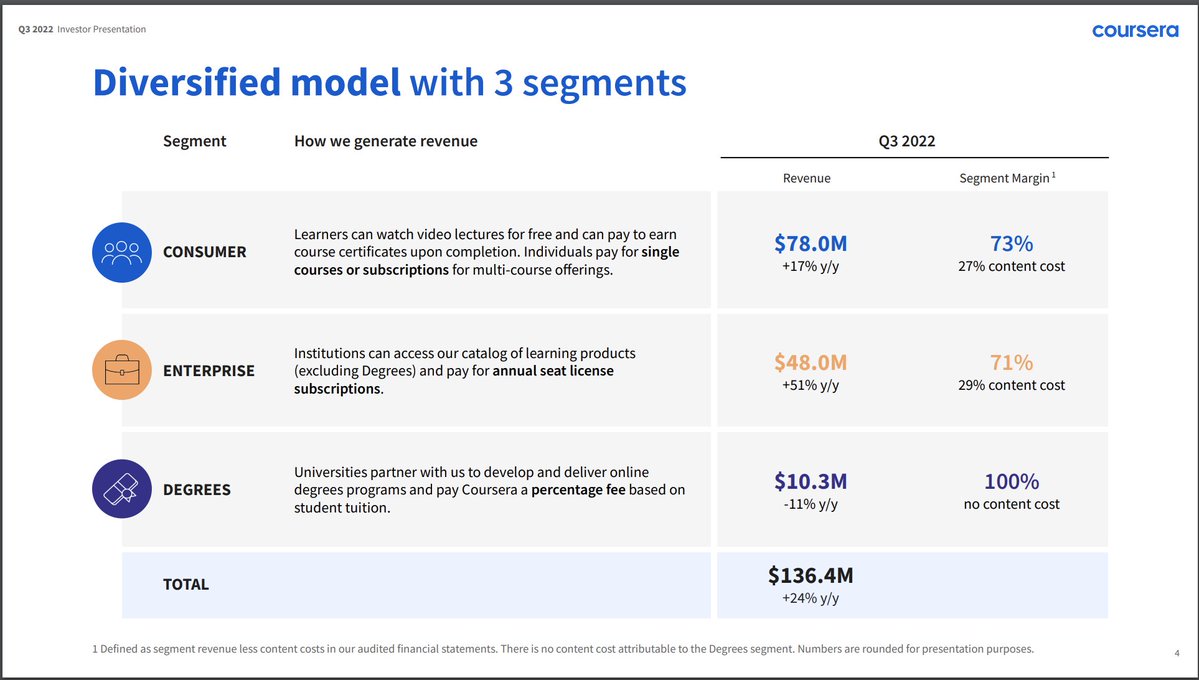
Coursera's diversified model with 3 segments -- consumer, enterprise, and degrees

The point of this slide is to show the diversification of Coursera’s business. Degree programs may be down, but enterprise licenses and direct-to-consumer certificates are up. But it also indicates Coursera’s ability to diversify revenue streams for its university content providers. The enterprise business provides a distribution channel between universities and employers. From what I can tell, it’s a Guild competitor, even though the two companies look very different on the surface. The consumer segment started as the MOOC business and has expanded into the “tweener” space between courses and degrees: certificates, microdegrees, whatever.


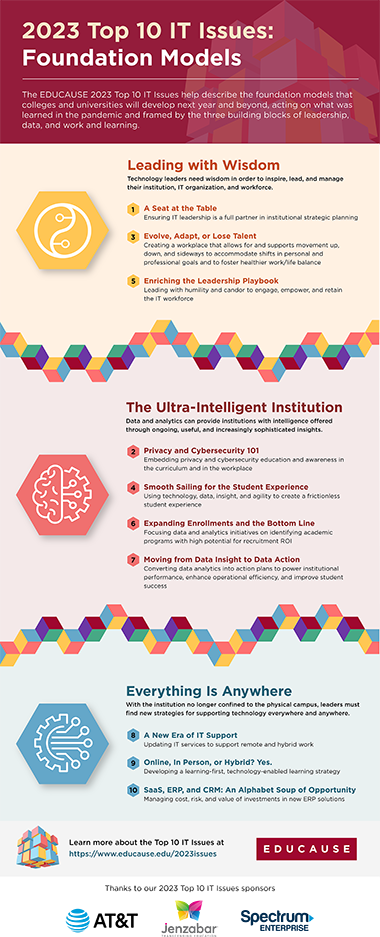
2023 Top 10 IT Issues: Foundation Models — from educause.edu

Excerpt:

Recent times have brought about a Great Rethink that is upending previous models of management and working. Higher education is no exception. In 2023, institutional and technology leaders are ready for a new approach.

The EDUCAUSE 2023 Top 10 IT Issues help describe the foundation models that colleges and universities will develop next year and beyond, acting on what was learned in the pandemic and framed by the three building blocks of leadership, data, and work and learning.

See where things are headed in 2023 and beyond.
.

The Educause 2023 Top 10 IT Issues


.

From DSC:
At this point in time, I’d find your visionary, innovative, tech-savvy leaders out there — and not just for IT-related positions but for Presidents, Provosts, CFO’s, Heads of HR, and similar levels of positions (and ideally on the Boards as well.) Such people need to be at the table when strategies are hammered out.

For example, if your institution didn’t get seriously into online learning long before Covid19 hit, I’d clear house and go back to the drawing board on your leadership.

Also, data won’t save higher ed. New directions/pathways might. But I’m doubtful that new sources of data will — no matter how they are sliced and diced. That sort of thing is too much at the fringe of things — and not at the heart of what’s being offered. The marketplace will eventually dictate to higher ed which directions institutions of traditional higher education need to go in. Or perhaps I should say that this is already starting to occur.

If alternatives to institutions of traditional higher education continue to grow in acceptance and usage — and don’t involve current institutions of higher ed — those sorts of institutions may already be too late. If more corporations fully develop their own training programs, pathways, and credentials, there may be even fewer students to go around.

A final thought: Cheaper forms of online-based learning for the liberal arts may be what actually saves the liberal arts in the long run.


Also relevant/see:


11 The Lord detests dishonest scales,
    but accurate weights find favor with him.

From DSC:
I thought about this verse the other day as I opened up a brand-new box of cereal. The box made it look like I was getting a lot of cereal — making it look like a decent value for the price. But when I opened it up, it was about half full (I realize some of this occurs by pushing out the box as the contents settle, but come on!). In fairness, I realize that the amount of the cereal is written on the box, but the manufacture likely kept the size of the box the same but decreased the amount that they put within it. They kept the price the same, but changed the quantity sold.

This shrinkification of items seems to be happening more these days — as companies don’t want to change their prices, so they’ll change the amounts of their products that you get.

  • It just strikes me as yet another deception.
  • We BS each other too much.
  • We rip each other off too much.
  • We bury stuff in the fine print.
  • Our advertising is not always truthful — words are easy to say, and much harder to back up.
  • We treat people as though they just exist to make money off of. It’s like Philip Morris did to people for years, and it still occurs today with other companies.
  • In today’s perspective, people are to be competed against but not to be in relationships with. 

I hope that we can all build and offer solid products and services — while putting some serious quality into those things. Let’s make those things and offer those services as if we were making them for ourselves and/or our families. Let’s use “accurate weights.” And while we’re trying to do the right things, let’s aim to be in caring relationships with others.


Get Ready to Relearn How to Use the Internet — from bloomberg.com by Tyle Cowen; with thanks to Sam DeBrule for this resource
Everyone knows that an AI revolution is coming, but no one seems to realize how profoundly it will change their day-to-day life.

Excerpts:

This year has brought a lot of innovation in artificial intelligence, which I have tried to keep up with, but too many people still do not appreciate the import of what is to come. I commonly hear comments such as, “Those are cool images, graphic designers will work with that,” or, “GPT-3 is cool, it will be easier to cheat on term papers.” And then they end by saying: “But it won’t change my life.”

This view is likely to be proven wrong — and soon, as AI is about to revolutionize our entire information architecture. You will have to learn how to use the internet all over again.

Change is coming. Consider Twitter, which I use each morning to gather information about the world. Less than two years from now, maybe I will speak into my computer, outline my topics of interest, and somebody’s version of AI will spit back to me a kind of Twitter remix, in a readable format and tailored to my needs.

The AI also will be not only responsive but active. Maybe it will tell me, “Today you really do need to read about Russia and changes in the UK government.” Or I might say, “More serendipity today, please,” and that wish would be granted.

Of course all this is just one man’s opinion. If you disagree, in a few years you will be able to ask the new AI engines what they think.

Some other recent items from Sam DeBrule include:

Natural Language Assessment: A New Framework to Promote Education — from ai.googleblog.com by Kedem Snir and Gal Elidan

Excerpt:

In this blog, we introduce an important natural language understanding (NLU) capability called Natural Language Assessment (NLA), and discuss how it can be helpful in the context of education. While typical NLU tasks focus on the user’s intent, NLA allows for the assessment of an answer from multiple perspectives. In situations where a user wants to know how good their answer is, NLA can offer an analysis of how close the answer is to what is expected. In situations where there may not be a “correct” answer, NLA can offer subtle insights that include topicality, relevance, verbosity, and beyond. We formulate the scope of NLA, present a practical model for carrying out topicality NLA, and showcase how NLA has been used to help job seekers practice answering interview questions with Google’s new interview prep tool, Interview Warmup.

How AI could help translate extreme weather alerts — from axios.com by Ayurella Horn-Muller

Excerpt:

A startup that provides AI-powered translation is working with the National Weather Service to improve language translations of extreme weather alerts across the U.S.

Using GPT-3 to augment human intelligence — from escapingflatland.substack.com by Henrik Karlsson

Excerpt:

When I’ve been doing this with GPT-3, a 175 billion parameter language model, it has been uncanny how much it reminds me of blogging. When I’m writing this, from March through August 2022, large language models are not yet as good at responding to my prompts as the readers of my blog. But their capacity is improving fast and the prices are dropping.

Soon everyone can have an alien intelligence in their inbox.


Innova: A Revolution in Education? — from gettingsmart.com by Chris Terrill

Key Points

  • Innova Schools is designed to rapidly cut through the vast inequities that exist and be a lever for change in Latin America.
  • Innova has the potential to revolutionize education around the globe.

Excerpts (emphasis DSC):

The initial school start-up was funded by Carlos Rodriguez Pastor, a Peruvian businessman. He saw an opportunity to provide high-quality schools in areas where the government struggled to supply essential education services (Peru and Colombia consistently rank near the bottom on the global education survey). He enlisted the famed US design firm IDEO to develop a comprehensive program that would eventually be utilized in multiple countries.

From DSC:
Stop the presses. I love that idea of using IDEO to be involved here. It seems like that is a positive step towards implementing Design Thinking within our learning ecosystems.

In the original model, the founders designed a rigorous, engaging, personalized curriculum, with a heavy emphasis on Project-Based Learning. I wanted to know if and how that is actualized, and how that is enacted across multiple countries in schools thousands of miles apart.

Finally, IDEO’s work included a design for the physical structure of schools to be quickly and economically replicated at each location; how was that design working? The vision for Innova may be one of the most ambitious educational undertakings today. What lessons can I, as an individual educational leader, and we, as a global education community, learn from their work?

The Maker Space and the Gaming Lab demonstrate clearly how digital competency is a central element of their curriculum. I saw highly engaging lessons that were perfectly synced with classroom projects, pursuing a bigger goal of equipping Colombian students to fill the digital labor gap. 


nbsp;


One of the Biggest Problems in Biology Has Finally Been Solved — from  scientificamerican.com by Tanya Lewis
Google DeepMind CEO Demis Hassabis explains how its AlphaFold AI program predicted the 3-D structure of every known protein

Excerpt:

We had to reengineer things for AlphaFold 2 and put a whole bunch of new ideas in there and also bring onto the team some more specialists—biologists and chemists and biophysicists who worked in protein folding—and combine them with our engineering and machine-learning team.

Were you surprised that AlphaFold was so successful?
Yeah, it was surprising, actually. I think it’s definitely been the hardest thing we’ve done, and I would also say the most complex system we’ve ever built.


12 For the word of God is alive and active. Sharper than any double-edged sword, it penetrates even to dividing soul and spirit, joints and marrow; it judges the thoughts and attitudes of the heart.

From DSC:
I’ve found this to be true, although sometimes I wish it weren’t the case. There are times when I read scripture that I wish it were a bit “lighter.” The Word can cut deeply. Though I suppose that’s also helped me many times in convicting me or helping me see blindspots and/or guiding my thinking/behaviors. I have it that if we can’t communicate with God, we can’t have a relationship with Him.  Trust = faith. We can’t build trust with someone who we can’t communicate with.


What to Know About the New Rules on Pell Grants for Prison Education — from chronicle.com by Katherine Mangan

Excerpt:

The U.S. Department of Education on Thursday released final regulations that spell out how colleges can lay the groundwork for enrolling some of the more than 700,000 incarcerated people who are expected to become eligible next summer to apply for Pell Grants to pay for college.

The new prison-education initiative, which will take effect in July, will eventually replace the Second-Chance Pell Program, a pilot that began in 2015 under the Obama administration. Since then, it has grown to allow around 200 colleges to offer prison-education programs that are supported by Pell Grants, currently worth up to around $7,000 per year.


What does the ‘metaverse’ mean for education? — from hechingerreport.org by Javeria Salman
Experts warn educators to think twice before jumping on new technologies

Excerpt:

Sometime in the past year or two, you’ve likely heard the word “metaverse.” It’s the future, the next big frontier of the internet, if you ask technology CEOs or researchers.

While the term has become the latest buzzword in education circles, what it means for teaching and learning largely remains to be seen. Experts say much of what we see marketed as the metaverse from education technology companies isn’t actually the metaverse.

In a true metaverse experience, your digital identity travels between the physical and virtual worlds, Platt said. With the help of blockchain technology, that identity — your preferences, your achievements, your educational records, other elements of who you are — is maintained across platforms and applications.


More than half of L&D pros foresee demise of in-person corporate learning, survey finds — from hrdive.com by Ryan Golden

Dive Brief:

  • Learning and development leaders increasingly see online and hybrid learning models as a permanent fixture in the talent space rather than a temporary trend, according to a survey of 515 L&D leaders at North American and European corporations by NovoEd.
  • Per the company’s survey, 83% of respondents said that hybrid work would force organizations to rethink and redesign corporate L&D offerings. Additionally, more than half said that they agreed with the sentiment that the growth of remote learning would “lead to the demise” of brick and mortar corporate learning.
  • As their organizations increase investment in the space, most L&D leaders said they would evaluate their programs by emphasizing metrics such as improvement in job performance; improvement in knowledge and competency; and application and implementation of learning.
 
© 2025 | Daniel Christian