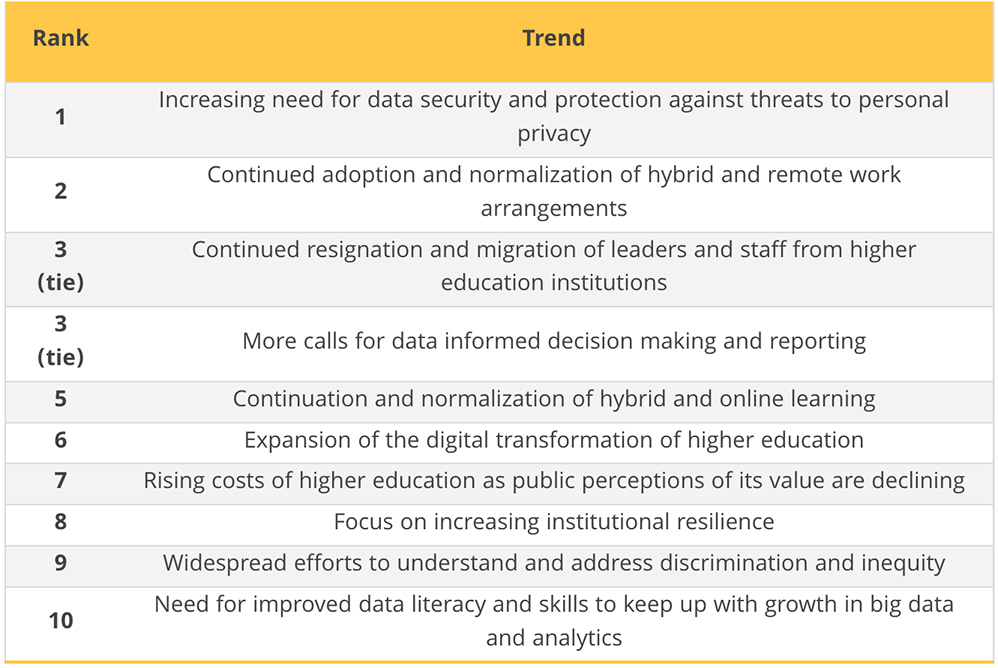
2023 Higher Education Trend Watch — from educause.edu

Excerpt:

This report focuses on the workforce, cultural, and technological shifts for ten macro trends emerging in higher education in 2023. Across these three areas of shift, we report the major impacts and steps that institutions are taking in response to each trend. Some trends overlap with the 2022 Higher Education Trend Watch report. However, while some topics and issues remain consistent, significant shifts have occurred across many of the trends for 2023.


To future-proof a workforce, kill the perpetual hiring machine and embrace lifelong learning — from fortune.com by Clay Dillow

Excerpt:

A looming economic slowdown, the Great Resignation, a relentlessly expanding skills gap, and employees that would simply rather work from home. This week at Fortune’s CEO Initiative forum, a panel of company executives discussed the litany of challenges they face in developing and maintaining their workforces over the next several years.


You want your students back in the classroom? Give them a good reason! — from educationalist.substack.com by Alexandra Mihai

Excerpt:

Right now what I would like to do is turn things upside- down and bring the physical classroom and the in-person teaching and learning into the spotlight. After almost three years of doing things differently, for better or worse, I believe this is a crucial exercise that will help us calibrate our practice moving further. Ironically, despite our expectations that students will happily rush back to campus, many of us noticed a different reality: low attendance levels and in some cases also low engagement.

So, a few questions we could start by asking ourselves are…

So the next time someone asks “why should students come to class?” let’s try to answer anything else than “because they have to”.


From DSC:
This article contains some interesting ideas for professional development.


Improving the Exit Ticket — from theeffortfuleducator.com by Blake Harvard

Excerpts (emphasis DSC):

So, how can the exit ticket be improved upon? How can it be a more effective assessment of learning?

Allow time for forgetting. The main problem with the traditional usage of the exit ticket is that there’s no time to forget, which leads to the measuring of performance and not learning.

Opt for an entrance ticket. Instead of assessing the day’s lesson as they leave, provide students with an index card (or sticky note or whatever) on their way in the next day and assess their knowledge then. Asking those same questions twenty-four hours after the lesson is much more indicative of their true level of understanding.

From DSC:
Though not quite related to the item above, it does have to do with instructional design:


Post-Conference LMS Market News — from philonedtech.com by Phil Hill

Excerpt:

Educause used to be THE EdTech conference, and the LMS market news tended to deliberately coincide with the fall event – with vendors releasing news that week. The conference competition has heated up and Educause is now one among several EdTech conferences, but it does tend to remain the premier event in North American higher ed in terms of combined exhibitor booths and marketing presence.

Having seen so many LMS vendors at #Edu22 (Instructure Canvas, Google Classroom sort of, D2L Brightspace, Anthology Learn, Open LMS, Sakai, and Cypher Learning), it is worth collecting some items in one place after the conference, organized this time around market wins of significance.


From DSC:
Will this become a trend within higher education (i.e., more transparent, accurate pricing)?


Why so many colleges have been resetting their tuition — from highereddive.com by Lilah Burke
Colby-Sawyer College is reducing its prices by 60% so tuition more accurately reflects what students pay. Other institutions are doing the same.

Excerpt:

Starting next academic year, Colby-Sawyer College will be decreasing tuition, but it’s not just shaving a few hundred dollars off its sticker price. The college is cutting its price from $46,364 to $17,500, a drop of more than 60%.

The move, said President Susan Stuebner, is intended to make more students consider attending the private New Hampshire college.

“We really recognize the need for transparency in pricing and we’re trying to align the published price more closely with what students currently pay,” she said.

But for Stuebner at Colby-Sawyer, the choice was clear. 

“The pattern of higher education being on this trajectory of high-price, high-discount has just gotten so confusing for families. We’re really doing a disservice to them,” she said. “And they’re starting to push back.”


Beyond Courses: Instructional Approaches in 2022 — from learningguild.com by Jane Bozarth

Excerpts (emphasis DSC):

 In researching “upskilling for L&D practitioners” earlier this year, Learning Guild members were asked what they feel has been the biggest shift in their work over time: While technology has driven much change, sometimes seemingly exponentially, nearly everyone talked about a different sort of shift. This was true even of those who landed on the younger end of the experience spectrum. According to respondents, the biggest change is the move away from the idea that the primary role of L&D is to create “courses.” Technology changed and became easier to use, enabling development of myriad digital solutions. As noted in that report, respondents viewed this change as welcome and positive.

When asked what other types of content respondents created to be delivered OUTSIDE of a traditional course, the most common responses were creating video and job aids/performance support materials. Microlearning and curated content were also frequently mentioned, and curated collections of existing material was popular with those engaged in traditional design.

Also relevant/see:

Games, Organizing, & Motivation: ID Links 10/25/22 — from christytuckerlearning.com by Christy Tucker
Curated links on games built in Twine, storytelling, organization, useful tools, motivation, and transitioning from teaching to ID.

From DSC:
Under the Storytelling and CYOA books section, it was interesting to see the Random Plot Generator, where Christy wrote: “A writing prompt tool to generate two characters, a setting, situation, theme, and character action. This could be a fun way to start scenarios if you’re feeling stuck. h/t Jean Marrapodi.”

I thought this might be a good tool for developing writers, improv actors, and likely others as well!  🙂  
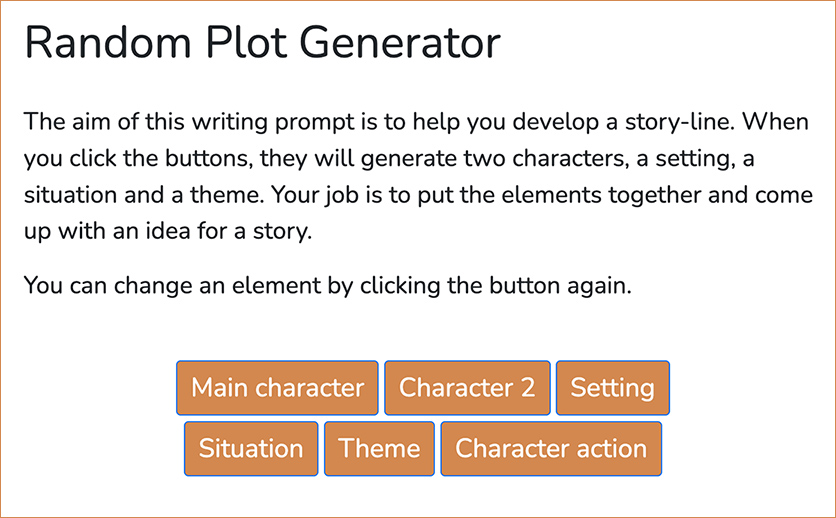
Random Plot Generator

Also from Christy Tucker, see:

If the content is very stable and unlikely to change much over time, voice over might make sense in a branching scenario. Investing in creating video also makes more sense for more stable content and skills than for something that changes every 6 months.


From DSC:
And while I’m adding Tweets here…


How to survive as the only remote person in the hybrid room — from protocol.com by Tim Stevens
Experts weigh in on how remote tech workers can be seen and heard when everyone in a meeting is in the office.

Excerpt:

The hybrid approach to remote work can meet the needs of diverse teams of people, but too often those who sign in from afar can feel left out, absent from impromptu hallway discussions or outright ignored on Zoom calls.

When you’re on the outside it’s tempting to just stay quiet and hope things will improve, but if your team isn’t aware of your struggles, things will only get worse. I spoke with three experts in remote work and here are their pro tips on how to survive and even thrive.

Addendum on 11/14/22:

84% of meetings have at least one remote participant — from inavateonthenet.net

Excerpt:

A report commissioned by Crestron has found that 84% of employees regularly have at least one remote participant in their meetings.

The report, titled Tackling the Modern Workplace by the Numbers, explores employee behaviors and preferences in a hybrid workplace, the technology tools they need and lack, and what employers are (and could be) doing to enable more consistently productive collaboration remotely and in-office.

“The findings of this report reveal that for the first time in years, we have a reliable sense of what to expect from the enterprise workplace in terms of where work is done and how meetings have to be held,” said Brad Hintze, exec VP, global marketing, Crestron. “If every meeting isn’t equipped to be hybrid, the data unequivocally shows teams will experience challenges in staying connected to each other, to leadership, and to the company culture, no matter where they’re working.”


In one giant classroom, four teachers manage 135 kids – and love it — from hechingerreport.org by Neal Morton
Schools in Mesa, Arizona, piloted a team teaching model to combat declining enrollment and teacher shortages; now the approach is spreading

Excerpts (emphasis DSC):

Five years ago, faced with high teacher turnover and declining student enrollment, Westwood’s leaders decided to try something different. Working with professors at Arizona State University’s teachers college, they piloted a classroom model known as team teaching. It allows teachers to voluntarily dissolve the walls that separate their classes across physical or grade divides.

Here, more than 130 freshmen at Westwood High School learn in one giant classroom overseen by four teachers. 

Team teaching is taking hold in Mesa, Arizona’s largest school district. Here, more than 130 freshmen at Westwood High School learn in one giant classroom overseen by four teachers. Credit: Matt York/Associated Press


By giving teachers more opportunities to collaborate and greater control over how and what they teach, Mesa’s administrators hoped to fill staffing gaps and boost teacher morale and retention. Initial research suggests the gamble could pay off.


Also see:

Educator shortages are a real crisis — especially in special education — from k12dive.com
Administrators are straining under the pressure of finding qualified personnel to meet federal requirements on specialized instruction and related services.

The Council of Administrators of Special Education is keenly aware of the shortage of qualified teachers, specialized instructional support personnel and administrators to fill vacancies in school districts across the country, with shortages particularly acute in special education. We hear daily from administrators citing the impossibility of finding qualified personnel to meet mandates of the federal law requiring specialized instruction and related services for children with disabilities.


I Never Wanted to Be a School Administrator. Here’s Why I Changed My Mind. — from edsurge.com by Patrick Harris II

Excerpt:

What made him so unique? Maybe it was his humility. He didn’t claim to have all the answers. Maybe it was the trust he put in me as a new teacher on his team. When I asked him which curriculum we used, he said, “I trust you to collaborate with the team and build it. I have some resources here to help us ensure that we create a scope-and-sequence for the literacy skills our students need. But we have to create it.” Maybe it was how frequently he said “we.”

Principal Williams had to answer to the school board, to our school’s executive director and to parents, but when it came down to decision-making, everything was up for discussion. I could walk into his office for anything. I felt motivated to become more involved in the school community because he made room for me.

He was flattening the hierarchy.

Cultivating a culture where every voice matters is not the quickest solution, nor is it the easiest, but my hope is that it will have a long-lasting impact at our school. The more that we flatten the hierarchy, focus our attention on building trust and talk more with one another, the better chance we have of creating schools that teachers want to stay at and that students want to learn in.


Recent Advancements In Artificial Intelligence — from forbes.com by Gaurav Tewari

Excerpts:

As the founder of a technology investment firm, I’ve seen firsthand just how much AI has advanced in such a short period of time. The underlying building blocks of the technology are getting astonishingly better at an exponential rate, far outpacing our expectations. Techniques like deep learning allow us to run complex AI models to solve the most difficult problems. But while those who work in technology-centric careers are aware of AI’s explosive capabilities, the public at large is still largely unaware of the depth of AI’s potential.

Enterprise functions such as marketing, sales, finance and HR are all areas that can utilize new AI-enabled applications; these applications include providing customers with 24/7 financial guidance, predicting and assessing loan risks and collecting and analyzing client data.

Also relevant/see:

What is the Future of Artificial Intelligence? — from thedigitalspeaker.com by Dr. Mark van Rijmenam

Excerpts:

Let’s explore some real-life artificial intelligence applications.

  1. Using Artificial Intelligence for Navigation
  2. Marketers Use Artificial Intelligence to Increase Their Efficiency
  3. The use of Artificial Intelligence in robotics
  4. Gaming and Artificial Intelligence
  5. Incorporating Artificial Intelligence into Lifestyles

Artificial intelligence (AI): 7 roles to prioritize now — from enterprisersproject.com by Marc Lewis; with thanks to Mr. Stephen Downes for this resource
Which artificial intelligence (AI) jobs are hottest now? Consider these seven AI/ML roles to prioritize in your organization

While these seven AI roles are critical, finding talent to fill them is difficult.  AI, machine learning, and data analytics are new fields, and few people have relevant experience.

This leads us back to the fact: We are dealing with a Great Reallocation of the labor force to an AI/Machine learning, data-driven world.

3 ways AI is scaling helpful technologies worldwide — from blog.google by Jeff Dean
Decades of research have led to today’s rapid progress in AI. Today, we’re announcing three new ways people are poised to benefit.

Excerpts:

  1. Supporting 1,000 languages with AI
  2. Empowering creators and artists with AI
  3. Addressing climate change and health challenges with AI
 

How can colleges better serve students with autism? — from by Laura Spitalniak
Professor Sarah Howorth says her program at the University of Maine helps bridge the gap between high school and college for students with autism.

Excerpts:

In 2019, Howorth led the pilot for the University of Maine’s Step Up to College, a program meant to model how colleges can effectively support students with autism spectrum disorder.

There are so many myths and misunderstandings out there about what a person with autism is like. Autism is not necessarily associated with cognitive impairment. I have a 16-year-old son who is on the autism spectrum. He is also very intelligent, and he’s definitely college bound. There’s a lot of kids out there like him on the autism spectrum.

Individuals on the spectrum bring a lot to communities, whether that be university campuses, or high schools or businesses. Oftentimes, we focus on the challenges they face, but I think they have many, many more strengths than challenges.

Look at things from a Universal Design for Learning perspective. The things that you offer for students with autism on college campuses, like peer mentors, will help all students.


Also relevant/see:

So what can we do to decrease the exclusion and bullying that leads to trauma? We need to create activities and spaces where autistic people can be their authentic selves and be accepted without having to mask to fit in. We need to eradicate the isolation that is so commonplace by creating supportive communities that are truly safe and inclusive.


When It Comes to Picking Edtech, Are Schools Listening to Teachers? — from edsurge.com by Nadia Tamez-Robledo

Excerpt:

But where in the conversation are the people implementing those tools: the teachers? And how much say do they—or should they—have in edtech decisions?

For both questions, as it turns out, it depends on who you ask.

In a survey released earlier this year, the edtech company Clever found that 85 percent of administrators say teachers are involved in choosing tools. When the company asked teachers, more than 60 percent said they were hardly ever—or never—involved in those choices.

As we started asking educators, administrators and experts about the issue as part of an investigation into how teachers inform the development of edtech products, everyone agreed: teacher voice should be part of edtech decisions.

So what explains the disconnect?


Addendum on 11/9/22:

Lessons from Treadmills and Owls: The Most Important Feature in Educational Technology Products — from opencontent.org by David Wiley; with thanks to Mr. Stephen Downes for this resource

Excerpt:

The primary point, of course, is this: unused features in exercise technologies and educational technologies can improve neither fitness nor learning. From this perspective, one might argue:

The most important feature in educational technology products is the nudge – the feature that persuades you to actually use the features that will improve learning.

Duolingo is a great example here. On its surface, the language learning app may appear rather straightforward. But there are some pretty sophisticated things happening behind the scenes that make your language learning more effective.


© 2025 | Daniel Christian