


10 This is love: not that we loved God, but that he loved us and sent his Son as an atoning sacrifice for our sins.
On 02/25/2023,
in faith, global / globalization, hearts -- matters of the heart, relationships, religion,
by Daniel Christian
On 02/24/2023,
in business, career development, change, corporate / business world, skills, vision/possibilities, workplace,
by Daniel Christian
Eliminate a Degree of Difficulty: Hire for Skills, Not School — from bain.com by Joe Lischwe, Alex Noether, Maria Gordian, Andrea D’Arcy, and Jon Barfield; resource via GSV
Too many jobs require college degrees, locking out qualified Black talent. Skills-first hiring helps companies rethink what really matters.
At a Glance
- Black Americans are 30% less likely than white Americans to have jobs that pay family-sustaining wages—a key factor in the income and family wealth gaps between Black and white Americans.
- One key barrier to Black talent obtaining these jobs is that 70% to 80% require a four-year college degree, which 75% of Black Americans do not have.
- Requiring four-year degrees is not the only way to assess talent or identify the best candidates, and skills-first hiring can mitigate this credentials barrier, making the process fairer for all job applicants.
- The business case is strong: Skills-first hiring criteria are 5 times more predictive of future job performance than educational background and 2.5 times more predictive than work experience.
- While the transition to skills-first hiring—particularly the shift in culture and mindset it entails—is challenging, there are proven steps companies can take to make the switch successfully, as illustrated by the example of companies in the OneTen coalition such as Merck.
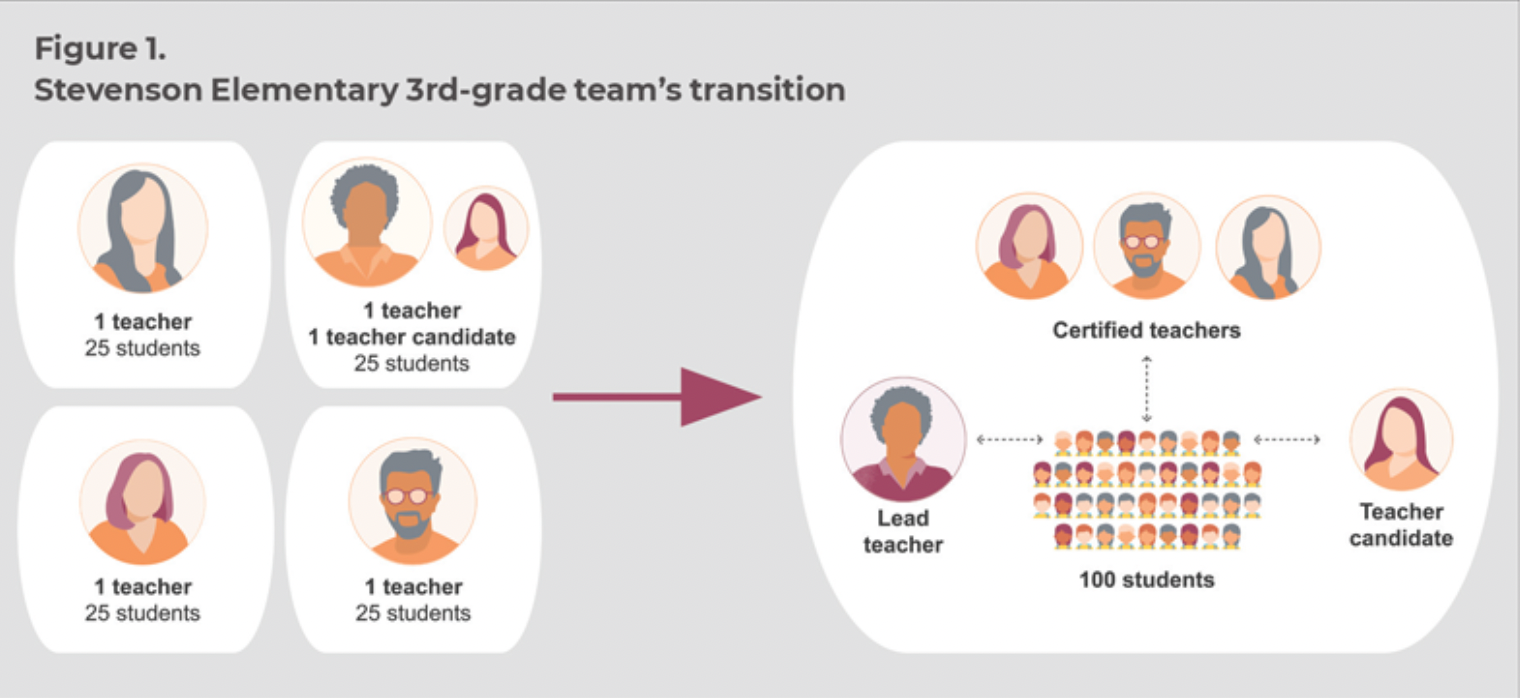
Team Teaching, Educator Retention and Education’s Next Workforce — from gettingsmart.com by
Key Points
- Team teaching models present an innovative solution to build high-quality teams of satisfied and empowered educators.
- The future of the nation depends on the quality of education provided to the next generation.
- Discovering, creating and retaining great teachers who are driven to support every K-12 learner is one of the most effective ways to change long-term outcomes for both students and their future communities.
Also from GettingSmart.com:
Why Teach Journalism When AI Writes Articles? — from gettingsmart.com by Tom Vander Ark
Key Points
- Historically, journalism has been a valued and viable career path.
- However, the rise of the web, particularly social media, disrupted time-honored media business models.
- Good writing matters in careers and in a healthy democracy and journalism–the regular production of public content in newspapers, magazines, and websites–is a great way to teach it.
On 02/23/2023,
in accessibility / UDL, assistive technologies, Bias | Diversity Equity & Inclusion (DE&I), Google, neurodivergent/special needs,
by Daniel Christian
Google Enhances Accessibility Information — from disabilityscoop.com by Shaun Heasley
Excerpt (emphasis DSC):
Google is making it easier to find out if places in the community are accessible to people with disabilities, all with the touch of a button.
The company said recently that it is expanding a feature called “Accessible Places,” which allows Google Maps users to see if businesses are wheelchair accessible and free of stairs.
Google originally rolled out Accessible Places in 2020 in the U.S., Australia, Japan and the United Kingdom, but now says the option is available globally and includes details on more than 40 million locations.
Along the lines of accessibility-related items, see:
Over 11 Million Jobs in the U.S. May Exclude Color-Blind Persons — from billfischer.substack.com by Bill Fischer
Employing design solutions that involve text, pattern, and other types of visual differentiation besides color as well as developing color-identifying smart-glasses technology can start to break down occupational barriers for color-blind persons.
Excerpt:
Below is a list of occupations that require testing for color-blindness, divided into two categories: those in which design choices create challenges and those in which the issues are rooted in the natural environment.
On 02/23/2023,
in Access to Justice (A2J), change, changing business models, India, innovation, law schools, Legal operations, legal reform, legal technologies, legislatures / government / legal, tools, United States, vendors, vision/possibilities,
by Daniel Christian
Allen & Overy breaks the internet (and new ground) with co-pilot Harvey — from legaltechnology.com by Caroline Hill
Excerpt (emphasis DSC):
We’re told that at the end of the trial, around 3,500 of A&O’s lawyers had asked Harvey around 40,000 queries for their day-to-day client work. MIG head David Wakeling said in a statement yesterday: “I have been at the forefront of legal tech for 15 years but I have never seen anything like Harvey. It is a game-changer that can unleash the power of generative AI to transform the legal industry. Harvey can work in multiple languages and across diverse practice areas, delivering unprecedented efficiency and intelligence. In our trial, we saw some amazing results.”
Also related/see:
OpenAI-backed startup brings chatbot technology to first major law firm — from reuters.com by Sara Merken
Summary:
- Allen & Overy partners with legal startup Harvey
- Harvey received $5 million in a funding round led by the OpenAI Startup Fund last year
Today: the 7th largest law firm on Earth announced a 3,500-lawyer deal with Harvey, an OpenAI-backed AI Lawyer startup:
See below for:
– Deal details
– Harvey’s capabilities (?)
– Harvey’s open roles (I refer talent to them!)1/6 pic.twitter.com/OLdusvcqrG
— AI Pub (@ai__pub) February 16, 2023
Global Firm Allen & Overy Rolling Out Harvey.ai — from legallydisrupted.com by Zach Abramowitz
Excerpt:
Here’s another way to think about what it can do: read, understand, analyze, issue spot and draft responsive documents. Does that apply to a lot of contract work? Sure. Litigation? Yep, that too. The reason this is hard to swallow is that we’re stuck in a framework where there are contract tools for contracts, eDiscovery tools for discovery, drafting tools for drafting etc. The AI revolution could potentially change that paradigm.
The Top Legal Tech Startups to Watch in 2023 — from gritdaily.com by Spencer Hulse
Excerpt:
There are certain industries that have been slower to embrace technology than others, and the legal profession is one of those at the very top. However, legal tech startups have been gaining ground in recent years, with the market expected to reach around $32 billion in 2025. There is also a significant rise in legal department spending on legal tech, which is only going to rise in the coming years.
Legal tech offers numerous solutions, which include everything from offering legal advice digitally to AI and automating some of the time-consuming processes formerly handled with pen and paper.
The following list includes legal tech startups and companies of all sorts, from those that have been around for years to up-and-coming innovators.
Embracing The Tectonic Shift: How Technology Is Transforming The Legal Profession — from livelaw.in by Khushboo Luthra
According to a Gartner Report, 4 of 5 legal departments plan to increase technology spending. By 2024, legal departments will replace one out of five lawyers with a nonlawyer staff, and 1/4th of the expenditure on corporate legal applications will go to non-specialist technology providers. By 2025, legal departments will have automated 50% of legal work related to significant corporate transactions.
Generative AI Is Coming For the Lawyers — from wired.com by Chris Stokel-Walker
Large law firms are using a tool made by OpenAI to research and write legal documents. What could go wrong?
Excerpt:
The rise of AI and its potential to disrupt the legal industry has been forecast multiple times before. But the rise of the latest wave of generative AI tools, with ChatGPT at its forefront, has those within the industry more convinced than ever.
“I think it is the beginning of a paradigm shift,” says Wakeling. “I think this technology is very suitable for the legal industry.”
Generative AI is having a cultural and commercial moment, being touted as the future of search, sparking legal disputes over copyright, and causing panic in schools and universities.
As law profs/law schools consider how to deal with chatGPT on exams, let me propose one approach: students *must* use it on one issue-spotting question, but then have to redline the answer, showing their work in improving upon it. 1/3
— Gabe Teninbaum (@GTeninbaum) February 22, 2023
Addendum on 3/6/23:
Will artificial intelligence replace your lawyer–and will its name be Harvey? — from fortunes.com by Aron Solomon
On 02/23/2023,
in adult learning, change, colleges, communities of practice, community colleges, Daniel S. Christian, education, experimentation, future, future of higher education, game-changing environment, higher education, innovation, instructional design, K-12 related, learning, learning ecosystem, Learning Experience Design, lifelong learning, reinvent, society, staying relevant, United States,
by Daniel Christian
From DSC:
It seems to me that the idea of a Trim Tab Group goes waaaaay back. And from an excellent teacher — the LORD.
Mark 2:21 — from bible.com
“No one sews a patch of unshrunk cloth on an old garment. Otherwise, the new piece will pull away from the old, making the tear worse.”
So the idea of starting a small, different group that will grow into an amazingly large group of people may turn out to be the route that the invention of a new lifelong learning ecosystem will need to go through.

On 02/23/2023,
in adult learning, assessment, corporate universities / corporate training, instructional design, learning, Learning Experience Design, training / L&D,
by Daniel Christian
Three Ways to Deal with Learners Who Skip the Content & Go to the Quiz — from blogs.articulate.com by Tom Kuhlmann
Excerpt:
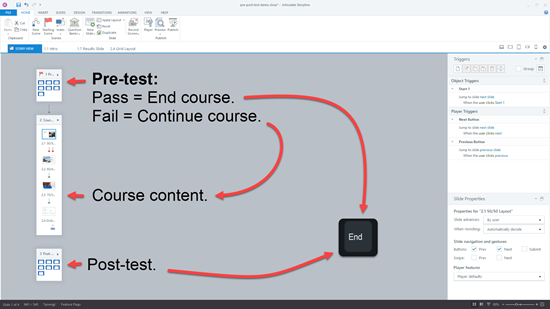
Quiz Tip #1: Provide a Pre-Test
Don’t fight skipping to the quiz. Instead, put it up front. Give the learners who know the content the opportunity to prove it upfront.
If they can pass the quiz, then they demonstrate they know the content (or at least to the level that you’re quizzing). Pass the quiz, get credit for completion. Don’t pass the quiz, go to page 1 of the course.
On a somewhat relevant note, see:
Creating Better Video For Learning, Part 3 — from elearningindustry.com by Patti Shank
Summary:
Which principles are valuable for making instructional video better for mental processing? Part 3 of my series on better video for learning primarily discusses processing issues and Mayer’s (2021) and Brame’s (2016) instructional video design principles.
Start Building Your Knowledge About Artificial Intelligence — from learningguild.com by Bill Brandon
Excerpt:
In this article I have listed some resources that I believe will help readers get started on the journey toward more fully understanding the technology and its applications to the field of learning and development.
On 02/23/2023,
in 21st century, 24x7x365 access, adult learning, business, corporate / business world, corporate universities / corporate training, productivity / tips and tricks, professional development, strategy, training / L&D, workplace,
by Daniel Christian
7 ways to think and act strategically in your organisation about AI in learning — from donaldclarkplanb.blogspot.com by Donald Clark
Excerpt:
Above all, you need to see it strategically. There is no imperative to use this tech but there is an imperative to consider its use. Sure, it’s OK to say no but you should have a reason for saying no, as this is the technology of the age. I’ve been saying this in three books, lots of articles and a ton of keynotes for 7 years and it is now happening. This is the new internet, only smarter.
On 02/22/2023,
in business, career development, change, changing business models, collaboration, colleges, communities of practice, community colleges, corporate / business world, corporate universities / corporate training, dangers of the status quo, Daniel S. Christian, Design Thinking, education, education reform, Emotion, engagement / engaging students, entrepreneurship, experimentation, future, higher education, homeschooling/homeschoolers, ideas, K-12 related, leadership, learning, learning ecosystem, Learning Experience Design, legislatures / government / legal, lifelong learning, motivation, participation, passions, traditional / tradition, training / L&D, United States, universities,
by Daniel Christian
Why The Education Economy Is The Next Big Thing For The American Workforce — from fastcompany.com by Brandon Busteed
How can integrating our educational system, our employers, and our job creators affect our modern economy?
Excerpts (emphasis DSC):
Though the economy and education have long been topics of top concern to Americans, we haven’t created strong linkages between the two.
The topics are more like two castles with a large moat between them. Yet there is nothing more important we can do as a country than to build the world’s most effective “educonomy,” which would seamlessly integrate our educational system, our employers, and our job creators.
…
All told, we collected the voices of close to 1 million Americans on this subject in the past year alone. And what we’ve learned is alarming:
Student engagement in school drops precipitously from 5th grade through 12th grade. About three quarters of elementary school kids (76%) are engaged in school, while only 44% of high school kids are engaged. The longer students stay in school, the less engaged they become. If we were doing this right, the trend would be going in the exact opposite direction.
From DSC:
I appreciated the imagery of the economy and education being like two castles with a large moat between them. I, like many others, also use the term siloed to describe our various learning ecosystems — PreK-12, higher education and vocational programming, and the corporate/business world (I realize I could also include those who work in other areas such as the government, but hopefully folks get the gist of what I’m trying to say).
But here’s the most disturbing part (albeit likely not a surprise to those working within K-12 environments):
About seven in 10 K-12 teachers are not engaged in their work (69%), and as a profession, teachers are dead last among all professions Gallup studied in saying their “opinions count” at work and their “supervisors create an open and trusting environment.” We also found that teacher engagement is the most important driver of student engagement. We’ll never improve student engagement until we boost teachers’ own workplace engagement first.
Our older daughter works in an elementary school where several of the teachers left prior to Christmas and more have announced that they are leaving after this academic year. For teachers to leave halfway through the year, you know something is majorly wrong!
I think that legislators are part of the problem, as they straight-jacket teachers, principals, and administrators with all kinds of standardized testing.
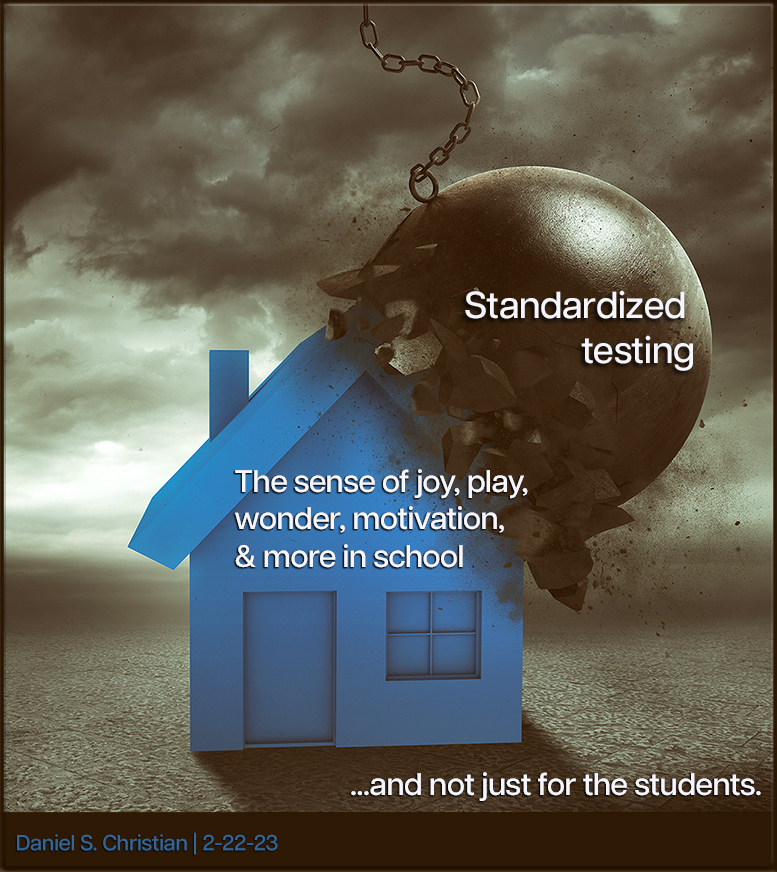
I would think that such testing dictates the pace and the content and the overall agendas out there. I don’t recall taking nearly as many standardized tests as our youth do today. Looking back, each of my teachers was engaged and seemed to be happy and enthusiastic. I don’t think that’s the case any longer. Let’s ask the teachers — not the legislators — why that is the case and what they would recommend to change things (before it’s too late).