Colleges and universities that contract with an online program management company need to submit details about those arrangements by May 1.

Oversight Coming for Online Program Providers — from insidehighered.com by Katherine Knott

Excerpt:

The Education Department is planning to increase oversight of the outside contractors that colleges and universities use to help run online programs.

To address that finding, the department said in guidance issued Wednesday that OPMs and any entity that provides recruitment services for a college are considered third-party servicers, subjecting the companies’ contracts with institutions to regular audits. Colleges and universities are required to report details of their agreements to the department by May 1.


Instructional Design 2023: Experts Share Top Predictions — from td.org by Jes Thompson

“As technology options continue to increase for IDs, they’ll have a lot to choose from to create useful learning experiences. To prove our worth to the organizations we work for, it will be more important than ever to focus on the solution rather than the technology—especially as layoffs continue in the tech industry. Hopefully we’ll see a greater presence in events and online networks as people try to find new roles. I think we’ll continue to see an influx of educators coming into the profession too. As a field, we’re in a great place to learn from the experience of others and to use technology to find innovative ways to support our learners.”

Heidi Kirby, Customer Education Manager and Co-Founder, Useful Stuff


“I think we’ll continue to see an influx of educators coming into the profession too.” — which brings me to another article:

Edtech Career Opportunities: 7 Tips To Stand Out At A Job Fair — from teachercareercoach.com

Excerpts (emphasis DSC):

Are you a transitioning teacher looking for an edtech career? If so, you’re in luck! Jeff Patterson, the CEO of Gaggle, hosts virtual Edtech Career Fairs.

This is a great chance to learn about the edtech industry and connect with key players. So, grab your pen and paper and get ready to take notes! We’ll be sharing some insight to help you make the most of your experience and stand out from the crowd. Let’s get started!


Podcast Special: Using Generative AI in Education — from drphilippahardman.substack.com by Dr. Philippa Hardman
An exploration of the risks and benefits of Generative AI in education, in conversation with Mike Palmer

Excerpt:

Among other things, we discussed:

  • The immediate challenges that Generative AI presents for learning designers, educators and students.
  • The benefits & opportunities that Generative AI might offer the world of education, both in terms of productivity and pedagogy.
  • How bringing together the world of AI and the world of learning science, we might revolutionise the way we design and deliver learning experiences.

Speaking of podcasts, this article lists some podcasts to check out for those working in — or interested in — higher education.


Also relevant/see:


Also relevant/see:

Are librarians the next prompt engineers? — from linkedin.com by Laura Solomon

Excerpt:

  • Without the right prompt, AI fails to provide what someone might be looking for. This probably is a surprise to no one, especially librarians. If you remember the days before Google, you know exactly how this tended to play out. Google became dominant in large part to its inherent ability to accept natural language queries.
  • A small industry is now popping up to provide people with the correct, detailed prompts to get what they want when interacting with AI. The people doing this work are referred to as “prompt engineers.”
  • Prompt engineers aren’t just people who write queries to be directed to an AI. They also have tend to have a great deal of technical expertise and a deep understanding of how artificial intelligences and natural language can intersect.
  • Prompt engineers don’t work for free.

The above item links to The Most Important Job Skill of This Century — from theatlantic.com by Charlie Warzel
Your work future could depend on how well you can talk to AI. 


Also relevant/see:

My class required AI. Here’s what I’ve learned so far. — from oneusefulthing.substack.com by Ethan Mollick
(Spoiler alert: it has been very successful, but there are some lessons to be learned)

Excerpt:

I fully embraced AI for my classes this semester, requiring students to use AI tools in a number of ways. This policy attracted a lot of interest, and I thought it worthwhile to reflect on how it is going so far. The short answer is: great! But I have learned some early lessons that I think are worth passing on.

AI is everywhere already
Even if I didn’t embrace AI, it is also clear that AI is now everywhere in classes. For example, students used it to help them come up with ideas for class projects, even before I even taught them how to do that. As a result, the projects this semester are much better than previous pre-AI classes. This has led to greater project success rates and more engaged teams. On the downside, I find students also raise their hands to ask questions less. I suspect this might be because, as one of them told me, they can later ask ChatGPT to explain things they didn’t get without needing to speak in front of the class. The world of teaching is now more complicated in ways that are exciting, as well as a bit unnerving.


The Broken Higher Education System: Addressing Stakeholder Needs for a More Adaptive Model — from educationoneducation.substack.com

Excerpt:

Higher education Chief Academic Officers (CAOs) must shift their perspective and strive to increase customer satisfaction to ensure the highest quality of educational products. A recent survey by Higher Education found that only 25% of customers were satisfied with the results higher education provided, contradicting the satisfaction differences of 99% of CAOs. Clearly, a disconnect exists between what higher education leaders deliver and what students, employers, and the changing labor market requirements are. To bridge this gap, higher education must develop products focusing on stakeholder feedback in product design, job requirements, and practical skills development.

From DSC:
So in terms of Design Thinking for reinventing lifelong learning, it seems to me that we need much more collaboration between the existing siloes. That is, we need students, educators, administrators, employers, and other stakeholders at the (re)design table. More experiments and what I call TrimTab Groups are needed.

But I think that the culture of many institutions of traditional higher education will prevent this from occurring. Many in academia shy away from (to put it politely) the world of business (even though they themselves ARE a business). I know, it’s not fair nor does it make sense. But many faculty members lean towards much more noble purposes, while never seeing the mounting gorillas of debt that they’ve heaped upon their students’/graduates’ backs. Those in academia shouldn’t be so quick to see themselves as being so incredibly different from those working in the corporate/business world.

The following quote seems appropriate to place here:


Along the lines of other items in the higher education space, see:

New Data Shows Emergency Pandemic Aid Helped Keep 18 Million Students Enrolled — from forbes.com by Edward Conroy

Excerpt:

The Department of Education (ED) has released new data showing that 18 million students were helped by emergency aid for colleges and universities throughout the height of the COVID-19 pandemic, more than half of which was used to provide emergency grants to students. These funds were provided through three rounds of Higher Education Emergency Relief Funds (HEERF) In total, $76.2 billion was provided, with half of those funds going to support students directly. Unusually for funding in higher education, the money was not heavily means-tested, and was distributed very quickly.

The report indicates that the funds were used for several essential purposes, including student basic needs, keeping staff employed, and helping keep students enrolled. For example, students used funds to cover things like food and housing at a time when employment was drying up for many students, ensuring that the Pandemic did not plunge students who already had limited funds deeper into basic needs insecurity.

Flagships prosper, while regionals suffer — from chronicle.com by Lee Gardner
Competition is getting fierce, and the gap is widening

Excerpts:

Some key numbers are moving in the right direction at the University of Oregon. The flagship institution enrolled 5,338 freshmen in the fall of 2022, its largest entering class ever. First-year enrollment increased 16 percent over 2021, which was also a record year. Meanwhile, Western Oregon University, a regional public institution an hour’s drive north, just outside Salem, lost nearly 7 percent of its enrollment over the same period.

In 28 states, flagships have seen enrollment rise between 2010 to 2021, while regionals have trended down, according to a Chronicle analysis of U.S. Education Department data. Across all states, enrollment at 78 public flagships rose 12.3 percent from 2010 to 2021, the most recent year for which data is available. Enrollment at 396 public regional universities slumped more than 4 percent during the same period.

Chronicle analysis of federal data showed, for example, that in Michigan, a state being hit hard by demographic shifts and with no central higher-ed authority, the flagship University of Michigan at Ann Arbor saw undergraduate enrollment rise 16 percent between 2010 and 2020. Over the same period, it fell at 11 of the state’s 12 other four-year public campuses.


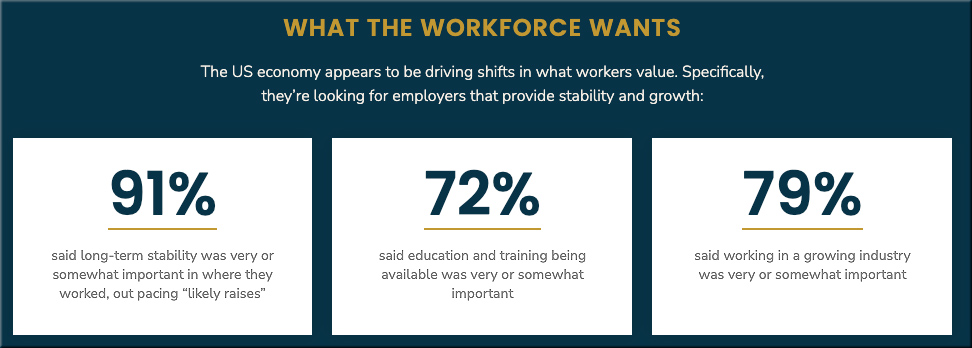
Making Change: How America’s Workforce is Responding to Rising Costs — from insights.guildeducation.com

Taken together, the results show an American workforce focused on the long-term. Workers are managing to costs, but more than that, they’re making down payments on their future. This is a workforce motivated more than ever by a path to career growth and economic stability.

What the workforce wants in 2023 -- looking for more education, training, and long-term stability


College Inside - a biweekly newsletter about the future of postsecondary education in prisons

The future of computer programming in prison – College Inside; written by Open Campus national reporter Charlotte West.
A biweekly newsletter about the future of postsecondary education in prisons.

Excerpt:

Participant Leonard Bishop hadn’t touched technology in the 17 years he served in the federal system prior to transferring to the D.C. Jail in 2018. When he first got a tablet, he said it took him a few days to figure out how to navigate through it, but then “I couldn’t put it down.”

Bishop said he was surprised by how easy it was to learn the skills he needed to earn the AWS certification. “It helps you transition back into society, especially for someone who has been gone so long,” he said.


Also relevant/see:

This AWS Cloud certification program opens new paths for inmates — from amazon.com; with thanks to Paul Fain for this resource
A jail-based program aims to expand career opportunities through cloud-skills training.

Excerpt:

Julian Blair knew nothing about cloud computing when he became incarcerated in a Washington, D.C. jail more than two years ago.

“I’d never done anything with a computer besides video games, typing papers in college, and downloading music on an iPad,” said Blair.

Now, after three months of work with an educational program led by APDS and Amazon Web Services (AWS) inside the jail, Blair and 10 other residents at the facility have successfully passed the AWS Certified Cloud Practitioner exam.


Digital credentials’ appeal is strong, while corporate upskilling moves at a ‘snail’s pace’ — from by Elyse Ashburn; with thanks to Paul Fain for this resource
Surveys out this week from IBM and LinkedIn take a closer look at the role of digital credentials and other forms upskilling in education and on the job.

Excerpt:

Interest in upskilling and short-term credentials, either as an alternative or an add-on to college, has grown steadily over the past few years. And a couple of surveys out this week take a closer look at the role digital credentials and other forms upskilling can play in bridging the gap between formal education and work.

A major IBM survey fielded in 13 countries, including the United States, found that almost half of students, job seekers, and career changers are interested in jobs in science, technology, engineering and math (STEM)—but more than 61% think they aren’t qualified because they lack the right degrees.

  • 75% of respondents thought that digital credentials were a good way to supplement traditional education, but only 47% were actually familiar with such credentialing programs.
  • Among those who’d earned a digital credential, 86% said that it helped them achieve their career goals.

Eight in 10 people surveyed said they planned to upgrade their skills in the next two years—but time, cost, or simply not knowing how to begin were major barriers. Among both students and job seekers, 40% said that they don’t know where to start in developing new professional or technical skills.


From DSC:
Below are several months’ worth of labor market updates from Handshake’s blog — with thanks to Paul Fain for this resource.

February 2023 Early Talent Labor Market Update — from joinhandshake.com/blog/
Demand for tech talent outside of coastal states

Key takeaways

  • Tech hubs no longer? Traditional tech hubs like California and New York are seeing fewer entry-level job openings for technical talent and less interest from students.
  • A rising tech diaspora: States in other parts of the country, like Iowa (+10.9%) and Maryland (+5.1%), are emerging as locations with more job postings for technical roles—at the same time, students have demonstrated interest in applying to opportunities in those states.
  • New hubs for tech talent: Students are demonstrating greater openness to a wider array of geographic locations for tech roles with large increases in applications per job in states like Oklahoma (4.8x), Arizona (2.3x), and Oregon (2.7x).

January 2023 Early Talent Labor Market Updates — from joinhandshake.com/blog/
Employers still have strong demand for entry-level technical talent.

Key takeaways
2022 was a difficult year for workers in tech, as the industry was hit hard by hiring freezes and layoffs. Despite an overall slowdown in tech sector hiring, there are several bright spots in the technical labor market that should give early talent reason for optimism.

  • Tech industry is still investing in (tech) talent
  • Software and computer tech jobs outside of tech industry
  • Tech, but not in software

December 2022 Early Talent Labor Market Updates — from joinhandshake.com/blog/
Part-time jobs falling year over year with retail leading the way

Key takeaways

  1. Demand for early talent to fill part-time roles has dropped compared to earlier this year, and part-time jobs saw the largest year-over-year decrease (-32%) in job postings on the platform, when compared to full-time and internships.
  2. Notably employers who are still creating new jobs have been hiring more for full-time roles and internships with job postings per employer up 1% and 7% respectively.
  3. The retail industry, which relies on part-time workers through the holiday season, has seen the greatest year-over-year decrease in part-time job postings that were listed between October and November with a drop of 51%
 

Psalm 19:7-14

The law of the Lord is perfect,
    refreshing the soul.
The statutes of the Lord are trustworthy,
    making wise the simple.
The precepts of the Lord are right,
    giving joy to the heart.
The commands of the Lord are radiant,
    giving light to the eyes.
The fear of the Lord is pure,
    enduring forever.
The decrees of the Lord are firm,
    and all of them are righteous.

10 They are more precious than gold,
    than much pure gold;
they are sweeter than honey,
    than honey from the honeycomb.
11 By them your servant is warned;
    in keeping them there is great reward.
12 But who can discern their own errors?
    Forgive my hidden faults.
13 Keep your servant also from willful sins;
    may they not rule over me.
Then I will be blameless,
    innocent of great transgression.

14 May these words of my mouth and this meditation of my heart
    be pleasing in your sight,
    Lord, my Rock and my Redeemer.


The 2023 Underwater Photographer of the Year Contest Dives into the Stunning, Heartbreaking Lives of Aquatic Creatures — from thisiscolossal.com by Grace Ebert & Co.


Image @ Kat Zhou/UPY2023


Image © Alvaro Herrero Lopez-Beltran/UPY2023


ChatGPT for Spanish Classrooms — from rdene915.com by Nicole Biscotti, M. Ed.

Excerpt:

ChatGPT is just what the busy Spanish teacher necesita – no wasted time searching for the perfect “lectura” (text). Effective language instruction is coupled with learning about culture and now I’m able to generate texts in seconds AND I can even center them around a Latin American country, cultural point of interest, holiday, grammatical structure, etc.  Differentiation and personalized learning, those lofty teaching ideals that can feel a bit heavy when you mean well but have 35 kids in your room, have become that much easier to attain with ChatGPT.  It’s possible to generate texts about diverse aspects of culture in seconds and make adjustments for interests, length, rigor, etc. (Kuo & Lai, 2006) (Salaberry, 1999; Rost, 2002).

CURATING YOUR CLASSROOM WITH 9 MUST-HAVE TOOLS FOR RESOURCE COLLECTION – EASY EDTECH PODCAST 202 — from classtechtips.com by Monica Burns

Description:

How do you share resources with students? In this episode, we’ll focus on what happens after you find the very best resources to share with students. You’ll also hear about nine digital tools to help educators build a resource collection for students. So whether you have ten great resources on endangered species to share with your fourth graders or a dozen tutorial videos to share with your eleventh graders, this episode is for you!

50+ Useful AI Writing Tools to Know (2023) — from hongkiat.com

Excerpt:

AI writing tools generate content based on the keywords or prompt provided by users. You can then improve upon the output and make it suitable according to your own requirements.

There are different types of AI writing tools and in this post we are featuring some of the best ones. From content generators and editors to translators and typing assistants, there’s a whole gamut of AI-powered writing tools in the list. Take a look and see if one (or more) catches your interest.

How to Use Minecraft as a Teaching Tool — from intelligenthq.com

Excerpt:

Kids today have grown up with Minecraft, so it’s easy to get them enthusiastic about lessons using it. They can build anything they like, and use Minecraft skins to make the characters they create uniquely their own, getting them especially enthusiastic and involved in their lessons.

Teachers who learn how to use Minecraft as a teaching tool have found that it noticeably improves problem solving, creativity, and the ability to work together. It teaches both 21st century skills and timeless lessons.


On a somewhat related note, also see:


Blogs are back baby — from blog.edtechie.net by Martin Weller

Excerpt:

The conclusion I take from all this (which I carefully assembled so I could draw the conclusion I want), is that there is a desire to have a core place on the net, that is not subject to the whims of billionaires, institutions or markets, where you can engage in a range of dialogue, from personal to professional, and that you enjoy revisiting. Ladies and gentleman, I give you, the blog.

From DSC:
I hope you’re right Martin!!! I still really appreciate blogs, as readers of this Learning Ecosystems blog might have guessed. 


Why Many Early Childhood Educators Can’t Afford to Retire — from edsurge.com by Emily Tate Sullivan

Excerpt:

It’s a bitter contradiction that spans the field: The job is a difficult one to do into old age, yet few who stick with it are able to set aside enough money to enjoy a traditional retirement.

For child care providers to come away with even the slimmest of profit margins, they are often already charging families the maximum they can afford to pay, explains Powell. And that’s before providers have built in a buffer to cover an emergency fund, health insurance and retirement savings.

At a certain age, you’re not going to catch up. You won’t own a home. You won’t have retirement savings.

— Anna Powell

“Even by the time they’re in their 50s, they may not be able to start a savings account,” Powell says. “They’re still hitting that ceiling of what parents can afford to pay.”


10 Tips to Help You Find the Legal Career That’s Right for You — from abaforlawstudents.com by Bill D. Henslee

Excerpts:

Career planning is a process that requires time and thought. Perhaps you’ve known what you want to be when you grow up for as long as you can remember. Or perhaps you’re still trying to figure it out. Most of us fit somewhere on the spectrum between “born to serve” and “stay loose and adjust.”

Wherever you land on that spectrum, you’ll still need to get a job. Here are 10 tips to help you identify and land the position that fits your skills and interests.

1. Think about Practice Areas

2. Consider Culture

3. Know the People


“Click Here” Isn’t Enough Context for Hyperlinks — from boia.org

Excerpt:

If a link reads “click here,” “learn more,” or “read more,” you’re not telling users anything about the link’s purpose — you’re simply telling them that they can click on the link (and most users understand that hyperlinks can be activated).

That can be frustrating for many people. Unfortunately, it’s a common user experience (UX) issue, but it’s easy to correct.

4 Things People with Disabilities Look For On Your Website — from boia.org

Excerpts:

To that end, it’s useful to consider what individuals with disabilities experience when visiting a new website — the features that tell them whether or not your website is accessible.

1. An Accessibility Statement
2. Consistent Web Design

4 Simple Ways That Content Writers Can Promote Accessibility — from boia.org

Excerpts:

1. Look for inclusive stock photos
2. Avoid making assumptions about your readers

 
© 2025 | Daniel Christian