The Top 10 In-Demand Skills For 2030 — from forbes.com by Bernard Marr

Excerpt:

Digital Literacy
According to the WEF, more than half of the jobs that we do in 2030 will require an understanding of digital technology. This means that people who are able to effectively use digital tools and platforms to solve problems and create value will be increasingly in demand. I would go as far as saying that those who lack digital literacy will be at a severe disadvantage when it comes to competing for jobs and business opportunities by 2030, whatever career path they decide to follow.


Employers value microcredentials but don’t know how to assess their quality — from highereddive.com by Natalie Schwartz

Dive Brief:

  • Although a majority of surveyed employers say they value alternative credentials, many also harbor concerns over assessing the quality of education and understanding the skills and competencies they represent.
  • That’s according to a recent survey of 510 employers from the University Professional and Continuing Education Association, also known as UPCEA, and Collegis Education, a technology services provider for colleges.
  • Despite their concerns, 23% of respondents said the greatest benefit alternative credentials provide are giving workers real-world experience. Also, 16% of respondents said alternative credentials help employees develop specialized skills and 13% said they improve performance.
 

Unboxing the Future of Education:“A Sneak Peek into a Day in the Life of a Student in 2040” — from thinklearningstudio.org by Russell Cailey

Potential view of students in the year 2040 -- where ed tech will likely be taken to the next level

Excerpts:

To explore this question, I collaborated with my new friend Chat GPT to create a concept of what a day in the life of a 2040 student might look like. The results were fascinating, providing a glimpse into the possible future of education.

In response to our collaborative moment, I would like to pose three guiding questions to the audience:

How might we re-imagine education to create a more holistic and meaningful learning experience for our students as we move forward towards 2040?

How might we cultivate a sense of curiosity, wonder, and creativity in our students, and how might this foster a deeper engagement with learning?

How might we expand the definition of “education” beyond the confines of the classroom and foster lifelong learning and growth in our students?

From DSC:
I appreciated this interesting thought experiment re: the future of learning in the year 2040. I appreciate Russell’s statement where he says:

To conduct a thorough and accurate foresight project, it is crucial to explore multiple potential futures. While the scenario presented here is intended to be playful and imaginative, it represents only one possible outcome among many. I encourage readers to share their scenarios and perspectives in the comments, as this will help to create a more robust and diverse exploration of the future.


9 ways ChatGPT will help CIOs — from enterprisersproject.com by Katie Sanders
What are the potential benefits of this popular tool? Experts share how it can help CIOs be more efficient and bring competitive differentiation to their organizations.

Excerpt:

Don’t assume this new technology will replace your job. As Mark Lambert, a senior consultant at netlogx, says, “CIOs shouldn’t view ChatGPT as a replacement for humans but as a new and exciting tool that their IT teams can utilize. From troubleshooting IT issues to creating content for the company’s knowledge base, artificial intelligence can help teams operate more efficiently and effectively.”


Would you let ChatGPT control your smart home? — from theverge.com by

While the promise of an inherently competent, eminently intuitive voice assistant — a flawless butler for your home — is very appealing, I fear the reality could be more Space Odyssey than Downton Abbey. But let’s see if I’m proven wrong.


How ChatGPT Is Being Used To Enhance VR Training — from vrscout.com by Kyle Melnick

Excerpt:

The company claims that its VR training program can be used to prepare users for a wide variety of challenging scenarios, whether you’re a recent college graduate preparing for a difficult job interview or a manager simulating a particularly tough performance review. Users can customize their experiences depending on their role and receive real-time feedback based on their interactions with the AI.


From DSC:
Below are some example topics/articles involving healthcare and AI. 


Role of AI in Healthcare — from doctorsexplain.media
The role of Artificial Intelligence (AI) in healthcare is becoming increasingly important as technology advances. AI has the potential to revolutionize the healthcare industry, from diagnosis and treatment to patient care and management. AI can help healthcare providers make more accurate diagnoses, reduce costs, and improve patient outcomes.

60% of patients uncomfortable with AI in healthcare settings, survey finds — from healthcaredive.com by Hailey Mensik

Dive Brief:

  • About six in 10 U.S. adults said they would feel uncomfortable if their provider used artificial intelligence tools to diagnose them and recommend treatments in a care setting, according to a survey from the Pew Research Center.
  • Some 38% of respondents said using AI in healthcare settings would lead to better health outcomes while 33% said it would make them worse, and 27% said it wouldn’t make much of a difference, the survey found.
  • Ultimately, men, younger people and those with higher education levels were the most open to their providers using AI.

The Rise of the Superclinician – How Voice AI Can Improve the Employee Experience in Healthcare — from medcitynews.com by Tomer Garzberg
Voice AI is the new frontier in healthcare. With its constantly evolving landscape, the healthcare […]

Excerpt:

Voice AI can generate up to 30% higher clinician productivity, by automating these healthcare use cases

  • Updating records
  • Provider duress
  • Platform orchestration
  • Shift management
  • Client data handoff
  • Home healthcare
  • Maintenance
  • Equipment ordering
  • Meal preferences
  • Case data queries
  • Patient schedules
  • Symptom logging
  • Treatment room setup
  • Patient condition education
  • Patient support recommendations
  • Medication advice
  • Incident management
  • … and many more

ChatGPT is poised to upend medical information. For better and worse. — from usatoday.com by Karen Weintraub

Excerpt:

But – and it’s a big “but” – the information these digital assistants provide might be more inaccurate and misleading than basic internet searches.

“I see no potential for it in medicine,” said Emily Bender, a linguistics professor at the University of Washington. By their very design, these large-language technologies are inappropriate sources of medical information, she said.

Others argue that large language models could supplement, though not replace, primary care.

“A human in the loop is still very much needed,” said Katie Link, a machine learning engineer at Hugging Face, a company that develops collaborative machine learning tools.

Link, who specializes in health care and biomedicine, thinks chatbots will be useful in medicine someday, but it isn’t yet ready.


Planning for AGI and beyond — from OpenAI.org by Sam Altman

Excerpt:

There are several things we think are important to do now to prepare for AGI.

First, as we create successively more powerful systems, we want to deploy them and gain experience with operating them in the real world. We believe this is the best way to carefully steward AGI into existence—a gradual transition to a world with AGI is better than a sudden one. We expect powerful AI to make the rate of progress in the world much faster, and we think it’s better to adjust to this incrementally.

A gradual transition gives people, policymakers, and institutions time to understand what’s happening, personally experience the benefits and downsides of these systems, adapt our economy, and to put regulation in place. It also allows for society and AI to co-evolve, and for people collectively to figure out what they want while the stakes are relatively low.

*AGI stands for Artificial General Intelligence


Donald Clark’s recent thoughts regarding how ChatGPT is and will impact the Learning & Development world — from linkedin.com by Donald Clark

Excerpts:

Fascinating chat with three people heading up L&D in a major international company. AI has led them to completely re-evaluate their strategy. Key concepts were performance, process and data. What I liked was their focus on that oft-quoted issue of aligning L&D with the business goals – unlike most, they really meant it.

The technology that puts that in the hands of learners has arrived. Performance support will be a teacher or trainer at your fingertips.

We also talked about prompting, the need to see it as ‘CHAT’gpt, an iterative process, where you need to understand how to speak to the tech. It’s a bit like speaking to an alien from space, as it has no comprehension or consciousness but it is still competent and smart. We have put together 100 prompt tips for learning professionals and taking it out on the road soon. All good in the hood.

Also from Donald Clark, see:

OpenAI releases massive wave of innovation — from donaldclarkplanb.blogspot.com

Excerpt:

With LLMs, OpenAI’s ChatGPT, based on GPT 3.5, started a race where:

  • AI is integrated into mainstream tools like Teams
  • Larger LLMs are being built
  • LLMs are changing ‘search’
  • LLMs are being used on a global scale in real businesses
  • Real businesses are being built on the back of LLMs
  • LLMs as part of ensembes of other tools are being researched to solve accuracy, updatability & provenance issues
  • Open, transparent LLMs (Bloom) are being built
 

It’s Not Just Our Students — ChatGPT Is Coming for Faculty Writing — from chronicle.com by Ben Chrisinger (behind a paywall)
And there’s little agreement on the rules that should govern it.

Excerpt:

While we’ve been busy worrying about what ChatGPT could mean for students, we haven’t devoted nearly as much attention to what it could mean for academics themselves. And it could mean a lot. Critically, academics disagree on exactly how AI can and should be used. And with the rapidly improving technology at our doorstep, we have little time to deliberate.

Already some researchers are using the technology. Among only the small sample of my work colleagues, I’ve learned that it is being used for such daily tasks as: translating code from one programming language to another, potentially saving hours spent searching web forums for a solution; generating plain-language summaries of published research, or identifying key arguments on a particular topic; and creating bullet points to pull into a presentation or lecture.


10 This is love: not that we loved God, but that he loved us and sent his Son as an atoning sacrifice for our sins.


Eliminate a Degree of Difficulty: Hire for Skills, Not School — from bain.com by Joe Lischwe, Alex Noether, Maria Gordian, Andrea D’Arcy, and Jon Barfield; resource via GSV
Too many jobs require college degrees, locking out qualified Black talent. Skills-first hiring helps companies rethink what really matters.

At a Glance

  • Black Americans are 30% less likely than white Americans to have jobs that pay family-sustaining wages—a key factor in the income and family wealth gaps between Black and white Americans.
  • One key barrier to Black talent obtaining these jobs is that 70% to 80% require a four-year college degree, which 75% of Black Americans do not have.
  • Requiring four-year degrees is not the only way to assess talent or identify the best candidates, and skills-first hiring can mitigate this credentials barrier, making the process fairer for all job applicants.
  • The business case is strong: Skills-first hiring criteria are 5 times more predictive of future job performance than educational background and 2.5 times more predictive than work experience.
  • While the transition to skills-first hiring—particularly the shift in culture and mindset it entails—is challenging, there are proven steps companies can take to make the switch successfully, as illustrated by the example of companies in the OneTen coalition such as Merck.
 

Team Teaching, Educator Retention and Education’s Next Workforce — from gettingsmart.com by

Key Points

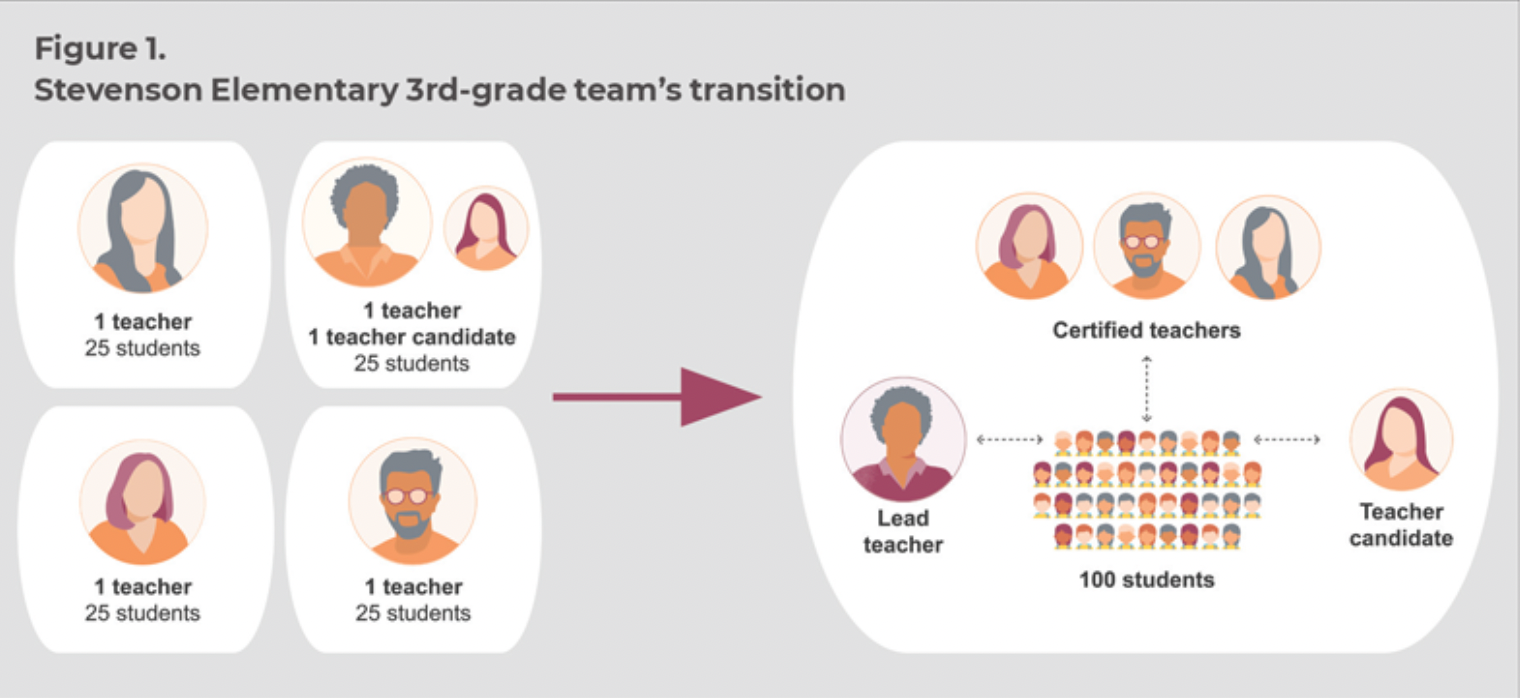
  • Team teaching models present an innovative solution to build high-quality teams of satisfied and empowered educators.
  • The future of the nation depends on the quality of education provided to the next generation.
  • Discovering, creating and retaining great teachers who are driven to support every K-12 learner is one of the most effective ways to change long-term outcomes for both students and their future communities.

Stevenson Elementary Third-Grade Team's Transition -- still teaching 100 students, let's say, but in a different team-teaching sort of way

Also from GettingSmart.com:

Why Teach Journalism When AI Writes Articles? — from gettingsmart.com by Tom Vander Ark

Key Points

  • Historically, journalism has been a valued and viable career path.
  • However, the rise of the web, particularly social media, disrupted time-honored media business models.
  • Good writing matters in careers and in a healthy democracy and journalism–the regular production of public content in newspapers, magazines, and websites–is a great way to teach it.
 

Some Ideas for Using ChatGPT in Middle and High School Classes — from edutopia.org by Geoff Richman
Teachers can use tools like ChatGPT as one strategy in their efforts to teach students how to think critically and write effectively.

Excerpts:

There can be an upside, however.  In a social studies classroom, students might craft a prompt about a topic they’ve been considering and then examine the machine’s response in forensic detail. This may involve a sentence-by-sentence dissection of what the AI has written. By unearthing possible inconsistencies or straight-up inaccuracies, students reinforce their correct understanding of the topic.

For a playful exercise, share two or three pieces of human writing from the past year or two and slip in an example from ChatGPT, and have students discuss what makes these examples human—or decidedly not. Nuance, passion, and, perhaps, even fallibility will be clues that students can investigate.


What ChatGPT And Generative AI Mean For Your Business? — from forbes.com by Gil Press [behind a paywall]

Excerpt:

Challenges abound with deploying AI in general but when it comes to generative AI, businesses face a “labyrinth of problems,” according to Forrester: Generating coherent nonsense; recreating biases; vulnerability to new security challenges and attacks; trust, reliability, copyright and intellectual property issues. “Any fair discussion of the value of adopting generative AI,” says Forrester, “must acknowledge its considerable costs. Training and re-training models takes time and money, and the GPUs required to run these workloads remain expensive.”

As is always the case with the latest and greatest enterprise technologies, tools and techniques, the answer to “what’s to be done?” boils down to one word: Learn. Study what your peers have been doing in recent years with generic AI. A good starting point is the just-published All-in On AI: How Smart Companies Win Big with Artificial Intelligence.

Also relevant/see:

Generative AI is here, along with critical legal implications — from venturebeat.com by Nathaniel Bach, Eric Bergner, and Andrea Del-Carmen Gonzalez

Excerpt:

With that promise comes a number of legal implications. For example, what rights and permissions are implicated when a GAI user creates an expressive work based on inputs involving a celebrity’s name, a brand, artwork, and potentially obscene, defamatory or harassing material? What might the creator do with such a work, and how might such use impact the creator’s own legal rights and the rights of others?

This article considers questions like these and the existing legal frameworks relevant to GAI stakeholders.


AI starter tools for video content creation — from techthatmatters.beehiiv.com by Harsh Makadia

Excerpt:

One of the most exciting applications of AI is in the realm of content creation. What if I told you there are tools to generate videos in mins?

Try these tools today:

  • Supercreator AI: Create short form videos 10x faster
  • Lumen5: Automatically turn blog posts into videos
  • InVideo: Idea to YouTube video
  • Synthesia: Create videos from plain text in minutes
  • Narakeet: Get a professionally sounding audio or video in minutes
  • Movio: Create engaging video content
 

Google Enhances Accessibility Information — from disabilityscoop.com by Shaun Heasley

Excerpt (emphasis DSC):

Google is making it easier to find out if places in the community are accessible to people with disabilities, all with the touch of a button.

The company said recently that it is expanding a feature called “Accessible Places,” which allows Google Maps users to see if businesses are wheelchair accessible and free of stairs.

Google originally rolled out Accessible Places in 2020 in the U.S., Australia, Japan and the United Kingdom, but now says the option is available globally and includes details on more than 40 million locations.

Along the lines of accessibility-related items, see:

Over 11 Million Jobs in the U.S. May Exclude Color-Blind Persons — from billfischer.substack.com by Bill Fischer
Employing design solutions that involve text, pattern, and other types of visual differentiation besides color as well as developing color-identifying smart-glasses technology can start to break down occupational barriers for color-blind persons.

Excerpt:

Below is a list of occupations that require testing for color-blindness, divided into two categories: those in which design choices create challenges and those in which the issues are rooted in the natural environment.


Allen & Overy breaks the internet (and new ground) with co-pilot Harvey — from legaltechnology.com by Caroline Hill

Excerpt (emphasis DSC):

We’re told that at the end of the trial, around 3,500 of A&O’s lawyers had asked Harvey around 40,000 queries for their day-to-day client work. MIG head David Wakeling said in a statement yesterday: “I have been at the forefront of legal tech for 15 years but I have never seen anything like Harvey. It is a game-changer that can unleash the power of generative AI to transform the legal industry. Harvey can work in multiple languages and across diverse practice areas, delivering unprecedented efficiency and intelligence. In our trial, we saw some amazing results.”

Also related/see:

OpenAI-backed startup brings chatbot technology to first major law firm — from reuters.com by Sara Merken

Summary:

  • Allen & Overy partners with legal startup Harvey
  • Harvey received $5 million in a funding round led by the OpenAI Startup Fund last year


Global Firm Allen & Overy Rolling Out Harvey.ai — from legallydisrupted.com by Zach Abramowitz

Excerpt:

Here’s another way to think about what it can do: read, understand, analyze, issue spot and draft responsive documents. Does that apply to a lot of contract work? Sure. Litigation? Yep, that too. The reason this is hard to swallow is that we’re stuck in a framework where there are contract tools for contracts, eDiscovery tools for discovery, drafting tools for drafting etc. The AI revolution could potentially change that paradigm.


The Top Legal Tech Startups to Watch in 2023 — from gritdaily.com by Spencer Hulse

Excerpt:

There are certain industries that have been slower to embrace technology than others, and the legal profession is one of those at the very top. However, legal tech startups have been gaining ground in recent years, with the market expected to reach around $32 billion in 2025. There is also a significant rise in legal department spending on legal tech, which is only going to rise in the coming years.

Legal tech offers numerous solutions, which include everything from offering legal advice digitally to AI and automating some of the time-consuming processes formerly handled with pen and paper.

The following list includes legal tech startups and companies of all sorts, from those that have been around for years to up-and-coming innovators.


Embracing The Tectonic Shift: How Technology Is Transforming The Legal Profession — from livelaw.in by Khushboo Luthra

According to a Gartner Report, 4 of 5 legal departments plan to increase technology spending. By 2024, legal departments will replace one out of five lawyers with a nonlawyer staff, and 1/4th of the expenditure on corporate legal applications will go to non-specialist technology providers. By 2025, legal departments will have automated 50% of legal work related to significant corporate transactions.


Generative AI Is Coming For the Lawyers — from wired.com by Chris Stokel-Walker
Large law firms are using a tool made by OpenAI to research and write legal documents. What could go wrong?

Excerpt:

The rise of AI and its potential to disrupt the legal industry has been forecast multiple times before. But the rise of the latest wave of generative AI tools, with ChatGPT at its forefront, has those within the industry more convinced than ever.

“I think it is the beginning of a paradigm shift,” says Wakeling. “I think this technology is very suitable for the legal industry.”

Generative AI is having a cultural and commercial moment, being touted as the future of search, sparking legal disputes over copyright, and causing panic in schools and universities.


Addendum on 3/6/23:

Will artificial intelligence replace your lawyer–and will its name be Harvey? — from fortunes.com by Aron Solomon


© 2025 | Daniel Christian