From DSC:
It seems to me that the idea of a Trim Tab Group goes waaaaay back. And from an excellent teacher — the LORD.


Mark 2:21 — from bible.com

“No one sews a patch of unshrunk cloth on an old garment. Otherwise, the new piece will pull away from the old, making the tear worse.”


So the idea of starting a small, different group that will grow into an amazingly large group of people may turn out to be the route that the invention of a new lifelong learning ecosystem will need to go through.


Three Ways to Deal with Learners Who Skip the Content & Go to the Quiz — from blogs.articulate.com by Tom Kuhlmann

Excerpt:

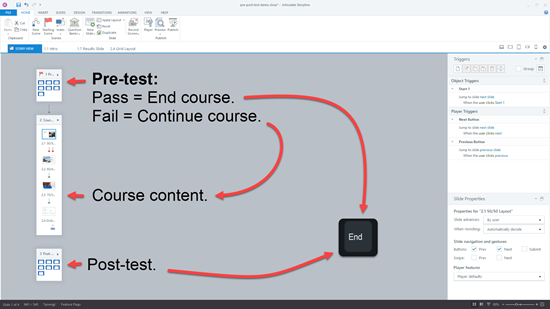
Quiz Tip #1: Provide a Pre-Test
Don’t fight skipping to the quiz. Instead, put it up front. Give the learners who know the content the opportunity to prove it upfront.

If they can pass the quiz, then they demonstrate they know the content (or at least to the level that you’re quizzing). Pass the quiz, get credit for completion. Don’t pass the quiz, go to page 1 of the course.


On a somewhat relevant note, see:

Creating Better Video For Learning, Part 3 — from elearningindustry.com by Patti Shank

Summary: 

Which principles are valuable for making instructional video better for mental processing? Part 3 of my series on better video for learning primarily discusses processing issues and Mayer’s (2021) and Brame’s (2016) instructional video design principles.


Start Building Your Knowledge About Artificial Intelligence — from learningguild.com by Bill Brandon

Excerpt:

In this article I have listed some resources that I believe will help readers get started on the journey toward more fully understanding the technology and its applications to the field of learning and development.


7 ways to think and act strategically in your organisation about AI in learning — from donaldclarkplanb.blogspot.com by Donald Clark

Excerpt:

Above all, you need to see it strategically. There is no imperative to use this tech but there is an imperative to consider its use. Sure, it’s OK to say no but you should have a reason for saying no, as this is the technology of the age. I’ve been saying this in three books, lots of articles and a ton of keynotes for 7 years and it is now happening. This is the new internet, only smarter.


AI hallucinations, jackpot moments, and other key insights from the GenAI conference — from linkedin.com by Tom Emrich, Director of Product @ Niantic – WebAR, Augmented Reality, Mixed Reality & Metaverse

Excerpts:

  1. AI is a powerful horizontal technology that will “rewrite civilization”
  2. Innovating the user interface is just as important as evolving the model
  3. Today’s AI hallucinates which makes it hard to trust, but it wants to be better
  4. AI’s unreliability creates jackpot moments that make humans feel like badasses
  5. Leaning into what makes us human is the key to thrive in the age of AI
 

Why Faculty Must Learn to Swim in Other Waters — from insidehighered.com by Rachel Toor, professor of creative writing at Eastern Washington University in Spokane.

Excerpts:

Academics, even with the best intentions, and especially if we’ve never left school, don’t realize that we’re all swimming in our own little pond.

Most faculty members continue to teach how they were taught. We focus on our disciplines. We indoctrinate students into academic conventions and genres. We sling jargon like short-order cooks. We ask students to write 20-page research papers—the likes of which few professions would ever require.

But how often do faculty members require students to create final projects that will help them get a job?

How many professors are adept at writing a one-page job cover letter? Or a one-page résumé?

From DSC:
I appreciate these great thoughts here from Rachel Toor. Besides helping students learn about networking (and actually putting those skills into practice), applying their research skills to finding good job/organization fits, write effective cover letters, etc., I think such real-world skill development needs to be integrated into the very core of what they are teaching. It needs to be integrated into the curriculum. 
 

Why The Education Economy Is The Next Big Thing For The American Workforce — from fastcompany.com by Brandon Busteed
How can integrating our educational system, our employers, and our job creators affect our modern economy?

Excerpts (emphasis DSC):

Though the economy and education have long been topics of top concern to Americans, we haven’t created strong linkages between the two.

The topics are more like two castles with a large moat between them. Yet there is nothing more important we can do as a country than to build the world’s most effective “educonomy,” which would seamlessly integrate our educational system, our employers, and our job creators.

All told, we collected the voices of close to 1 million Americans on this subject in the past year alone. And what we’ve learned is alarming:

Student engagement in school drops precipitously from 5th grade through 12th grade. About three quarters of elementary school kids (76%) are engaged in school, while only 44% of high school kids are engaged. The longer students stay in school, the less engaged they become. If we were doing this right, the trend would be going in the exact opposite direction.

From DSC:
I appreciated the imagery of the economy and education being like two castles with a large moat between them. I, like many others, also use the term siloed to describe our various learning ecosystems — PreK-12, higher education and vocational programming, and the corporate/business world (I realize I could also include those who work in other areas such as the government, but hopefully folks get the gist of what I’m trying to say).

But here’s the most disturbing part (albeit likely not a surprise to those working within K-12 environments):

About seven in 10 K-12 teachers are not engaged in their work (69%), and as a profession, teachers are dead last among all professions Gallup studied in saying their “opinions count” at work and their “supervisors create an open and trusting environment.” We also found that teacher engagement is the most important driver of student engagement. We’ll never improve student engagement until we boost teachers’ own workplace engagement first.

Our older daughter works in an elementary school where several of the teachers left prior to Christmas and more have announced that they are leaving after this academic year. For teachers to leave halfway through the year, you know something is majorly wrong!

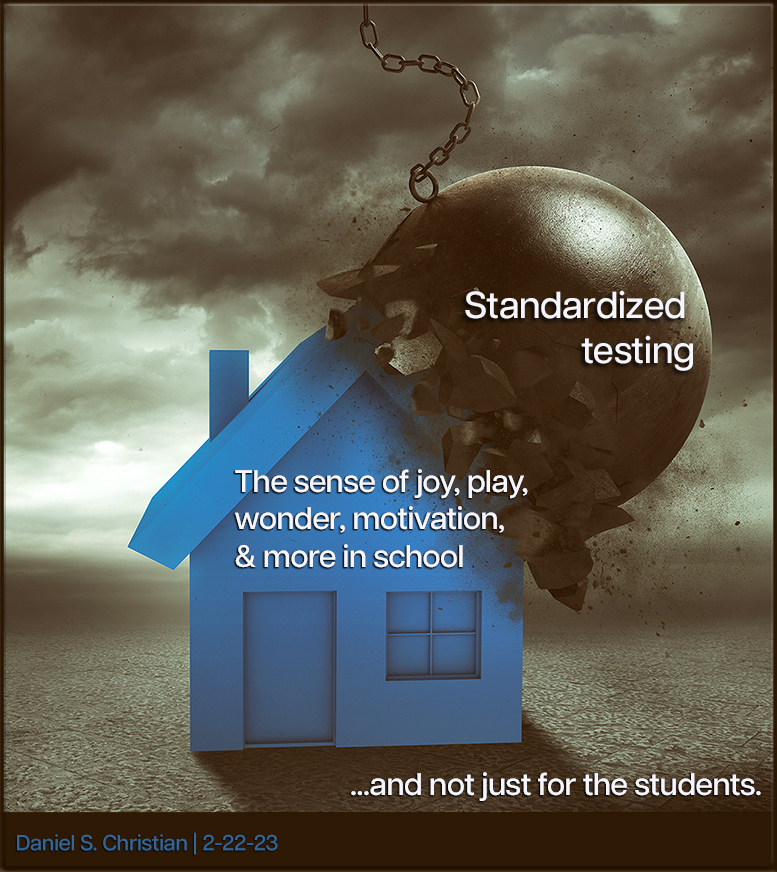
I think that legislators are part of the problem, as they straight-jacket teachers, principals, and administrators with all kinds of standardized testing.

Standardized testing is like a wrecking ball on our educational systems -- impacting things like our students' and teachers' sense of joy, play, wonder, and motivation

I would think that such testing dictates the pace and the content and the overall agendas out there. I don’t recall taking nearly as many standardized tests as our youth do today. Looking back, each of my teachers was engaged and seemed to be happy and enthusiastic. I don’t think that’s the case any longer. Let’s ask the teachers — not the legislators — why that is the case and what they would recommend to change things (before it’s too late).


Does ‘Flipped Learning’ Work? A New Analysis Dives Into the Research — from edsurge.com by Jeffrey R. Young

Excerpt:

The researchers do think that flipped learning has merit — if it is done carefully. They end their paper by presenting a model of flipped learning they refer to as “fail, flip, fix and feed,” which they say applies the most effective aspects they learned from their analysis. Basically they argue that students should be challenged with a problem even if they can’t properly solve it because they haven’t learned the material yet, and then the failure to solve it will motivate them to watch the lecture looking for the necessary information. Then classroom time can be used to fix student misconceptions, with a mix of a short lecture and student activities. Finally, instructors assess the student work and give feedback.

From DSC:
Interesting. I think their “fail, flip, fix and feed” method makes sense.

Also, I do think there’s merit in presenting information ahead of time so that students can *control the pace* of listening/processing/absorbing what’s being relayed. (This is especially helpful for native language differences.) If flipped learning would have been a part of my college experience, it would have freed me from just being a scribe. I could have tried to actually process the information while in class.


Colleges and universities that contract with an online program management company need to submit details about those arrangements by May 1.

Oversight Coming for Online Program Providers — from insidehighered.com by Katherine Knott

Excerpt:

The Education Department is planning to increase oversight of the outside contractors that colleges and universities use to help run online programs.

To address that finding, the department said in guidance issued Wednesday that OPMs and any entity that provides recruitment services for a college are considered third-party servicers, subjecting the companies’ contracts with institutions to regular audits. Colleges and universities are required to report details of their agreements to the department by May 1.


Instructional Design 2023: Experts Share Top Predictions — from td.org by Jes Thompson

“As technology options continue to increase for IDs, they’ll have a lot to choose from to create useful learning experiences. To prove our worth to the organizations we work for, it will be more important than ever to focus on the solution rather than the technology—especially as layoffs continue in the tech industry. Hopefully we’ll see a greater presence in events and online networks as people try to find new roles. I think we’ll continue to see an influx of educators coming into the profession too. As a field, we’re in a great place to learn from the experience of others and to use technology to find innovative ways to support our learners.”

Heidi Kirby, Customer Education Manager and Co-Founder, Useful Stuff


“I think we’ll continue to see an influx of educators coming into the profession too.” — which brings me to another article:

Edtech Career Opportunities: 7 Tips To Stand Out At A Job Fair — from teachercareercoach.com

Excerpts (emphasis DSC):

Are you a transitioning teacher looking for an edtech career? If so, you’re in luck! Jeff Patterson, the CEO of Gaggle, hosts virtual Edtech Career Fairs.

This is a great chance to learn about the edtech industry and connect with key players. So, grab your pen and paper and get ready to take notes! We’ll be sharing some insight to help you make the most of your experience and stand out from the crowd. Let’s get started!


Podcast Special: Using Generative AI in Education — from drphilippahardman.substack.com by Dr. Philippa Hardman
An exploration of the risks and benefits of Generative AI in education, in conversation with Mike Palmer

Excerpt:

Among other things, we discussed:

  • The immediate challenges that Generative AI presents for learning designers, educators and students.
  • The benefits & opportunities that Generative AI might offer the world of education, both in terms of productivity and pedagogy.
  • How bringing together the world of AI and the world of learning science, we might revolutionise the way we design and deliver learning experiences.

Speaking of podcasts, this article lists some podcasts to check out for those working in — or interested in — higher education.


Also relevant/see:


Also relevant/see:

Are librarians the next prompt engineers? — from linkedin.com by Laura Solomon

Excerpt:

  • Without the right prompt, AI fails to provide what someone might be looking for. This probably is a surprise to no one, especially librarians. If you remember the days before Google, you know exactly how this tended to play out. Google became dominant in large part to its inherent ability to accept natural language queries.
  • A small industry is now popping up to provide people with the correct, detailed prompts to get what they want when interacting with AI. The people doing this work are referred to as “prompt engineers.”
  • Prompt engineers aren’t just people who write queries to be directed to an AI. They also have tend to have a great deal of technical expertise and a deep understanding of how artificial intelligences and natural language can intersect.
  • Prompt engineers don’t work for free.

The above item links to The Most Important Job Skill of This Century — from theatlantic.com by Charlie Warzel
Your work future could depend on how well you can talk to AI. 


Also relevant/see:

My class required AI. Here’s what I’ve learned so far. — from oneusefulthing.substack.com by Ethan Mollick
(Spoiler alert: it has been very successful, but there are some lessons to be learned)

Excerpt:

I fully embraced AI for my classes this semester, requiring students to use AI tools in a number of ways. This policy attracted a lot of interest, and I thought it worthwhile to reflect on how it is going so far. The short answer is: great! But I have learned some early lessons that I think are worth passing on.

AI is everywhere already
Even if I didn’t embrace AI, it is also clear that AI is now everywhere in classes. For example, students used it to help them come up with ideas for class projects, even before I even taught them how to do that. As a result, the projects this semester are much better than previous pre-AI classes. This has led to greater project success rates and more engaged teams. On the downside, I find students also raise their hands to ask questions less. I suspect this might be because, as one of them told me, they can later ask ChatGPT to explain things they didn’t get without needing to speak in front of the class. The world of teaching is now more complicated in ways that are exciting, as well as a bit unnerving.


The Broken Higher Education System: Addressing Stakeholder Needs for a More Adaptive Model — from educationoneducation.substack.com

Excerpt:

Higher education Chief Academic Officers (CAOs) must shift their perspective and strive to increase customer satisfaction to ensure the highest quality of educational products. A recent survey by Higher Education found that only 25% of customers were satisfied with the results higher education provided, contradicting the satisfaction differences of 99% of CAOs. Clearly, a disconnect exists between what higher education leaders deliver and what students, employers, and the changing labor market requirements are. To bridge this gap, higher education must develop products focusing on stakeholder feedback in product design, job requirements, and practical skills development.

From DSC:
So in terms of Design Thinking for reinventing lifelong learning, it seems to me that we need much more collaboration between the existing siloes. That is, we need students, educators, administrators, employers, and other stakeholders at the (re)design table. More experiments and what I call TrimTab Groups are needed.

But I think that the culture of many institutions of traditional higher education will prevent this from occurring. Many in academia shy away from (to put it politely) the world of business (even though they themselves ARE a business). I know, it’s not fair nor does it make sense. But many faculty members lean towards much more noble purposes, while never seeing the mounting gorillas of debt that they’ve heaped upon their students’/graduates’ backs. Those in academia shouldn’t be so quick to see themselves as being so incredibly different from those working in the corporate/business world.

The following quote seems appropriate to place here:


Along the lines of other items in the higher education space, see:

New Data Shows Emergency Pandemic Aid Helped Keep 18 Million Students Enrolled — from forbes.com by Edward Conroy

Excerpt:

The Department of Education (ED) has released new data showing that 18 million students were helped by emergency aid for colleges and universities throughout the height of the COVID-19 pandemic, more than half of which was used to provide emergency grants to students. These funds were provided through three rounds of Higher Education Emergency Relief Funds (HEERF) In total, $76.2 billion was provided, with half of those funds going to support students directly. Unusually for funding in higher education, the money was not heavily means-tested, and was distributed very quickly.

The report indicates that the funds were used for several essential purposes, including student basic needs, keeping staff employed, and helping keep students enrolled. For example, students used funds to cover things like food and housing at a time when employment was drying up for many students, ensuring that the Pandemic did not plunge students who already had limited funds deeper into basic needs insecurity.

Flagships prosper, while regionals suffer — from chronicle.com by Lee Gardner
Competition is getting fierce, and the gap is widening

Excerpts:

Some key numbers are moving in the right direction at the University of Oregon. The flagship institution enrolled 5,338 freshmen in the fall of 2022, its largest entering class ever. First-year enrollment increased 16 percent over 2021, which was also a record year. Meanwhile, Western Oregon University, a regional public institution an hour’s drive north, just outside Salem, lost nearly 7 percent of its enrollment over the same period.

In 28 states, flagships have seen enrollment rise between 2010 to 2021, while regionals have trended down, according to a Chronicle analysis of U.S. Education Department data. Across all states, enrollment at 78 public flagships rose 12.3 percent from 2010 to 2021, the most recent year for which data is available. Enrollment at 396 public regional universities slumped more than 4 percent during the same period.

Chronicle analysis of federal data showed, for example, that in Michigan, a state being hit hard by demographic shifts and with no central higher-ed authority, the flagship University of Michigan at Ann Arbor saw undergraduate enrollment rise 16 percent between 2010 and 2020. Over the same period, it fell at 11 of the state’s 12 other four-year public campuses.


Making Change: How America’s Workforce is Responding to Rising Costs — from insights.guildeducation.com

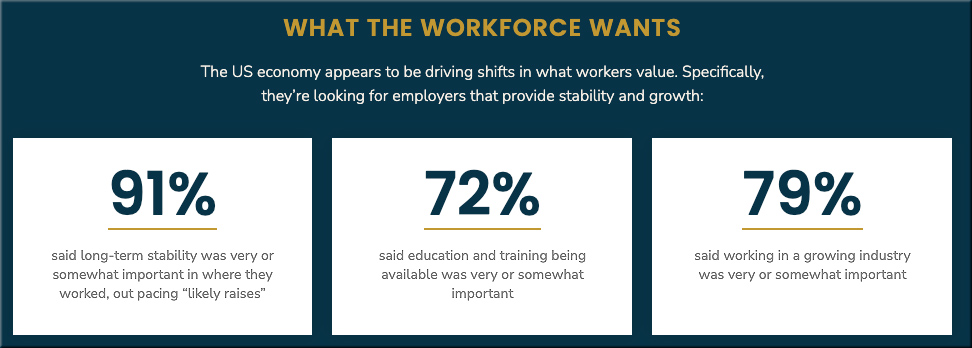
Taken together, the results show an American workforce focused on the long-term. Workers are managing to costs, but more than that, they’re making down payments on their future. This is a workforce motivated more than ever by a path to career growth and economic stability.

What the workforce wants in 2023 -- looking for more education, training, and long-term stability


College Inside - a biweekly newsletter about the future of postsecondary education in prisons

The future of computer programming in prison – College Inside; written by Open Campus national reporter Charlotte West.
A biweekly newsletter about the future of postsecondary education in prisons.

Excerpt:

Participant Leonard Bishop hadn’t touched technology in the 17 years he served in the federal system prior to transferring to the D.C. Jail in 2018. When he first got a tablet, he said it took him a few days to figure out how to navigate through it, but then “I couldn’t put it down.”

Bishop said he was surprised by how easy it was to learn the skills he needed to earn the AWS certification. “It helps you transition back into society, especially for someone who has been gone so long,” he said.


Also relevant/see:

This AWS Cloud certification program opens new paths for inmates — from amazon.com; with thanks to Paul Fain for this resource
A jail-based program aims to expand career opportunities through cloud-skills training.

Excerpt:

Julian Blair knew nothing about cloud computing when he became incarcerated in a Washington, D.C. jail more than two years ago.

“I’d never done anything with a computer besides video games, typing papers in college, and downloading music on an iPad,” said Blair.

Now, after three months of work with an educational program led by APDS and Amazon Web Services (AWS) inside the jail, Blair and 10 other residents at the facility have successfully passed the AWS Certified Cloud Practitioner exam.


Digital credentials’ appeal is strong, while corporate upskilling moves at a ‘snail’s pace’ — from by Elyse Ashburn; with thanks to Paul Fain for this resource
Surveys out this week from IBM and LinkedIn take a closer look at the role of digital credentials and other forms upskilling in education and on the job.

Excerpt:

Interest in upskilling and short-term credentials, either as an alternative or an add-on to college, has grown steadily over the past few years. And a couple of surveys out this week take a closer look at the role digital credentials and other forms upskilling can play in bridging the gap between formal education and work.

A major IBM survey fielded in 13 countries, including the United States, found that almost half of students, job seekers, and career changers are interested in jobs in science, technology, engineering and math (STEM)—but more than 61% think they aren’t qualified because they lack the right degrees.

  • 75% of respondents thought that digital credentials were a good way to supplement traditional education, but only 47% were actually familiar with such credentialing programs.
  • Among those who’d earned a digital credential, 86% said that it helped them achieve their career goals.

Eight in 10 people surveyed said they planned to upgrade their skills in the next two years—but time, cost, or simply not knowing how to begin were major barriers. Among both students and job seekers, 40% said that they don’t know where to start in developing new professional or technical skills.


From DSC:
Below are several months’ worth of labor market updates from Handshake’s blog — with thanks to Paul Fain for this resource.

February 2023 Early Talent Labor Market Update — from joinhandshake.com/blog/
Demand for tech talent outside of coastal states

Key takeaways

  • Tech hubs no longer? Traditional tech hubs like California and New York are seeing fewer entry-level job openings for technical talent and less interest from students.
  • A rising tech diaspora: States in other parts of the country, like Iowa (+10.9%) and Maryland (+5.1%), are emerging as locations with more job postings for technical roles—at the same time, students have demonstrated interest in applying to opportunities in those states.
  • New hubs for tech talent: Students are demonstrating greater openness to a wider array of geographic locations for tech roles with large increases in applications per job in states like Oklahoma (4.8x), Arizona (2.3x), and Oregon (2.7x).

January 2023 Early Talent Labor Market Updates — from joinhandshake.com/blog/
Employers still have strong demand for entry-level technical talent.

Key takeaways
2022 was a difficult year for workers in tech, as the industry was hit hard by hiring freezes and layoffs. Despite an overall slowdown in tech sector hiring, there are several bright spots in the technical labor market that should give early talent reason for optimism.

  • Tech industry is still investing in (tech) talent
  • Software and computer tech jobs outside of tech industry
  • Tech, but not in software

December 2022 Early Talent Labor Market Updates — from joinhandshake.com/blog/
Part-time jobs falling year over year with retail leading the way

Key takeaways

  1. Demand for early talent to fill part-time roles has dropped compared to earlier this year, and part-time jobs saw the largest year-over-year decrease (-32%) in job postings on the platform, when compared to full-time and internships.
  2. Notably employers who are still creating new jobs have been hiring more for full-time roles and internships with job postings per employer up 1% and 7% respectively.
  3. The retail industry, which relies on part-time workers through the holiday season, has seen the greatest year-over-year decrease in part-time job postings that were listed between October and November with a drop of 51%
 
© 2025 | Daniel Christian