Psalm 19:7-14

The law of the Lord is perfect,
    refreshing the soul.
The statutes of the Lord are trustworthy,
    making wise the simple.
The precepts of the Lord are right,
    giving joy to the heart.
The commands of the Lord are radiant,
    giving light to the eyes.
The fear of the Lord is pure,
    enduring forever.
The decrees of the Lord are firm,
    and all of them are righteous.

10 They are more precious than gold,
    than much pure gold;
they are sweeter than honey,
    than honey from the honeycomb.
11 By them your servant is warned;
    in keeping them there is great reward.
12 But who can discern their own errors?
    Forgive my hidden faults.
13 Keep your servant also from willful sins;
    may they not rule over me.
Then I will be blameless,
    innocent of great transgression.

14 May these words of my mouth and this meditation of my heart
    be pleasing in your sight,
    Lord, my Rock and my Redeemer.


The 2023 Underwater Photographer of the Year Contest Dives into the Stunning, Heartbreaking Lives of Aquatic Creatures — from thisiscolossal.com by Grace Ebert & Co.


Image @ Kat Zhou/UPY2023


Image © Alvaro Herrero Lopez-Beltran/UPY2023


ChatGPT for Spanish Classrooms — from rdene915.com by Nicole Biscotti, M. Ed.

Excerpt:

ChatGPT is just what the busy Spanish teacher necesita – no wasted time searching for the perfect “lectura” (text). Effective language instruction is coupled with learning about culture and now I’m able to generate texts in seconds AND I can even center them around a Latin American country, cultural point of interest, holiday, grammatical structure, etc.  Differentiation and personalized learning, those lofty teaching ideals that can feel a bit heavy when you mean well but have 35 kids in your room, have become that much easier to attain with ChatGPT.  It’s possible to generate texts about diverse aspects of culture in seconds and make adjustments for interests, length, rigor, etc. (Kuo & Lai, 2006) (Salaberry, 1999; Rost, 2002).

CURATING YOUR CLASSROOM WITH 9 MUST-HAVE TOOLS FOR RESOURCE COLLECTION – EASY EDTECH PODCAST 202 — from classtechtips.com by Monica Burns

Description:

How do you share resources with students? In this episode, we’ll focus on what happens after you find the very best resources to share with students. You’ll also hear about nine digital tools to help educators build a resource collection for students. So whether you have ten great resources on endangered species to share with your fourth graders or a dozen tutorial videos to share with your eleventh graders, this episode is for you!

50+ Useful AI Writing Tools to Know (2023) — from hongkiat.com

Excerpt:

AI writing tools generate content based on the keywords or prompt provided by users. You can then improve upon the output and make it suitable according to your own requirements.

There are different types of AI writing tools and in this post we are featuring some of the best ones. From content generators and editors to translators and typing assistants, there’s a whole gamut of AI-powered writing tools in the list. Take a look and see if one (or more) catches your interest.

How to Use Minecraft as a Teaching Tool — from intelligenthq.com

Excerpt:

Kids today have grown up with Minecraft, so it’s easy to get them enthusiastic about lessons using it. They can build anything they like, and use Minecraft skins to make the characters they create uniquely their own, getting them especially enthusiastic and involved in their lessons.

Teachers who learn how to use Minecraft as a teaching tool have found that it noticeably improves problem solving, creativity, and the ability to work together. It teaches both 21st century skills and timeless lessons.


On a somewhat related note, also see:


Blogs are back baby — from blog.edtechie.net by Martin Weller

Excerpt:

The conclusion I take from all this (which I carefully assembled so I could draw the conclusion I want), is that there is a desire to have a core place on the net, that is not subject to the whims of billionaires, institutions or markets, where you can engage in a range of dialogue, from personal to professional, and that you enjoy revisiting. Ladies and gentleman, I give you, the blog.

From DSC:
I hope you’re right Martin!!! I still really appreciate blogs, as readers of this Learning Ecosystems blog might have guessed. 


Why Many Early Childhood Educators Can’t Afford to Retire — from edsurge.com by Emily Tate Sullivan

Excerpt:

It’s a bitter contradiction that spans the field: The job is a difficult one to do into old age, yet few who stick with it are able to set aside enough money to enjoy a traditional retirement.

For child care providers to come away with even the slimmest of profit margins, they are often already charging families the maximum they can afford to pay, explains Powell. And that’s before providers have built in a buffer to cover an emergency fund, health insurance and retirement savings.

At a certain age, you’re not going to catch up. You won’t own a home. You won’t have retirement savings.

— Anna Powell

“Even by the time they’re in their 50s, they may not be able to start a savings account,” Powell says. “They’re still hitting that ceiling of what parents can afford to pay.”


10 Tips to Help You Find the Legal Career That’s Right for You — from abaforlawstudents.com by Bill D. Henslee

Excerpts:

Career planning is a process that requires time and thought. Perhaps you’ve known what you want to be when you grow up for as long as you can remember. Or perhaps you’re still trying to figure it out. Most of us fit somewhere on the spectrum between “born to serve” and “stay loose and adjust.”

Wherever you land on that spectrum, you’ll still need to get a job. Here are 10 tips to help you identify and land the position that fits your skills and interests.

1. Think about Practice Areas

2. Consider Culture

3. Know the People


“Click Here” Isn’t Enough Context for Hyperlinks — from boia.org

Excerpt:

If a link reads “click here,” “learn more,” or “read more,” you’re not telling users anything about the link’s purpose — you’re simply telling them that they can click on the link (and most users understand that hyperlinks can be activated).

That can be frustrating for many people. Unfortunately, it’s a common user experience (UX) issue, but it’s easy to correct.

4 Things People with Disabilities Look For On Your Website — from boia.org

Excerpts:

To that end, it’s useful to consider what individuals with disabilities experience when visiting a new website — the features that tell them whether or not your website is accessible.

1. An Accessibility Statement
2. Consistent Web Design

4 Simple Ways That Content Writers Can Promote Accessibility — from boia.org

Excerpts:

1. Look for inclusive stock photos
2. Avoid making assumptions about your readers


Competition Can Motivate, Encourage and Inspire Students. But It Can Also Harm Them. — from edsurge.com by Patrick Harris II

Excerpt:

The American Psychological Association (APA) defines competition as “any performance situation structured in such a way that success depends on performing better than others.” Naturally, this could create challenges in a school setting, but in my experience, whether innate or as a product of a structure, competition itself isn’t always problematic. In fact, some studies confirm that competition has benefits, though they vary based on the individual and the competition.

Competition can be thrilling and motivating to those who choose to engage. But it’s important to remember that competition is not a golden key to unlock student engagement. Depending on how we use it, competition can also cause harm, such as anxiety, low self-esteem or negative feelings of self-worth.

For every student who was celebrated, there was another student who, by design, was shamed.

Looking back, these competitions weren’t used to teach students sportsmanship or resilience. They were used as gimmicks and antics to “motivate” students. I now recognize that I played a part in reinforcing a system of inequity by awarding those students who were already privileged.

From DSC:
I appreciate Patrick’s balanced article here — mentioning both the potential advantages and disadvantages of using competitive activities in the classroom.

I’m also going to comment on the topic of competition but from a different perspective. One that involves my faith journey and relationships.

I used to play a lot of sports and I played one sport at the university level. I mention this to establish that I’ve had my share of competition. In my experience, competition was anti-relational. That could have been just my perspective, but perhaps others share this perspective as well.

That is, I viewed people as to be competed against…not to be in relationships with. When my identity was tied up with my sport, that was ok. But as my identity changed in my senior year, it was not ok. When I became a Christian (in faith), my identity shifted big time. And the LORD wanted me to be in relationships with other people. Competition didn’t help that part of my journey.

As an aside, competition was also encouraged in terms of grades and performance in school — including at the university level. Several professors put our results up on the walls outside their offices — clearly showing everyone where they stood in the class. And I saw competition in the corporate world all the time as well. So while it’s something we here in the United States practice big time, it does seem to have its plusses and minuses. 


Why Studying Is So Hard, and What Teachers Can Do to Help — from edutopia.org by Laura McKenna
Beginning in the upper elementary grades, research-backed study skills should be woven into the curriculum, argues psychology professor Daniel Willingham in a new book.

Excerpt:

The additional context for Willingham’s new book is that students often don’t know the best methods to study for tests, master complex texts, or take productive notes, and it’s difficult to explain to them why they should take a different tack. In the book, Willingham debunks popular myths about the best study strategies, explains why they don’t work, and recommends effective strategies that are based on the latest research in cognitive science.

I recently spoke to him about why listening to lectures isn’t like watching a movie, how our self-monitoring of learning is often flawed and self-serving, and when it’s too late to start teaching students good study skills.


Why Are Students So Disengaged? — from insidehighered.com by Johanna Alonso
A new survey by Wiley finds that one-fourth of students said they would be more invested in their courses if they learned in a way that emulated their future careers.

Excerpt:

Undergraduate students are struggling to stay engaged in class—and they believe that material more directly connected to real-life issues could help solve the problem.

That’s a key finding of the recent State of the Student 2022 survey by the academic publishing company Wiley, which noted that 55 percent of undergraduate and 38 percent of graduate students said they struggle to remain interested in their classes. The same proportion of undergraduates and 34 percent of graduate students also said they have trouble retaining the material they learn.

The survey of 5,258 students and 2,452 instructors in North America was conducted in August 2022 and sought to understand the factors that most impact student success, as well as what factors instructors perceive as the most impactful.


ChatGPT: 30 incredible ways to use the AI-powered chatbot — from interestingengineering.com by Christopher McFadden
You’ve heard of ChatGPT, but do you know how to use it? Or what to use it for? If not, then here are some ideas to get you started.

Excerpts:

  • It’s great at writing CVs and resumes
  • It can also read and improve the existing CV or resume
  • It can help you prepare for a job interview
  • ChatGPT can even do some translation work for you
  • Have it draft you an exam

Chatbots’ Time Has Come. Why Now? — from every.to by Nathan Baschez
Narratives have network effects

Excerpt:

There are obvious questions like “Are the AI’s algorithms good enough?” (probably not yet) and “What will happen to Google?” (nobody knows), but I’d like to take a step back and ask some more fundamental questions: why chat? And why now?

Most people don’t realize that the AI model powering ChatGPT is not all that new. It’s a tweaked version of a foundation model, GPT-3, that launched in June 2020. Many people have built chatbots using it before now. OpenAI even has a guide in its documentation showing exactly how you can use its APIs to make one.

So what happened? The simple narrative is that AI got exponentially more powerful recently, so now a lot of people want to use it. That’s true if you zoom out. But if you zoom in, you start to see that something much more complex and interesting is happening.

This leads me to a surprising hypothesis: perhaps the ChatGPT moment never would have happened without DALL-E 2 and Stable Diffusion happening earlier in the year!


The Most Important Job Skill of This Century — from theatlantic.com by Charlie Warzel
Your work future could depend on how well you can talk to AI.

Excerpt:

Like writing and coding before it, prompt engineering is an emergent form of thinking. It lies somewhere between conversation and query, between programming and prose. It is the one part of this fast-changing, uncertain future that feels distinctly human.


The ChatGPT AI hype cycle is peaking, but even tech skeptics don’t expect a bust — from cnbc.com by Eric Rosenbaum

Key Points:

  • OpenAI’s ChatGPT, with new funding from Microsoft, has grown to over one million users faster than many of dominant tech companies, apps and platforms of the past decade.
  • Unlike the metaverse concept, which had a hype cycle based on an idea still nebulous to many, generative AI as tech’s next big thing is being built on top of decades of existing machine learning already embedded in business processes.
  • We asked top technology officers, specifically reaching out to many at non-tech sector companies, to break down the potential and pitfalls of AI adoption.

ChatGPT and the college curriculum — out at youtube.com by Bryan Alexander with Maria Anderson


AI in EDU: Know the Risks– from linkedin.com by Angela Maiers

AI in EDU -- Know the Risks


Preparing Today’s Students for the Future Workforce — from rdene915.com by Rachelle Dené Poth

Excerpt:

Today’s high school students are the future of our workforce. Before long they will be in college or starting full-time jobs of their own. But how are today’s students preparing for their futures? What will the workforce look like when these students move on to the next stage of their lives?

Schools, districts, and even state education departments provide various programs for students to gain relevant work experience and gain necessary skills outside of the classroom.

What Are These Programs?
There are a number of school-based programs that support student growth through work such as…


Also relevant/see:


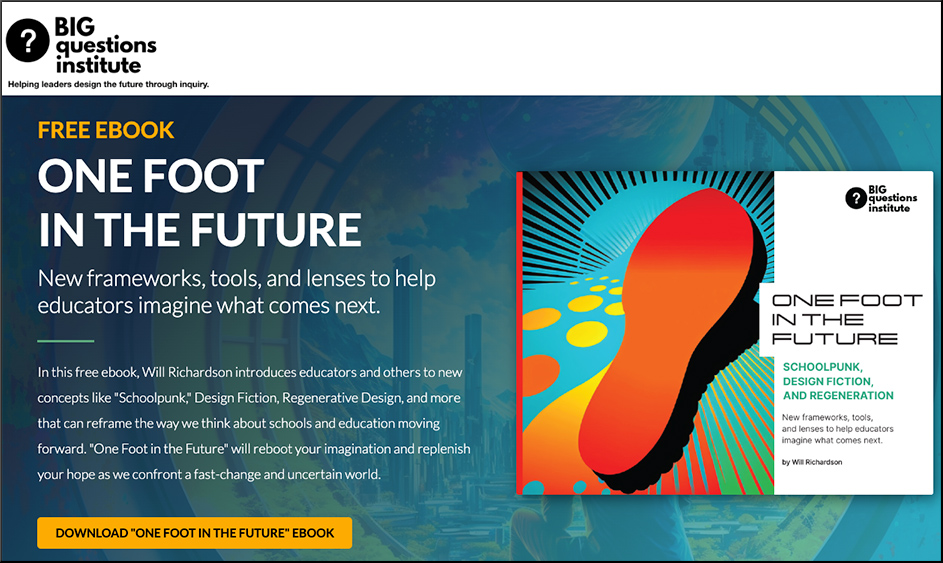
One Foot in the Future — from the BIG questions institute

As an excerpt from an email describing this new/free ebook, Homa Tavangar and Will Richardson write:

We need a fresh set of tools, frameworks, and lenses if we are to meet the future effectively.

With this new ebook, “One Foot in the Future,” we’re charting a different path forward, introducing readers to things like:

  • Design Fiction – A tool to help us become “archeologists of the future” and help us
  • Regenerative Learning – A lens that helps us see our work as it impacts all living things
  • Schoolpunk – A movement and a community to help imagine the future of education together.

And much more.

Our sense is that there is growing appetite to get out of the traditional school box and to design a more aspirational future. This new ebook is a great starting point for anyone who wants to do just that.

ONE FOOT IN THE FUTURE -- a free ebook from the BIG questions institute regarding new frameworks, tools, and lenses to help educators imagine what comes next


Along the lines of tools, also see:

6 Apps and Websites to Make Video Journals — from classtechtips.com by Monica Burns

Excerpt:

Have you made video journals with your students? Earlier this year on the blog, I shared some of the reasons why this medium is worth considering. Today on the blog, we’ll look at six apps and websites to make video journals alongside a few more reasons why video journals are worth considering.

There are several reasons why a teacher might introduce video journals to their students. First, video journals can be a powerful tool for self-reflection and personal growth. By creating and reflecting on videos of themselves, students can better understand their own thoughts, feelings, and behaviors and identify areas for improvement.

Video journals can also provide a creative outlet for students to express themselves. Students may enjoy experimenting with different video-editing techniques and sharing their work with their peers. This experience using video tools can transfer to additional learning experiences, especially because video journals can help students practice their communication skills in speaking and visual storytelling.


And speaking of tools and technologies, also see:

A Valentine for Education Technology — from campustechnology.com by Mary Grush and Gardner Campbell

Excerpt:

However, in making some adjustments for an online experience, I soon realized that I was able, actually, to enhance aspects of the Read-a-thon and thus the course as well. For the first time, I could choose to invite the wider Milton community to the event, encouraging people to join from many different points across the country and potentially around the globe!

I like certain kinds of management technologies that help me with record keeping and organization. But I don’t love them. I love technologies of communication because, I think, they’re at the heart of teaching and learning — creating opportunities for human beings to think together, to study something together.


Brandon Busteed (emphasis DSC):

This is a Titanic moment. The iceberg is right in front of us and there just isn’t enough time to turn the massive U.S. education/higher education/employer training ship. Unless… We all go to work on work.

From DSC:
My comment on that string from Brandon was:

And I can’t help but think that part of that work involves Design Thinking…reinventing what lifelong learning looks/acts like.

 
© 2025 | Daniel Christian