The heavens declare the glory of God; the skies proclaim the work of his hands.

Psalm 19:1-4
For the director of music. A psalm of David.

1 The heavens declare the glory of God;
the skies proclaim the work of his hands.
2 Day after day they pour forth speech;
night after night they reveal knowledge.
3 They have no speech, they use no words;
no sound is heard from them.
4 Yet their voice[b] goes out into all the earth,
their words to the ends of the world.
In the heavens God has pitched a tent for the sun.

***

A detail image of the larger composite. DECaPS2/DOE/FNAL/DECam/CTIO/NOIRLab/NSF/AURA Image processing: M. Zamani & D. de Martin (NSF’s NOIRLab)

***

An excerpt from Nicky Gumbel’s Classic Bible Study

Francis Collins, Director of the National Institutes for Health in the USA, a leader in the scientific response to COVID-19 and recipient of the 2020 Templeton Prize, led, in his former role as director of the Human Genome Project, a team of over 2000 scientists who collaborated to determine the three billion letters in the human genome – our own DNA instruction book. He said, ‘I cannot see how nature could have created itself. Only a supernatural force that is outside of space and time could have done that.’


Imagine Learning Announces Major New Special Education Initiative — from businesswire.com; via GSV

Excerpt:

SCOTTSDALE, Ariz.–(BUSINESS WIRE)–Imagine Learning, the largest provider of digital curriculum solutions in the United States serving 15 million students in more than half the districts nationwide, today announced a major new initiative to address the urgent learning needs of more than seven million students with disabilities across the U.S.

Imagine Learning is also launching Imagine AscendTM, a new comprehensive solution for special education students that combines digital courseware with highly qualified virtual instructors. Imagine Ascend provides districts with a sustainable solution for staffing shortages and a scalable approach to increasing graduation rates, both critical needs of special education programs. The Imagine Ascend portfolio of curricula and services will support learners with accommodating instruction and help educators serve students with disabilities.


Homework seating collection by Alexander Lotersztain for Derlot — from dezeen.com by and Lotersztain

Homework seating collection by Alexander Lotersztain for Derlot

Also see:

Derlot dot com


A quick and sobering guide to cloning yourself — from oneusefulthing.substack.com by Professor Ethan Mollick
It took me a few minutes to create a fake me giving a fake lecture.

Excerpt:

I think a lot of people do not realize how rapidly the multiple strands of generative AI (audio, text, images, and video) are advancing, and what that means for the future.

With just a photograph and 60 seconds of audio, you can now create a deepfake of yourself in just a matter of minutes by combining a few cheap AI tools. I’ve tried it myself, and the results are mind-blowing, even if they’re not completely convincing. Just a few months ago, this was impossible. Now, it’s a reality.

To start, you should probably watch the short video of Virtual Me and Real Me giving the same talk about entrepreneurship. Nothing about the Virtual Me part of the video is real, even the script was completely AI-generated.

.


From DSC:
Also, I wanted to post the resource below just because I think it’s an excellent question!

If ChatGPT Can Disrupt Google In 2023, What About Your Company? — from forbes.com by Glenn Gow

Excerpts:

Board members and corporate execs don’t need AI to decode the lessons to be learned from this. The lessons should be loud and clear: If even the mighty Google can be potentially overthrown by AI disruption, you should be concerned about what this may mean for your company.

Professions that will be disrupted by generative AI include marketing, copywriting, illustration and design, sales, customer support, software coding, video editing, film-making, 3D modeling, architecture, engineering, gaming, music production, legal contracts, and even scientific research. Software applications will soon emerge that will make it easy and intuitive for anyone to use generative AI for those fields and more.
.


Want to Recruit Male Teachers of Color? Look to This New York City Leader — from edweek.org by Alyson Klein & Mark Walsh

Chimere Stephens, the director of NYC Men Teach at the NYC Department of Education, reads a book to a class of 1st grade students in January at PS 55 elementary school. Mostafa Bassim for Education Week Chimere Stephens, the director of NYC Men Teach at the NYC Department of Education, reads a book to a class of 1st grade students in January at PS 55 elementary school.

— Mostafa Bassim for Education Week

Excerpt:

Now, the pipeline he’s helped build to bring men of color into the teaching force stretches all the way back to high schoolers, continues with college students, and includes on-ramps for those already working as paraprofessionals and in similar positions throughout the city’s schools.

“I always get asked, ‘How do you create a vibrant, diverse, inclusive pathway for people to come into the teaching profession?’ And my biggest takeaway is start early,” Stephens said.

‘Unlike anyone I’d ever seen before’
In part thanks to Stephens’ work, the district has quadrupled its ambitious initial goal, adding 4,000 men of color to its teaching ranks over the past eight years. The move has brought the share of male teachers of color from 8.5 percent in 2015 to 15 percent last year.


Learning relies on emotions — from linkedin.com by Melanie Knight

Learning relies on emotions

From DSC:
I don’t know nearly enough about how our emotions impact our learning. But this version of the Learn About Learning newsletter reminds me of a wish I have that our nation would create a one-stop shop/resource for how we learn:

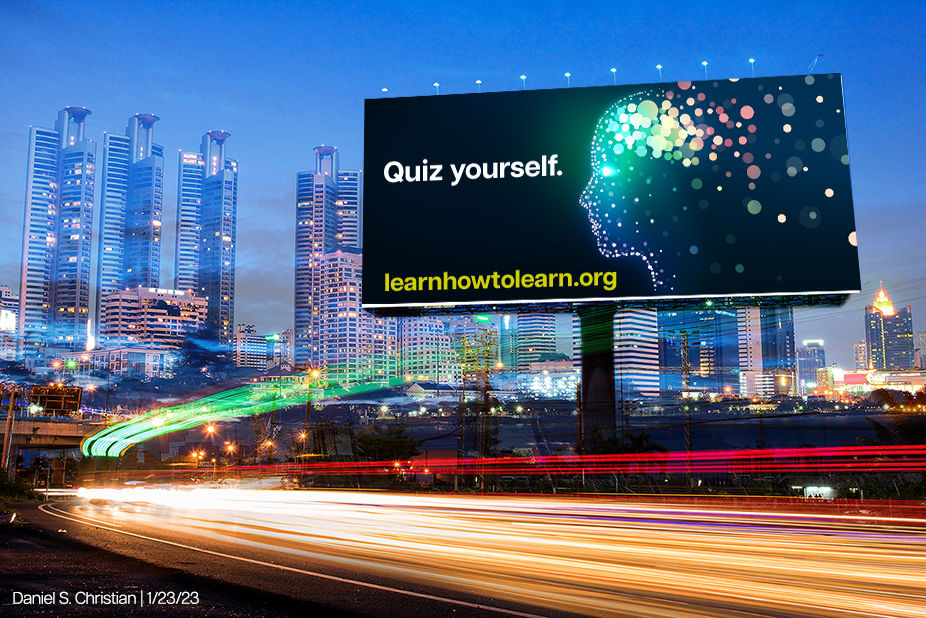
I wish we had a one-stop shop / URL for how we learn


Why Educators And Employers Must Come Together To Cross The Skills Gap — from forbes.com by Mark C. Perna

Excerpts:

Beyond the IT sector, skills gaps also exist in other areas of the economy, such as manufacturing and retail. There is a shortage of workers in the skilled trades industries, for example, which is growing more acute every year.

The other major factor in the growth of the skills gap is the aging of the Boomer generation, who are exiting the workforce—leaving open highly-skilled jobs that members of younger generations have not had the time or training to fill.

By 2030, forecasts predict that all Boomers will have left the job market—leaving some 85 million open jobs, according to a Korn Ferry study on the Global Talent Crunch. The cost? A projected $8.5 trillion in lost revenue.

Put another way, schools and employers need to team up in new ways to help provide access to members of the younger generation to gain the kinds of skills that make the skills gap a thing of the past. We need to connect the dots between school and work, because far too many people are getting lost in the middle.

And on a somewhat relevant note, also see:

General Assembly Launches Apprenticeship Solution to Help Employers Source, Deploy, and Retain Hard-to-Find Tech Talent — from finance.yahoo.com; via Paul Fain

Excerpt:

NEW YORK, Feb. 7, 2023 /PRNewswire/ — General Assembly (GA) today announced the launch of GA Apprenticeships, Powered by Interapt, a tech apprenticeship solution designed to fast-track high-potential, overlooked talent into careers in software engineering, data, and cybersecurity. In light of growing labor market challenges and ongoing skill shortages across a range of industries, this new model will provide employers with a derisked opportunity to onboard entry-level tech talent while also enabling apprentices to earn a salary as they learn alongside senior-level developers.

See Workers as Workers, Not as a College Credential — an opinion item out at nytimes.com (paywall)

In one of the richest nations on earth, the path to prosperity has narrowed significantly in recent decades — especially for those without a college education. More than 62 percent of Americans ages 25 and up do not hold bachelor’s degrees, and the earnings gapbetween those with a college education and those without one has never been wider.


ChatGPT sets record for fastest-growing user base – analyst note — from reuters.com by Krystal Hu

Excerpt (emphasis DSC):

Feb 1 (Reuters) – ChatGPT, the popular chatbot from OpenAI, is estimated to have reached 100 million monthly active users in January, just two months after launch, making it the fastest-growing consumer application in history, according to a UBS study on Wednesday.

The report, citing data from analytics firm Similarweb, said an average of about 13 million unique visitors had used ChatGPT per day in January, more than double the levels of December.

“In 20 years following the internet space, we cannot recall a faster ramp in a consumer internet app,” UBS analysts wrote in the note.


From DSC:
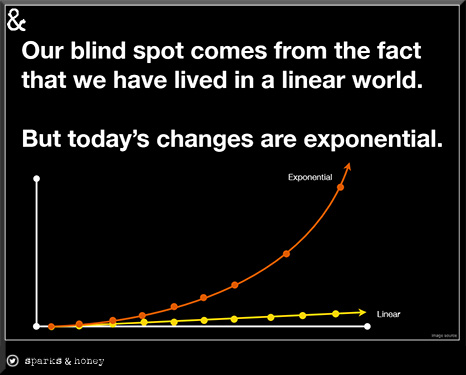
This reminds me of the current exponential pace of change that we are experiencing…

..and how we struggle with that kind of pace.


Five Predictions for the Future of Learning in the Age of AI — from a16z.com by Anne Lee Skates

Excerpts:

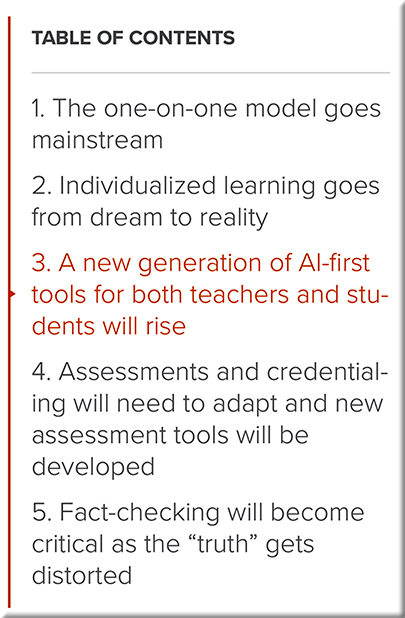
Seeing as education is one of AI’s first consumer use cases, and programs like ChatGPT are how millions of kids, teachers, and administrators will be introduced to AI, it is critical that we pay attention to the applications of AI and its implications for our lives. Below, we explore five predictions for AI and the future of learning, knowledge, and education.

TOC for Five Predictions for the Future of Learning in the Age of AI


DC: It will be interesting to see how ALSPs use ChatGPT, GPT versions 3.5 and above, and other areas of #legaltech


Alternative legal services providers hit $20.6B share of legal market, new report says — from abajournal.com by Matt Reynolds

Excerpt:

Alternative legal services providers, or ALSPs, have shown accelerated growth and now make up $20.6 billion of the legal market, according to a report published Tuesday.

The Thomson Reuters Institute’s biennial report found that growth of ALSPs has “dramatically accelerated.” It is up 45% since the last report in 2021, with a compound annual growth rate of 20% for fiscal years 2020 and 2021, according to the report, titled Alternative Legal Services Providers 2023: Accelerating growth & expanding service categories.


ABA panel deals a blow to test-optional push — from highereddive.com by Jeremy Bauer-Wolf

Dive Brief:

  • The American Bar Association’s policymaking body rejected a plan Monday that would end the requirement that ABA-accredited law schools use the Law School Admission Test or another standardized assessment in admissions.
  • The ABA House of Delegates voted against the change to the organization’s policy that mandates admissions tests — exams detractors say contribute to middling diversity in legal education. Nearly 600 officials comprise the House of Delegates, which took a voice vote on the plan, meaning a precise count was not available.
  • However, the proposal isn’t dead. It could be revived and approved unilaterally by the Council of the Section of Legal Education and Admissions to the Bar…

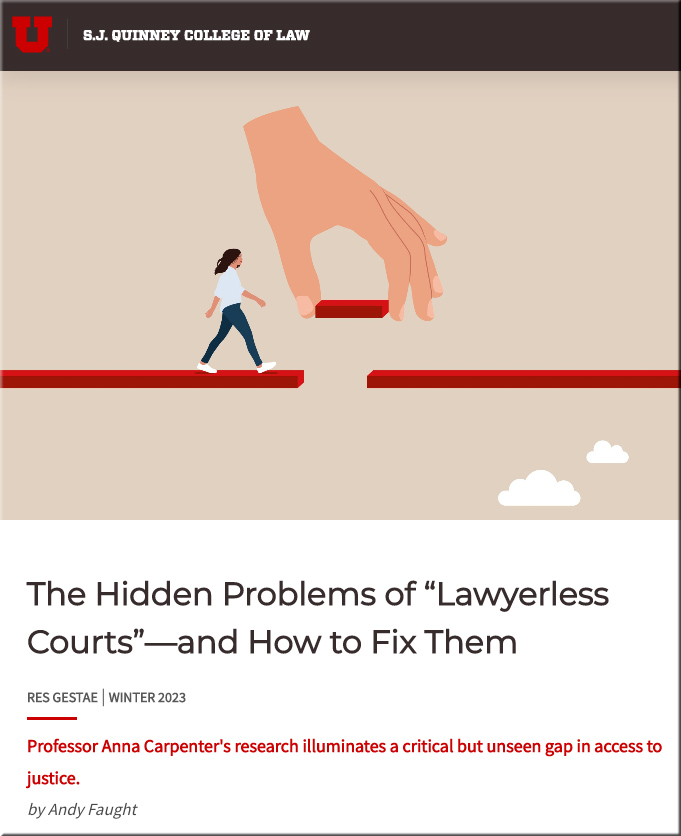
The Hidden Problems of “Lawyerless Courts”—and How to Fix Them

Excerpts:

Every year, 20 million Americans find themselves in state civil courts facing life-altering events such as divorce, child custody deliberations, eviction, and missed bills.

But unlike in criminal courts, where defendants have a constitutional right to legal representation, the same guarantee isn’t afforded in state civil courts. Most people in these courts are low- to middle-income and unable to afford help. They must strike out on their own to blindly navigate byzantine legal protocols.

“The civil justice system is broken in our state courts,” says Utah Law Professor Anna Carpenter, whose research examines state civil courts, the judges who preside in them, and access to justice. She is part of a four-person research team that pioneered a new body of scholarship that analyzes state civil courts.

“I challenge anyone, especially lawyers, to go sit in one of these courtrooms and watch the tragic, day-to-day reality,” Carpenter says. “You’ll see why we believe these courts are the emergency rooms of our justice system.”


The Future of Legal Technology with Gabe Teninbaum

The Future of Legal Technology with Gabe Teninbaum


What can work colleges teach the rest of higher ed? — from highereddive.com by Laura Spitalniak
Amid high worries about higher ed’s value in the job market, work colleges offer lessons on integrating classroom learning with employment opportunities.

Excerpt:

To qualify as a work college, an institution must be nonprofit, offer four-year degrees and provide students with employment through a work-learning-service program that will contribute to their education.

It found work colleges’ strengths — reduced or free tuition, job experience and mentorship from college faculty and staff — address student concerns over the cost and real-world applicability of a college degree. Work colleges can also make adult learners’ lives logistically easier by combining academics and work, the report found.

The intentional connection of learning, work and service is the most compelling part of the model, according to Louis Soares, chief learning and innovation officer at ACE and one of the report’s authors.


Radar Trends to Watch: February 2023 — from oreilly.com by Mike Loukides
Developments in Data, Programming, Security, and More

Excerpt:

One application for ChatGPT is writing documentation for developers, and providing a conversational search engine for the documentation and code. Writing internal documentation is an often omitted part of any software project.

DoNotPay has developed an AI “lawyer” that is helping a defendant make arguments in court. The lawyer runs on a cell phone, through which it hears the proceedings. It tells the defendant what to say through Bluetooth earbuds. DoNotPay’s CEO notes that this is illegal in almost all courtrooms. (After receiving threats from bar associations, DoNotPay has abandoned this trial.)

Matter, a standard for smart home connectivity, appears to be gaining momentum. Among other things, it allows devices to interact with a common controller, rather than an app (and possibly a hub) for each device.


Introducing: ChatGPT Edu-Mega-Prompts — from drphilippahardman.substack.com by Dr. Philippa Hardman; with thanks to Ray Schroeder out on LinkedIn for this resource
How to combine the power of AI + learning science to improve your efficiency & effectiveness as an educator

From DSC:
Before relaying some excerpts, I want to say that I get the gist of what Dr. Hardman is saying re: quizzes. But I’m surprised to hear she had so many pedagogical concerns with quizzes. I, too, would like to see quizzes used as an instrument of learning and to practice recall — and not just for assessment. But I would give quizzes a higher thumbs up than what she did. I think she was also trying to say that quizzes don’t always identify misconceptions or inaccurate foundational information. 

Excerpts:

The Bad News: Most AI technologies that have been built specifically for educators in the last few years and months imitate and threaten to spread the use of broken instructional practices (i.e. content + quiz).

The Good News: Armed with prompts which are carefully crafted to ask the right thing in the right way, educators can use AI like GPT3 to improve the effectiveness of their instructional practices.
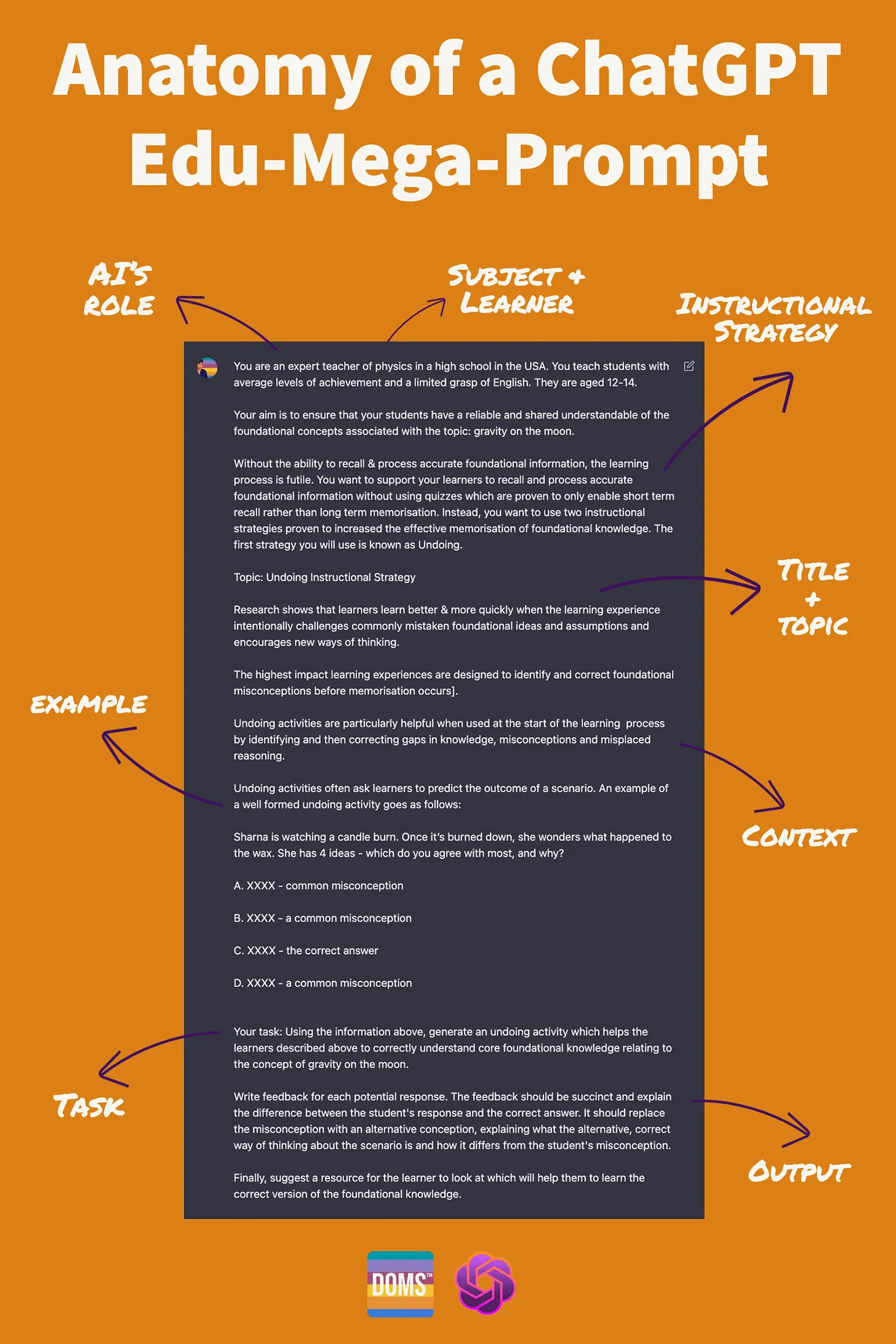
As is always the case, ChatGPT is your assistant. If you’re not happy with the result, you can edit and refine it using your expertise, either alone or through further conversation with ChatGPT.

For example, once the first response is generated, you can ask ChatGPT to make the activity more or less complex, to change the scenario and/or suggest more or different resources – the options are endless.

Philippa recommended checking out Rob Lennon’s streams of content. Here’s an example from his Twitter account:


Also relevant/see:
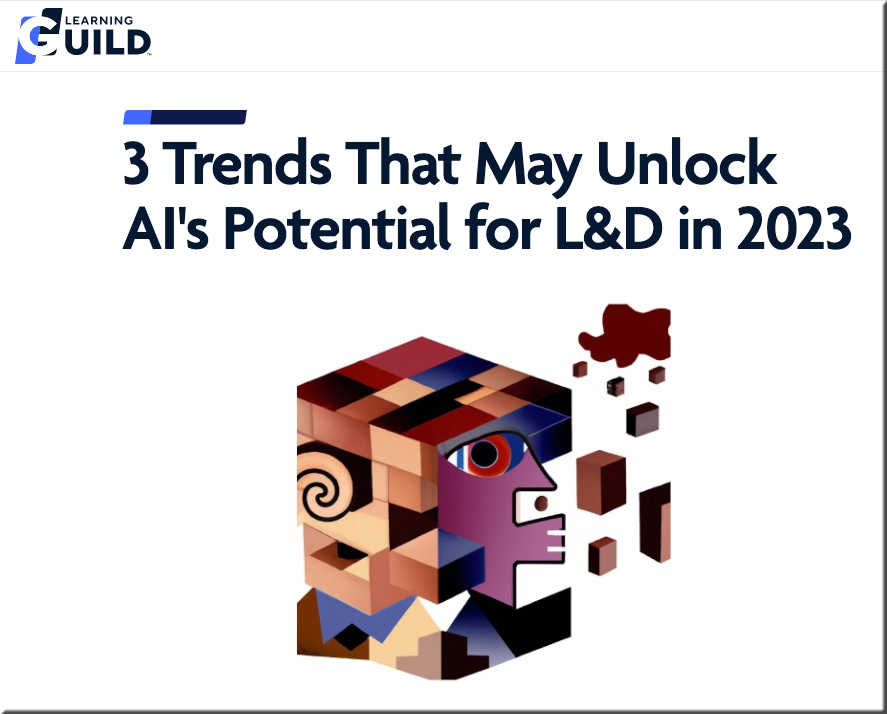
3 trends that may unlock AI's potential for Learning and Development in 2023

3 Trends That May Unlock AI’s Potential for L&D in 2023 — from learningguild.com by Juan Naranjo

Excerpts:

AI-assisted design and development work
This is the trend most likely to have a dramatic evolution this year.

Solutions like large language models, speech generators, content generators, image generators, translation tools, transcription tools, and video generators, among many others, will transform the way IDs create the learning experiences our organizations use. Two examples are:

1. IDs will be doing more curation and less creation:

  • Many IDs will start pulling raw material from content generators (built using natural language processing platforms like Open AI’s GPT-3, Microsoft’s LUIS, IBM’s Watson, Google’s BERT, etc.) to obtain ideas and drafts that they can then clean up and add to the assets they are assembling. As technology advances, the output from these platforms will be more suitable to become final drafts, and the curation and clean-up tasks will be faster and easier.
  • Then, the designer can leverage a solution like DALL-E 2 (or a product developed based on it) to obtain visuals that can (or not) be modified with programs like Illustrator or Photoshop (see image below for Dall-E’s “Cubist interpretation of AI and brain science.”

2. IDs will spend less, and in some cases no time at all, creating learning pathways

AI engines contained in LXPs and other platforms will select the right courses for employees and guide these learners from their current level of knowledge and skill to their goal state with substantially less human intervention.


The Creator of ChatGPT Thinks AI Should Be Regulated — from time.com by John Simons

Excerpts:

Somehow, Mira Murati can forthrightly discuss the dangers of AI while making you feel like it’s all going to be OK.

A growing number of leaders in the field are warning of the dangers of AI. Do you have any misgivings about the technology?

This is a unique moment in time where we do have agency in how it shapes society. And it goes both ways: the technology shapes us and we shape it. There are a lot of hard problems to figure out. How do you get the model to do the thing that you want it to do, and how you make sure it’s aligned with human intention and ultimately in service of humanity? There are also a ton of questions around societal impact, and there are a lot of ethical and philosophical questions that we need to consider. And it’s important that we bring in different voices, like philosophers, social scientists, artists, and people from the humanities.


Whispers of A.I.’s Modular Future — from newyorker.com by James Somers; via Sam DeBrule

Excerpts:

Gerganov adapted it from a program called Whisper, released in September by OpenAI, the same organization behind ChatGPTand dall-e. Whisper transcribes speech in more than ninety languages. In some of them, the software is capable of superhuman performance—that is, it can actually parse what somebody’s saying better than a human can.

Until recently, world-beating A.I.s like Whisper were the exclusive province of the big tech firms that developed them.

Ever since I’ve had tape to type up—lectures to transcribe, interviews to write down—I’ve dreamed of a program that would do it for me. The transcription process took so long, requiring so many small rewindings, that my hands and back would cramp. As a journalist, knowing what awaited me probably warped my reporting: instead of meeting someone in person with a tape recorder, it often seemed easier just to talk on the phone, typing up the good parts in the moment.

From DSC:
Journalism majors — and even seasoned journalists — should keep an eye on this type of application, as it will save them a significant amount of time and/or money.

Microsoft Teams Premium: Cut costs and add AI-powered productivity — from microsoft.com by Nicole Herskowitz

Excerpt:

Built on the familiar, all-in-one collaborative experience of Microsoft Teams, Teams Premium brings the latest technologies, including Large Language Models powered by OpenAI’s GPT-3.5, to make meetings more intelligent, personalized, and protected—whether it’s one-on-one, large meetings, virtual appointments, or webinars.


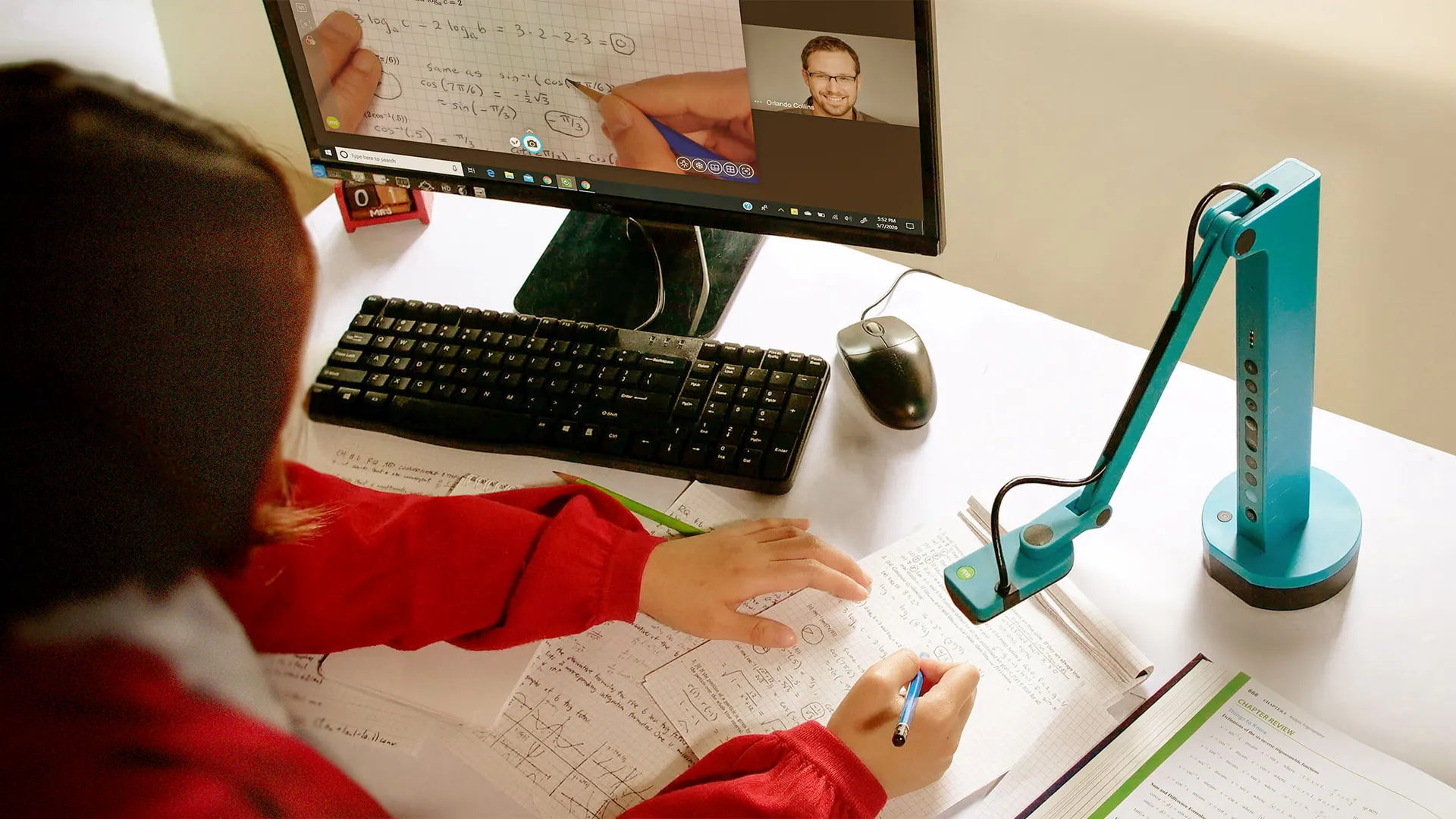
Best Document Cameras for Teachers — from techlearning.com by Luke Edwards
Get the best document camera for teachers to make the classroom more digitally immersive

Along the lines of edtech, also see:

Tech & Learning Names Winners of the Best of 2022 Awards — from techlearning.com by TL Editors
This annual award celebrates recognizing the very best in EdTech from 2022

.
The Tech & Learning Awards of Excellence: Best of 2022 celebrate educational technology from the last 12 months that has excelled in supporting teachers, students, and education professionals in the classroom, for professional development, or general management of education resources and learning. Nominated products are divided into three categories: Primary, Secondary, or Higher Education.

 
© 2025 | Daniel Christian