Are High Schools Preparing Students for the Future? — from xqsuperschool.org; with thanks to Marisa Sergnese out on LinkedIn for this resource

Excerpt:

High school is the last stop before students enter the real world of college, career, and adult life. It’s where adolescents are supposed to develop both academically and socially, so they’ll graduate prepared for all the future has to offer. But does it?

Along with students, educators, families, and employers across the country, we at XQ believe it’s time to rethink high school to ensure that it does. We invited our readers to weigh in and here is what they told us:

Out of more than 300 participants polled, the vast majority—93 percent—said they didn’t think high schools are fully preparing students to succeed in the future.

That’s a dramatically high percentage—and it lines up with current research. A study from the Hechinger Report reveals that the vast majority of the nation’s two- and four-year colleges report enrolling students who are unprepared for college-level work. Furthermore, the National Center for Education Statistics reports that up to 65 percent of community college students take at least one remedial course.


How ChatGPT is going to change the future of work and our approach to education — from livemint.com

From DSC: 
I thought that the article made a good point when it asserted:

The pace of technological advancement is booming aggressively and conversations around ChatGPT snatching away jobs are becoming more and more frequent. The future of work is definitely going to change and that makes it clear that the approach toward education is also demanding a big shift.

A report from Dell suggests that 85% of jobs that will be around in 2030 do not exist yet. The fact becomes important as it showcases that the jobs are not going to vanish, they will just change and most of the jobs by 2030 will be new.

The Future of Human Agency — from pewresearch.org by Janna Anderson and Lee Rainie

Excerpt:

Thus the question: What is the future of human agency? Pew Research Center and Elon University’s Imagining the Internet Center asked experts to share their insights on this; 540 technology innovators, developers, business and policy leaders, researchers, academics and activists responded. Specifically, they were asked:

By 2035, will smart machines, bots and systems powered by artificial intelligence be designed to allow humans to easily be in control of most tech-aided decision-making that is relevant to their lives?

The results of this nonscientific canvassing:

    • 56% of these experts agreed with the statement that by 2035 smart machines, bots and systems will not be designed to allow humans to easily be in control of most tech-aided decision-making.
    • 44% said they agreed with the statement that by 2035 smart machines, bots and systems will be designed to allow humans to easily be in control of most tech-aided decision-making.

What are the things humans really want agency over? When will they be comfortable turning to AI to help them make decisions? And under what circumstances will they be willing to outsource decisions altogether to digital systems?

The next big threat to AI might already be lurking on the web — from zdnet.com by Danny Palmer; via Sam DeBrule
Artificial intelligence experts warn attacks against datasets used to train machine-learning tools are worryingly cheap and could have major consequences.

Excerpts:

Data poisoning occurs when attackers tamper with the training data used to create deep-learning models. This action means it’s possible to affect the decisions that the AI makes in a way that is hard to track.

By secretly altering the source information used to train machine-learning algorithms, data-poisoning attacks have the potential to be extremely powerful because the AI will be learning from incorrect data and could make ‘wrong’ decisions that have significant consequences.

Why AI Won’t Cause Unemployment — from pmarca.substack.com by Marc Andreessen

Excerpt:

Normally I would make the standard arguments against technologically-driven unemployment — see good summaries by Henry Hazlitt (chapter 7) and Frédéric Bastiat (his metaphor directly relevant to AI). And I will come back and make those arguments soon. But I don’t even think the standand arguments are needed, since another problem will block the progress of AI across most of the economy first.

Which is: AI is already illegal for most of the economy, and will be for virtually all of the economy.

How do I know that? Because technology is already illegal in most of the economy, and that is becoming steadily more true over time.

How do I know that? Because:


From DSC:
And for me, it boils down to an inconvenient truth: What’s the state of our hearts and minds?

AI, ChatGPT, Large Language Models (LLMs), and the like are tools. How we use such tools varies upon what’s going on in our hearts and minds. A fork can be used to eat food. It can also be used as a weapon. I don’t mean to be so blunt, but I can’t think of another way to say it right now.

  • Do we care about one another…really?
  • Has capitalism gone astray?
  • Have our hearts, our thinking, and/or our mindsets gone astray?
  • Do the products we create help or hurt others? It seems like too many times our perspective is, “We will sell whatever they will buy, regardless of its impact on others — as long as it makes us money and gives us the standard of living that we want.” Perhaps we could poll some former executives from Philip Morris on this topic.
  • Or we will develop this new technology because we can develop this new technology. Who gives a rat’s tail about the ramifications of it?


Leaders who practice foresight stay ahead of the innovation curve — from tfsx.com

Excerpt (emphasis DSC):

According to famed futurist Richard Slaughter, foresight (also known as futures thinking or futuring) is “the ability to create and maintain a high-quality, coherent and functional forward view, and to use the insights arising in useful organizational ways.”2 In other words, foresight is a way to examine the paths the future might take, using qualitative and quantitative metrics, and then use the insights gained from this analysis to navigate our uncertain and changing world with purpose.

“The art and science of futuring is fast becoming a necessary skill, where we read signals, see trends and ruthlessly test our own assumptions…Like the ability to make a budget or think critically, it’s a skill that anyone who has to make long-range decisions should, and can, acquire.”3

From DSC:
The development of these futuring skills needs to begin in K-12 and continue into vocational programs as well as in college.


Also relevant/see:

The future isn’t what it used to be: Here’s how strategic foresight can help — from weforum.org

Excerpt (emphasis DSC):

  • Three-quarters (75%) of organizations are not prepared for the pace of change in and around their industry.
  • Across sectors, we all need to rethink how we operate to both survive and thrive in the future.
  • Foresight can help individuals and organizations be more future prepared, innovative and agile.

The exponential pace of change


The Surging World of Work [Gusky]

The Surging World of Work — from gettingsmart.com by Norton Gusky

Key Points

  • World of Work (WoW) is a career initiative that started in the Cajon Valley Union School District, San Diego CA.
  • There are now districts across the United States who are using this model to prepare students in K-12 for their future directions.

Excerpt:

Philip Martell, the Superintendent of River Valley looks at the WoW movement from a Workforce Development perspective. According to Mr. Martell, Superintendent of River Valley, “The WoW framework makes a difference for learners because it cultivates career development and paths to gainful employment K-12.  WoW gives our River Valley students exposure to career options at an early age. Students have the opportunity to learn about careers, receive hands-on experiences, meet professionals, and practice skills needed for that career. The goal is for our River Valley students to have a personalized career experience. We currently use the WoW/Beable framework along with the RIASEC model which allows students to explore different careers to see what their interests are so that we can build career opportunities within their learning path K-12.”


Mixed media online project serves as inspiration for student journalists — from jeadigitalmedia.org by Michelle Balmeo

Excerpt:

If you’re on the hunt for inspiration, go check out Facing Life: Eight stories of life after life in California’s prisons.

This project, created by Pendarvis Harshaw and Brandon Tauszik, has so many wonderful and original storytelling components, it’s the perfect model for student journalists looking for ways to tell important stories online.

Facing Life -- eight stories of life after life in California's prisons


Meet CoCounsel — “the world’s first AI legal assistant” — from casetext.com

Excerpt:

As we shared in our official press release, we’ve been collaborating with OpenAI to build CoCounsel on their latest, most advanced large language model. It was a natural fit between our two teams. OpenAI, the world leader in generative AI, selected Casetext to create a product powered by its technology that was suitable for professional use by lawyers. Our experience leading legal tech since 2013 and applying large language models to the law for over five years made us an ideal choice.

Meet CoCounsel -- the world's first AI legal assistant -- from casetext

From DSC:
I look forward to seeing more vendors and products getting into the legaltech space — ones that use AI and other technologies to make significant progress on the access to justice issues that we have here in the United States.


Using Stories to Support Mathematical Thinking in Young Students — from edutopia.org by Kathleen Crawford-McKinney and Asli Özgün-Koca
Children’s books often contain valuable lessons that can help young students begin to think like mathematicians.

Excerpt:

Many students and teachers view math as a subject for numbers and computation, instead of one that benefits from discussion and interpretation. Based on our experience as children’s literature and mathematics teacher-educators, we’ve found that providing the context to mathematical problems through literature supports students’ learning—children’s books can be used to integrate math and literacy and to provide context for math.

Also from edutopia.org, see:

Things Professional Writers Do That Students Should Too — by Andrew Boryga
Everyone gets stumped when they begin a new writing project—even the professionals. Here are some strategies the world’s best writers use to push past the doldrums and generate higher-quality writing.

Excerpt:

Asking students to read aloud, while focusing on things like tone, sentence structure, and cadence, is a simple, effective, and researched-backed way to improve their writing—particularly during the revision stage.

That insight got us thinking about other easy strategies—used by real pros—that students can also employ to improve their writing.

The Power of a Compliment — by Scott Wisniewski
A project that invites students to anonymously compliment their classmates and teachers has improved the culture at one high school.

Excerpt:

A small act of kindness can change the complexion of someone’s day. Giving someone a compliment, telling them how much they mean to you, or just sharing words of encouragement can change a person’s overall outlook.


OPINION: Let’s pay more attention to colleges that educate the vast majority of Americans — from hechingerreport.org by Julie E. Wollman and Jaquiline M. Wallis
It’s time to worry less about the elites and more about schools that are helping all kinds of students

Excerpt:

Certain evidence does indeed suggest that an elite institution can transform the lives of such students, although other studies demonstrate that elite spaces exacerbate marginalization. Notably, expanding the size of the entering classes at elite institutions would impact only a small number of students.

We can do much better than that. We should, instead, focus on addressing the needs of the other 95 percent of institutions that are actually educating the vast majority of college students.

The other 95 percent serve a diverse group, including older students, veterans and parents and caregivers. Students at the 95 percent are typically seeking an affordable education and are reluctant to take on debt for higher education.

They are also seeking convenience: a safe, economical way to get to campus or study online or in a hybrid format and a schedule that allows them to continue to work full or part time.


Employment of people with disabilities surges to a record high amid remote work policies — from thenationalnews.com; with thanks to Robert Gibson on LinkedIn for this resource
Employment among disabled people in the US rose to 21.3% in 2022

Excerpt:

Daily tasks such as commuting and navigating an office space can be difficult for people depending on their disabilities. As companies adopted remote and hybrid work arrangements, more disabled people applied for and landed jobs — sometimes for the first time in years.

The recent push by companies urging workers to return to the office may threaten the gains made by disabled people, who comprise about 12 per cent of the population, according to the bureau. A report by the consulting firm McKinsey and Company published last June estimated that 35 per cent of companies offered a fully remote option.

Overall, disabled people are still less likely to be employed than their counterparts who don’t have disabilities, and they are twice as likely to be employed part-time, the BLS report said. They’re also more likely to be self-employed.


Speaking of AI-related items, also see:

OpenAI debuts Whisper API for speech-to-text transcription and translation — from techcrunch.com by Kyle Wiggers

Excerpt:

To coincide with the rollout of the ChatGPT API, OpenAI today launched the Whisper API, a hosted version of the open source Whisper speech-to-text model that the company released in September.

Priced at $0.006 per minute, Whisper is an automatic speech recognition system that OpenAI claims enables “robust” transcription in multiple languages as well as translation from those languages into English. It takes files in a variety of formats, including M4A, MP3, MP4, MPEG, MPGA, WAV and WEBM.

Introducing ChatGPT and Whisper APIs — from openai.com
Developers can now integrate ChatGPT and Whisper models into their apps and products through our API.

Excerpt:

ChatGPT and Whisper models are now available on our API, giving developers access to cutting-edge language (not just chat!) and speech-to-text capabilities.


Everything you wanted to know about AI – but were afraid to ask — from theguardian.com by Dan Milmo and Alex Hern
From chatbots to deepfakes, here is the lowdown on the current state of artificial intelligence

Excerpt:

Barely a day goes by without some new story about AI, or artificial intelligence. The excitement about it is palpable – the possibilities, some say, are endless. Fears about it are spreading fast, too.

There can be much assumed knowledge and understanding about AI, which can be bewildering for people who have not followed every twist and turn of the debate.

 So, the Guardian’s technology editors, Dan Milmo and Alex Hern, are going back to basics – answering the questions that millions of readers may have been too afraid to ask.


Nvidia CEO: “We’re going to accelerate AI by another million times” — from
In a recent earnings call, the boss of Nvidia Corporation, Jensen Huang, outlined his company’s achievements over the last 10 years and predicted what might be possible in the next decade.

Excerpt:

Fast forward to today, and CEO Jensen Huang is optimistic that the recent momentum in AI can be sustained into at least the next decade. During the company’s latest earnings call, he explained that Nvidia’s GPUs had boosted AI processing by a factor of one million in the last 10 years.

“Moore’s Law, in its best days, would have delivered 100x in a decade. By coming up with new processors, new systems, new interconnects, new frameworks and algorithms and working with data scientists, AI researchers on new models – across that entire span – we’ve made large language model processing a million times faster,” Huang said.

From DSC:
NVIDA is the inventor of the Graphics Processing Unit (GPU), which creates interactive graphics on laptops, workstations, mobile devices, notebooks, PCs, and more. They are a dominant supplier of artificial intelligence hardware and software.


How Does Your Firm Stack Up When It Comes To Legal Tech? A Look Through the 2022 ABA Legal Technology Survey Report — from jdsupra.com

Excerpt:

The 2022 ABA Legal Technology Survey Report measures current legal technology trends. How does your firm compare to the rest?

Lawyers are rarely accused of rushing into change, but current legal technology trends show a few glimmers of hope that (slowly but surely) law firms are realizing the significance of incorporating technology into their litigation practice to remain relevant and competitive. The 2022 ABA Legal Technology Survey Report: Vol. 5 – Litigation Technology & E-Discovery reveals that law firms went through a belt-tightening phase in 2020 and 2021 but then made investments in 2022 to improve their litigation offerings.


ChatGPT Writes Our February 2023 FPI Newsletter Blog Post — from .law.upenn.edu by the Future of the Profession Initiative (FPI) at Penn Carey Law

Excerpt:

For our February 2023 FPI Newsletter, we used ChatGPT, the advanced chatbot, to help us write this blog post. Below, our prompts are in bold, with ChatGPT responses following.

Write the introduction to a newsletter focused on the legal implications of ChatGPT. Include implications for legal education, law firms, and clients.


Trends and Highlights from the 2023 Midsize Law Firm Priorities Report — from lawtechnologytoday.org Taylor Young

Excerpt:

Earlier this month, Actionstep released the results of the 2023 Midsize Law Firm Priorities Report, an inaugural survey of legal and administrative staff from midsize US law firms focused on identifying their key priorities, challenges, goals, and opportunities heading into 2023.

Trends and insights that rose to the top…


23 Legal Tech Insights for 2023 — New Report with Input from Industry Experts — from lawtechnologytoday.org Taylor Young

Excerpt:

If you are in legal tech, change is constant. This means staying on top of emerging trends (yes, even beyond the latest ChatGPT craze) is vital — not because you need to sign up for every new, shiny thing, but because you want to harness the advantages technology creates and prepare your organization for the future. That’s why tech-savvy practitioners will soon be heading to the ABA TECHSHOW.

As you head into conference-mode to dig into the latest in legal technology at TECHSHOW, our team thought this is the perfect time to share trends and industry insights to give you some food for thought and areas to investigate at the show.

Last year, we shared 10 legal tech trends driving success in the legal industry. Because what we shared was so well received, we’ve expanded the content with our latest report, 23 Legal Technology Insights for 2023, which includes thoughtful analysis of major trends, comments from industry experts, and tips to help you make the most of the tech in your organization. Here’s a snapshot of some of the key technology trends for 2023.


One County Is Making Tutors ‘Co-Teachers.’ Will That Help With Teacher Burnout? — from edsurge.com by Daniel Mollenkamp

Excerpt:

Teachers can sign up specific students for one-on-one or small group online tutoring sessions during class, as part of the school day, as if there were another teacher in the room. (Though, those tutors are sourced through the company that designed the program, Varsity Tutors, and not the school.) Schools also have access to more standard on-demand tutoring, outside of school hours, as part of the deal.

Teachers are usually the ones who know when a student needs help, but they’re already stretched thin, Heid says. This way, teachers can use assessment and testing data to identify students who are struggling and get them in front of tutors, he adds.

On a somewhat related note, also see:

The Current State of Teacher Pay, in Charts — from edweek.org by Libby Stanford


Teaching in an Age of ‘Militant Apathy’ — from chronicle.com by Beth McMurtrie
Immersive education offers a way to reach students. But can it ever become the norm?

Excerpts (emphasis DSC):

But as many students continue to exhibit debilitating levels of anxiety, hopelessness, and disconnection — what one professor termed “militant apathy” — colleges are struggling to come up with a response beyond short-term solutions. The standard curricula in higher ed — and the way it’s discussed as primarily a path to economic success — can exacerbate those feelings. Students are told the main point of college is to move up the economic ladder, so no wonder it feels transactional. And the threat of failure must seem paralyzing given the high cost of a degree.

Colleges try to counter that by telling students that critical-thinking and communication skills are important as well. “But that’s a pretty vague argument that isn’t obvious for students to internalize and motivate their behavior. So what you see then is widespread disengagement from the curriculum,” says Arum. “For educators like me, what’s missing is what education is about. It’s about psychological well-being and flourishing and growth and human development and encouraging a set of dispositions, attitudes and behaviors that lead to fulfilling lives.”

“In every context, the student needs to feel like they are driving, they are the ones managing their own learning,” says Immordino-Yang. Instead, students have come to expect “‘you tell me what to do and I’ll do it,’” she says. “We need to take that away. That is a crutch. That is not real learning. That is compliance.”

From DSC:
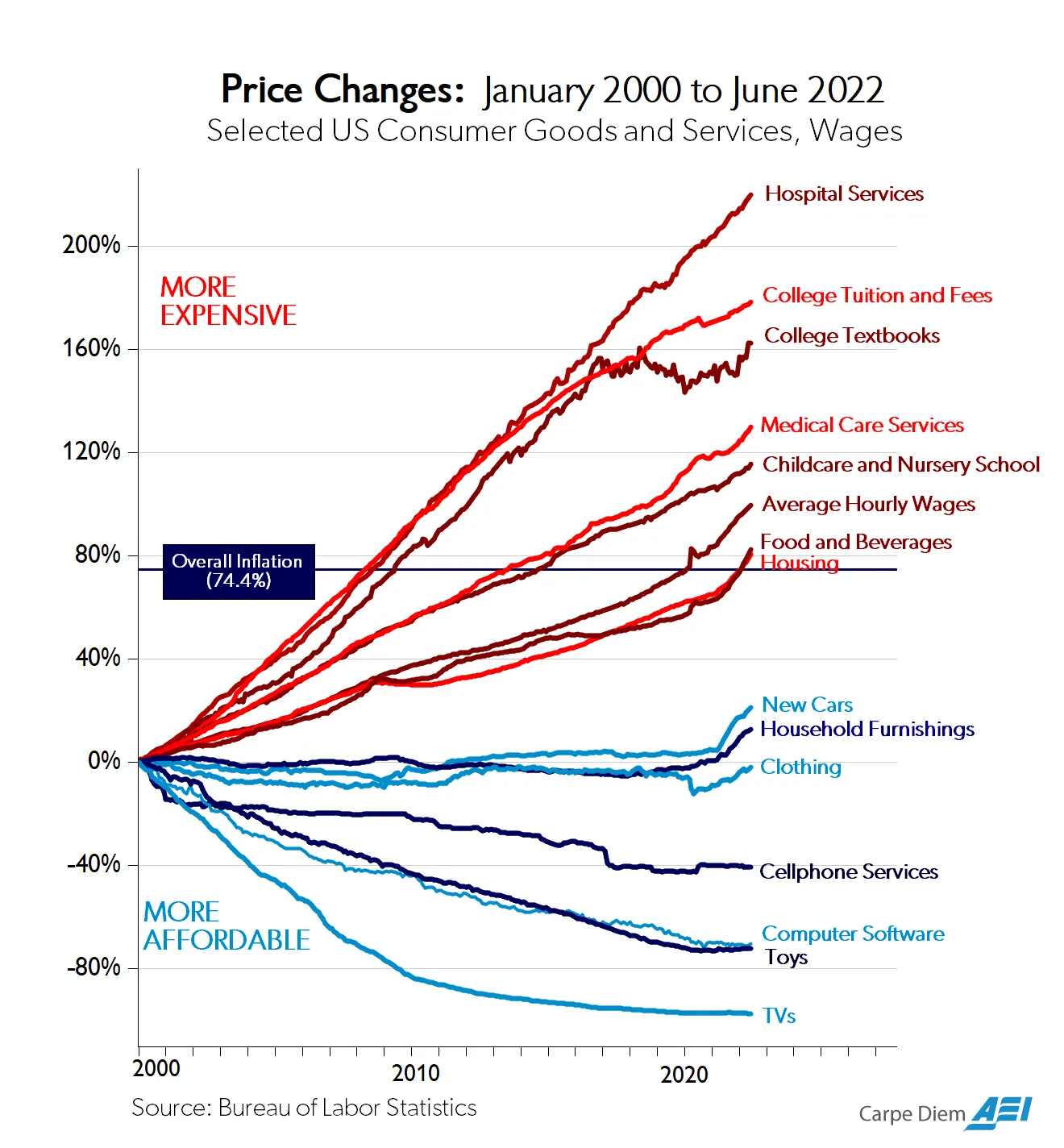
The liberal arts are so important. But at what cost? What are people willing to pay for a more rounded education? The market is speaking — and the liberal arts are dying. I think that less expensive forms of online-based learning may turn out to be the best chance of the liberal arts surviving in the 21st century. The price must come waaaay down.

And speaking of the cost of getting a degree, this item is relevant as well:

Colleges Fear Cost of Doing Business Will Become Much Costlier — from chronicle.com by Lee Gardner
Inflation, enrollment woes, and increasing intolerance of tuition increases have made this budget season especially difficult.

Excerpts:

In decades past, colleges might have mitigated precarious budgets by raising tuition, but that’s a hard row to hoe in 2023.

The public colleges most feeling the financial squeeze from lowered enrollments are regional universities and community colleges, which typically receive less state support per student than public flagship universities.

Inflation remains high, at around 6 percent, and the biggest worry that it presents for college leaders comes from upward pressure on wages, says Staisloff.

While the sky may not be falling for higher education, Staisloff says “the cloud ceiling keeps dropping and dropping and dropping and dropping, and that’s getting harder to ignore.”


Speaking of the cost of getting a degree as well as higher education’s need to reinvent itself, also see:

College Doesn’t Need to Take Four Years — an opinion piece from the Wall Street Journal by Scott L. Wyatt and Allen C. Guelzo
For many students, the standard bachelor’s degree program has become a costly straitjacket.


Apprenticeship programs are becoming more popular as an alternative to college — from cnbc.com by Jessica Dickler

Key Points

  • Daniel Swan started as an apprentice and now works full time as an HVAC technician in California.
  • Apprenticeship programs are becoming more popular as an alternative to college.
  • Over a decade, the number of registered apprentices rose 64%, according to the latest data from the U.S. Department of Labor.
 
© 2025 | Daniel Christian