AI Aids In Connecting Learning and Performance Ecosystems — from learningguild.com by Markus Bernhardt and Teresa Rose

Excerpt:

The ways in which employees access information, surface answers to questions, and find the right subject matter experts is shifting and drastically improving. With this, so is access to and potential efficiency of formal learning and training.

The question is, how do these elements fuse together in the reimagined ecosystem? What will performance support, formal learning and training, or upskilling and reskilling look like when we combine the best of digital and asynchronous tools, as well as synchronous and in-person endeavors.

Power Performance with Microlearning’s Purpose and Potential — from learningguild.com by Robyn Defelice

Excerpt:

Because we are dealing in performance-based microlearning, each campaign and product will have its own purpose and potential (P&P).

The P&P are not derived from the organization’s definition but by the goals of the campaign itself.

Performance Pathways (Purpose) and Use Cases (Potential) provide opportunity to think through the alignment to a campaign goal while preparing for the design of the microlearning products.

Augmented Reality: Your Next Step Into Immersive Learning — from learningguild.com by Bill Brandon

Excerpt:

I asked Debbie Richard for her thoughts on the uses of AR and immersive learning. Debbie is the founder and president of Creative Interactive Ideas, where she helps talent development professionals thrive and flourish in their careers.

Debbie offered this reply:

“Developing an augmented reality experience is a great way for instructional designers to get started with immersive learning. There are a number of AR development applications that require little to no programming skills. All the learner will need to access the experience is a smart device.

Some great examples of using augmented reality in immersive learning are:

    • Performance support…
    • Language support…
    • Visualizations…
 

GPT-4 Is a Reasoning Engine — from every.to by Dan Shipper
Reason is only as good as the information we give it

Excerpt:

Even though our AI models were trained by reading the whole internet, that training mostly enhances their reasoning abilities not how much they know. And so, the performance of today’s AI models is constrained by their lack of knowledge.

I saw Sam Altman speak at a small Sequoia event in SF last week, and he emphasized this exact point: GPT models are actually reasoning engines not knowledge databases.

This is crucial to understand because it predicts that advances in the usefulness of AI will come from advances in its ability to access the right knowledge at the right time—not just from advances in its reasoning powers.

Why? It’s expensive and time consuming to find information that’s relevant to the things you think about. Even if you give AI access to a search engine, so it can make queries to find the right information—it’ll cost you money and time.

If, instead, you’ve spent a lifetime gathering and curating  information that’s important to you, you can customize your AI experience so it’s more useful to you right off the bat.


What Is the Secret Sauce for Deeper Learning? — from cultofpedagogy.com by Jennifer Gonzalez

Excerpt:

One place that was a consistent source of deep learning was what Fine and Mehta referred to as “the periphery,” elective classes like art and robotics and extracurriculars like debate and athletics that are outside of what we consider to be the core academic classes. “Nobody talks very much about what’s going on in those spaces,” Fine says, “and yet they were the places where we saw the richest learning happening.” In these spaces, much of what they call the “grammar” of school is different: Students are there by choice, they have opportunities for apprenticeship and leadership, they can specialize in a subdomain of the field, and there’s usually a real product being produced for an authentic audience.

In the book, the authors used a school theater program as an example of this kind of learning at the periphery.


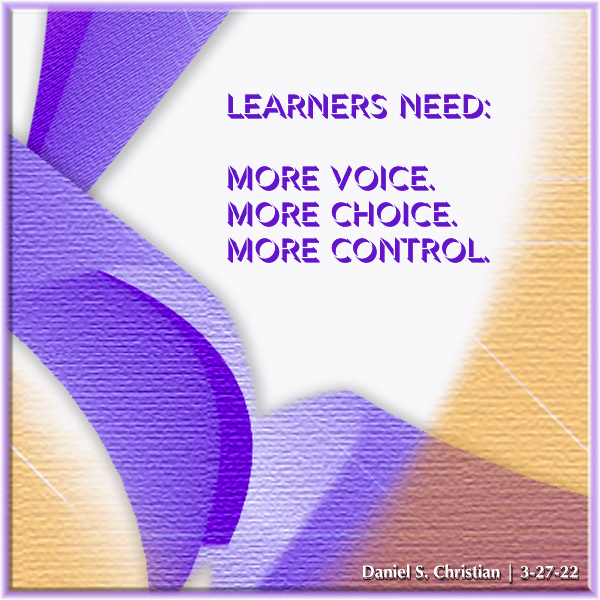
Learners need: More voice. More choice. More control. -- this image was created by Daniel Christian


Why some college professors are adopting ChatGPT AI as quickly as students — from cnbc.com by Carolyn Chun

Key Points:

  • A recent analysis by researchers at NYU, Princeton and the Wharton School finds that many of the jobs that will be most “exposed” to generative AI such as ChatGPT are in the college teaching profession.
  • One of the first narratives to emerge from the sudden explosion in usage of ChatGPT is the risk of students cheating on writing assignments.
  • But use by college teachers is growing quickly too, and adoption by educators may be critical to making the case that AI will augment the jobs humans are doing rather than replace them.

Also relevant/see:


John 12:12-16 NIV — from biblegateway.com

Jesus Comes to Jerusalem as King

12 The next day the great crowd that had come for the festival heard that Jesus was on his way to Jerusalem. 13 They took palm branches and went out to meet him, shouting,

“Hosanna![a]

“Blessed is he who comes in the name of the Lord!”[b]

“Blessed is the king of Israel!”

14 Jesus found a young donkey and sat on it, as it is written:

15 “Do not be afraid, Daughter Zion;
    see, your king is coming,
    seated on a donkey’s colt.”[c]

16 At first his disciples did not understand all this. Only after Jesus was glorified did they realize that these things had been written about him and that these things had been done to him.


Also relevant/see:


5 AI-Driven Healthcare Trends and Solutions in 2023 — from hitconsultant.net by Dmitrii Evstiukhin

Excerpt:

Healthcare enterprises are quickly embracing artificial intelligence solutions to mitigate loss, streamline operations, improve efficiency, and enhance customer service.

Learn about the latest trends and solutions in healthcare AI, obstacles to AI adoption, and how artificial intelligence is rapidly transforming standards of patient care in 2023.


ANALYSIS: ‘Microcredentials’ poised to disrupt higher ed as degrees lose relevance to employers — from campusreform.org by Shelby Kearns; with thanks to Ray Schroeder on LinkedIn for this resource

Key points:

  • Survey respondents are demonstrating confidence in microcredentials–online training programs that take no more than six months to complete–as four-year degree programs often overlook job training.
  • ‘Grade inflation and efforts to help everyone … attend college make it harder for employers to differentiate among applicants.’


Also relevant/see:


Learning Designers will have to adapt or die. 10 ways to UPSKILL to AI…. — from donaldclarkplanb.blogspot.com by Donald Clark

Learning Designers need to upskill


From Ethan Mollick on LinkedIn:

Take a look at this simulated negotiation, with grading and feedback. Prompt: “I want to do deliberate practice about how to conduct negotiations. You will be my negotiation teacher. You will simulate a detailed scenario in which I have to engage in a negotiation. You will fill the role of one party, I will fill the role of the other. You will ask for my response to in each step of the scenario and wait until you receive it. After getting my response, you will give me details of what the other party does and says. You will grade my response and give me detailed feedback about what to do better using the science of negotiation. You will give me a harder scenario if I do well, and an easier one if I fail.”

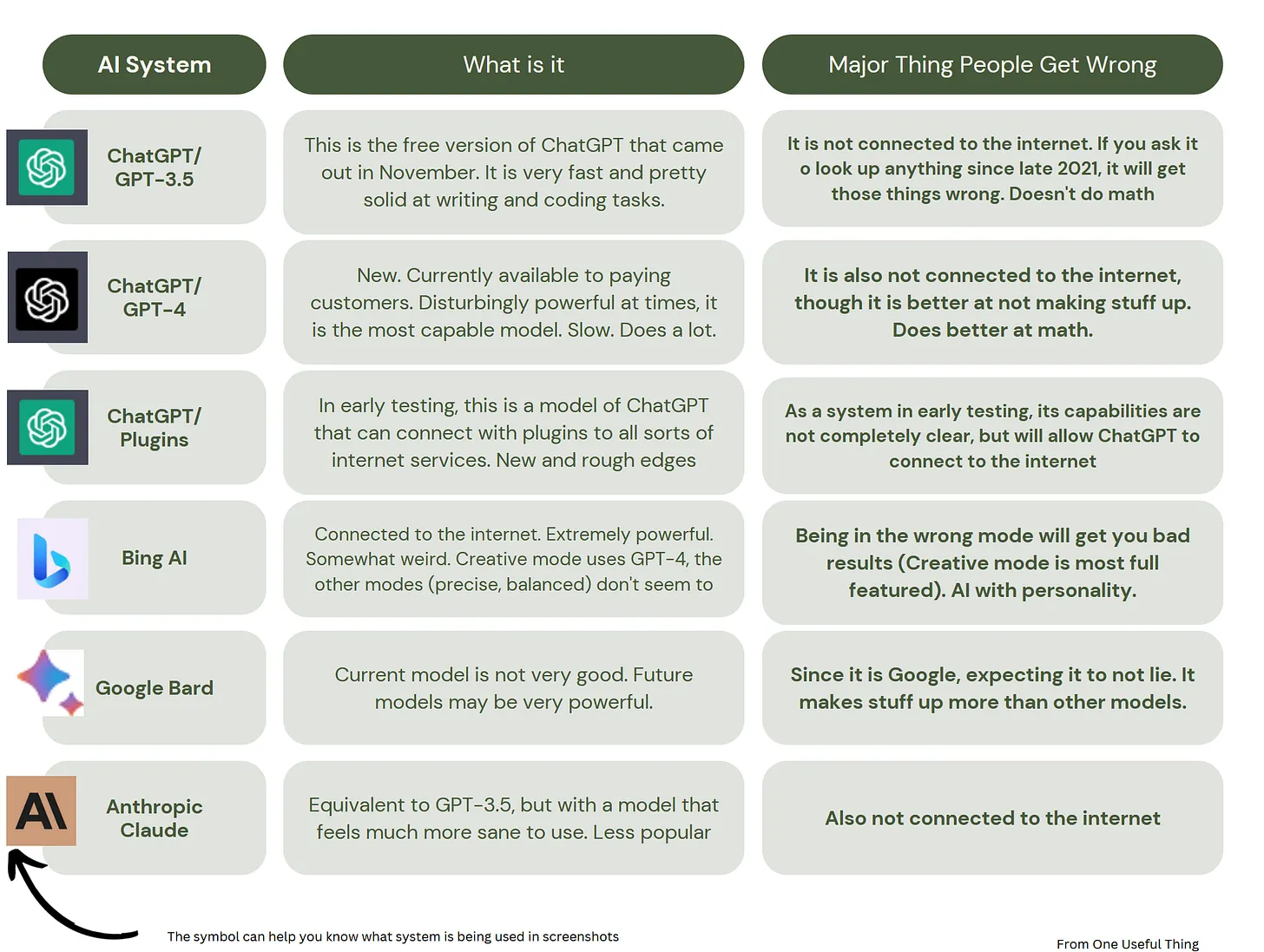
Samples from Bing Creative mode and ChatGPT-4 (3.5, the free version, does not work as well)


I’m having a blast with ChatGPT – it’s testing ME! — from by Mark Mrohs
Using ChatGPT as an agent for asynchronous active learning

I have been experimenting with possible ways to incorporate interactions with ChatGPT into instruction. And I’m blown away. I want to show you some of what I’ve come up with.


VR & robotics could be the future of medical training — from vrscout.com by Kyle Melnick
FundamentalVR is partnering with Haply Robotics to provide more realistic VR surgical simulations.

VR & Robotics Could Be The Future Of Medical Training

Also relevant/see:


Canva’s New AI Wonder Tools — from wondertools.substack.com  by Jeremy Caplan
A magic eraser, a branding kit, AI presentations, and more new features

Excerpt:

Canva launched a bunch of new features at a live event viewed by 1.5 million people globally. The Australian company is no longer an upstart. 125 million people use it monthly, including 13 million paid subscribers yielding $1.4 billion in revenue. Canva’s increasingly competing with Adobe to help people create eye-catching visuals. Here are its most useful new tricks.


The Secret to Great Learning Design? Focus on Problems, not Solutions — from drphilippahardman.substack.com by Dr. Philippa Hardman
What a recent resurgence of research into problem-based learning has taught us about the value & impact of problem-based approaches

Excerpts:

Problem-based learning is an instructional approach that engages students in active, collaborative, and self-directed learning by exploring complex, real-world problems (rather than sitting and listening to a stage on the stage).

In a Problem-based learning scenario, students work in small groups and, under the guidance of a facilitator or instructor, identify, research, and analyse a problem before proposing and evaluating potential solutions and reaching a resolution.

Here are five of the most interesting research projects published on problem-based learning in the last few months:


How to use AI to do practical stuff: A new guide — from oneusefulthing.substack.com by Ethan Mollick
People often ask me how to use AI. Here’s an overview with lots of links.

Excerpts:

We live in an era of practical AI, but many people haven’t yet experienced it, or, if they have, they might have wondered what the big deal is. Thus, this guide. It is a modified version of one I put out for my students earlier in the year, but a lot has changed. It is an overview of ways to get AI to do practical things.

I want to try to show you some of why AI is powerful, in ways both exciting and anxiety-producing.

The Six Large Language Models


Also see Ethan’s posting:

Power and Weirdness: How to Use Bing AI
Bing AI is a huge leap over ChatGPT, but you have to learn its quirks


Teaching: What You Can Learn From Students About ChatGPT — from chronicle.com by Beth McMurtrie

Excerpts (emphasis DSC):

Like a lot of you, I have been wondering how students are reacting to the rapid launch of generative AI tools. And I wanted to point you to creative ways in which professors and teaching experts have helped involve them in research and policymaking.

At Kalamazoo College, Autumn Hostetter, a psychology professor, and six of her students surveyed faculty members and students to determine whether they could detect an AI-written essay, and what they thought of the ethics of using various AI tools in writing. You can read their research paper here.

Next, participants were asked about a range of scenarios, such as using Grammarly, using AI to make an outline for a paper, using AI to write a section of a paper, looking up a concept on Google and copying it directly into a paper, and using AI to write an entire paper. As expected, commonly used tools like Grammarly were considered the most ethical, while writing a paper entirely with AI was considered the least. But researchers found variation in how people approached the in-between scenarios. Perhaps most interesting: Students and faculty members shared very similar views with each scenario.


Also relevant/see:

This Was Written By a Human: A Real Educator’s Thoughts on Teaching in the Age of ChatGPT — from er.educause.edu educause.org by Jered Borup
The well-founded concerns surrounding ChatGPT shouldn’t distract us from considering how it might be useful.


© 2025 | Daniel Christian