From DSC:
After seeing this…

…I wondered:

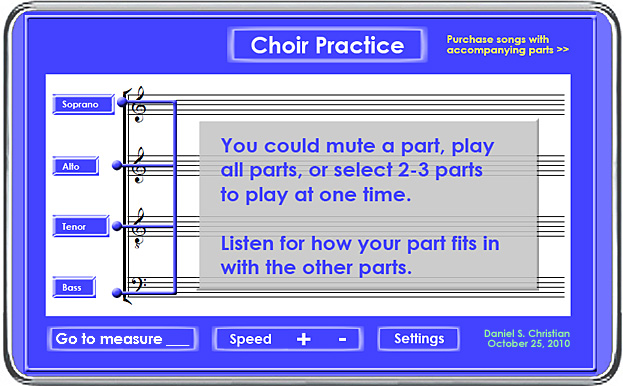
  • Could GPT-4 create the “Choir Practice” app mentioned below?
    (Choir Practice was an idea for an app for people who want to rehearse their parts at home)
  • Could GPT-4 be used to extract audio/parts from a musical score and post the parts separately for people to download/practice their individual parts?

This line of thought reminded me of this posting that I did back on 10/27/2010 entitled, “For those institutions (or individuals) who might want to make a few million.”

Choir Practice -- an app for people who want to rehearse at home

And I want to say that when I went back to look at this posting, I was a bit ashamed of myself. I’d like to apologize for the times when I’ve been too excited about something and exaggerated/hyped an idea up on this Learning Ecosystems blog. For example, I used the words millions of dollars in the title…and that probably wouldn’t be the case these days. (But with inflation being what it is, heh…who knows!? Maybe I shouldn’t be too hard on myself.) I just had choirs in mind when I posted the idea…and there aren’t as many choirs around these days.  🙂


The above Tweet links to:

Pause Giant AI Experiments: An Open Letter — from futureoflife.org
We call on all AI labs to immediately pause for at least 6 months the training of AI systems more powerful than GPT-4.


However, the letter has since received heavy backlash, as there seems to be no verification in signing it. Yann LeCun from Meta denied signing the letter and completely disagreed with the premise. (source)


In Sudden Alarm, Tech Doyens Call for a Pause on ChatGPT — from wired.com by Will Knight (behind paywall)
Tech luminaries, renowned scientists, and Elon Musk warn of an “out-of-control race” to develop and deploy ever-more-powerful AI systems.


Building a bridge to justice from the other side — from jordanfurlong.substack.com by Jordan Furlong
Our professional-centric approach to resolving unmet legal needs hasn’t worked. Maybe it’s time we empowered the people who are already there.

An enormous and intricate bridge with parts of it bending down and part of it bending up -- creating a criss-cross pattern

Excerpts:

Given all that, I think it’s time we tried demand-side approach instead — one that doesn’t require us to licence and deploy more legal services professionals, but instead focuses on and empowers those who are already dealing with people’s unmet and unrecognized legal needs.

So if we’re not looking for legal professionals, who are we looking for? If we take a user-centred, needs-focused approach, we’ll find ourselves looking for someone who’s familiar to and trusted by the vulnerable people with unmet legal needs, who’s walked with them, earned their confidence over time — “someone who looks like them, understands their situation, and are trusted members of their community.”

These individuals are already present in the lives of people with unmet legal needs. They’re community activists, librarians, hospital employees, teachers, social workers, homeless advocates, therapists, food bank employees, members of a religious order, financial counsellors, mental health clinic staffers, juvenile case workers, and many others.


When It Comes to College Closures, the Sky Is Never Going to Fall — from chronicle.com by Lee Gardner
Are you tired of reading nearly annual predictions of a looming wave of colleges shutting down? Not nearly as tired as one Chronicle reporter.

Excerpts:

I’ve learned a lot of things about how colleges work in the last 10 years, including that they die hard. They make new appeals to students and alumni. They scrimp. They raise their tuition-discount rate yet again. They limp along with budget deficits, sometimes for years. They make withdrawals from their endowments. They sell off assets. They look for partnerships, mergers, and buyers, although sometimes when it’s far too late.

I could be wrong, of course, and there may be a giant wave of college closures rearing somewhere on the horizon. But I can guarantee you that there are dozens of institutions in danger of quietly slipping toward a gradual end as you read this.

Also highly relevant here/see:

Contingent faculty jobs are still the standard, AAUP report finds — from highereddive.com by Laura Spitalniak

Dive Brief:

  • Colleges are continuing to increase their reliance on faculty positions that lack pathways to tenure, according to a new report from the American Association of University Professors. Over two-thirds of faculty members, 68%, held contingent positions in fall 2021, compared to about 47% in fall 1987.
  • Part-time work is also becoming more common. Almost half of faculty, 48%, taught part time in fall 2021, up from 33% in fall 1987. Less than 1% of all part-time faculty positions are tenured or tenure-track, according to AAUP.
  • Both of these factors are cutting into the number of available tenured positions, the report said. Fewer than 1 in 4 faculty members, 24%, held tenured full-time positions in fall 2021. That number fell from 39% in fall 1987.

Americans Are Losing Faith in College Education, WSJ-NORC Poll Finds — from wsj.com by Douglas Belkin (behind a firewall)
Confidence in value of a degree plummeted among women and senior citizens during pandemic

Excerpt:

A majority of Americans don’t think a college degree is worth the cost, according to a new Wall Street Journal-NORC poll, a new low in confidence in what has long been a hallmark of the American dream.

The survey, conducted with NORC at the University of Chicago, a nonpartisan research organization, found that 56% of Americans think earning a four-year degree is a bad bet compared with 42% who retain faith in the credential.

Skepticism is strongest among people ages 18-34, and people with college degrees are among those whose opinions have soured the most, portending a profound shift for higher education in the years ahead.
 

Isaiah 53:5-6

But he was pierced for our transgressions, he was crushed for our iniquities; the punishment that brought us peace was on him, and by his wounds we are healed. We all, like sheep, have gone astray, each of us has turned to our own way; and the Lord has laid on him the iniquity of us all.


ChatGPT: Student insights are necessary to help universities plan for the future — from theconversation.com by Alpha Abebe and Fenella Amarasinghe

Excerpt:

In the race to get ahead of new technologies, are we forgetting about the perspectives of the most important stakeholders within our post-secondary institutions: the students?

Leaving students out of early discussions and decision-making processes is almost always a recipe for ill-fitting, ineffective and/or damaging approaches. The mantra “nothing for us without us” comes to mind here.


Evolving Zoom IQ, our smart companion, with new features and a collaboration with OpenAI — from blog.zoom.us

Excerpt:

Today we’re announcing that we’re evolving the capabilities of Zoom IQ to become a smart companion that empowers collaboration and unlocks people’s potential by summarizing chat threads, organizing ideas, drafting content for chats, emails, and whiteboard sessions, creating meeting agendas, and more.


Also from Julie Sobowale, see:

  • Law’s AI revolution is here — from nationalmagazine.ca
    At least this much we know. Firms need to develop a strategy around language models.

Also re: legaltech, see:

  • Pioneers and Pathfinders: Richard Susskind — from seyfarth.com by J. Stephen Poor
    In our conversation, Richard discusses the ways we should all be thinking about legal innovation, the challenges of training lawyers for the future, and the qualifications of those likely to develop breakthrough technologies in law, as well as his own journey and how he became interested in AI as an undergraduate student.

Also re: legaltech, see:

There is an elephant in the room that is rarely discussed. Who owns the IP of AI-generated content?


What’s Different Between the Life of a Classroom Teacher vs. Instructional Designer? — from tedcurran.net by Ted Curran

Excerpt:

How is the day-to-day life of an Instructional Designer different than that of a K12 classroom teacher?

Many classroom teachers are looking to make the switch into instructional design, and even though it’s all still teaching and learning, there are some big differences in the way you’ll work in an ID role.

This post attempts to outline the large changes you might find as you transition outside the classroom and into the world of ID.


You no longer need a college degree to work at these 7 companies — from businessinsider.com by Ethan Dodd

Key points:

  • College-degree requirements have locked out millions of Americans from good-paying jobs.
  • Persistent labor shortages are causing more and more companies to drop degree requirements.
  • These seven companies in tech, finance, and aviation are leading the charge.


To help new students adapt, some colleges are eliminating grades — from npr.org by Jon Marcus

Excerpt (emphasis DSC):

Experiences like these are among the reasons behind a growing movement to stop assigning conventional A through F letter grades to first-year college students and, sometimes, upperclassmen.

Called “un-grading,” the idea is meant to ease the transition to higher education — especially for freshmen who are the first in their families to go to college or who weren’t well prepared for college-level work in high school and need more time to master it.

But advocates say the most important reason to adopt un-grading is that students have become so preoccupied with grades, they aren’t actually learning.


Higher Learning Commission's 2023 Trends


Artist Spotlight: Minyoung Choi [booooooom.com]

Artist Spotlight: Minyoung Choi — from booooooom.com

Painting of a fish tank with colorful guppies in it

 
© 2025 | Daniel Christian