Google Devising Radical Search Changes to Beat Back A.I. Rivals — from nytimes.com by Nico Grant
The tech giant is sprinting to protect its core business with a flurry of projects, including updates to its search engine and plans for an all-new one.

Excerpt:

Google’s employees were shocked when they learned in March that the South Korean consumer electronics giant Samsung was considering replacing Google with Microsoft’s Bing as the default search engine on its devices.

For years, Bing had been a search engine also-ran. But it became a lot more interesting to industry insiders when it recently added new artificial intelligence technology.

A.I. competitors like the new Bing are quickly becoming the most serious threat to Google’s search business in 25 years, and in response, Google is racing to build an all-new search engine powered by the technology. It is also upgrading the existing one with A.I. features, according to internal documents reviewed by The Times.

P.S. According to The Rundown’s take on this:

The bottom line: Google is replacing the old-school method of displaying 10 results per page with an intelligent chatbot that provides instant answers.


Also relevant/see:

Google planning new search engine while working on new search features under Project Magi — from searchengineland.com by Barry Schwartz
Project Magi will help searchers complete transactions while incorporating search ads on the page.


Also relevant/see:


Teachers, Don’t Take Your Work Home — from edweek.org by Larry Ferlazzo (behind paywall)

Excerpt:

I asked teachers on social media to share their best strategies for minimizing the amount of work they have to take home.

Here are some of their responses:


A.I. Is Coming for Lawyers, Again — from nytimes.com by Steve Lohr (behind paywall)
Previous advances in A.I. inspired predictions that the law was the lucrative profession most likely to suffer job losses. It didn’t happen. Is this time different?

Excerpt:

But unless the past isn’t a guide, the impact of the new technology is more likely to be a steadily rising tide than a sudden tidal wave. New A.I. technology will change the practice of law, and some jobs will be eliminated, but it also promises to make lawyers and paralegals more productive, and to create new roles. That is what happened after the introduction of other work-altering technologies like the personal computer and the internet.

One new study, by researchers at Princeton University, the University of Pennsylvania and New York University, concluded that the industry most exposed to the new A.I. was “legal services.” Another research report, by economists at Goldman Sachs, estimated that 44 percent of legal work could be automated. Only the work of office and administrative support jobs, at 46 percent, was higher.

Lawyers are only one occupation in the path of A.I. progress. A study by researchers at OpenAI, the creator of ChatGPT, and the University of Pennsylvania found that about 80 percent of American workers would have at least 10 percent of their tasks affected by the latest A.I. software.

Also relevant/see:

039 | Micro-legal & AI Legal Help — from thebrainyacts.beehiiv.com

Keywords for Better ChatGPT Responses


Justice Through Code — from centerforjustice.columbia.edu by ; via Matt Tower
Unlocking Potential for the 80+ Million Americans with a Conviction History.

Excerpt:

A world where every person, regardless of past convictions or incarceration can access life-sustaining and meaningful careers.

We are working to make this vision a reality through our technical and professional career development accelerators.

Our Mission: We educate and nurture talent with conviction histories to create a more just and diverse workforce. We increase workplace equity through partnerships that educate and prepare teams to create supportive pathways to careers that end the cycle of poverty that contributes to incarceration and recidivism.

JTC is jointly offered by Columbia University’s Center for Justice, and the Tamer Center for Social Enterprise at the Columbia Business School.


Luke 9:18-22

Luke 9:18-22

Peter Declares That Jesus Is the Messiah

18 Once when Jesus was praying in private and his disciples were with him, he asked them, “Who do the crowds say I am?”

19 They replied, “Some say John the Baptist; others say Elijah; and still others, that one of the prophets of long ago has come back to life.”

20 “But what about you?” he asked. “Who do you say I am?”

Peter answered, “God’s Messiah.”

Jesus Predicts His Death

21 Jesus strictly warned them not to tell this to anyone. 22 And he said, “The Son of Man must suffer many things and be rejected by the elders, the chief priests and the teachers of the law, and he must be killed and on the third day be raised to life.”


Tech Titans: The crossroads of humanity and technology — from enterprisersproject.com by E.G. Nadhan
This year’s panel of IT leaders discusses the ongoing problem of equitable access to technology for underserved communities

Excerpts:

Can technology be a catalyst to improve the quality of life in these communities and, thus, resist the status quo?

“You cannot escape technology – tech is intertwined no matter what we do; it has become a utility like water, heat, and electricity. Not having access to technology can be detrimental to having access to the essentials of daily life. We need to work together to ensure that everyone – especially the underserved and disenfranchised communities – have access to technology.”

Also relevant/see:

Anywhere Learning Happens: The eduroam Global WiFi Access Service — from campustechnology.com by Mary Grush
A conversation with eduroam community leaders Saira Hasnain and Brett Bieber

Steadily, eduroam is reaching toward ubiquity, and that’s one big factor that will ultimately allow it to continue to expand services to users all around the globe.

Impressively, in 2022, eduroam logged more than 6.4 billion individual authentications around the globe.


AutoGPT is the next big thing in AI— from therundown.ai by Rowan Cheung

Excerpt:

AutoGPT has been making waves on the internet recently, trending on both GitHub and Twitter. If you thought ChatGPT was crazy, AutoGPT is about to blow your mind.

AutoGPT creates AI “agents” that operate automatically on their own and complete tasks for you. In case you’ve missed our previous issues covering it, here’s a quick rundown:

    • It’s open-sourced [code]
    • It works by chaining together LLM “thoughts”
    • It has internet access, long-term and short-term memory, access to popular websites, and file storage

.


From DSC:
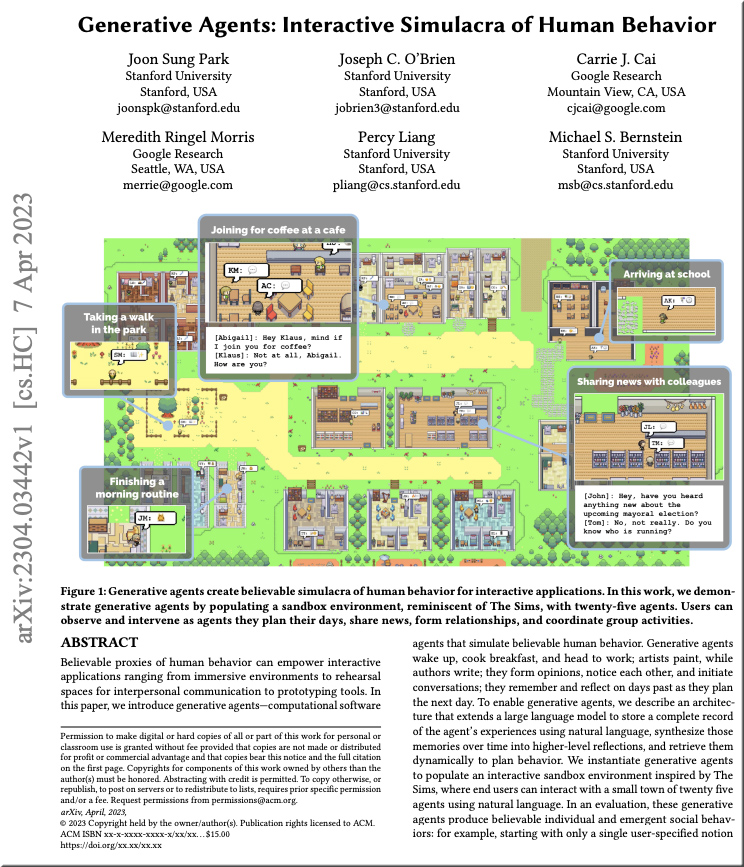
I want to highlight that paper from Stanford, as I’ve seen it cited several times recently:.

Generative Agents: Interactive Simulacra of Human Behavior -- a paper from Stanford from April 2023


From DSC:
And for a rather fun idea/application of these emerging technologies, see:

  • Quick Prompt: Kitchen Design — from linusekenstam.substack.com by Linus Ekenstam
    Midjourney Prompt. Create elegant kitchen photos using this starting prompt. Make it your own, experiment, add, remove and tinker to create new ideas.

…which made me wonder how we might use these techs in the development of new learning spaces (or in renovating current learning spaces).


From DSC:
On a much different — but still potential — note, also see:

A.I. could lead to a ‘nuclear-level catastrophe’ according to a third of researchers, a new Stanford report finds — from fortune.com by Tristan Bove

Excerpt:

Many experts in A.I. and computer science say the technology is likely a watershed moment for human society. But 36% don’t mean that as a positive, warning that decisions made by A.I. could lead to “nuclear-level catastrophe,” according to researchers surveyed in an annual report on the technology by Stanford University’s Institute for Human-Centered A.I., published earlier this month.


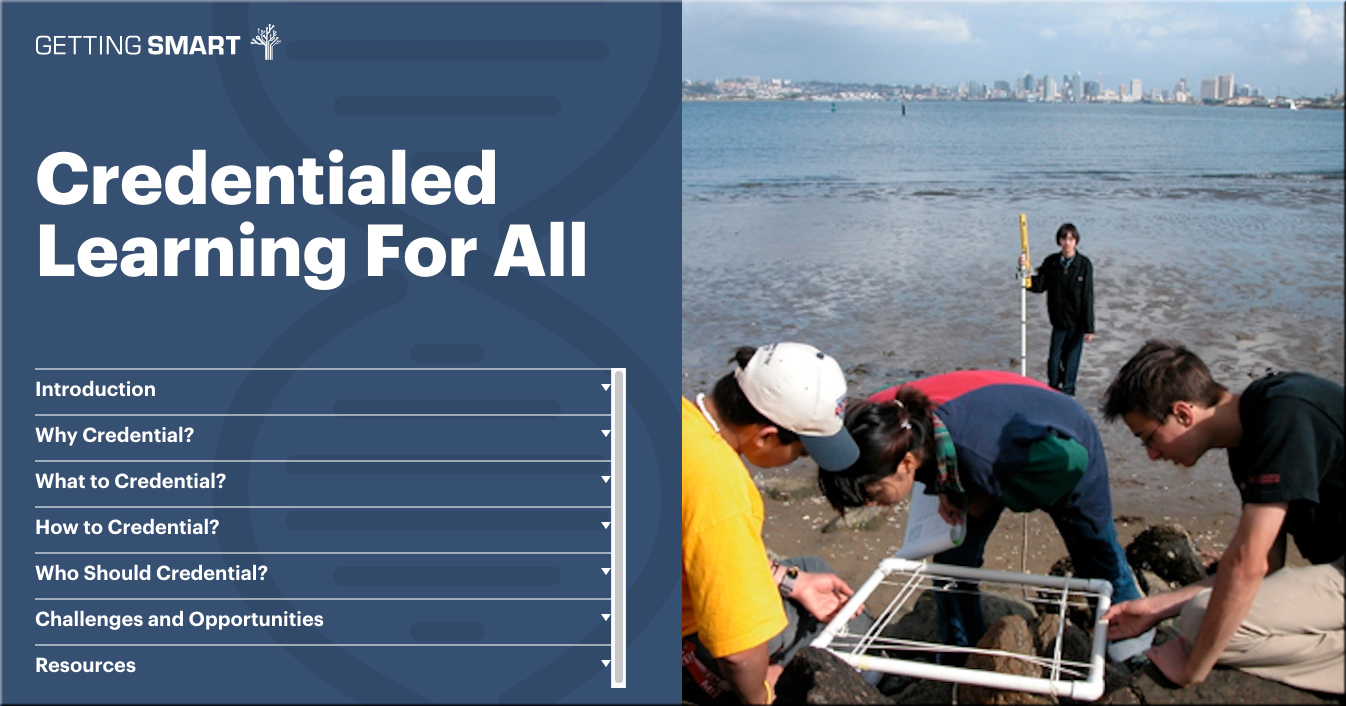
Credentialed learning for all -- from Getting Smart


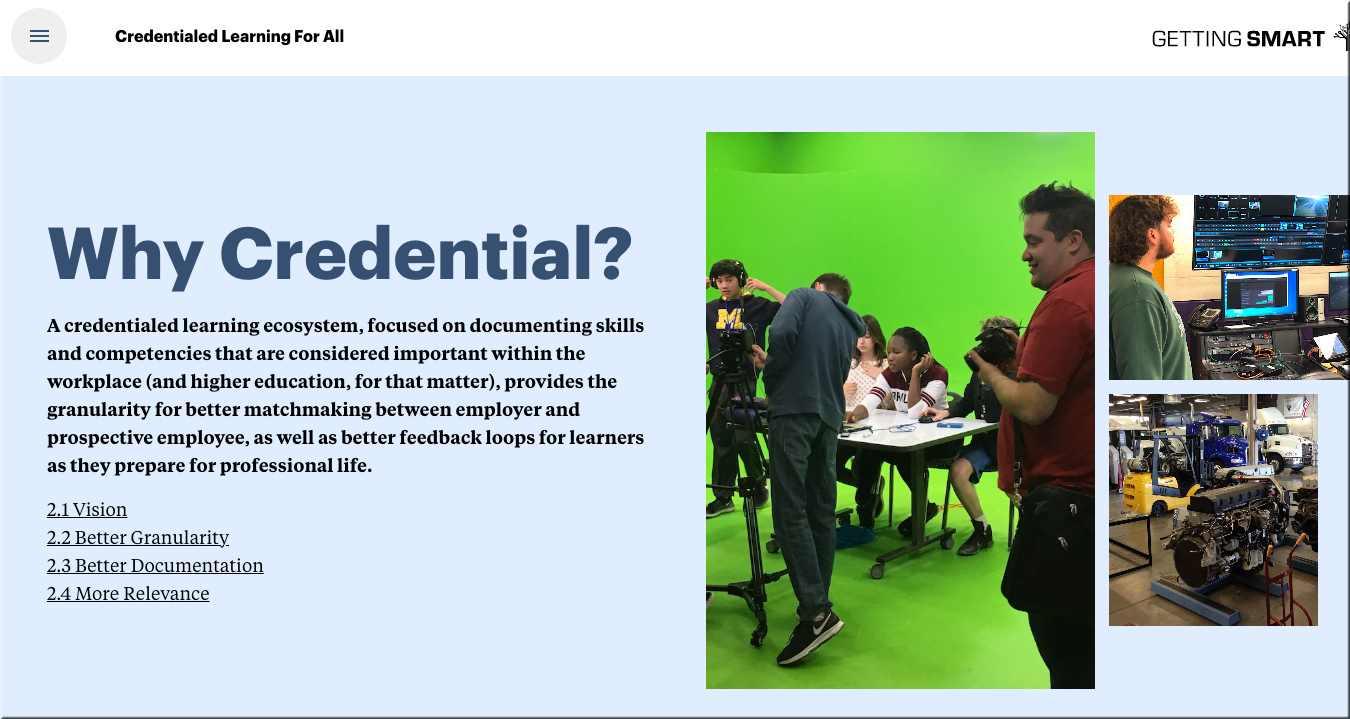
Why credential section -- from Getting Smart's Credentialed Learning for All

Credentialed Learning For All — from gettingsmart.com

Vision

Learning happens throughout life and is not isolated to the K-12 or higher education sectors. Yet, often, validations of learning only happen in these specific areas. The system of evaluation based on courses, grades, and credit serves as a poor proxy for communicating skills given the variation in course content, grade inflation, and inclusion of participation and extra credit within course grades.

Credentialed learning provides a way to accurately document human capability for all learners throughout their life. A lifetime credentialed learning ecosystem provides better granularity around learning, better documentation of the learning, and more relevance for both the credential recipient and reviewer. This improves the match between higher education and/or employment with the individual, while also providing a more clear and accurate lifetime learning pathway.

With a fully-credentialed system, individuals can own well-documented evidence of a lifetime of learning and choose what and when to share this data. This technology enables every learner to have more opportunities for finding the best career match without today’s existing barriers around cost, access, and proxies.


Addendum on 4/28/23 — speaking of credentials:

First Rung — from the-job.beehiiv.com by Paul Fain
New research shows stacking credentials pays off for low-income learners.

Stacking credentials pays off for many low-income students, new research finds, but only if learners move up the education ladder. Also, Kansas is hoping a new grant program will attract more companies to participate in microinternships.


Proverbs 8:27-31 NIV

Proverbs 8:27-31 NIV (speaking about wisdom)

I was there when he set the heavens in place, when he marked out the horizon on the face of the deep, when he established the clouds above and fixed securely the fountains of the deep, when he gave the sea its boundary so the waters would not overstep his command, and when he marked out the foundations of the earth. Then I was constantly at his side. I was filled with delight day after day, rejoicing always in his presence, rejoicing in his whole world and delighting in mankind.


The future of education in a world of AI — from oneusefulthing.org by Ethan Mollick
A positive vision for the transformation to come

Excerpt:

Imagine introducing high-quality AI tutors into the flipped classroom model. These AI-powered systems have the potential to significantly enhance the learning experience for students and make flipped classrooms even more effective. They provide personalized learning, where AI tutors can tailor instruction to each student’s unique needs while continually adjusting content based on performance. This means that students can engage with the content at home more effectively, ensuring they come to class better prepared and ready to dive into hands-on activities or discussions.

With AI tutors taking care of some of the content delivery outside of class, teachers can devote more time to fostering meaningful interactions with their students during class. They can also use insights from the AI tutors to identify areas where students might need extra support or guidance, enabling them to provide more personalized and effective instruction. And with AI assistance, they can design better active learning opportunities in class to make sure learnings stick.


Also relevant/see:

ChatGPT is going to change education, not destroy it — from technologyreview.com by Will Douglas Heaven
The narrative around cheating students doesn’t tell the whole story. Meet the teachers who think generative AI could actually make learning better.

Advanced chatbots could be used as powerful classroom aids that make lessons more interactive, teach students media literacy, generate personalized lesson plans, save teachers time on admin, and more.

Will ChatGPT Change How Professors Assess Learning? — from chronicle.com by Becky Supiano
It won’t be easy without their colleges’ support.

What the Past Can Teach Us About the Future of AI and Education — from campustechnology.com by Dr. David Wiley
Current attitudes toward generative AI hearken back to early skepticism about the impact of the internet on education. Both then and now, technology has created challenges but also opportunities that can’t be ignored.


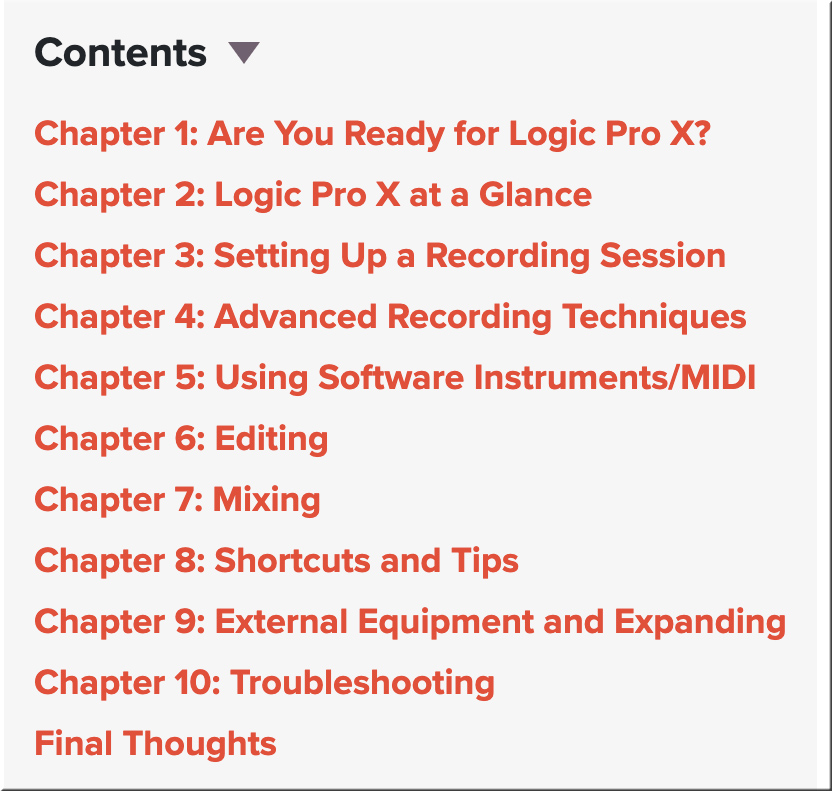
How to Use Logic Pro X: The Ultimate Guide for Beginners — from soundswow.com by  Donovan Sharpe; with thanks to Yana Mogyla for this resource. Yana is the content manager at SoundsWow — “a resource blog dedicated to helping individual musicians build home recording studios.”

Excerpts:

Logic Pro X is one of the best DAWs for music creation and production. It’s an extremely capable tool that provides you with everything you need to make music professionally in any way you can dream up.

With all this power at your fingertips, getting started with Logic Pro X can be challenging if you don’t have any experience. This guide was written with beginners in mind and will direct you through all the first steps to using the app.
.

Table of contents for how to use Logic Pro X


Improve Objectives By Asking “Then What?” — from byrdseed.com by Ian Byrd

Excerpt:

As a new teacher, so many of my objectives stopped at a very low level of thinking.

  • Students will understand Z.
  • Students will know the difference between X and Y.
  • Students will be able to explain C.

When I look at these objectives now, they leave me asking, “then what?”

Ok. My students know the difference between X from Y. They can explain C. They understand fact Z. “What do they do now?”


From DSC:
Regarding the core curricula of colleges and universities…

For decades now, faculty members have taught what they wanted to teach and what interested them. They taught what they wanted to research vs. what the wider marketplace/workplace needed. They were not responsive to the needs of the workplace — nor to the needs of their students!

And this situation has been all the more compounded by the increasing costs of obtaining a degree plus the exponential pace of change. We weren’t doing a good job before this exponential pace of change started taking place — and now it’s (almost?) impossible to keep up.

The bottom line on the article below: ***It’s sales.***

Therefore, it’s about what you are selling — and at what price. The story hasn’t changed much. The narrative (i.e., the curricula and more) is pretty much the same thing that’s been sold for years.

But the days of faculty members teaching whatever they wanted to are over, or significantly waning.

Faculty members, faculty senates, provosts, presidents, and accreditors are reaping what they’ve sown.

The questions are now:

  • Will new seeds be sown?
  • Will new crops arise in the future?
  • Will there be new narratives?
  • Will institutions be able to reinvent themselves (one potential example here)? Or will their cultures not allow such significant change to take place? Will alternatives to institutions of traditional higher education continue to pick up steam?

A Profession on the Edge — from chronicle.com by Eric Hoover
Why enrollment leaders are wearing down, burning out, and leaving jobs they once loved.

Excerpts:

Similar stories are echoing throughout the hallways of higher education. Vice presidents for enrollment, as well as admissions deans and directors, are wearing down, burning out, and leaving jobs they once loved. Though there’s no way to compile a chart quantifying the churn, industry insiders describe it as significant. “We’re at an inflection point,” says Rick Clark, executive director of undergraduate admission at Georgia Tech. “There have always been people leaving the field, but not in the numbers we’re seeing now.”

Some are being shoved out the door by presidents and boards. Some are resigning out of exhaustion, frustration, and disillusionment. And some who once sought top-level positions are rethinking their ambitions. “The pressures have ratcheted up tenfold,” says Angel B. Pérez, chief executive of the National Association for College Admission Counseling, known as NACAC. “I talk with someone each week who’s either leaving the field or considering leaving.”


From DSC:
This quote points to what I’m trying to address here:

Dahlstrom and other veterans of the field say they’ve experienced something especially disquieting: an erosion of faith in the transformational power of higher education. Though she sought a career in admissions to help students, her disillusionment grew after taking on a leadership role. She became less confident that she was equipped to effect positive changes, at her institution or beyond, especially when it came to the challenge of expanding college access in a nation of socioeconomic disparities: “I felt like a cog in a huge machine that’s not working, yet continues to grind while only small, temporary fixes are made.”


© 2025 | Daniel Christian