5 Playful Strategies That Reduce Language Learning Anxiety — from edutopia.org by Paige Tutt
We visited a classroom in Denmark to see how a playful learning philosophy can put students at ease and make language learning joyful and engaging.

Excerpt:

Instead of trying to convince students that their fears aren’t warranted, Belouahi makes a point of creating a positive, mistake-friendly classroom where students feel comfortable experimenting. One of the ways she does this is by incorporating playful learning strategies. “It doesn’t have to be perfect from the beginning,” Belouahi says. “The goal is for them to use their English language as much as possible and as best as they can. Not perfectly.”

Here are five playful learning strategies from Belouahi’s classroom designed to make the act of learning a new language less daunting, and more joyful, social, and engaging.

Also from edutopia.org, see:

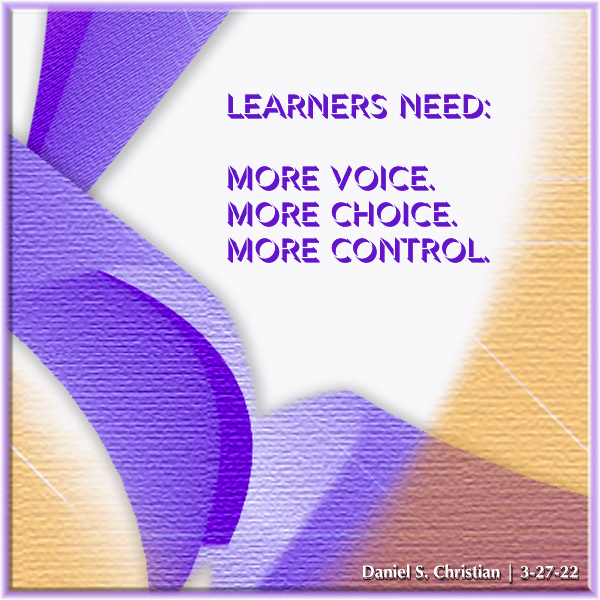
Learners need: More voice. More choice. More control. -- this image was created by Daniel Christian


The Good and the Bad of Solo Practice, Per Clio’s Latest Legal Trends Report for Solos — from lawnext.com by Bob Ambrogi

Excerpt:

As a solo myself, I can tell you that there is much to be said for practicing on your own – freedom and independence not least among them. In fact, during 2022’s “Great Resignation,” a third of lawyers who quit their jobs did so to start their own solo practices, according to Legal Trends for Solo Law Firms, a report published today by law practice management company Clio.

But there are also disadvantages to practicing alone and challenges unique to solo lawyers, as this latest report documents.


A New Era for Education — from linkedin.com by Amit Sevak, CEO of ETS and Timothy Knowles, President of the Carnegie Foundation for the Advancement of Teaching

Excerpt (emphasis DSC):

It’s not every day you get to announce a revolution in your sector. But today, we’re doing exactly that. Together, we are setting out to overturn 117 years of educational tradition.

The fundamental assumption [of the Carnegie Unit] is that time spent in a classroom equals learning. This formula has the virtue of simplicity. Unfortunately, a century of research tells us that it’s woefully inadequate.


From DSC:
It’s more than interesting to think that the Carnegie Unit has outlived its usefulness and is breaking apart. In fact, the thought is very profound.

It's more than interesting to think that the Carnegie Unit has outlived its usefulness and is breaking apart. In fact, the thought is very profound.

If that turns out to be the case, the ramifications will be enormous and we will have the opportunity to radically reinvent/rethink/redesign what our lifelong learning ecosystems will look like and provide.

So I appreciate what Amit and Timothy are saying here and I appreciate their relaying what the new paradigm might look like. It goes with the idea of using design thinking to rethink how we build/reinvent our learning ecosystems. They assert:

It’s time to change the paradigm. That’s why ETS and the Carnegie Foundation have come together to design a new future of assessment.

    • Whereas the Carnegie Unit measures seat time, the new paradigm will measure skills—with a focus on the ones we know are most important for success in career and in life.
    • Whereas the Carnegie Unit never leaves the classroom, the new paradigm will capture learning wherever it takes place—whether that is in after-school activities, during a work-experience placement, in an internship, on an apprenticeship, and so on.
    • Whereas the Carnegie Unit offers only one data point—pass or fail—the new paradigm will generate insights throughout the learning process, the better to guide students, families, educators, and policymakers.

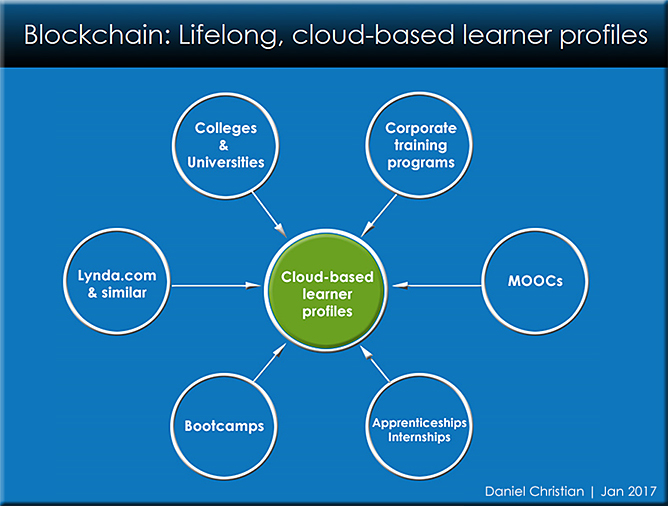
I could see this type of information being funneled into peoples’ cloud-based learner profiles — which we as individuals will own and determine who else can access them. I diagrammed this back in January of 2017 using blockchain as the underlying technology. That may or may not turn out to be the case. But the concept will still hold I think — regardless of the underlying technology(ies).

Perhaps blockchain will be the underlying technology to provide us with cloud-based learner profiles

For example, we are seeing a lot more articles regarding things like Comprehensive Learner Records (CLR) or Learning and Employment Records (LER; example here), and similar items.

LER — The Learning and Employment Record for a Skills-Based Economy


Speaking of reinventing our learning ecosystems, also see:


New NVIDIA Research — excerpted section from this version of The Rundown

The NVIDIA research team just dropped a new research paper on creating high-quality short videos from text prompts. This technique uses Video Latent Diffusion Models (Video LDMs), which work efficiently without using too much computing power.

It can create 113 frame-long videos at 1280×2048 resolution, rendered at 24 FPS, resulting in 4.7-second clips. The team first trained the model on images, then added a time dimension to make it work with videos.

This new research is impressive. At the current pace of development, we may soon be able to generate full-length movies from just a handful of text prompts within the next few years.


Also relevant/see:


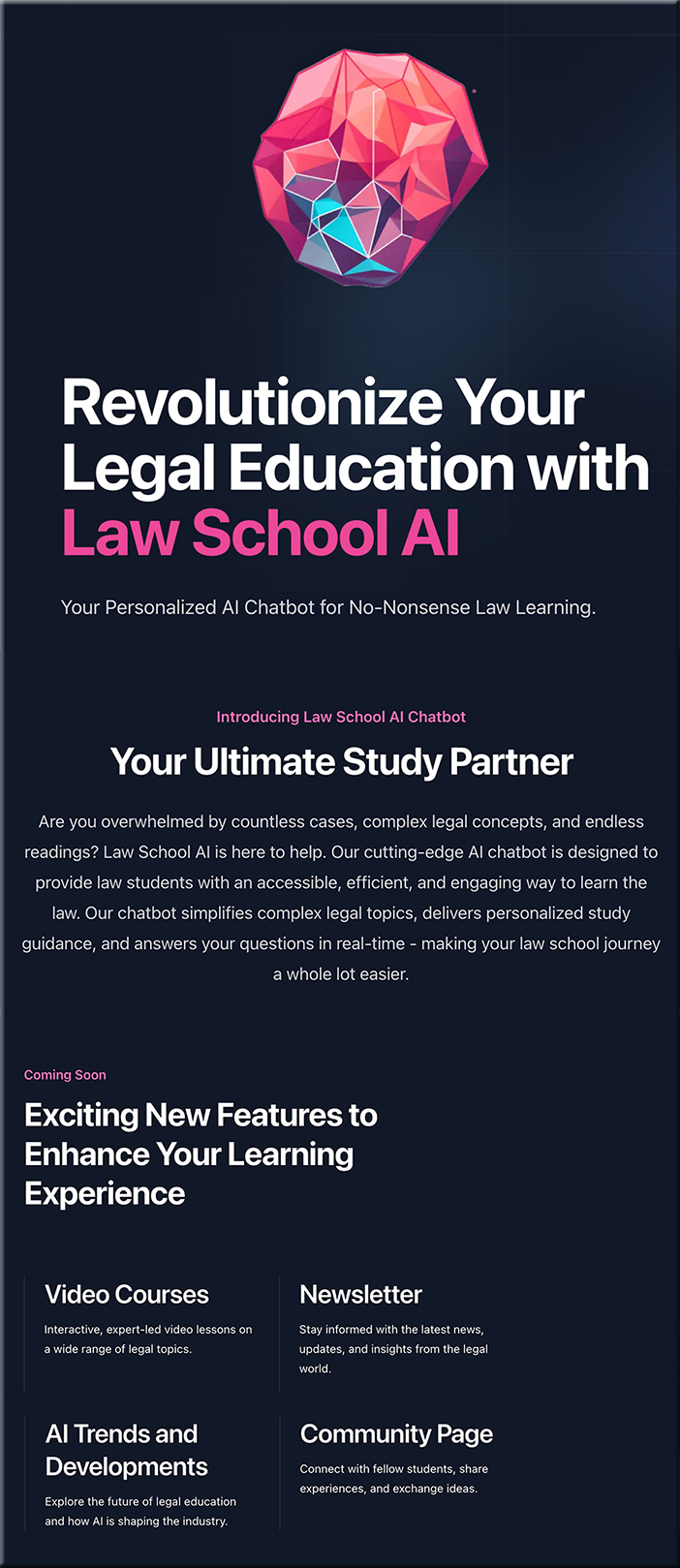
law-school-ai.vercel.app -- Your Personalized AI Chatbot for No-Nonsense Law Learning.


From DSC:
I haven’t used this app or their website (which seems to have a lot of broken links!). But my question/reflection is…is this a piece of legal education’s future? Or even larger than that? I can easily see a LegalGPT type of service out there for ***society at large.***


Adobe’s AI Generator Firefly Looks To Reimagine Video and Audio Workflows — from provideocoalition.com by Michelle DeLateur

Excerpt:

What if you could create storyboards, change the color of a video, and generate relevant sound effects just by working with an AI Generator? It may be on the (generated sunset) horizon sooner rather than later: Adobe hopes to transform these processes through their AI product Firefly. As shared today at NAB Show 2023, Adobe looks to expand and innovate Firefly’s ability in the creative sphere, including font changes and effects, script analysis, color changes, generated music, storyboard edits, and more.


From DSC:
I don’t know anything about Jack Harlow. I just liked the idea of the NBA using AI to market the playoffs! I find this piece to be clever and creative. I’m sure we’ll be seeing a lot more of this kind of thing in the future. 


‘Legal Tech Lists’: The 10 Most Significant Legal Tech Developments Since 2010 — from abovethelaw.com by Robert Ambrogi
Startups, AI, the cloud, and much more.

Excerpt:

Every year, I write a year-end wrap-up of the most significant developments in legal technology.

At the end of the past decade, I decided to look back on the most significant developments of the 2010s as a whole. It may well have been the most tumultuous decade ever in changing how legal services are delivered.

Here, I revisit those changes — and add a few post-2020 updates.


What I Learned From My Students Who Became Teachers — from edsurge.com by Corey Winchester

Excerpt:

After nearly two hours of laughter, tears and thoughtful discussion with students who have become teachers, I walked away with two important messages that affirm why teachers decide to stay and why our stories deserve to be heard.

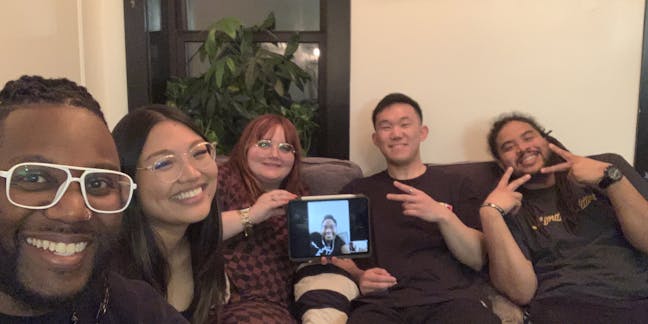
Pictured from left to right: Corey Winchester, Paula Katrina Camaya, Victoria Kosiba, Gariecia Rose (on Zoom), John Lee and Nick Davis. Photo courtesy of Winchester.

Our dinner conversation revealed that sometimes, it feels like we’re swimming against the flow of what we know is right for students and ourselves, while our education system emphasizes laws, mandates and standards purported to guide the next generation. Because of that, I worry that too many educators – newcomers and veterans alike – feel like they won’t be able to sustain the work. Now more than ever, educators need to be acknowledged and celebrated for the important work we do, especially when stories like ours reveal that meaningful relationships matter, especially when we have the ability and support to meet young people where they’re at.

To Improve a Child’s Education, We Must Be Willing to Let Old Practices Die — from edsurge.com by Isabel Bozada-Jones

Excerpt:

As the weeks turned to months and the surge from the pandemic finally ended, the question still hung in the air: what are we willing to lose in order to change a child’s life? We are still buckling under the weight of the inequitable education system that preceded the pandemic and the makeshift solutions created during the pandemic. At the same time, we fear losing what has kept us going. In order to answer this question, we need to shift from a mindset of scarcity and claim abundance.

They Left Teaching in Search of a Better Life. Did They Find It? — from edsurge.com by Emily Tate Sullivan

Excerpt:

To find out what happens after teachers put in their notice, as they transition into their next acts, EdSurge talked with six former classroom teachers who resigned at the end of the last school year, after that NEA survey was conducted. Is life on the other side everything they hoped and expected — and are they happy now?

How Music Technology Helped My Students Tap Into Their Creativity — from edsurge.com by David Casali

OPINION: Post-pandemic, let’s develop true education-to-workforce pathways to secure a better future — from hechingerreport.org by Mat Gandal
New partnerships will help smooth the way from high school to higher education and careers

That’s why it is once again time for a major evolution in how we think about U.S. education. If we want to address the challenges and inequities faced by students and the ongoing needs of employers and communities, we must deliver on a concept that has gained substantial momentum in recent years: education-to-workforce pathways.

Through LAUNCH, teams of legislative, K-12, higher education and workforce leaders will be deeply analyzing existing education systems to identify barriers for students. They’ll also come up with ways to help students persist and complete high-quality pathways.


The top online learning statistics in 2023 — from Devlin Peck’s Online Learning Statistics: The Ultimate List in 2023

  • Worldwide, 49% of students have completed some sort of online learning
  • Online learning is the fastest-growing market in the education industry – it has grown 900% since its creation in 2000
  • 70% of students say online learning is better than traditional classroom learning
  • The number of online learning users is expected to increase to 57 million by 2027
  • 80% of businesses now offer online learning or training solutions
  • 63% of students in the US engage in online learning activities daily
  • Online learning can increase student and employee retention to as much as 50%
  • Online learning can reduce the time needed to learn a subject by 40% to 60%
  • The online learning industry is projected to be worth more than $370 billion by 2026
  • Online learning and training can improve employee performance by 15% to 25%

Trade programs — unlike other areas of higher education — are in hot demand — from hechingerreport.org by Olivia Sanchez
Many young people choose to pursue short-term credentials over traditional college because they see them as a quicker and a more affordable path to a good

Excerpt:

While almost every sector of higher education is seeing fewer students registering for classes, many trade school programs are booming. Jones and his classmates, seeking certificates and other short-term credentials, not associate degrees, are part of that upswing.

Mechanic and repair trade programs saw an enrollment increase of 11.5 percent from spring 2021 to 2022, according to the National Student Clearinghouse. Enrollment in construction trades courses increased by 19.3 percent, while culinary program enrollment increased 12.7 percent, according to the Clearinghouse.


Death of a Traditional Lecture — from by

Excerpts:

However, some of the digital/remote content is better than what we can provide in the physical classroom. For example, in a biology course, instructors can watch students interact with thousands of 3D models, such as those found on Sketchfab or virtual programs such as BioDigital. Additionally, students can follow along virtually as instructors point out different structures. This approach is not possible in a physical classroom unless each student has their own physical model or they bring their computers.

We should welcome the unfamiliarity of new and blended course designs and strive to build courses based on the best approach for the content regardless of the format, rather than revert to the comfort of analog lecturing.


How College Students Say They Learn Best— from insidehighered.com by Colleen Flaherty
In a new Student Voice survey, students share their preferences for class format, active learning strategies and note-taking. Interactive lectures and case studies are especially popular.


OPM Market Landscape And Dynamics: Spring 2023 Updates — from philhillaa.com by Phil Hill

Excerpt:

OPM Market Landscape

  • Market valuations of publicly-traded OPM companies have continued to drop, with 2U/edX, Coursera, and Keypath all down 75% or more from March 2021.
  • Pearson tapped out of the market, agreeing to sell its OPM business to private equity firm Regent.
  • Zovio is no more. It has ceased to be.
  • FutureLearn sold the remnants of its business to a for-profit system, and it now has the most obnoxious website of any OPM provider, past or present.
  • Byju’s, which (according to multiple media accounts) had been considering an acquisition of 2U/edX or Coursera, abandoned these plans to go off and deal with its own financial crisis.
  • Noodle acquired South Africa-based Hubble Studios.
  • The Government Accountability Office (GAO) released a report on the OPM market, triggering (but not causing) official efforts to make massive regulatory changes.

Harvard and MIT Launch Nonprofit to Increase College Access — from edsurge.com by Jeffrey R. Young
The effort is backed by the $800 million sale of the online platform edX in 2021.

Excerpt:

What would you do if you had $800 million to build a new nonprofit to support innovation in online learning?

That’s the privileged question that officials at Massachusetts Institute of Technology and Harvard University have been mulling over for the last two years, and late last month they announced some answers.

The result is a new nonprofit named Axim Collaborative, and its focus will be on serving learners that higher education has historically left behind.

As the group’s new CEO, Stephanie Khurana, put it in an interview with EdSurge this week: “The focus of the mission is to really help postsecondary completion and issues of economic mobility.”


California helps college students cut their debt by paying them to help their communities — from hechingerreport.org by Gail Cornwall
Inspired by service programs from earlier eras, the College Corps program puts low-income, first-generation students to work in education, food insecurity and climate mitigation


‘The reckoning is here’: More than a third of community college students have vanished — from hechingerreport.org by Jon Marcus
Among those who do enroll, red tape and a lack of support are crushing their ambition


The Importance of Student Agency and Self-Direction — from evolllution.com by Cathrael Kazin

Excerpt:

The traditional higher education model is not a one-size-fits all. And students are increasingly calling for adaptability and flexibility to meet their needs. The focus on student agency is a tactic that many leaders can leverage when looking to support these needs and thrive moving forward. In this interview, Cathrael Kazin discusses the need for student agency and self-direction, the challenges that come with it and how to improve student retention and success.


The mounting human and environmental costs of generative AI — from by Sasha Luccioni
Op-ed: Planetary impacts, escalating financial costs, and labor exploitation all factor.

Abstract image of a person wearing a gas mask, reaching out to a floating brain

Excerpt:

Over the past few months, the field of artificial intelligence has seen rapid growth, with wave after wave of new models like Dall-E and GPT-4 emerging one after another. Every week brings the promise of new and exciting models, products, and tools. It’s easy to get swept up in the waves of hype, but these shiny capabilities come at a real cost to society and the planet.

Downsides include the environmental toll of mining rare minerals, the human costs of the labor-intensive process of data annotation, and the escalating financial investment required to train AI models as they incorporate more parameters.

Let’s look at the innovations that have fueled recent generations of these models—and raised their associated costs.


Also relevant/see:

ChatGPT is Thirsty: a mini exec briefing — from BrainyActs #040 | ChatGPT’s Thirst Problem
Between the growing number of data centers + the exponential growth in consumer-grade Generative AI tools, water is becoming a scarce resource.


Augmented Reality: Your Next Step Into Immersive Learning — from learningguild.com by Bill Brandon

Excerpt — per Debbie Richard:

Some great examples of using augmented reality in immersive learning are:

Performance support: providing just in time text, video and/or conference calls where the information is overlayed over the physical world.

Language support: an AR app such as Google Translate can overlay translated text over the real text.

Visualizations: Overlaying virtual objects over physical ones such showing the inner working of a machine without opening it up.

Top 10 Tips for Creating a Successful Onboarding Experience — from learningguild.com by Tara Roberson-Moore
Here are 10 things you can do to make your onboarding program a learner experience that will provide the anchor newbies need to stick around.

Excerpt:

In many instances, onboarding is expected to be handled by human resources. There is absolutely nothing wrong with that but unless they are also training experts, a lot of companies could be missing an opportunity to create something special. Letting training and development experts augment HR can result in an onboarding program that provides the experience new employees need to get comfy.

Here are 10 things you can do to make your onboarding program a learner experience that will provide the anchor newbies need to stick around.

How to Manage a Poor Listener & Improve Listening Skills — from learningguild.com by Adam Hockman

Excerpt:

Your L&D team can collaborate in creating a conversational template—a script to guide behavior. An employee might be aware of their problematic listening and welcome this type of scaffold, and even help create it. Once the template is set, the employee can use it to lead an internal meeting, a setting where structure matters. The template can be useful in helping other team members or employees in the organization improve their listening and communication skills as well.

Let’s break the initial template meeting into sections and create language that will help the employee practice new skills.

 
© 2025 | Daniel Christian