


DC: I wonder if this will come standard in the future. Nice feature.#accessibility https://t.co/vC4xoMLQYI
— Daniel Christian (he/him/his) (@dchristian5) April 24, 2023
DC: I wonder if this will come standard in the future. Nice feature.#accessibility https://t.co/vC4xoMLQYI
— Daniel Christian (he/him/his) (@dchristian5) April 24, 2023
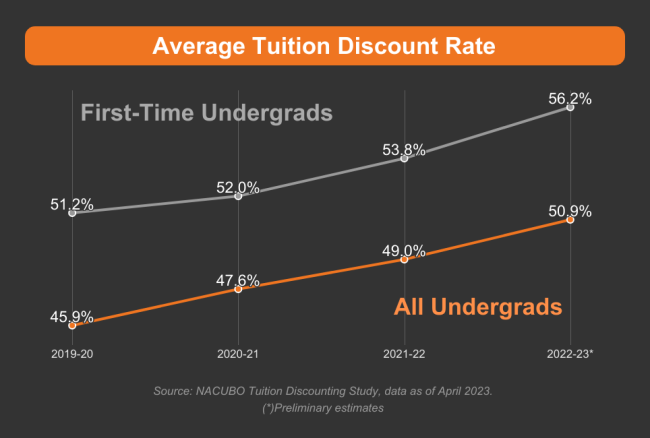
Tuition Discount Rates Hit New High — from insidehighered.com by Josh Moody
According to a new NACUBO study, private college tuition discount rates hit a record 56.2 percent, continuing a pattern of annual increases.
College prices aren’t skyrocketing—but they’re still too high for some — from brookings.edu by Phillip Levine
If we do not find better ways to track college costs for students with different family financial circumstances, we will not easily know if that happened. Students and their families will continue to make one of the most important financial decisions of their lives half in the dark.
Addendum:
Private colleges’ tuition discount rates continue to hit record highs — from highereddive.com by Jeremy Bauer-Wolf
Dive Brief:
AutoGPT’s – Everything you need to know — from linusekenstam.substack.com by Linus Ekenstam
What exactly are AutoGPT’s? Autonomous agents are here, and most likely to stay.

Fresh Voices on Legal Tech with Natalie Knowlton — from legaltalknetwork.com by Dennis Kennedy and Tom Mighell
EPISODE NOTES
Technology has become the main driver for increasing access to justice, and there are huge opportunities for legal service providers to leverage both existing and emerging tech to reach new clients. Dennis and Tom welcome Natalie Knowlton to discuss the current state of legal services, the justice gap, and ways technology is helping attorneys provide better and more affordable services to consumers. As always, stay tuned for the parting shots, that one tip, website, or observation that you can use the second the podcast ends.
New report on ChatGPT & generative AI in law firms shows opportunities abound, even as concerns persist — from thomsonreuters.com; via Brainyacts #43
Excerpt:
The survey, conducted in late-March by the Thomson Reuters Institute, gathered insight from more than 440 respondent lawyers at large and midsize law firms in the United States, United Kingdom, and Canada. The survey forms the basis of a new report, ChatGPT & Generative AI within Law Firms, which takes a deep look at the evolving attitudes towards generative AI and ChatGPT within law firms, measuring awareness and adoption of the technology as well as lawyers’ views on its potential risks.
The report also reveals several key findings that deserve special attention from law firm leaders and other legal professionals as ChatGPT and generative AI evolve from concept to reality for the vast majority of the legal industry participants. These findings include:
‘Legal Tech Lists’: 5 Lawyer Tropes That Were Upended By Legal Tech — from abovethelaw.com by Jared Correia
These common fictitious scenarios would be solved by technology.
Excerpt:
There are lots of tropes related to lawyers and law firms that frequently show up in works of fiction. The thing is, those tropes are tropes because they’re sort of old; they’ve been around for a long time. Now, however, modern technology can solve a heck of a lot of those issues. So, for this edition of the “Reference Manual of Lists,” we’re going to relay a trope, offer an example, and talk about how legal tech actually fixes the problem today.
The Future of Generative Large Language Models and Potential Applications in LegalTech — from jdsupra.com by Johannes Scholtes and Geoffrey Vance
Excerpt:
If you made it this far, you should by now understand that ChatGPT is not by itself a search engine, nor an eDiscovery data reviewer, a translator, knowledge base, or tool for legal analytics. But it can contribute to these functionalities.
In-person vs. virtual ADR — How to choose? — from reuters.com by Eric Larson
Excerpt:
April 20, 2023 – Alternative dispute resolution (ADR), a common technique parties can use to settle disputes with the help of a third party, offers several unique benefits over traditional litigation. It is typically more cost-effective, confidential and generally a preferred method to resolving disputes. As a result, counsel and their clients often view ADR as a no-brainer. But the once simple decision to engage in ADR is now complicated by whether to proceed in-person, virtually or with a hybrid approach.
ChatGPT: A Lawyer’s Friend or Ethical Time Bomb? A Look at Professional Responsibility in the Age of AI — from jdsupra.com by Mitchell, Williams, Selig, Gates, & Woodyard
Excerpt:
The emergence of ChatGPT comes with tremendous promise of increased automation and efficiency. But at what cost? In this blog post, we’ll explore the potential ethical time bomb of using ChatGPT and examine the responsibility of lawyers in the age of AI.
Cleveland Cavaliers Turn Their Arena Into An AR Arcade — from vrscout.com by Kyle Melnick

.
How Audi Used AR Tech To Build Its New Concept Car — from vrscout.com by Kyle Melnick

.
Celebrate Earth Day With An Out-Of-This-World VR Film — from vrscout.com by Kyle Melnick

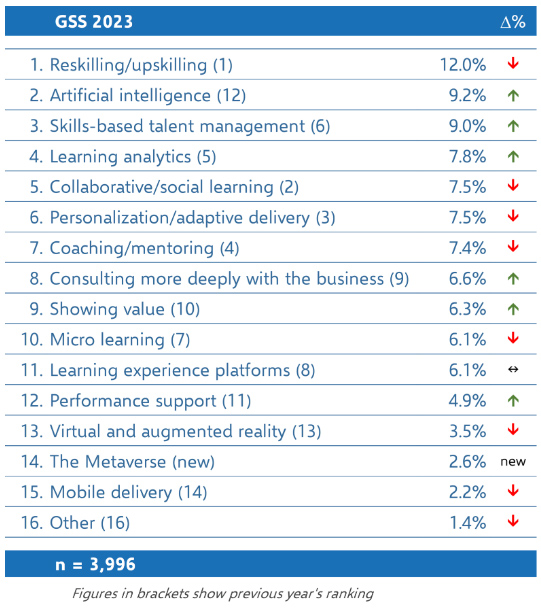
The 2023 Global Sentiment Survey — from donaldhtaylor.co.uk by Don Taylor
Excerpt:
This year’s Global Sentiment Survey – the tenth – paints a picture that is both familiar and unusual. In our 2020 survey report, we noted that ‘Data dominates this year’s survey’. It does so again this year, with the near 4,000 respondents showing a strong interest in AI, Skills-based talent management and Learning analytics (in positions #2, #3 and #4), all of which rely on data. The table is topped by Reskilling/upskilling, in the #1 spot for the third year running.
.
.
35 Ways Real People Are Using A.I. Right Now — from nytimes.com by Francesca Paris and Larry Buchanan
From DSC:
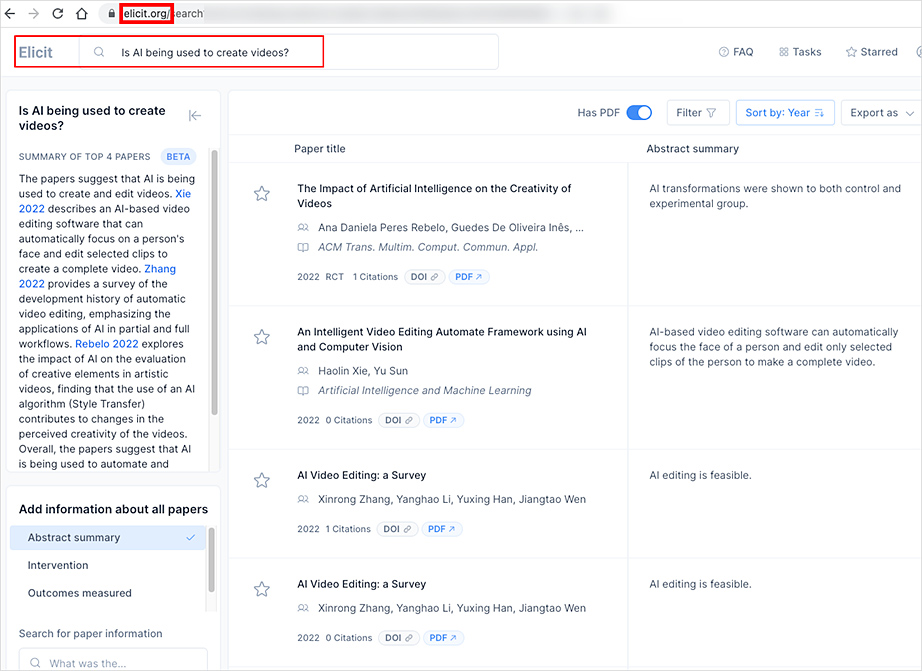
It was interesting to see how people are using AI these days. The article mentioned things from planning Gluten Free (GF) meals to planning gardens, workouts, and more. Faculty members, staff, students, researchers and educators in general may find Elicit, Scholarcy and Scite to be useful tools. I put in a question at Elicit and it looks interesting. I like their interface, which allows me to quickly resort things.
.
There Is No A.I. — from newyorker.com by Jaron Lanier
There are ways of controlling the new technology—but first we have to stop mythologizing it.
Excerpts:
If the new tech isn’t true artificial intelligence, then what is it? In my view, the most accurate way to understand what we are building today is as an innovative form of social collaboration.
…
The new programs mash up work done by human minds. What’s innovative is that the mashup process has become guided and constrained, so that the results are usable and often striking. This is a significant achievement and worth celebrating—but it can be thought of as illuminating previously hidden concordances between human creations, rather than as the invention of a new mind.
Resource per Steve Nouri on LinkedIn
Verified Skills — from the-job.beehiiv.com by Paul Fain
Hunting for a common thread amid the hype around skills.
Excerpt:
The glitzy ASU+GSV gathering this week was titled “Brave New World.” But Tim Knowles wanted to talk about 1906.
That was when the organization Knowles leads, the Carnegie Foundation for the Advancement of Teaching, created the credit-hour standard. The time has arrived, argue Knowles and Amit Sevak, CEO of ETS, to move away from the Carnegie Unit and toward a new currency of education based on meaningful skills and accomplishments, demonstrated through assessment.
Our old way of training Americans for ‘good jobs’ is past its sell-by date — from workshift.opencampusmedia.org by JB Holston
We’re at a pivot point in education and workforce development. Employers in the U.S. and its allies have an opportunity to accelerate their economies by collaborating to scale new pathways to prosperity. They need to seize that opportunity, writes JB Holston, former CEO of the Greater Washington Partnership.
The country is at a pivot point. COVID’s acceleration of remote work and training; an increased dedication to inclusion, equity, and diversity since the murder of George Floyd; the inexorable pace of technological change; and America’s new, well-funded industrial policy have created an opportunity for the most significant re-set in the relationship between employers and our education systems in the last 150 years.
The old path to family-supporting career positions—which depended on large employers recruiting graduates from a small universe of ranked colleges whose education stopped with that degree—is past its sell-by date.
AI in Hiring and Evaluating Workers: What Americans Think — from pewresearch.org by Lee Rainie, Monica Anderson, Colleen McClain, Emily A. Vogels, and Risa Gelles-Watnick
62% believe artificial intelligence will have a major impact on jobholders overall in the next 20 years, but far fewer think it will greatly affect them personally. People are generally wary and uncertain of AI being used in hiring and assessing workers
Excerpt:
A new Pew Research Center survey finds crosscurrents in the public’s opinions as they look at the possible uses of AI in workplaces. Americans are wary and sometimes worried. For instance, they oppose AI use in making final hiring decisions by a 71%-7% margin, and a majority also opposes AI analysis being used in making firing decisions. Pluralities oppose AI use in reviewing job applications and in determining whether a worker should be promoted. Beyond that, majorities do not support the idea of AI systems being used to track workers’ movements while they are at work or keeping track of when office workers are at their desks.