


A Rippling Townhouse Facade by Alex Chinneck Takes a Seat in a London Square — from thisiscolossal.com by Alex Chinneck and Kate Mothes

A Rippling Townhouse Facade by Alex Chinneck Takes a Seat in a London Square — from thisiscolossal.com by Alex Chinneck and Kate Mothes
AI-Powered Lawyering: AI Reasoning Models, Retrieval Augmented Generation, and the Future of Legal Practice
Minnesota Legal Studies Research Paper No. 25-16; March 02, 2025; from papers.ssrn.com by:
Daniel Schwarcz
University of Minnesota Law School
Sam Manning
Centre for the Governance of AI
Patrick Barry
University of Michigan Law School
David R. Cleveland
University of Minnesota Law School
J.J. Prescott
University of Michigan Law School
Beverly Rich
Ogletree Deakins
Abstract
Generative AI is set to transform the legal profession, but its full impact remains uncertain. While AI models like GPT-4 improve the efficiency with which legal work can be completed, they can at times make up cases and “hallucinate” facts, thereby undermining legal judgment, particularly in complex tasks handled by skilled lawyers. This article examines two emerging AI innovations that may mitigate these lingering issues: Retrieval Augmented Generation (RAG), which grounds AI-powered analysis in legal sources, and AI reasoning models, which structure complex reasoning before generating output. We conducted the first randomized controlled trial assessing these technologies, assigning upper-level law students to complete six legal tasks using a RAG-powered legal AI tool (Vincent AI), an AI reasoning model (OpenAI’s o1-preview), or no AI. We find that both AI tools significantly enhanced legal work quality, a marked contrast with previous research examining older large language models like GPT-4. Moreover, we find that these models maintain the efficiency benefits associated with use of older AI technologies. Our findings show that AI assistance significantly boosts productivity in five out of six tested legal tasks, with Vincent yielding statistically significant gains of approximately 38% to 115% and o1-preview increasing productivity by 34% to 140%, with particularly strong effects in complex tasks like drafting persuasive letters and analyzing complaints. Notably, o1-preview improved the analytical depth of participants’ work product but resulted in some hallucinations, whereas Vincent AI-aided participants produced roughly the same amount of hallucinations as participants who did not use AI at all. These findings suggest that integrating domain-specific RAG capabilities with reasoning models could yield synergistic improvements, shaping the next generation of AI-powered legal tools and the future of lawyering more generally.
Guest post: How technological innovation can boost growth — from legaltechnology.com by Caroline Hill
One key change is the growing adoption of technology within legal service providers, and this is transforming the way firms operate and deliver value to clients.
The legal services sector’s digital transformation is gaining momentum, driven both by client expectations as well as the potential for operational efficiency. With the right support, legal firms can innovate through tech adoption and remain competitive to deliver strong client outcomes and long-term growth.
AI Can Do Many Tasks for Lawyers – But Be Careful — from nysba.org by Rebecca Melnitsky
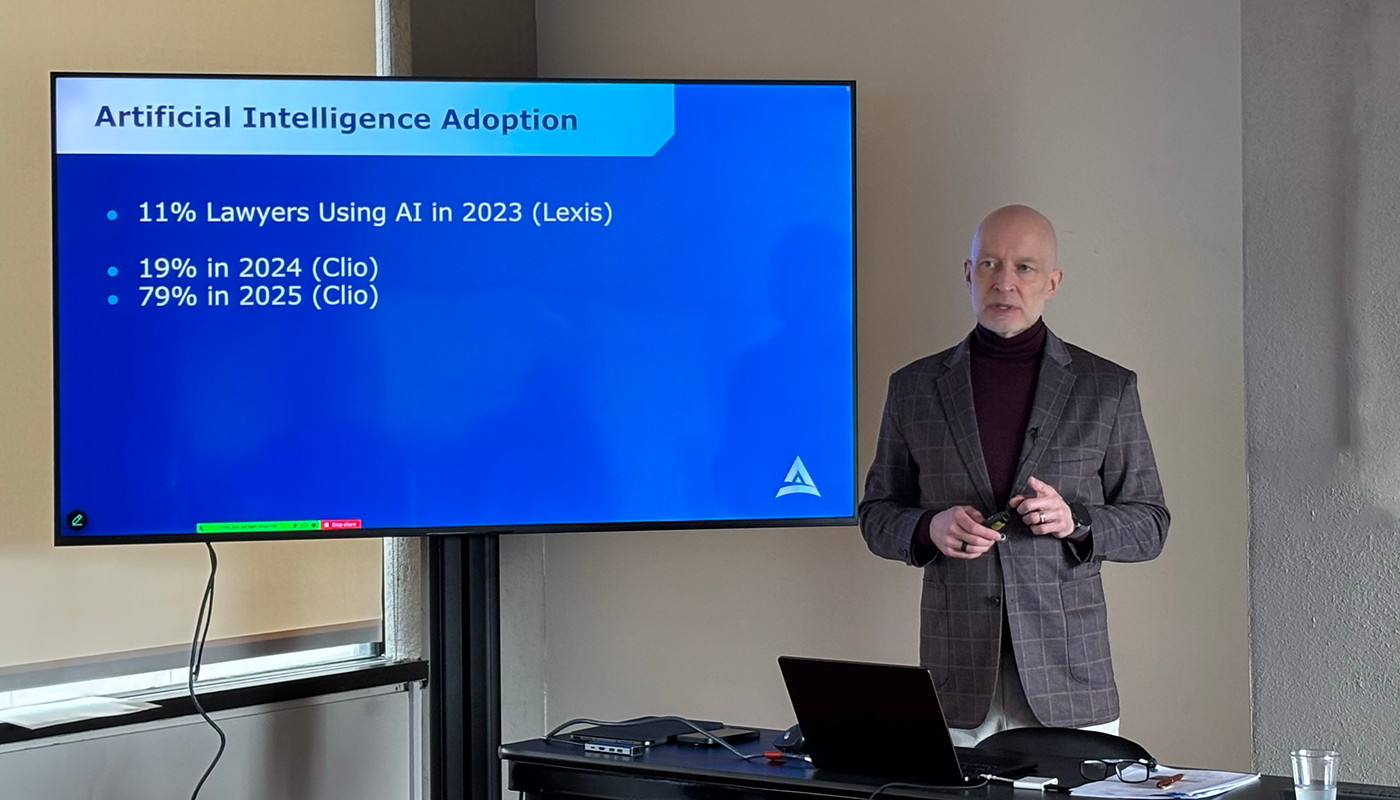
Artificial intelligence can perform several tasks to aid lawyers and save time. But lawyers must be cautious when using this new technology, lest they break confidentiality or violate ethical standards.
The New York State Bar Association hosted a hybrid program discussing AI’s potential and its pitfalls for the legal profession. More than 300 people watched the livestream.
For that reason, Unger suggests using legal AI tools, like LexisNexis AI, Westlaw Edge, and vLex Fastcase, for legal research instead of general generative AI tools. While legal-specific tools still hallucinate, they hallucinate much less. A legal tool will hallucinate 10% to 20% of the time, while a tool like ChatGPT will hallucinate 50% to 80%.
Fresh Voices on Legal Tech with Nikki Shaver — from legaltalknetwork.com by Dennis Kennedy, Tom Mighell, and Nikki Shaver
Determining which legal technology is best for your law firm can seem like a daunting task, so Legaltech Hub does the hard work for you! In another edition of Fresh Voices, Dennis and Tom talk with Nikki Shaver, CEO at Legaltech Hub, about her in-depth knowledge of technology and AI trends. Nikki shares what effective tech strategies should look like for attorneys and recommends innovative tools for maintaining best practices in modern law firms. Learn more at legaltechnologyhub.com.
AI for in-house legal: 2025 predictions — from deloitte.com
Our expectations for AI engagement and adoption in the legal Market over the coming year.
AI will continue to transform in-house legal departments in 2025
As we enter 2025, over two-thirds of organisations plan to increase their Generative AI (GenAI) investments, providing legal teams with significant executive support and resources to further develop this Capabilities. This presents a substantial opportunity for legal departments, particularly as GenAI technology continues to advance at an impressive pace. We make five predictions for AI engagement and adoption in the legal Market over the coming year and beyond.
Navigating The Fine Line: Redefining Legal Advice In The Age Of Tech With Erin Levine And Quinten Steenhuis — from abovethelaw.com by Olga V. Mack
The definition of ‘practicing law’ is outdated and increasingly irrelevant in a tech-driven world. Should the line between legal advice and legal information even exist?
Practical Takeaways for Legal Leaders
Google I/O 2025: From research to reality — from blog.google
Here’s how we’re making AI more helpful with Gemini.
Google I/O 2025 LIVE — all the details about Android XR smart glasses, AI Mode, Veo 3, Gemini, Google Beam and more — from tomsguide.com by Philip Michaels
Google’s annual conference goes all in on AI
With a running time of 2 hours, Google I/O 2025 leaned heavily into Gemini and new models that make the assistant work in more places than ever before. Despite focusing the majority of the keynote around Gemini, Google saved its most ambitious and anticipated announcement towards the end with its big Android XR smart glasses reveal.
Shockingly, very little was spent around Android 16. Most of its Android 16 related news, like the redesigned Material 3 Expressive interface, was announced during the Android Show live stream last week — which explains why Google I/O 2025 was such an AI heavy showcase.
That’s because Google carved out most of the keynote to dive deeper into Gemini, its new models, and integrations with other Google services. There’s clearly a lot to unpack, so here’s all the biggest Google I/O 2025 announcements.
Our vision for building a universal AI assistant— from blog.google
We’re extending Gemini to become a world model that can make plans and imagine new experiences by simulating aspects of the world.
Making Gemini a world model is a critical step in developing a new, more general and more useful kind of AI — a universal AI assistant. This is an AI that’s intelligent, understands the context you are in, and that can plan and take action on your behalf, across any device.
By applying LearnLM capabilities, and directly incorporating feedback from experts across the industry, Gemini adheres to the principles of learning science to go beyond just giving you the answer. Instead, Gemini can explain how you get there, helping you untangle even the most complex questions and topics so you can learn more effectively. Our new prompting guide provides sample instructions to see this in action.
Learn in newer, deeper ways with Gemini — from blog.google.com by Ben Gomes
We’re infusing LearnLM directly into Gemini 2.5 — plus more learning news from I/O.
At I/O 2025, we announced that we’re infusing LearnLM directly into Gemini 2.5, which is now the world’s leading model for learning. As detailed in our latest report, Gemini 2.5 Pro outperformed competitors on every category of learning science principles. Educators and pedagogy experts preferred Gemini 2.5 Pro over other offerings across a range of learning scenarios, both for supporting a user’s learning goals and on key principles of good pedagogy.
Gemini gets more personal, proactive and powerful — from blog.google.com by Josh Woodward
It’s your turn to create, learn and explore with an AI assistant that’s starting to understand your world and anticipate your needs.
Here’s what we announced at Google IO:
Fuel your creativity with new generative media models and tools — from by Eli Collins
Introducing Veo 3 and Imagen 4, and a new tool for filmmaking called Flow.

AI in Search: Going beyond information to intelligence
We’re introducing new AI features to make it easier to ask any question in Search.
AI in Search is making it easier to ask Google anything and get a helpful response, with links to the web. That’s why AI Overviews is one of the most successful launches in Search in the past decade. As people use AI Overviews, we see they’re happier with their results, and they search more often. In our biggest markets like the U.S. and India, AI Overviews is driving over 10% increase in usage of Google for the types of queries that show AI Overviews.
This means that once people use AI Overviews, they’re coming to do more of these types of queries, and what’s particularly exciting is how this growth increases over time. And we’re delivering this at the speed people expect of Google Search — AI Overviews delivers the fastest AI responses in the industry.
In this story:
From AI avatars to virtual reality crime scenes, courts are grappling with AI in the justice system — from whec.com by Rio Yamat
The family of a man who died in a road rage shooting incident played a video showing a likeness of him generated with AI.
Defense attorney Jason Lamm won’t be handling the appeal, but said a higher court will likely be asked to weigh in on whether the judge improperly relied on the AI-generated video when sentencing his client.
Courts across the country have been grappling with how to best handle the increasing presence of artificial intelligence in the courtroom. Even before Pelkey’s family used AI to give him a voice for the victim impact portion — believed to be a first in U.S. courts — the Arizona Supreme Court created a committee that researches best AI practices.
In Florida, a judge recently donned a virtual reality headset meant to show the point of view of a defendant who said he was acting in self-defense when he waved a loaded gun at wedding guests. The judge rejected his claim.
Experts say using AI in courtrooms raises legal and ethical concerns, especially if it’s used effectively to sway a judge or jury. And they argue it could have a disproportionate impact on marginalized communities facing prosecution.
…
AI can be very persuasive, Harris said, and scholars are studying the intersection of the technology and manipulation tactics.
Poll: 1 in 3 would let an AI lawyer represent them — from robinai.com
April 29 2025: A major new survey, from legal intelligence platform Robin AI, has revealed a severe lack of trust in the legal industry. Just 1 in 10 people across the US and UK said they fully trust law firms, but while increasingly open to AI-powered legal services, few are ready to let technology take over without human oversight.
Perspectus Global polled a representative sample of 4,152 people across both markets. An overwhelming majority see Big Law as “expensive”, “elitist” or “intimidating” but only 30% of respondents would allow a robot lawyer — that is, an AI system acting alone — to represent them in a legal matter. On average, respondents said they would need a 57% discount to choose an AI lawyer over a human.
.
-p-3200.png)
Harvey Made Legal Tech Cool Enough for Silicon Valley to Care Again — from businessinsider.com by Melia Russell
In just three years, the company, which builds software for analyzing and drafting documents using legally tuned large language models, has drawn blue-chip law firms, Silicon Valley investors, and a stampede of rivals hoping to catch its momentum. Harvey has raised over half a billion dollars in capital, sending its valuation soaring to $3 billion.
Values in the wild: Discovering and analyzing values in real-world language model interactions — from anthropic.com
In the latest research paper from Anthropic’s Societal Impacts team, we describe a practical way we’ve developed to observe Claude’s values—and provide the first large-scale results on how Claude expresses those values during real-world conversations. We also provide an open dataset for researchers to run further analysis of the values and how often they arise in conversations.
Per the Rundown AI
Why it matters: AI is increasingly shaping real-world decisions and relationships, making understanding their actual values more crucial than ever. This study also moves the alignment discussion toward more concrete observations, revealing that AI’s morals and values may be more contextual and situational than a static point of view.
Also from Anthropic, see:
Anthropic Education Report: How University Students Use Claude

Adobe Firefly: The next evolution of creative AI is here — from blog.adobe.com
In just under two years, Adobe Firefly has revolutionized the creative industry and generated more than 22 billion assets worldwide. Today at Adobe MAX London, we’re unveiling the latest release of Firefly, which unifies AI-powered tools for image, video, audio, and vector generation into a single, cohesive platform and introduces many new capabilities.
The new Firefly features enhanced models, improved ideation capabilities, expanded creative options, and unprecedented control. This update builds on earlier momentum when we introduced the Firefly web app and expanded into video and audio with Generate Video, Translate Video, and Translate Audio features.
Per The Rundown AI (here):
Why it matters: OpenAI’s recent image generator and other rivals have shaken up creative workflows, but Adobe’s IP-safe focus and the addition of competing models into Firefly allow professionals to remain in their established suite of tools — keeping users in the ecosystem while still having flexibility for other model strengths.
Record Law Grad Employment Rates Suggest AI Isn’t Killing Off Lawyers Just Yet — from lawnext.com by Bob Ambrogi
At a time when legal doomsayers have been predicting the imminent replacement of junior associates by AI legal assistants, the law school graduating class of 2024 has delivered a contrary verdict: Human lawyers aren’t going anywhere just yet.
According to the latest American Bar Association employment report, the legal job market is showing not just resilience, but growth. The data, reported as of March 17, 2025 — approximately 10 months after spring graduations — reveals that 82.2% of the 38,937 2024 law school graduates secured positions requiring bar admission — a two-point increase from the previous year.
Also see:
Leeds to host UK’s largest LegalTech event outside London as sector booms in the region by 50% — from yorkshirepost.co.uk by Jo Jessop
Leeds is gearing up to welcome hundreds of Legal and Tech professionals [on 4/24/25], as it hosts the fourth annual LegalTech in Leeds Conference – now the largest LegalTech event outside of London.
Set to take place on April 24 at Cloth Hall Court, Leeds, the 2025 conference comes at a time of extraordinary growth for the region’s LegalTech sector, which has seen a 50% increase in LegalTech firms between 2023 and 2024, according to a new report from Whitecap Consulting.
The event, themed “People & Technology,” will spotlight how digital innovation is transforming the legal sector while keeping human experience at its core. This year’s agenda will delve into the practical ways individuals and organisations can collaborate to deliver more efficient, accessible, and forward-thinking legal services. With hundreds of attendees expected, it’s set to be a landmark gathering of legal professionals, lawyers, tech professionals, entrepreneurs, academics and policymakers.
How Legal Tech is Reshaping the Broader Legal Ecosystem — from community.nasscom.in
The legal profession, long characterized by tradition and precedent, is undergoing a transformative shift driven by technological innovation. Legal technology, or “legal tech,” is not merely a tool for efficiency; it is a catalyst redefining the practice of law, the structure of legal services, and the accessibility of justice.
1. Streamlining Legal Operations
2. Enhancing Access to Justice
3. Transforming Legal Education and Roles
4. Redefining Client Expectations and Service Delivery
5. plus several more
Is collaboration the key to digital accessibility? — from timeshighereducation.com by Sal Jarvis and George Rhodes
Digital accessibility is ethically important, and a legal requirement, but it’s also a lot of work. Here’s how universities can collaborate and pool their expertise to make higher education accessible for all
How easy do you find it to navigate your way around your university’s virtual estate – its websites, virtual learning environment and other digital aspects? If the answer is “not very”, we suspect you may not be alone. And for those of us who might access it differently – without a mouse, for example, or through a screen reader or keyboard emulator – the challenge is multiplied. Digital accessibility is the wide-ranging work to make these challenges a thing of the past for everyone. It is a legal requirement and a moral imperative.
Make Things Accessible is the outcome of a collaboration, initially between the University of Westminster and UCL, but now incorporating many other universities. It is a community of practice, a website and an archive of resources. It aims to make things accessible for all.
Five Legal Tech Insights From New York — from artificiallawyer.com by Richard Tromans
A week spent in Manhattan gave Artificial Lawyer plenty to think about. Here are five insights inspired by a series of ‘New York moments’, often about legal AI.
On the way back from Paddington the cab driver was also questioned on the topic. He replied with wisdom: ‘When they made Heathrow Express a lot of us feared it would take away work. The funny thing is, it pushes more people to Paddington and generates a steady flow of fares. Before, you might spend ages getting to Heathrow with one passenger and sometimes have to drive all the way back with no fare.’
The end result: the effort to increase speed and efficiency ended up making the taxi drivers of London much happier and their lives more flexible. Whereas the taxi drivers of New York remain stuck doing huge, one-off journeys, while the general public suffers high costs and slow – and unpredictable – travel times.
Now, one wonders where there could be a connection to how the legal world works…..?
ABA TECHSHOW 2025 to spotlight future of legal technology — from americanbar.org
Artificial intelligence, cloud-based practice management, data privacy and e-discovery will be among the hot topics featured at the American Bar Association TECHSHOW 2025, which spotlights the most useful and practical technologies available in the legal industry, April 2-5 in Chicago.

Legaltech leaders roundtable: The challenges and emerging best practices of GenAI adoption — from legaltechnology.com
One of the key themes to emerge was the need to encourage creativity and open mindedness around use cases. Conan Hines, Fried Frank’s director of practice innovation, said: “I felt a lot of ‘imaginative play’ vibes. This is where we give lawyers secure AI tools and support to explore the possibilities. The support is even more interesting as innovative teams are complementing their current staff with behavioural science and anthropological approaches to unlock this potential.”
Inhouse World Is Embracing Legal AI – Survey — from artificiallawyer.com

Feral Pigeons and a Feisty Fox Take Top Honors in the 2025 British Wildlife Photography Awards — from thisiscolossal.com

.
