From LinkedIn.com today:


Also see:


From DSC:
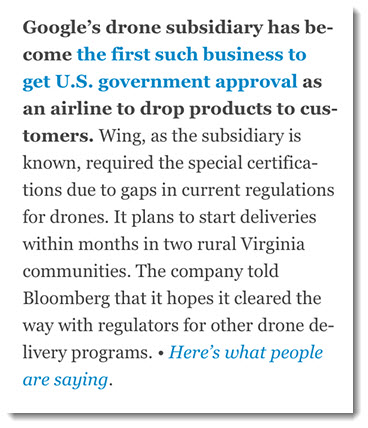
I don’t like this at all. If this foot gets in the door, vendor after vendor will launch their own hordes of drones. In the future, where will we go if we want some piece and quiet? Will the air be filled with swarms of noisy drones? Will we be able to clearly see the sun? An exaggeration..? Maybe…maybe not.

But, now what? What recourse do citizens have? Readers of this blog know that I’m generally pro-technology. But the folks — especially the youth — working within the FAANG companies (and the like) need to do a far better job asking, “Just because we can do something, should we do it?”

As I’ve said before, we’ve turned over the keys to the $137,000 Maserati to drivers who are just getting out of driving school. Then we wonder….”How did we get to this place?” 


If you owned this $137,000+ car, would you turn the keys of it over to your 16-25 year old?!


As another example, just because we can…

just because we can does not mean we should


…doesn’t mean we should.


just because we can does not mean we should


We Built an ‘Unbelievable’ (but Legal) Facial Recognition Machine — from nytimes.com by Sahil Chinoy

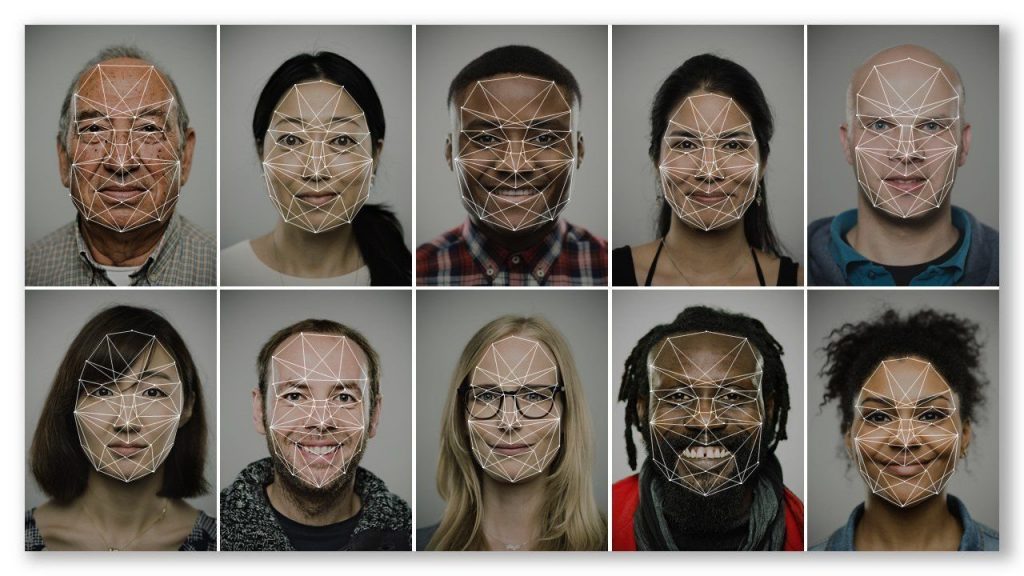
“The future of human flourishing depends upon facial recognition technology being banned,” wrote Woodrow Hartzog, a professor of law and computer science at Northeastern, and Evan Selinger, a professor of philosophy at the Rochester Institute of Technology, last year. ‘Otherwise, people won’t know what it’s like to be in public without being automatically identified, profiled, and potentially exploited.’ Facial recognition is categorically different from other forms of surveillance, Mr. Hartzog said, and uniquely dangerous. Faces are hard to hide and can be observed from far away, unlike a fingerprint. Name and face databases of law-abiding citizens, like driver’s license records, already exist. And for the most part, facial recognition surveillance can be set up using cameras already on the streets.” — Sahil Chinoy; per a weekly e-newsletter from Sam DeBrule at Machine Learnings in Berkeley, CA

Excerpt:

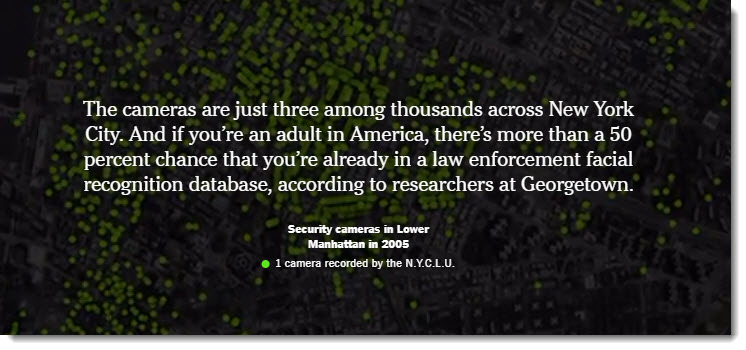
Most people pass through some type of public space in their daily routine — sidewalks, roads, train stations. Thousands walk through Bryant Park every day. But we generally think that a detailed log of our location, and a list of the people we’re with, is private. Facial recognition, applied to the web of cameras that already exists in most cities, is a threat to that privacy.

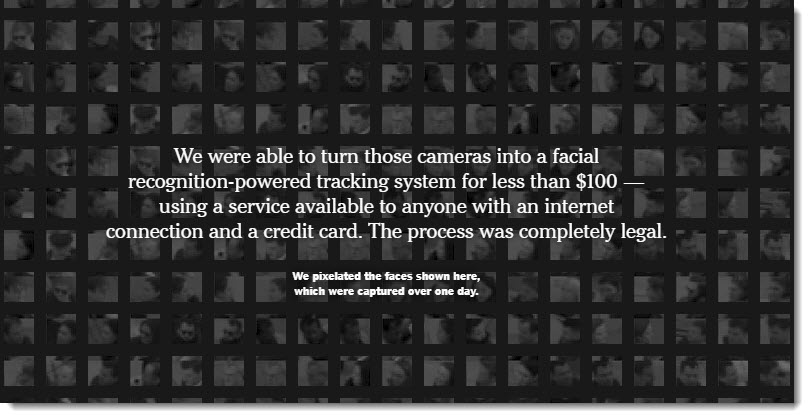
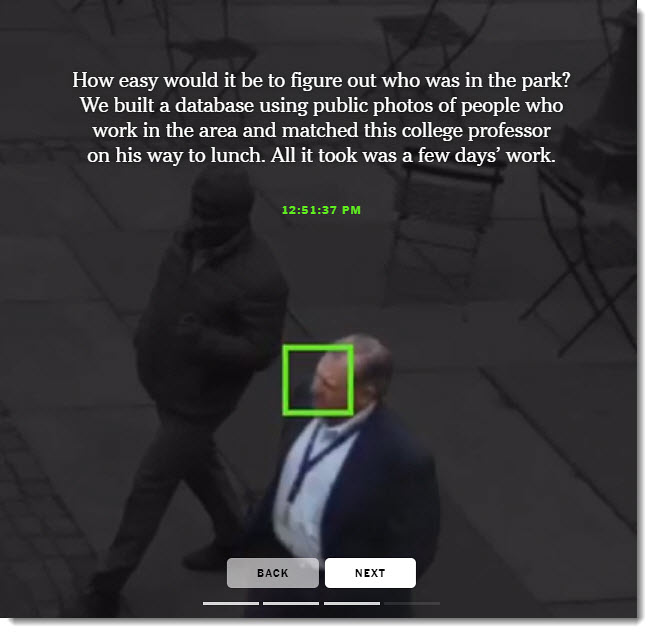
To demonstrate how easy it is to track people without their knowledge, we collected public images of people who worked near Bryant Park (available on their employers’ websites, for the most part) and ran one day of footage through Amazon’s commercial facial recognition service. Our system detected 2,750 faces from a nine-hour period (not necessarily unique people, since a person could be captured in multiple frames). It returned several possible identifications, including one frame matched to a head shot of Richard Madonna, a professor at the SUNY College of Optometry, with an 89 percent similarity score. The total cost: about $60.


From DSC:
What do you think about this emerging technology and its potential impact on our society — and on other societies like China? Again I ask…what kind of future do we want?

As for me, my face is against the use of facial recognition technology in the United States — as I don’t trust where this could lead.

This wild, wild, west situation continues to develop. For example, note how AI and facial recognition get their foot in the door via techs installed years ago:

The cameras in Bryant Park were installed more than a decade ago so that people could see whether the lawn was open for sunbathing, for example, or check how busy the ice skating rink was in the winter. They are not intended to be a security device, according to the corporation that runs the park.

So Amazon’s use of facial recognition is but another foot in the door. 

This needs to be stopped. Now.


Facial recognition technology is a menace disguised as a gift. It’s an irresistible tool for oppression that’s perfectly suited for governments to display unprecedented authoritarian control and an all-out privacy-eviscerating machine.

We should keep this Trojan horse outside of the city. (source)


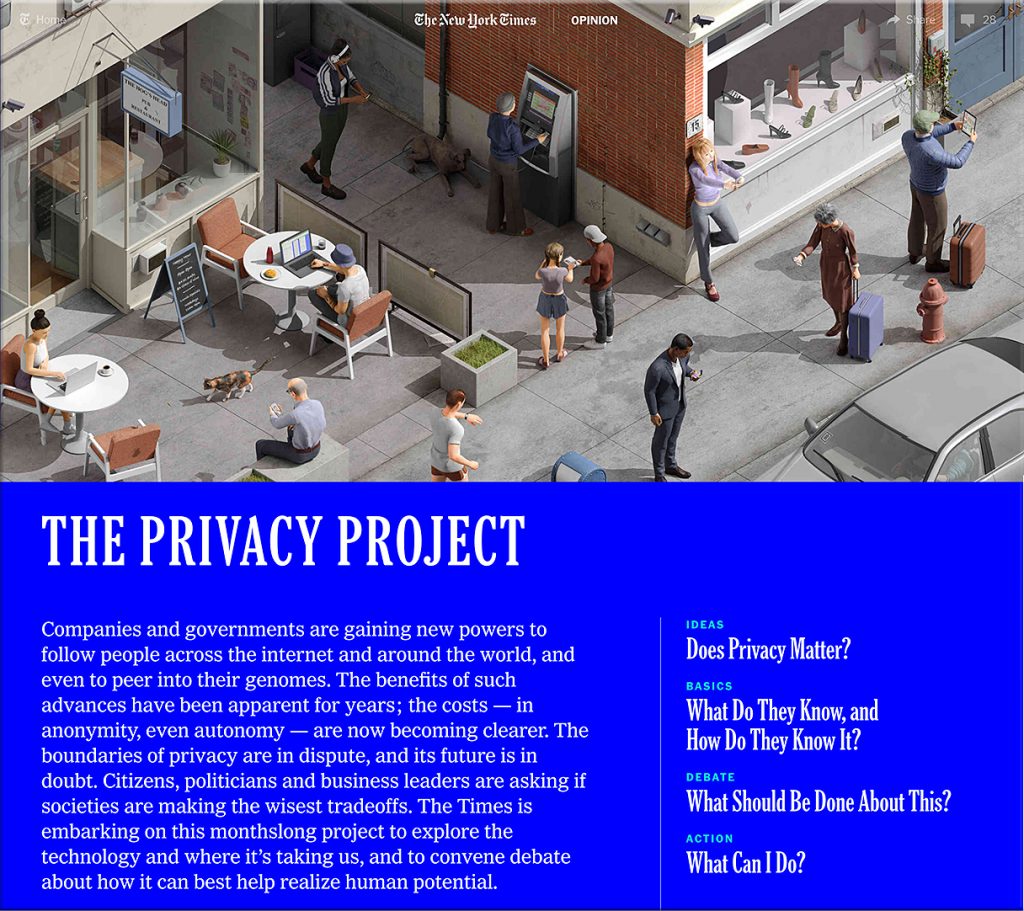
Example articles from the Privacy Project:

  • James Bennet: Do You Know What You’ve Given Up?
  • A. G. Sulzberger: How The Times Thinks About Privacy
  • Samantha Irby: I Don’t Care. I Love My Phone.
  • Tim Wu: How Capitalism Betrayed Privacy


Legal Battle Over Captioning Continues — from insidehighered.com by Lindsay McKenzie
A legal dispute over video captions continues after court rejects requests by MIT and Harvard University to dismiss lawsuits accusing them of discriminating against deaf people.

Excerpt:

Two high-profile civil rights lawsuits filed by the National Association of the Deaf against Harvard University and the Massachusetts Institute of Technology are set to continue after requests to dismiss the cases were recently denied for the second time.

The two universities were accused by the NAD in 2015 of failing to make their massive open online courses, guest lectures and other video content accessible to people who are deaf or hard of hearing.

Some of the videos, many of which were hosted on the universities’ YouTube channels, did have captions — but the NAD complained that these captions were sometimes so bad that the content was still inaccessible.

Spokespeople for both Harvard and MIT declined to comment on the ongoing litigation but stressed that their institutions were committed to improving web accessibility.


Video: Chatbots’ History and Future — from which-50.com by Joseph Brookes

Excerpt:

What’s Next For Chatbots?
One area where chatbots will have an increasing impact in the future is language, according to Kraeutler. He argues the further integration of language services from the likes of Google will bring down processing times in multilingual scenarios.

“Having a chatbot where a consumer can very easily speak in their native tongue and use services like Google to provide real-time translation — and increasingly very accurate real-time translation. That allows the bot to respond to the consumer, again, very accurately, but also in their native tongue.”

That translation feature, Kraeutler says, will also be vital in assisted conversations — where bots assist human agents to provide next-best actions — allowing the two human parties to converse in near real time in their native languages.


From DSC:
This is much more than a Voice Response Unit (VRU) Phase II…the educational realm should watch what happens with chatbots…as they could assist with doing some heavy lifting in the learning world.


Gartner: Top 10 Strategic Technologies Impacting Higher Ed in 2019 — from campustechnology.com by Rhea Kelly

Excerpt:

  • Artificial intelligence conversational interfaces. Gartner defines these as “a subset of conversational user interfaces (CUIs), in which user and machine interactions occur in the user’s spoken or written natural language.” The benefit for higher ed insitutions: “CUIs place responsibility on the machine interface to learn what the user wants, rather than the user having to learn the software, saving user time, increasing student satisfaction, and being available to use 24/7.”
  • Smart campus. This is “a physical or digital environment in which humans and technology-enabled systems interact to create more immersive and automated experiences for university stakeholders.” While smart campus initiatives are still in the early stages, there has been a rising interest across higher ed institutions, according to Gartner. “The smart campus will drive growth in markets like robotic process automation solutions and augmented and virtual reality in the higher education space. Campus efficiency will be enhanced and student learning will be enriched with the new capabilities they bring. It’s a win all-around, except for the data security implications that come with most technology initiatives today,” said Morgan.
    …
  • Digital credentialing technologies. “Students, faculty and the higher education institutions they are a part of are starting to expect the ability to quickly and freely exchange credentials to enhance the verification and recruitment process,” noted Gartner. Technologies such as blockchain and data encryption are driving change in this area. “In many ways, credentials issued by an education institution are the only tangible evidence of higher education. They should be considered the currency of the education ecosystem,” said Morgan. “These technologies really enable universities to leverage technology to improve the student experience by giving them more control over their information. The only hurdle is a general lack of understanding of digital credentialing technologies and risk-averseness in the high-stakes nature of the higher education market.”


Collaboration technology is fueling enterprise transformation – increasing agility, driving efficiency and improving productivity. Join Amy Chang at Enterprise Connect where she will share Cisco’s vision for the future of collaboration, the foundations we have in place and the amazing work we’re driving to win our customers’ hearts and minds. Cognitive collaboration – technology that weaves context and intelligence across applications, devices and workflows, connecting people with customers & colleagues, to deliver unprecedented experiences and transform how we work – is at the heart of our efforts. Join this session to see our technology in action and hear how our customers are using our portfolio of products today to transform the way they work.


Is Thomas Frey right? “…by 2030 the largest company on the internet is going to be an education-based company that we haven’t heard of yet.”

From a fairly recent e-newsletter from edsurge.com — though I don’t recall the exact date (emphasis DSC):

New England is home to some of the most famous universities in the world. But the region has also become ground zero for the demographic shifts that promise to disrupt higher education.

This week saw two developments that fit the narrative. On Monday, Southern Vermont College announced that it would shut its doors, becoming the latest small rural private college to do so. Later that same day, the University of Massachusetts said it would start a new online college aimed at a national audience, noting that it expects campus enrollments to erode as the number of traditional college-age students declines in the coming years.

“Make no mistake—this is an existential threat to entire sectors of higher education,” said UMass president Marty Meehan in announcing the online effort.

The approach seems to parallel the U.S. retail sector, where, as a New York Times piece outlines this week, stores like Target and WalMart have thrived by building online strategies aimed at competing with Amazon, while stores like Gap and Payless, which did little to move online, are closing stores. Of course, college is not like any other product or service, and plenty of campuses are touting the richness of the experience that students get by actually coming to a campus. And it’s not clear how many colleges can grow online to a scale that makes their investments pay off.


“It’s predicted that over the next several years, four to five major national players with strong regional footholds will be established. We intend to be one of them.”

University of Massachusetts President Marty Meehan


From DSC:
That last quote from UMass President Marty Meehan made me reflect upon the idea of having one or more enormous entities that will provide “higher education” in the future. I wonder if things will turn out to be that we’ll have more lifelong learning providers and platforms in the future — with the idea of a 60-year curriculum being an interesting idea that may come into fruition.

Long have I predicted that such an enormous entity would come to pass. Back in 2008, I named it the Forthcoming Walmart of Education. But then as the years went by, I got bumbed out on some things that Walmart was doing, and re-branded it the Forthcoming Amazon.com of Higher Education. We’ll see how long that updated title lasts — but you get the point. In fact, the point aligns very nicely with what futurist Thomas Frey has been predicting for years as well:

“I’ve been predicting that by 2030 the largest company on the internet is going to be an education-based company that we haven’t heard of yet,” Frey, the senior futurist at the DaVinci Institute think tank, tells Business Insider. (source)

I realize that education doesn’t always scale well…but I’m thinking that how people learn in the future may be different than how we did things in the past…communities of practice comes to mind…as does new forms of credentialing…as does cloud-based learner profiles…as does the need for highly efficient, cost-effective, and constant opportunities/means to reinvent oneself.

Also see:



Addendum:

74% of consumers go to Amazon when they’re ready to buy something. That should be keeping retailers up at night. — from cnbc.com

Key points (emphasis DSC)

  • Amazon remains a looming threat for some of the biggest retailers in the country — like Walmart, Target and Macy’s.
  • When consumers are ready to buy a specific product, nearly three-quarters of them, or 74 percent, are going straight to Amazon to do it, according to a new study by Feedvisor.
  • By the end of this year, Amazon is expected to account for 52.4 percent of the e-commerce market in the U.S., up from 48 percent in 2018.


“In New England, there will be between 32,000 and 54,000 fewer college-aged students just seven years from now,” Meehan said. “That means colleges and universities will have too much capacity and not enough demand at a time when the economic model in higher education is already straining under its own weight.” (Marty Meehan at WBUR)


A Chinese subway is experimenting with facial recognition to pay for fares — from theverge.com by Shannon Liao

Excerpt:

Scanning your face on a screen to get into the subway might not be that far off in the future. In China’s tech capital, Shenzhen, a local subway operator is testing facial recognition subway access, powered by a 5G network, as spotted by the South China Morning Post.

The trial is limited to a single station thus far, and it’s not immediately clear how this will work for twins or lookalikes. People entering the station can scan their faces on the screen where they would normally have tapped their phones or subway cards. Their fare then gets automatically deducted from their linked accounts. They will need to have registered their facial data beforehand and linked a payment method to their subway account.


From DSC:
I don’t want this type of thing here in the United States. But…now what do I do? What about you? What can we do? What paths are open to us to stop this?

I would argue that the new, developing, technological “Wild Wests” in many societies throughout the globe could be dangerous to our futures. Why? Because the pace of change has changed. And these new Wild Wests now have emerging, powerful, ever-more invasive (i.e., privacy-stealing) technologies to deal with — the likes of which the world has never seen or encountered before. With this new, rapid pace of change, societies aren’t able to keep up.

And who is going to use the data? Governments? Large tech companies? Other?

Don’t get me wrong, I’m generally pro-technology. But this new pace of change could wreak havoc on us. We need time to weigh in on these emerging techs.


Addendum on 3/20/19:

  • Chinese Facial Recognition Database Exposes 2.5 Million People — from futurumresearch.com by Shelly Kramer
    Excerpt:
    An artificial intelligence company operating a facial recognition system in China recently left its database exposed online, leaving the personal information of some 2.5 million Chinese citizens vulnerable. Considering how much the Chinese government relies on facial recognition technology, this is a big deal—for both the Chinese government and Chinese citizens.


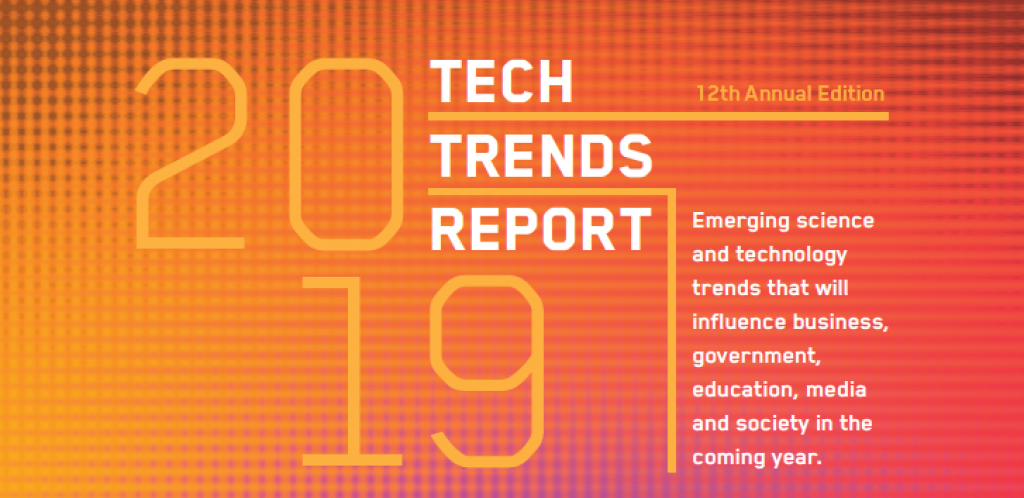
The Future Today Institute’s 12th Annual Emerging Tech Trends Report — from futuretodayinstitute.com

Excerpts:

At the Future Today Institute, we identify emerging tech trends and map the future for our clients. This is FTI’s 12th annual Tech Trends Report, and in it we identify 315 tantalizing advancements in emerging technologies — artificial intelligence, biotech, autonomous robots, green energy and space travel — that will begin to enter the mainstream and fundamentally disrupt business, geopolitics and everyday life around the world. As of the publication date, the annual FTI Tech Trend Report report has garnered more than 7.5 cumulative views.

Key findings for 2019 (emphasis DSC)

  • Privacy is dead. (DC: NOT GOOD!!! If this is true, can the situation be reversed?)
  • Voice Search Optimization (VSO) is the new SEO.
  • The Big Nine.
  • Personal data records are coming. (DC: Including cloud-based learner profiles I hope.)
  • China continues to ascend, and not just in artificial intelligence.
  • Lawmakers around the world are not prepared to deal with new challenges that arise from emerging science and technology.
  • Consolidation continues as a key theme for 2019.


How MIT’s Mini Cheetah Can Help Accelerate Robotics Research — from spectrum.ieee.org by Evan Ackerman
Sangbae Kim talks to us about the new Mini Cheetah quadruped and his future plans for the robot


From DSC:
Sorry, but while the video/robot is incredible, a feeling in the pit of my stomach makes me reflect upon what’s likely happening along these lines in the militaries throughout the globe…I don’t mean to be a fear monger, but rather a realist.


Five key trends for professional and continuing education leaders in the next five years — from evolllution.com by Ray Schroeder

Excerpts:

Higher education is on the cusp of major changes. Enrollments are on the decline—both online and on campus—and the trend is expected to accelerate.[1] Graduates are laboring under substantial college loan debts totaling more than $1.5 trillion.[2] Employers are demanding that applicants possess soft and hard skills that many college graduates do not hold.[3] At the same time new and emerging technologies are changing the way credentials are shared and work is done.

It is in this context that continuing, professional and online programs have been imported from the periphery to the center of traditional universities. Students and employers alike have made clear that their top priority is relevance to the rapidly changing workplace. Artificial intelligence, blockchain, augmented/virtual reality and other technologies are driving the changes. Professional and Continuing Education (PCE) has long been the leader in providing relevant courses, certificates and degrees that connect students with the needs of employers.


…the Online Master’s Science in Computer Science degree at Georgia Tech is now the largest computer science program in the world. And the degree costs less than $9,000.


Also see:

Interview with Hunt Lambert – What is the 60-year curriculum?
Colleges and universities used to be primarily responsible for a four-year learning experience. We now need to envision a 60-year curriculum, whereby educational institutions partner with learners at all stages of their professional career, providing skills and knowledge as needed.


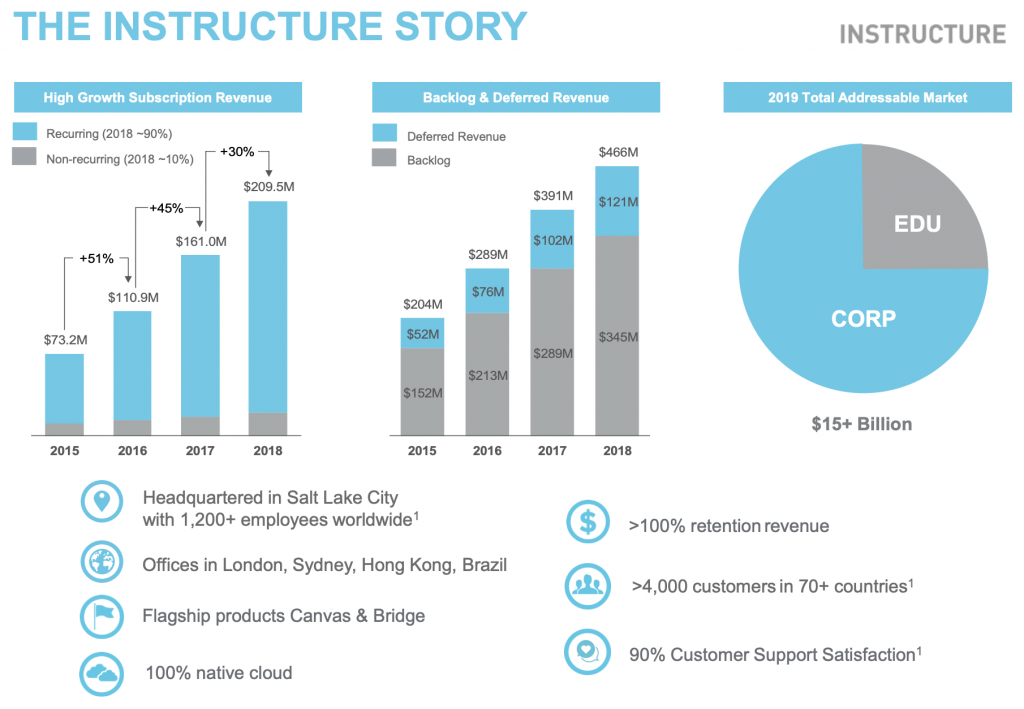
Instructure: Plans to expand beyond Canvas LMS into machine learning and AI — from mfeldstein.com by Phill Hill

Excerpts:

On the same day as Instructure’s earnings call and release of FY2018 financial results, the company announced the acquisition of Portfolium for $43 million, a small startup focusing on “ePortfolio network, student-centered assessment, job matching capabilities, and academic and co-curricular pathways”.
…
Instructure now views itself as a company with a suite of products, and they are much more open to using corporate M&A to build this portfolio.
…

We already have analytical capabilities in our Canvas platform. I want to be really clear and delineate the difference between an analytics and reporting capability, and a machine learning and AI platform.
…
We have the most comprehensive database on the educational experience in the globe. So given that information that we have, no one else has those data assets at their fingertips to be able to develop those algorithms and predictive models.
…

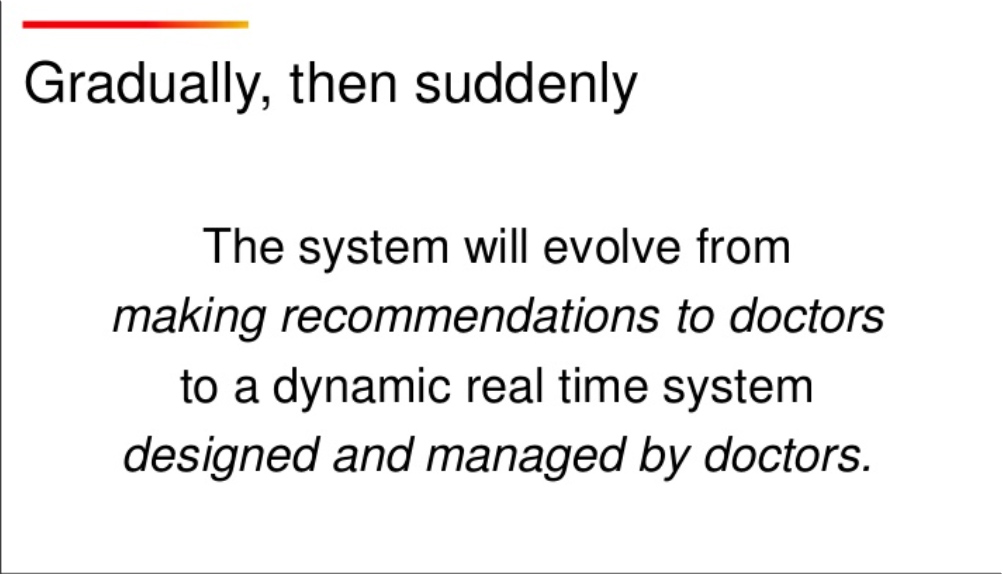
What’s even more interesting and compelling is that we can take that information, correlate it across all sorts of universities, curricula, etc, and we can start making recommendations and suggestions to the student or instructor in how they can be more successful. Watch this video, read this passage, do problems 17-34 in this textbook, spend an extra two hours on this or that. When we drive student success, we impact things like retention, we impact the productivity of the teachers, and it’s a huge opportunity. That’s just one small example. Our DIG initiative, it is first and foremost a platform for ML and AI, and we will deliver and monetize it by offering different functional domains of predictive algorithms and insights. Maybe things like student success, retention, coaching and advising, career pathing, as well as a number of the other metrics that will help improve the value of an institution or connectivity across institutions.


From DSC:
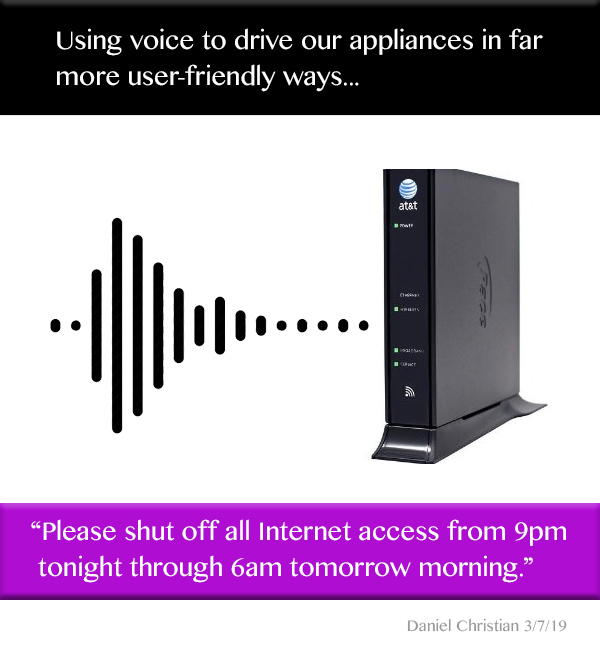
Our family uses AT&T for our smartphones and for our Internet access. What I would really like from AT&T is to be able to speak into an app — either located on a smartphone or have their routers morph into Alexa-type of devices — to be able to speak to what I want my router to do:

“Turn off Internet access tonight from 9pm until 6am tomorrow morning.”
“Only allow Internet access for parents’ accounts.”
“Upgrade my bandwidth for the next 2 hours.”

Upon startup, the app would ask whether I wanted to setup any “admin” types of accounts…and, if so, would recognize that voice/those voices as having authority and control over the device.

Would you use this type of interface? I know I would!

P.S. I’d like to be able to speak to our
thermostat in that sort of way as well.

 
© 2025 | Daniel Christian