OpenAI and NVIDIA announce strategic partnership to deploy 10 gigawatts of NVIDIA systems — from openai.com

  • Strategic partnership enables OpenAI to build and deploy at least 10 gigawatts of AI datacenters with NVIDIA systems representing millions of GPUs for OpenAI’s next-generation AI infrastructure.
  • To support the partnership, NVIDIA intends to invest up to $100 billion in OpenAI progressively as each gigawatt is deployed.
  • The first gigawatt of NVIDIA systems will be deployed in the second half of 2026 on NVIDIA’s Vera Rubin platform.

Also on Nvidia’s site here.

The Neuron Daily comments on this partnership here and also see their thoughts here:

Why this matters: The partnership kicks off in the second half of 2026 with NVIDIA’s new Vera Rubin platform. OpenAI will use this massive compute power to train models beyond what we’ve seen with GPT-5 and likely also power what’s called inference (when you ask a question to chatGPT, and it gives you an answer). And NVIDIA gets a guaranteed customer for their most advanced chips. Infinite money glitch go brrr am I right? Though to be fair, this kinda deal is as old as the AI industry itself.

This isn’t just about bigger models, mind you: it’s about infrastructure for what both companies see as the future economy. As Sam Altman put it, “Compute infrastructure will be the basis for the economy of the future.”

Our take: We think this news is actually super interesting when you pair it with the other big headline from today: Commonwealth Fusion Systems signed a commercial deal worth more than $1B with Italian energy company Eni to purchase fusion power from their 400 MW ARC plant in Virginia. Here’s what that means for AI…

…and while you’re on that posting from The Neuron Daily, also see this piece:

AI filmmaker Dinda Prasetyo just released “Skyland,” a fantasy short film about a guy named Aeryn and his “loyal flying fish”, and honestly, the action sequences look like they belong in an actual film…

What’s wild is that Dinda used a cocktail of AI tools (Adobe FireflyMidJourney, the newly launched Luma Ray 3, and ElevenLabs) to create something that would’ve required a full production crew just two years ago.


The Era of Prompts Is Over. Here’s What Comes Next. — from builtin.com by Ankush Rastogi
If you’re still prompting your AI, you’re behind the curve. Here’s how to prepare for the coming wave of AI agents.

Summary: Autonomous AI agents are emerging as systems that handle goals, break down tasks and integrate with tools without constant prompting. Early uses include call centers, healthcare, fraud detection and research, but concerns remain over errors, compliance risks and unchecked decisions.

The next shift is already peeking around the corner, and it’s going to make prompts look primitive. Before long, we won’t be typing carefully crafted requests at all. We’ll be leaning on autonomous AI agents, systems that don’t just spit out answers but actually chase goals, make choices and do the boring middle steps without us guiding them. And honestly, this jump might end up dwarfing the so-called “prompt revolution.”


Chrome: The browser you love, reimagined with AI — from blog.google by Parisa Tabriz

A new way to get things done with your AI browsing assistant
Imagine you’re a student researching a topic for a paper, and you have dozens of tabs open. Instead of spending hours jumping between sources and trying to connect the dots, your new AI browsing assistant — Gemini in Chrome 1 — can do it for you. Gemini can answer questions about articles, find references within YouTube videos, and will soon be able to help you find pages you’ve visited so you can pick up exactly where you left off.

Rolling out to Mac and Windows users in the U.S. with their language set to English, Gemini in Chrome can understand the context of what you’re doing across multiple tabs, answer questions and integrate with other popular Google services, like Google Docs and Calendar. And it’ll be available on both Android and iOS soon, letting you ask questions and summarize pages while you’re on the go.

We’re also developing more advanced agentic capabilities for Gemini in Chrome that can perform multi-step tasks for you from start to finish, like ordering groceries. You’ll remain in control as Chrome handles the tedious work, turning 30-minute chores into 3-click user journeys.


GRCC students to use AI to help businesses solve ‘real world’ challenges in new course — from www-mlive-com.cdn.ampproject.org by Brian McVicar; via Patrick Bailey on LinkedIn

GRAND RAPIDS, MI — A new course at Grand Rapids Community College aims to help students learn about artificial intelligence by using the technology to solve real-world business problems.

In a release, the college said its grant application was supported by 20 local businesses, including Gentex, TwistThink and the Grand Rapids Public Museum. The businesses have pledged to work with students who will use business data to develop an AI project such as a chatbot that interacts with customers, or a program that automates social media posts or summarizes customer data.

“This rapidly emerging technology can transform the way businesses process data and information,” Kristi Haik, dean of GRCC’s School of Science, Technology, Engineering and Mathematics, said in a statement. “We want to help our local business partners understand and apply the technology. We also want to create real experiences for our students so they enter the workforce with demonstrated competence in AI applications.”

As Patrick Bailey said on LinkedIn about this article:

Nice to see a pedagogy that’s setting a forward movement rather than focusing on what could go wrong with AI in a curriculum.


Forecast for Learning and Earning in 2025-2026 report — from pages.asugsvsummit.com by Jennifer Lee and Claire Zau

In this look ahead at the future of learning and work, we aim to define:

  • Major thematic observations
  • What makes this moment an inflection point
  • Key predictions (and their precedent)
  • Short- and long-term projected impacts


The LMS at 30: From Course Management to Learning Management (At Last) — from onedtech.philhillaa.com; a guest post from Matthew Pittinsky, Ph.D.

As a 30 year observer and participant, it seems to me that previous technology platform shifts like SaaS and mobile did not fundamentally change the LMS. AI is different. We’re standing at the precipice of LMS 2.0, where the branding change from Course Management System to Learning Management System will finally live up to its name. Unlike SaaS or mobile, AI represents a technology platform shift that will transform the way participants interact with learning systems – and with it, the nature of the LMS itself.

Given the transformational potential of AI, it is useful to set the context and think about how we got here, especially on this 30th anniversary of the LMS.

LMS at 30 Part 2: Learning Management in the AI Era — from onedtech.philhillaa.com; a guest post from Matthew Pittinsky, Ph.D.

Where AI is disruptive is in its ability to introduce a whole new set of capabilities that are best described as personalized learning services. AI offers a new value proposition to the LMS, roughly the set of capabilities currently being developed in the AI Tutor / agentic TA segment. These new capabilities are so valuable given their impact on learning that I predict they will become the services with greatest engagement within a school or university’s “enterprise” instructional platform.

In this way, by LMS paradigm shift, I specifically mean a shift from buyers valuing the product on its course-centric and course management capabilities, to valuing it on its learner-centric and personalized learning capabilities.


AI and the future of education: disruptions, dilemmas and directions — from unesdoc.unesco.org

This anthology reveals how the integration of AI in education poses profound philosophical, pedagogical, ethical and political questions. As this global AI ecosystem evolves and becomes increasingly ubiquitous, UNESCO and its partners have a shared responsibility to lead the global discourse towards an equity- and justice-centred agenda. The volume highlights three areas in which UNESCO will continue to convene and lead a global commons for dialog and action particularly in areas on AI futures, policy and practice innovation, and experimentation.

  1. As guardian of ethical, equitable human-centred AI in education.
  2. As thought leader in reimagining curriculum and pedagogy
  3. As a platform for engaging pluralistic and contested dialogues

AI, copyright and the classroom: what higher education needs to know — from timeshighereducation.com by Cayce Myers
As artificial intelligence reshapes teaching and research, one legal principle remains at the heart of our work: copyright. Understanding its implications isn’t just about compliance – it’s about protecting academic integrity, intellectual property and the future of knowledge creation. Cayce Myers explains


The School Year We Finally Notice “The Change” — from americanstogether.substack.com by Jason Palmer

Why It Matters
A decade from now, we won’t say “AI changed schools.” We’ll say: this was the year schools began to change what it means to be human, augmented by AI.

This transformation isn’t about efficiency alone. It’s about dignity, creativity, and discovery, and connecting education more directly to human flourishing. The industrial age gave us schools to produce cookie-cutter workers. The digital age gave us knowledge anywhere, anytime. The AI age—beginning now—gives us back what matters most: the chance for every learner to become infinitely capable.

This fall may look like any other—bells ringing, rows of desks—but beneath the surface, education has begun its greatest transformation since the one-room schoolhouse.


How should universities teach leadership now that teams include humans and autonomous AI agents? — from timeshighereducation.com by Alex Zarifis
Trust and leadership style are emerging as key aspects of teambuilding in the age of AI. Here are ways to integrate these considerations with technology in teaching

Transactional and transformational leaderships’ combined impact on AI and trust
Given the volatile times we live in, a leader may find themselves in a situation where they know how they will use AI, but they are not entirely clear on the goals and journey. In a teaching context, students can be given scenarios where they must lead a team, including autonomous AI agents, to achieve goals. They can then analyse the situations and decide what leadership styles to apply and how to build trust in their human team members. Educators can illustrate this decision-making process using a table (see above).

They may need to combine transactional leadership with transformational leadership, for example. Transactional leadership focuses on planning, communicating tasks clearly and an exchange of value. This works well with both humans and automated AI agents.


Introducing the 2025 State of the L&D Industry Report — from community.elearningacademy.io

What’s changing is not the foundation—it’s the ecosystem. Teams are looking to create more flexible, scalable, and diverse learning experiences that meet people where they are.

What Did We Explore?
Everyone seems to have a take on what’s happening in L&D these days. From bold claims about six-figure roles to debates over whether portfolios or degrees matter more, everyone seems to have a take. So, we wanted to get to the heart of it by exploring five of the biggest, most debated areas shaping our work today:

  • Salaries: Are compensation trends really keeping pace with the value we deliver?
  • Hiring: What skills are managers actually looking for—and are those ATS horror stories true?
  • Portfolios: Are portfolios helping candidates stand out, and what are hiring managers actually looking for?
  • Tools & Modalities: What types of training are teams building, and what tools are they using to build it?
  • Artificial Intelligence: Who’s using it, how, and what concerns still exist?

These five areas are shaping the future of instructional design—not just for job seekers, but for team leaders, hiring managers, and the entire ecosystem of L&D professionals.

The takeaway? A portfolio is more than a collection of projects—it’s a storytelling tool. The ones that stand out highlight process, decision-making, and results—not just pretty screens.


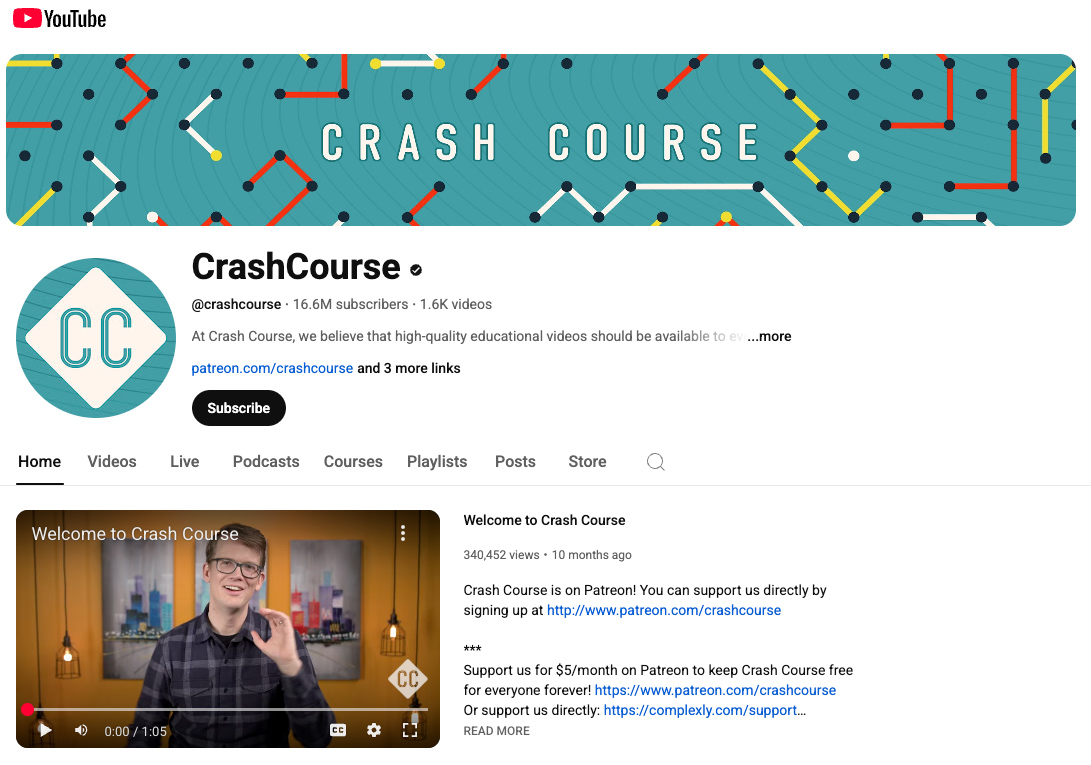
CrashCourse on YouTube — via Matt Tower’s The EdSheet Vol. 18

Description:
At Crash Course, we believe that high-quality educational videos should be available to everyone for free! Subscribe for weekly videos from our current courses! The Crash Course team has produced more than 50 courses on a wide variety of subjects, ranging from the humanities to sciences and so much more! We also recently teamed up with Arizona State University to bring you more courses on the Study Hall channel.

And as Matt stated:


From DSC:
I wasn’t familiar with this “channel” — but I like their mission to help people learn…very inexpensively! Along these lines,  I, too, pray for the world’s learning ecosystems — especially those belonging to children.


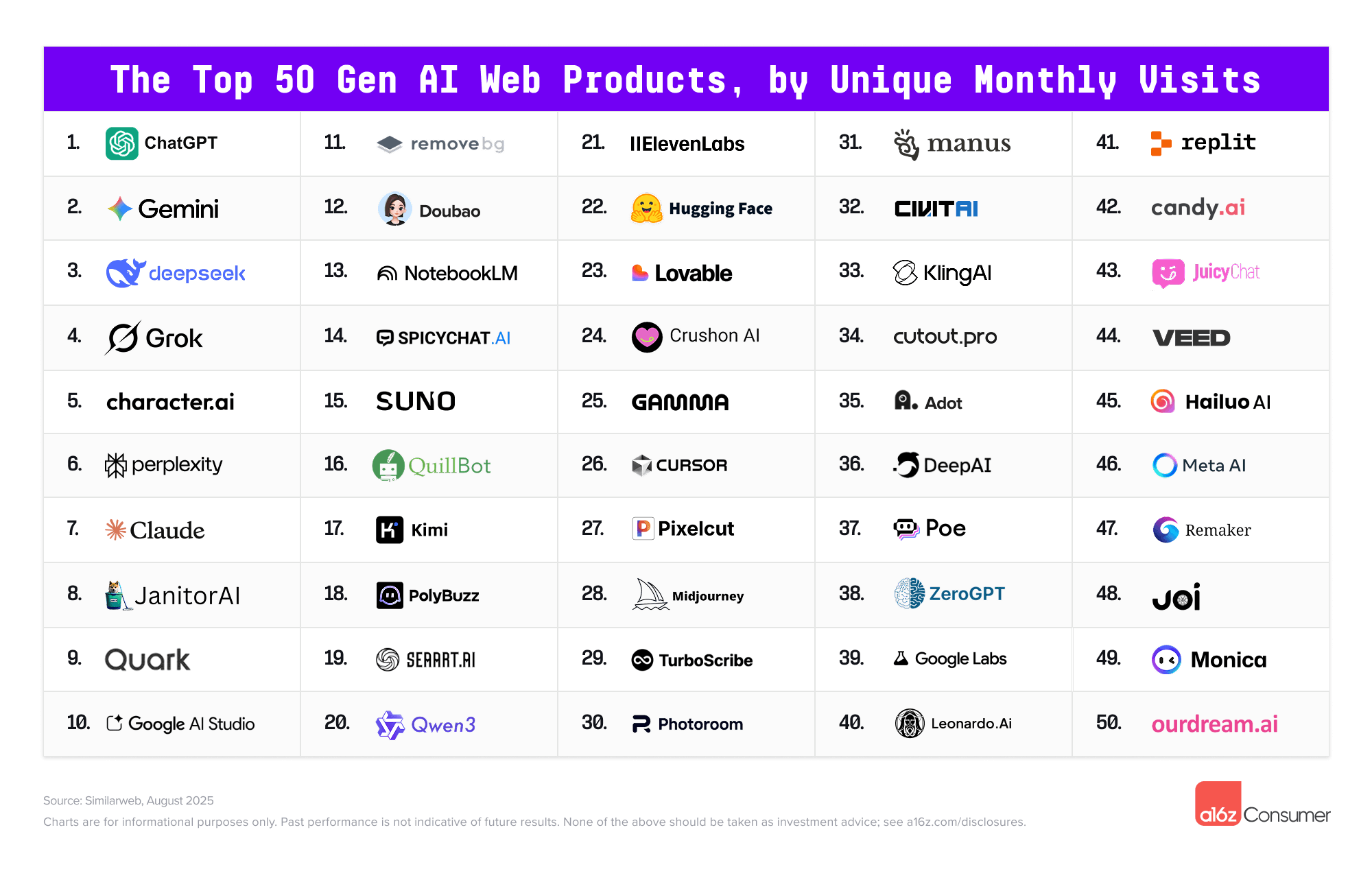
The Top 100 [Gen AI] Consumer Apps 5th edition — from a16z.com


And in an interesting move by Microsoft and Samsung:

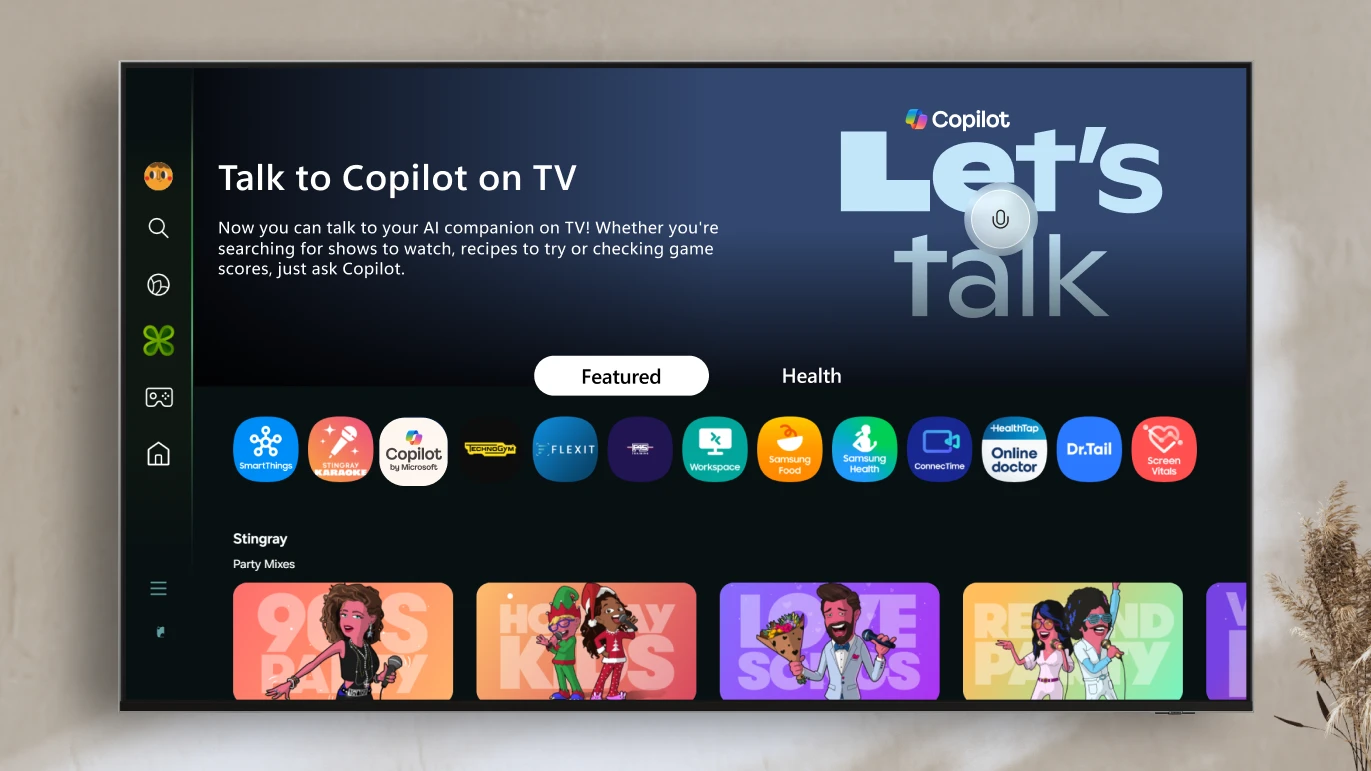
A smarter way to talk to your TV: Microsoft Copilot launches on Samsung TVs and monitors — from microsoft.com

Voice-powered AI meets a visual companion for entertainment, everyday help, and everything in between. 

Redmond, Wash., August 27—Today, we’re announcing the launch of Copilot on select Samsung TVs and monitors, transforming the biggest screen in your home into your most personal and helpful companion—and it’s free to use.

Copilot makes your TV easier and more fun to use with its voice-powered interface, friendly on-screen character, and simple visual cards. Now you can quickly find what you’re looking for and discover new favorites right from your living room.

Because it lives on the biggest screen in the home, Copilot is a social experience—something you can use together with family and friends to spark conversations, help groups decide what to watch, and turn the TV into a shared space for curiosity and connection.


Firefly adds new video capabilities, industry leading AI models, and Generate Sound Effects feature — from blog.adobe.com

Today, we’re introducing powerful enhancements to our Firefly Video Model, including improved motion fidelity and advanced video controls that will accelerate your workflows and provide the precision and style you need to elevate your storytelling. We are also adding new generative AI partner models within Generate Video on Firefly, giving you the power to choose which model works best for your creative needs across image, video and sound.

Plus, our new workflow tools put you in control of your video’s composition and style. You can now layer in custom-generated sound effects right inside the Firefly web app — and start experimenting with AI-powered avatar-led videos.

Generate Sound Effects (beta)
Sound is a powerful storytelling tool that adds emotion and depth to your videos. Generate Sound Effects (beta) makes it easy to create custom sounds, like a lion’s roar or ambient nature sounds, that enhance your visuals. And like our other Firefly generative AI models, Generate Sound Effects (beta) is commercially safe, so you can create with confidence.

Just type a simple text prompt to generate the sound effect you need. Want even more control? Use your voice to guide the timing and intensity of the sound. Firefly listens to the energy and rhythm of your voice to place sound effects precisely where they belong — matching the action in your video with cinematic timing.


“Using AI Right Now: A Quick Guide” [Molnick] + other items re: AI in our learning ecosystems

Thoughts on thinking — from dcurt.is by Dustin Curtis

Intellectual rigor comes from the journey: the dead ends, the uncertainty, and the internal debate. Skip that, and you might still get the insight–but you’ll have lost the infrastructure for meaningful understanding. Learning by reading LLM output is cheap. Real exercise for your mind comes from building the output yourself.

The irony is that I now know more than I ever would have before AI. But I feel slightly dumber. A bit more dull. LLMs give me finished thoughts, polished and convincing, but none of the intellectual growth that comes from developing them myself. 


Using AI Right Now: A Quick Guide — from oneusefulthing.org by Ethan Mollick
Which AIs to use, and how to use them

Every few months I put together a guide on which AI system to use. Since I last wrote my guide, however, there has been a subtle but important shift in how the major AI products work. Increasingly, it isn’t about the best model, it is about the best overall system for most people. The good news is that picking an AI is easier than ever and you have three excellent choices. The challenge is that these systems are getting really complex to understand. I am going to try and help a bit with both.

First, the easy stuff.

Which AI to Use
For most people who want to use AI seriously, you should pick one of three systems: Claude from Anthropic, Google’s Gemini, and OpenAI’s ChatGPT.

Also see:


Student Voice, Socratic AI, and the Art of Weaving a Quote — from elmartinsen.substack.com by Eric Lars Martinsen
How a custom bot helps students turn source quotes into personal insight—and share it with others

This summer, I tried something new in my fully online, asynchronous college writing course. These classes have no Zoom sessions. No in-person check-ins. Just students, Canvas, and a lot of thoughtful design behind the scenes.

One activity I created was called QuoteWeaver—a PlayLab bot that helps students do more than just insert a quote into their writing.

Try it here

It’s a structured, reflective activity that mimics something closer to an in-person 1:1 conference or a small group quote workshop—but in an asynchronous format, available anytime. In other words, it’s using AI not to speed students up, but to slow them down.

The bot begins with a single quote that the student has found through their own research. From there, it acts like a patient writing coach, asking open-ended, Socratic questions such as:

What made this quote stand out to you?
How would you explain it in your own words?
What assumptions or values does the author seem to hold?
How does this quote deepen your understanding of your topic?
It doesn’t move on too quickly. In fact, it often rephrases and repeats, nudging the student to go a layer deeper.


The Disappearance of the Unclear Question — from jeppestricker.substack.com Jeppe Klitgaard Stricker
New Piece for UNESCO Education Futures

On [6/13/25], UNESCO published a piece I co-authored with Victoria Livingstone at Johns Hopkins University Press. It’s called The Disappearance of the Unclear Question, and it’s part of the ongoing UNESCO Education Futures series – an initiative I appreciate for its thoughtfulness and depth on questions of generative AI and the future of learning.

Our piece raises a small but important red flag. Generative AI is changing how students approach academic questions, and one unexpected side effect is that unclear questions – for centuries a trademark of deep thinking – may be beginning to disappear. Not because they lack value, but because they don’t always work well with generative AI. Quietly and unintentionally, students (and teachers) may find themselves gradually avoiding them altogether.

Of course, that would be a mistake.

We’re not arguing against using generative AI in education. Quite the opposite. But we do propose that higher education needs a two-phase mindset when working with this technology: one that recognizes what AI is good at, and one that insists on preserving the ambiguity and friction that learning actually requires to be successful.


Leveraging GenAI to Transform a Traditional Instructional Video into Engaging Short Video Lectures — from er.educause.edu by Hua Zheng

By leveraging generative artificial intelligence to convert lengthy instructional videos into micro-lectures, educators can enhance efficiency while delivering more engaging and personalized learning experiences.


This AI Model Never Stops Learning — from link.wired.com by Will Knight

Researchers at Massachusetts Institute of Technology (MIT) have now devised a way for LLMs to keep improving by tweaking their own parameters in response to useful new information.

The work is a step toward building artificial intelligence models that learn continually—a long-standing goal of the field and something that will be crucial if machines are to ever more faithfully mimic human intelligence. In the meantime, it could give us chatbots and other AI tools that are better able to incorporate new information including a user’s interests and preferences.

The MIT scheme, called Self Adapting Language Models (SEAL), involves having an LLM learn to generate its own synthetic training data and update procedure based on the input it receives.


Edu-Snippets — from scienceoflearning.substack.com by Nidhi Sachdeva and Jim Hewitt
Why knowledge matters in the age of AI; What happens to learners’ neural activity with prolonged use of LLMs for writing

Highlights:

  • Offloading knowledge to Artificial Intelligence (AI) weakens memory, disrupts memory formation, and erodes the deep thinking our brains need to learn.
  • Prolonged use of ChatGPT in writing lowers neural engagement, impairs memory recall, and accumulates cognitive debt that isn’t easily reversed.
 

Google I/O 2025: From research to reality — from blog.google
Here’s how we’re making AI more helpful with Gemini.


Google I/O 2025 LIVE — all the details about Android XR smart glasses, AI Mode, Veo 3, Gemini, Google Beam and more — from tomsguide.com by Philip Michaels
Google’s annual conference goes all in on AI

With a running time of 2 hours, Google I/O 2025 leaned heavily into Gemini and new models that make the assistant work in more places than ever before. Despite focusing the majority of the keynote around Gemini, Google saved its most ambitious and anticipated announcement towards the end with its big Android XR smart glasses reveal.

Shockingly, very little was spent around Android 16. Most of its Android 16 related news, like the redesigned Material 3 Expressive interface, was announced during the Android Show live stream last week — which explains why Google I/O 2025 was such an AI heavy showcase.

That’s because Google carved out most of the keynote to dive deeper into Gemini, its new models, and integrations with other Google services. There’s clearly a lot to unpack, so here’s all the biggest Google I/O 2025 announcements.


Our vision for building a universal AI assistant— from blog.google
We’re extending Gemini to become a world model that can make plans and imagine new experiences by simulating aspects of the world.

Making Gemini a world model is a critical step in developing a new, more general and more useful kind of AI — a universal AI assistant. This is an AI that’s intelligent, understands the context you are in, and that can plan and take action on your behalf, across any device.

By applying LearnLM capabilities, and directly incorporating feedback from experts across the industry, Gemini adheres to the principles of learning science to go beyond just giving you the answer. Instead, Gemini can explain how you get there, helping you untangle even the most complex questions and topics so you can learn more effectively. Our new prompting guide provides sample instructions to see this in action.


Learn in newer, deeper ways with Gemini — from blog.google.com by Ben Gomes
We’re infusing LearnLM directly into Gemini 2.5 — plus more learning news from I/O.

At I/O 2025, we announced that we’re infusing LearnLM directly into Gemini 2.5, which is now the world’s leading model for learning. As detailed in our latest report, Gemini 2.5 Pro outperformed competitors on every category of learning science principles. Educators and pedagogy experts preferred Gemini 2.5 Pro over other offerings across a range of learning scenarios, both for supporting a user’s learning goals and on key principles of good pedagogy.


Gemini gets more personal, proactive and powerful — from blog.google.com by Josh Woodward
It’s your turn to create, learn and explore with an AI assistant that’s starting to understand your world and anticipate your needs.

Here’s what we announced at Google IO:

  • Gemini Live with camera and screen sharing, is now free on Android and iOS for everyone, so you can point your phone at anything and talk it through.
  • Imagen 4, our new image generation model, comes built in and is known for its image quality, better text rendering and speed.
  • Veo 3, our new, state-of-the-art video generation model, comes built in and is the first in the world to have native support for sound effects, background noises and dialogue between characters.
  • Deep Research and Canvas are getting their biggest updates yet, unlocking new ways to analyze information, create podcasts and vibe code websites and apps.
  • Gemini is coming to Chrome, so you can ask questions while browsing the web.
  • Students around the world can easily make interactive quizzes, and college students in the U.S., Brazil, Indonesia, Japan and the UK are eligible for a free school year of the Google AI Pro plan.
  • Google AI Ultra, a new premium plan, is for the pioneers who want the highest rate limits and early access to new features in the Gemini app.
  • 2.5 Flash has become our new default model, and it blends incredible quality with lightning fast response times.

Fuel your creativity with new generative media models and tools — from by Eli Collins
Introducing Veo 3 and Imagen 4, and a new tool for filmmaking called Flow.


AI in Search: Going beyond information to intelligence
We’re introducing new AI features to make it easier to ask any question in Search.

AI in Search is making it easier to ask Google anything and get a helpful response, with links to the web. That’s why AI Overviews is one of the most successful launches in Search in the past decade. As people use AI Overviews, we see they’re happier with their results, and they search more often. In our biggest markets like the U.S. and India, AI Overviews is driving over 10% increase in usage of Google for the types of queries that show AI Overviews.

This means that once people use AI Overviews, they’re coming to do more of these types of queries, and what’s particularly exciting is how this growth increases over time. And we’re delivering this at the speed people expect of Google Search — AI Overviews delivers the fastest AI responses in the industry.

In this story:

  • AI Mode in Search
  • Deep Search
  • Live capabilities
  • Agentic capabilities
  • Shopping
  • Personal context
  • Custom charts


New tools for ultimate character consistency — from heatherbcooper.substack.com by Heather B. Cooper
Plus simple & effective video prompt tips

We have some new tools for character, objects, and scene consistency with Runway and Midjourney.


Multimodal AI = multi-danger — from theneurondaily.com by Grant Harvey

According to a new report from Enkrypt AI, multimodal models have opened the door to sneakier attacks (like Ocean’s Eleven, but with fewer suits and more prompt injections).

Naturally, Enkrypt decided to run a few experiments… and things escalated quickly.

They tested two of Mistral’s newest models—Pixtral-Large and Pixtral-12B, built to handle words and visuals.

What they found? Yikes:

    • The models are 40x more likely to generate dangerous chemical / biological / nuclear info.
    • And 60x more likely to produce child sexual exploitation material compared to top models like OpenAI’s GPT-4o or Anthropic’s Claude 3.7 Sonnet.

Rise of AI-generated deepfake videos spreads misinformation — from iblnews.org


“Student Guide to AI”; “AI Isn’t Just Changing How We Work — It’s Changing How We Learn”; + other items re: AI in our LE’s

.Get the 2025 Student Guide to Artificial Intelligence — from studentguidetoai.org
This guide is made available under a Creative Commons license by Elon University and the American Association of Colleges and Universities (AAC&U).
.


AI Isn’t Just Changing How We Work — It’s Changing How We Learn — from entrepreneur.com by Aytekin Tank; edited by Kara McIntyre
AI agents are opening doors to education that just a few years ago would have been unthinkable. Here’s how.

Agentic AI is taking these already huge strides even further. Rather than simply asking a question and receiving an answer, an AI agent can assess your current level of understanding and tailor a reply to help you learn. They can also help you come up with a timetable and personalized lesson plan to make you feel as though you have a one-on-one instructor walking you through the process. If your goal is to learn to speak a new language, for example, an agent might map out a plan starting with basic vocabulary and pronunciation exercises, then progress to simple conversations, grammar rules and finally, real-world listening and speaking practice.

For instance, if you’re an entrepreneur looking to sharpen your leadership skills, an AI agent might suggest a mix of foundational books, insightful TED Talks and case studies on high-performing executives. If you’re aiming to master data analysis, it might point you toward hands-on coding exercises, interactive tutorials and real-world datasets to practice with.

The beauty of AI-driven learning is that it’s adaptive. As you gain proficiency, your AI coach can shift its recommendations, challenge you with new concepts and even simulate real-world scenarios to deepen your understanding.

Ironically, the very technology feared by workers can also be leveraged to help them. Rather than requiring expensive external training programs or lengthy in-person workshops, AI agents can deliver personalized, on-demand learning paths tailored to each employee’s role, skill level, and career aspirations. Given that 68% of employees find today’s workplace training to be overly “one-size-fits-all,” an AI-driven approach will not only cut costs and save time but will be more effective.


What’s the Future for AI-Free Spaces? — from higherai.substack.com by Jason Gulya
Please let me dream…

This is one reason why I don’t see AI-embedded classrooms and AI-free classrooms as opposite poles. The bone of contention, here, is not whether we can cultivate AI-free moments in the classroom, but for how long those moments are actually sustainable.

Can we sustain those AI-free moments for an hour? A class session? Longer?

Here’s what I think will happen. As AI becomes embedded in society at large, the sustainability of imposed AI-free learning spaces will get tested. Hard. I think it’ll become more and more difficult (though maybe not impossible) to impose AI-free learning spaces on students.

However, consensual and hybrid AI-free learning spaces will continue to have a lot of value. I can imagine classes where students opt into an AI-free space. Or they’ll even create and maintain those spaces.


Duolingo’s AI Revolution — from drphilippahardman.substack.com by Dr. Philippa Hardman
What 148 AI-Generated Courses Tell Us About the Future of Instructional Design & Human Learning

Last week, Duolingo announced an unprecedented expansion: 148 new language courses created using generative AI, effectively doubling their content library in just one year. This represents a seismic shift in how learning content is created — a process that previously took the company 12 years for their first 100 courses.

As CEO Luis von Ahn stated in the announcement, “This is a great example of how generative AI can directly benefit our learners… allowing us to scale at unprecedented speed and quality.”

In this week’s blog, I’ll dissect exactly how Duolingo has reimagined instructional design through AI, what this means for the learner experience, and most importantly, what it tells us about the future of our profession.


Are Mixed Reality AI Agents the Future of Medical Education? — from ehealth.eletsonline.com

Medical education is experiencing a quiet revolution—one that’s not taking place in lecture theatres or textbooks, but with headsets and holograms. At the heart of this revolution are Mixed Reality (MR) AI Agents, a new generation of devices that combine the immersive depth of mixed reality with the flexibility of artificial intelligence. These technologies are not mere flashy gadgets; they’re revolutionising the way medical students interact with complicated content, rehearse clinical skills, and prepare for real-world situations. By combining digital simulations with the physical world, MR AI Agents are redefining what it means to learn medicine in the 21st century.


4 Reasons To Use Claude AI to Teach — from techlearning.com by Erik Ofgang
Features that make Claude AI appealing to educators include a focus on privacy and conversational style.

After experimenting using Claude AI on various teaching exercises, from generating quizzes to tutoring and offering writing suggestions, I found that it’s not perfect, but I think it behaves favorably compared to other AI tools in general, with an easy-to-use interface and some unique features that make it particularly suited for use in education.


Students and folks looking for work may want to check out:

Also relevant/see:


© 2025 | Daniel Christian