Retailers cut tens of thousands of jobs. Again. — from money.cnn.com by Paul R. La Monica
The dramatic reshaping of the American retail industry has, unfortunately, led to massive job losses in the sector.

Excerpt (emphasis DSC):

The federal government said Friday that retailers shed nearly 30,000 jobs in March. That follows a more than 30,000 decline in the number of retail jobs in the previous month.

So-called general merchandise stores are hurting the most.

That part of the sector, which includes struggling companies like Macy’s, Sears, and J.C. Penney, lost 35,000 jobs last month. Nearly 90,000 jobs have been eliminated since last October.
…
“There is no question that the Amazon effect is overwhelming,” said Scott Clemons, chief investment strategist of private banking for BBH. “There has been a shift in the way we buy things as opposed to a shift in the amount of money spent.”

To that end, Amazon just announced plans to hire 30,000 part-time workers.


From DSC:
One of the reasons that I’m posting this item is for those who say disruption isn’t real…it’s only a buzz word…

A second reason that I’m posting this item is because those of us working within higher education should take note of the changes in the world of retail and learn the lesson now before the “Next Amazon.com of Higher Education*” comes on the scene. Though this organization has yet to materialize, the pieces of its foundation are beginning to come together — such as the ingredients, trends, and developments that I’ve been tracking in my “Learning from the Living [Class] Room” vision.

This new organization will be highly disruptive to institutions of traditional higher education.

If you were in an influential position at Macy’s, Sears, and/or at J.C. Penney today, and you could travel back in time…what would you do?

We in higher education have the luxury of learning from what’s been happening in the retail business. Let’s be sure to learn our lesson.


* Effective today, what I used to call the “Forthcoming Walmart of Education“ — which has already been occurring to some degree with things such as MOOCs and collaborations/partnerships such as Georgia Institute of Technology, Udacity, and AT&T — I now call the “Next Amazon.com of Higher Education.”

Cost. Convenience. Selection. Offering a service on-demand (i.e., being quick, responsive, and available 24×7). <– These all are powerful forces.


P.S. Some will say you can’t possibly compare the worlds of retail and higher education — and that may be true as of 2017. However, if:

  • the costs of higher education keep going up and we continue to turn a deaf ear to the struggling families/students/adult learners/etc. out there
  • alternatives to traditional higher education continue to come on the landscape
  • the Federal Government continues to be more open to financially supporting such alternatives
  • technologies such as artificial intelligence, machine learning, deep learning continue to get better and more powerful — to the point that they can effectively deliver a personalized education (one that is likely to be fully online and that utilizes a team of specialists to create and deliver the learning experiences)
  • people lose their jobs to artificial intelligence, robotics, and automation and need to quickly reinvent themselves

…I can assure you that people will find other ways to make ends meet. The Next Amazon.com of Education will be just what they are looking for.


The 82 Hottest EdTech Tools of 2017 According to Education Experts — from tutora.co.uk by Giorgio Cassella

Excerpt:

If you work in education, you’ll know there’s a HUGE array of applications, services, products and tools created to serve a multitude of functions in education.

Tools for teaching and learning, parent-teacher communication apps, lesson planning software, home-tutoring websites, revision blogs, SEN education information, professional development qualifications and more.

There are so many companies creating new products for education, though, that it can be difficult to keep up – especially with the massive volumes of planning and marking teachers have to do, never mind finding the time to actually teach!

So how do you know which ones are the best?

Well, as a team of people passionate about education and learning, we decided to do a bit of research to help you out.

We’ve asked some of the best and brightest in education for their opinions on the hottest EdTech of 2017. These guys are the real deal – experts in education, teaching and new tech from all over the world from England to India, to New York and San Francisco.

They’ve given us a list of 82 amazing, tried and tested tools…


From DSC:
The ones that I mentioned that Giorgio included in his excellent article were:

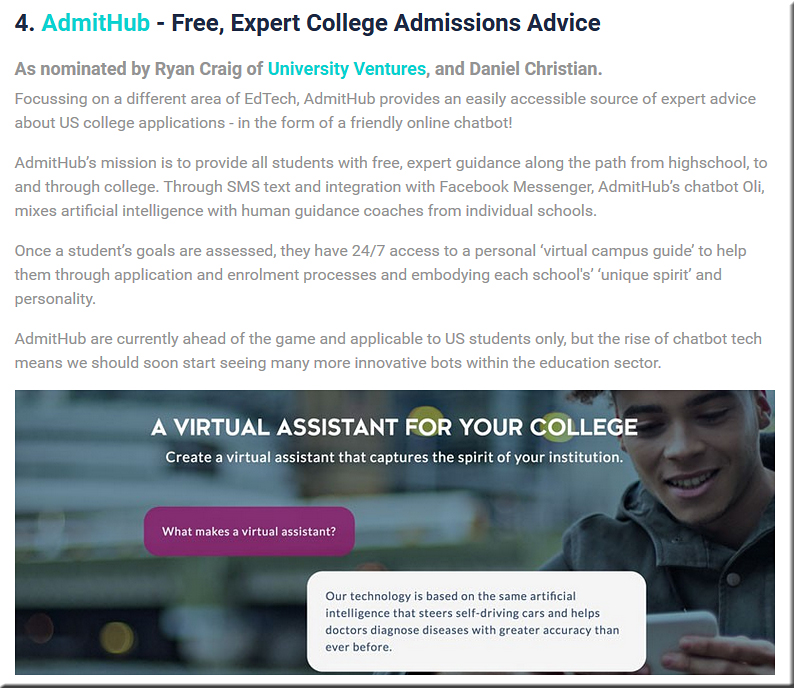
  • AdmitHub – Free, Expert College Admissions Advice
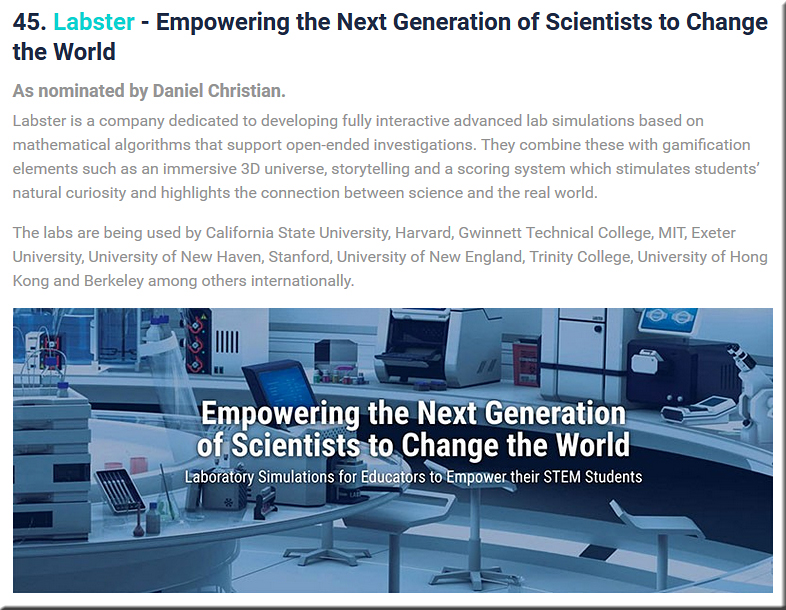
  • Labster – Empowering the Next Generation of Scientists to Change the World
  • Unimersiv – Virtual Reality Educational Experiences
  • Lifeliqe – Interactive 3D Models to Augment Classroom Learning


From DSC:
After reviewing the article and video (below), it will be interesting to see how machine-to-machine (M2M) communications will be used in combination with augmented reality — and perhaps with virtual reality and mixed reality as well. That is, get to within a certain range of an object, and something automatically happens on your mobile device or your head mounted device. Perhaps that’s the sort of thing Apple is building into their next smart phone. It would sure open up some interesting learning and entertainment-related experiences — as such new affordances could help foster anticipation and curiosity, while grabbing someone’s attention.

This type of thing could easily become a piece of the future of art and creativity.


Mini-Mirages Emerge in an Augmented Reality Art Exhibition — from creators.vice.com by Nathaniel Ainley
Adrien M and Claire B’s latest series of installations basically looks like Harry Potter magic come to life.

Excerpt:

Even in its early beta stages, the new live exhibition from digital artists Adrien M and Claire B will have you rubbing your eyes in disbelief. Throughout their Mirages & Miracles display, the artist duo uses wondrous applications of augmented reality to create an orchestra of new installations, both small and large. Much like their live dance performance work at BAM, the new bundle merges the digital with the material, blurring the lines between what is real and what is fake. The multi-pronged ensemble uses augmented drawings, holographic illusions, virtual-reality headsets, and large-scale projections to create a number of unbelievable scenarios “that take root in both the mirage and the miracle,” according to the duo.


Mirages & miracles, premier aperçu… from Adrien M & Claire B on Vimeo.


The Hidden Costs of Active Learning — from by Thomas Mennella
Flipped and active learning truly are a better way for students to learn, but they also may be a fast track to instructor burnout.

Excerpt:

The time has come for us to have a discussion about the hidden cost of active learning in higher education. Soon, gone will be the days of instructors arriving to a lecture hall, delivering a 75-minute speech and leaving. Gone will be the days of midterms and finals being the sole forms of assessing student learning. For me, these days have already passed, and good riddance. These are largely ineffective teaching and learning strategies. Today’s college classroom is becoming dynamic, active and student-centered. Additionally, the learning never stops because the dialogue between student and instructor persists endlessly over the internet. Trust me when I say that this can be exhausting. With constant ‘touch-points,’ ‘personalized learning opportunities’ and the like, the notion of a college instructor having 12 contact hours per week that even remotely total 12 hours is beyond unreasonable.

We need to reevaluate how we measure, assign and compensate faculty teaching loads within an active learning framework. We need to recognize that instructors teaching in these innovative ways are doing more, and spending more hours, than their more traditional colleagues. And we must accept that a failure to recognize and remedy these ‘new normals’ risks burning out a generation of dedicated and passionate instructors. Flipped learning works and active learning works, but they’re very challenging ways to teach. I still say I will never teach another way again … I’m just not sure for how much longer that can be.


From DSC:
The above article prompted me to revisit the question of how we might move towards using more team-based approaches…? Thomas Mennella seems to be doing an incredible job — but grading 344 assignments each week or 3,784 assignments this semester is most definitely a recipe for burnout.

Then, pondering this situation, an article came to my mind that discusses Thomas Frey’s prediction that the largest internet-based company of 2030 will be focused on education.

I wondered…who will be the Amazon.com of the future of education? 

Such an organization will likely utilize a team-based approach to create and deliver excellent learning experiences — and will also likely leverage the power of artificial intelligence/machine learning/deep learning as a piece of their strategy.


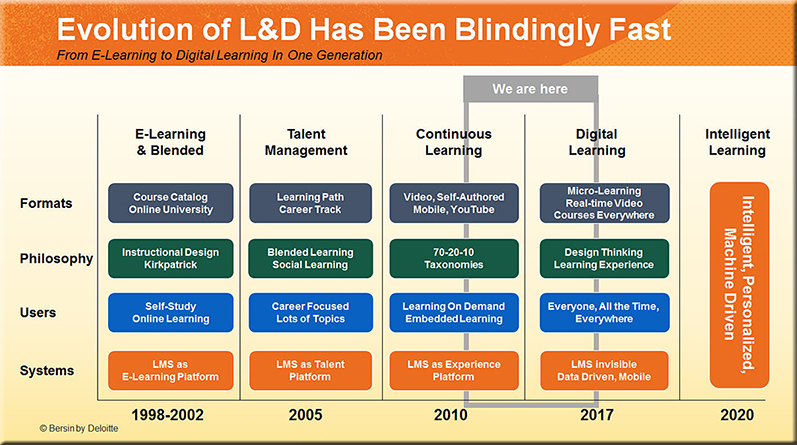
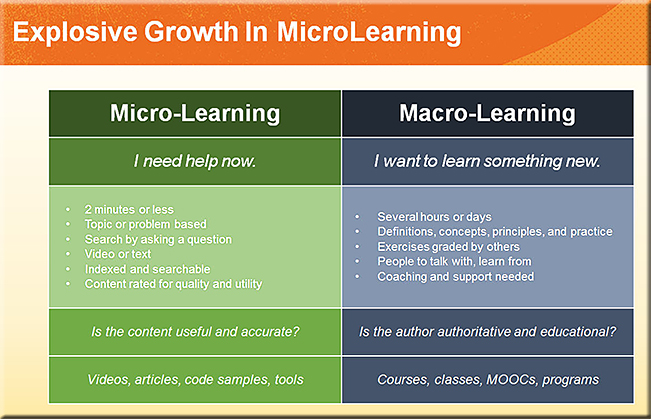
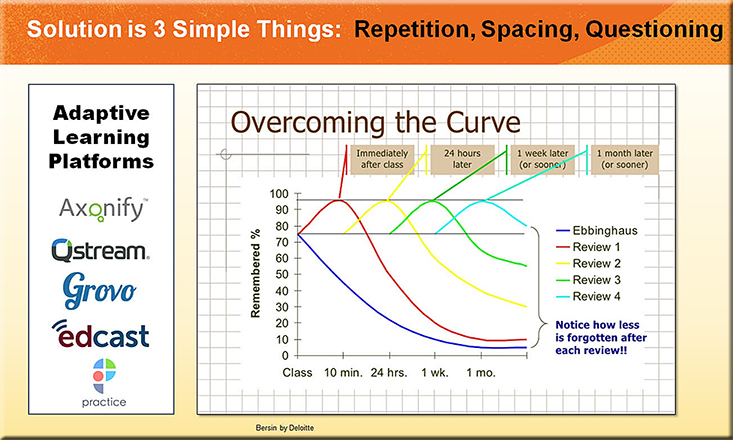
The disruption of digital learning: Ten things we have learned — from joshbersin.com

Excerpt:

Over the last few months I’ve had a series of meetings with Chief Learning Officers, talent management leaders, and vendors of next generation learning tools. My goal has been simple: try to make sense of the new corporate learning landscape, which for want of a better word, we can now call “Digital Learning.” In this article I’d like to share ten things to think about, with the goal of helping L&D professionals, HR leaders, and business leaders understand how the world of corporate learning has changed.


Digital Learning does not mean learning on your phone, it means “bringing learning to where employees are.” 

It is a “way of learning” not a “type of learning.”


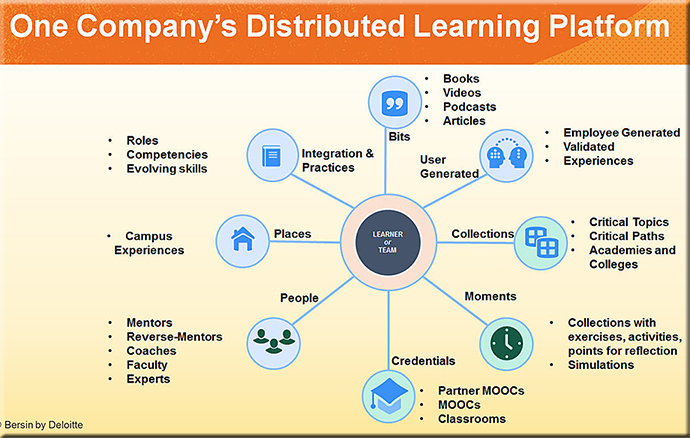
The traditional LMS is no longer the center of corporate learning, and it’s starting to go away.


What Josh calls a Distributed Learning Platform, I call a Learning Ecosystem:


Also see:

  • Watch Out, Corporate Learning: Here Comes Disruption — from forbes.com by Josh Bersin
    Excerpt:
    The corporate training market, which is over $130 billion in size, is about to be disrupted. Companies are starting to move away from their Learning Management Systems (LMS), buy all sorts of new tools for digital learning, and rebuild a whole new infrastructure to help employees learn. And the impact of GSuite,  Microsoft Teams, Slack, and Workplace by Facebook could be enormous.
    …
    We are living longer, jobs are changing faster than ever, and automation is impinging on our work lives more every day. If we can’t look things up, learn quickly, and find a way to develop new skills at work, most of us would prefer to change jobs, rather than stay in a company that doesn’t let us reinvent ourselves over time.


From DSC:
For you ed tech vendors, programmers, and/or entrepreneurs out there, would you please create the software to do this? By the way, for purposes of equal access, this could be done in class — it doesn’t have to be done outside of normal school hours.


From DSC:
Can you imagine this as a virtual reality or a mixed reality-based app!?! Very cool.

This resource is incredible on multiple levels:

  • For their interface/interaction design
  • For their insights and ideas
  • For their creativity
  • For their graphics
  • …and more!


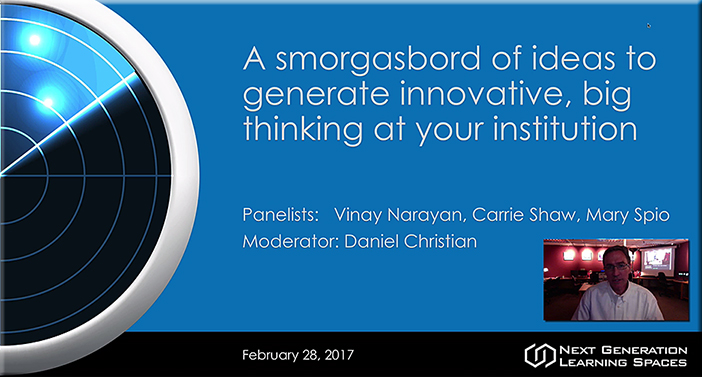
A smorgasboard of ideas to put on your organization’s radar! [Christian]

From DSC:
At the Next Generation Learning Spaces Conference, held recently in San Diego, CA, I moderated a panel discussion re: AR, VR, and MR.  I started off our panel discussion with some introductory ideas and remarks — meant to make sure that numerous ideas were on the radars at attendees’ organizations. Then Vinay and Carrie did a super job of addressing several topics and questions (Mary was unable to make it that day, as she got stuck in the UK due to transportation-related issues).

That said, I didn’t get a chance to finish the second part of the presentation which I’ve listed below in both 4:3 and 16:9 formats.  So I made a recording of these ideas, and I’m relaying it to you in the hopes that it can help you and your organization.


Presentations/recordings:


Audio/video recording (187 MB MP4 file)


Again, I hope you find this information helpful.

Thanks,
Daniel


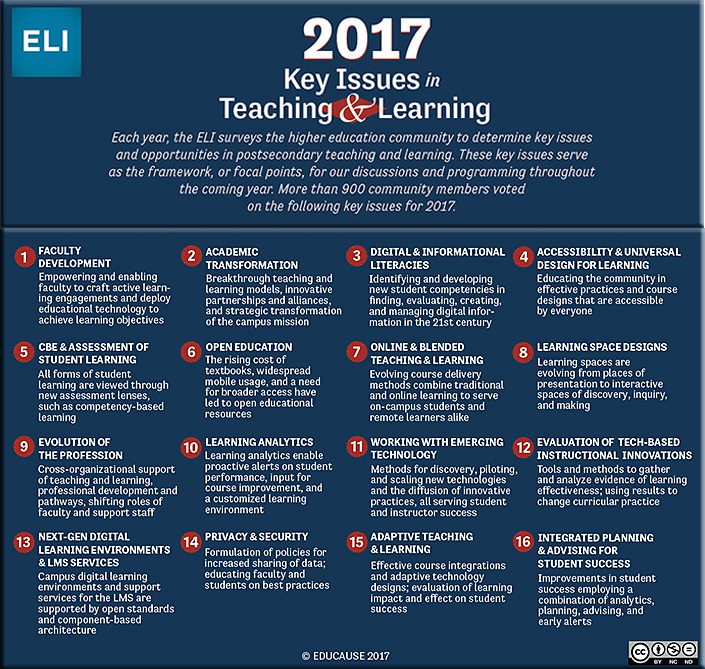
Key issues in teaching and learning 2017 — from Educause Learning Initiative (ELI)

Excerpt:

Since 2011, ELI has surveyed the higher education teaching and learning community to identify its key issues. The community is wide in scope: we solicit input from all those participating in the support of the teaching and learning mission, including professionals from the IT organization, the center for teaching and learning, the library, and the dean’s and provost’s offices.


IBM to Train 25 Million Africans for Free to Build Workforce — from by Loni Prinsloo
* Tech giant seeking to bring, keep digital jobs in Africa
* Africa to have world’s largest workforce by 2040, IBM projects

Excerpt:

International Business Machines Corp. is ramping up its digital-skills training program to accommodate as many as 25 million Africans in the next five years, looking toward building a future workforce on the continent. The U.S. tech giant plans to make an initial investment of 945 million rand ($70 million) to roll out the training initiative in South Africa…


Also see:

IBM Unveils IT Learning Platform for African Youth — from investopedia.com by Tim Brugger

Excerpt (emphasis DSC):

Responding to concerns that artificial intelligence (A.I.) in the workplace will lead to companies laying off employees and shrinking their work forces, IBM (NYSE: IBM) CEO Ginni Rometty said in an interview with CNBC last month that A.I. wouldn’t replace humans, but rather open the door to “new collar” employment opportunities.

IBM describes new collar jobs as “careers that do not always require a four-year college degree but rather sought-after skills in cybersecurity, data science, artificial intelligence, cloud, and much more.”

In keeping with IBM’s promise to devote time and resources to preparing tomorrow’s new collar workers for those careers, it has announced a new “Digital-Nation Africa” initiative. IBM has committed $70 million to its cloud-based learning platform that will provide free skills development to as many as 25 million young people in Africa over the next five years.

The platform will include online learning opportunities for everything from basic IT skills to advanced training in social engagement, digital privacy, and cyber protection. IBM added that its A.I. computing wonder Watson will be used to analyze data from the online platform, adapt it, and help direct students to appropriate courses, as well as refine the curriculum to better suit specific needs.


From DSC:
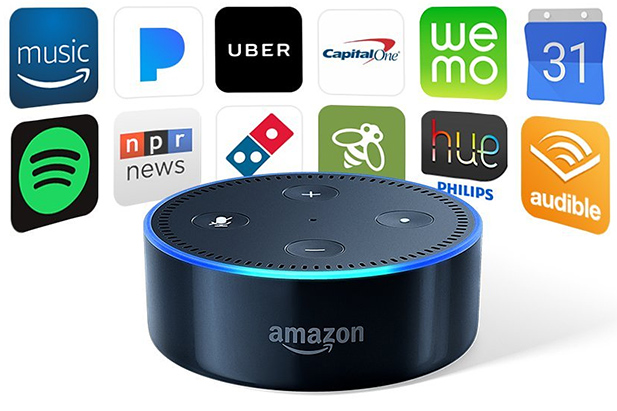
That last part, about Watson being used to personalize learning and direct students to appropropriate courses, is one of the elements that I see in the Learning from the Living [Class]Room vision that I’ve been pulse-checking for the last several years. AI/cognitive computing will most assuredly be a part of our learning ecosystems in the future.  Amazon is currently building their own platform that adds 100 skills each day — and has 1000 people working on creating skills for Alexa.  This type of thing isn’t going away any time soon. Rather, I’d say that we haven’t seen anything yet!


The Living [Class] Room -- by Daniel Christian -- July 2012 -- a second device used in conjunction with a Smart/Connected TV


And Amazon has doubled down to develop Alexa’s “skills,” which are discrete voice-based applications that allow the system to carry out specific tasks (like ordering pizza for example). At launch, Alexa had just 20 skills, which has reportedly jumped to 5,200 today with the company adding about 100 skills per day.

In fact, Bezos has said, “We’ve been working behind the scenes for the last four years, we have more than 1,000 people working on Alexa and the Echo ecosystem … It’s just the tip of the iceberg.” Just last week, it launched a new website to help brands and developers create more skills for Alexa.

Source


Also see:


“We are trying to make education more personalised and cognitive through this partnership by creating a technology-driven personalised learning and tutoring,” Lula Mohanty, Vice President, Services at IBM, told ET. IBM will also use its cognitive technology platform, IBM Watson, as part of the partnership.

“We will use the IBM Watson data cloud as part of the deal, and access Watson education insight services, Watson library, student information insights — these are big data sets that have been created through collaboration and inputs with many universities. On top of this, we apply big data analytics,” Mohanty added.

Source


Also see:

  • Most People in Education are Just Looking for Faster Horses, But the Automobile is Coming — from etale.org by Bernard Bull
    Excerpt:
    Most people in education are looking for faster horses. It is too challenging, troubling, or beyond people’s sense of what is possible to really imagine a completely different way in which education happens in the world. That doesn’t mean, however, that the educational equivalent of the automobile is not on its way. I am confident that it is very much on its way. It might even arrive earlier than even the futurists expect. Consider the following prediction.


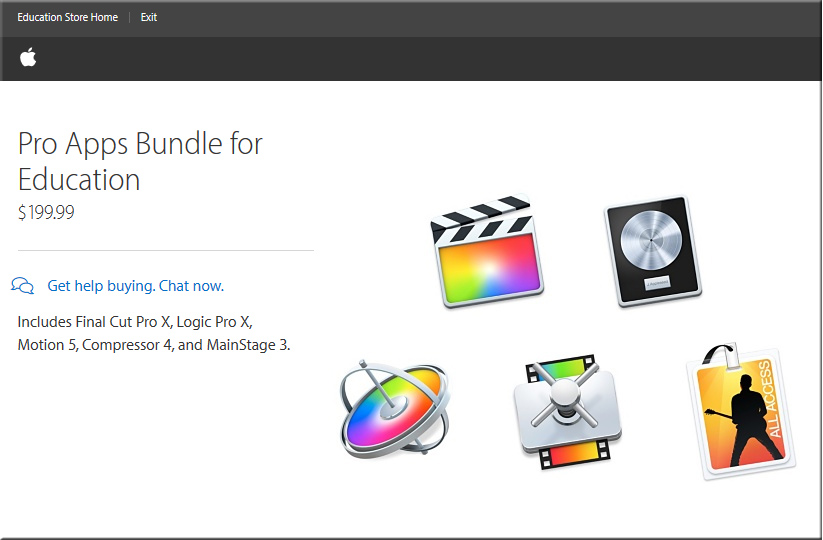
Apple Releases Education Bundle With Video, Audio Editing Tools — from campustechnology.com

Excerpt:

Apple Friday introduced its Pro Apps Bundle for Education, available for K–12 schools and higher ed institutions.

The bundle is a collection of five apps from Apple that deliver industry-level tools for video editors and musicians:


Also see:


Excerpt from Amazon fumbles earnings amidst high expectations (emphasis DSC):

Aside from AWS, Amazon Alexa-enabled devices were the top-selling products across all categories on Amazon.com throughout the holiday season and the company is reporting that Echo family sales are up over 9x compared to last season. Amazon aims to brand Alexa as a platform, something that has helped the product to gain capabilities faster than its competition. Developers and corporates released 4,000 new skills for the voice assistant in just the last quarter.


Alexa got 4,000 new skills in just the last quarter!

From DSC:
What are the teaching & learning ramifications of this?

By the way, I’m not saying for professors, teachers, & trainers to run for the hills (i.e., that they’ll be replaced by AI-based tools). But rather, I would like to suggest that we not only put this type of thing on our radars, but we should begin to actively experiment with such technologies to see if they might be able to help us do some heavy lifting for students learning about new topics.


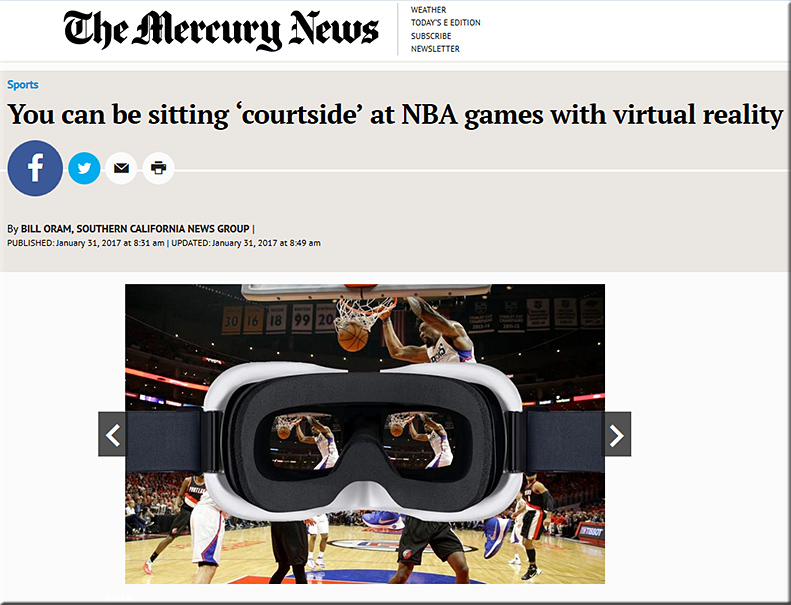
You can be sitting ‘courtside’ at NBA games with virtual reality — from mercurynews.com by Bill Oram

Excerpt:

“The result is a really strong sense of presence,” said David Cole, who helped found NextVR as a 3D company in 2009. “A vivid sense.”


“In some ways, we could still be at a point in time where a lot of people don’t yet know that they want this in VR,” said David Cramer, NextVR’s chief operating officer. “The thing that we’ve seen is that when people do see it, it just blows away their expectations.”


From DSC:
Hmm…the above piece from The Mercury News on #VR speaks of presence.  A vivid sense of presence.

If they can do this with an NBA game, why cant’ we do this with remote learners & bring them into face-to-face classrooms? How might VR be used in online learning and distance education? Could be an interesting new revenue stream for colleges and universities…and help serve more people who want to learn but might not be able to move to certain locations and/or not be able to attend face-to-face classrooms. Applications could exist within the corporate training/L&D world as well.


Also related/see:


ISNS students embrace learning in a world of virtual reality — from by

Excerpt (emphasis DSC):

To give students the skills needed to thrive in an ever more tech-centred world, the International School of Nanshan Shenzhen (ISNS) is one of the world’s first educational facilities now making instruction in virtual reality (VR) and related tools a key part of the curriculum.

Building on a successful pilot programme last summer in Virtual Reality, 3D art and animation, the intention is to let students in various age groups experiment with the latest emerging technologies, while at the same time unleashing their creativity, curiosity and passion for learning.

To this end, the school has set up a special VR innovation lab, conceived as a space for exploration, design and interdisciplinary collaboration involving a number of different subject teachers.

Using relevant software and materials, students learn to create high-quality digital content and to design “experiences” for VR platforms. In this “VR Lab makerspace” – a place offering the necessary tools, resources and support – they get to apply concepts and theories learned in the classroom, develop practical skills, document their progress, and share what they have learned with classmates and other members of the tech education community. 


As a next logical step, she is also looking to develop contacts with a number of the commercial makerspaces which have sprung up in Shenzhen. The hope is that students will then be able to meet engineers working on cutting-edge innovations and understand the latest developments in software, manufacturing, and areas such as laser cutting, and 3D printing, and rapid prototyping.  


© 2025 | Daniel Christian