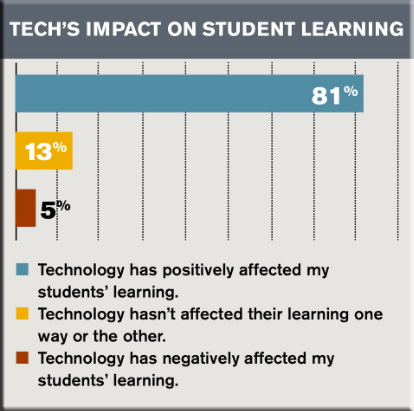
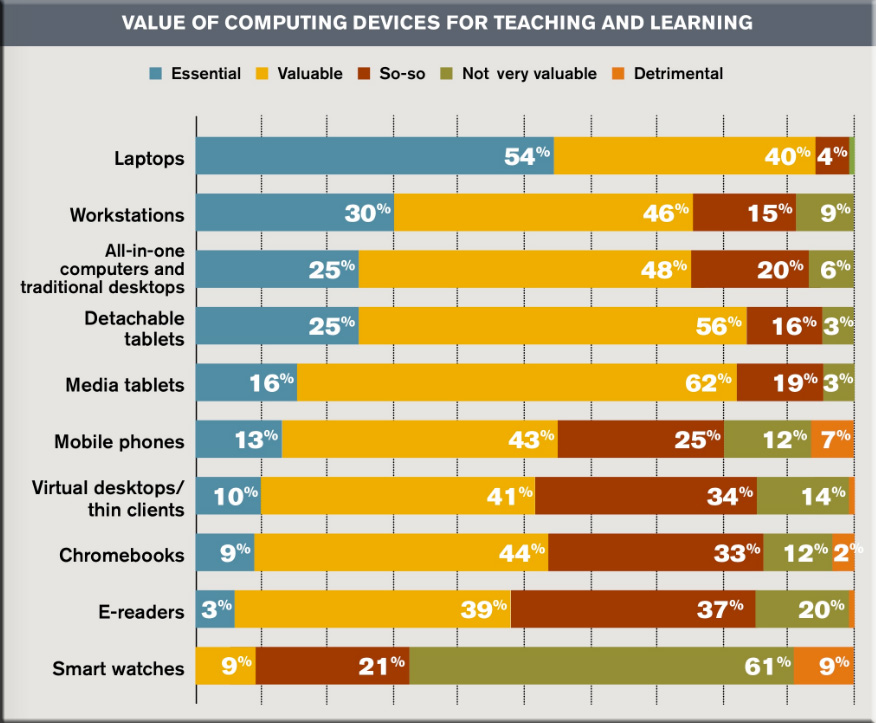
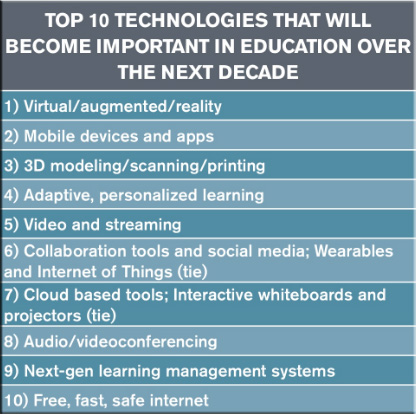
2017 Ed Tech Trends: The Halfway Point — from campustechnology.com by Rhea Kelly
Four higher ed IT leaders weigh in on the current state of education technology and what’s ahead.

This article includes some perspectives shared from the following 4 IT leaders:

  • Susan Aldridge, Senior Vice President for Online Learning, Drexel University (PA); President, Drexel University Online
  • Daniel Christian, Adjunct Faculty Member, Calvin College
  • Marci Powell, CEO/President, Marci Powell & Associates; Chair Emerita and Past President, United States Distance Learning Association
  • Phil Ventimiglia, Chief Innovation Officer, Georgia State University


Also see:


Campus Technology 2017: Virtual Reality Is More Than a New Medium — from edtechmagazine.com by Amy Burroughs
Experts weigh in on the future of VR in higher education.

Excerpts:

“It’s actually getting pretty exciting,” Georgieva said, noting that legacy companies and startups alike have projects in the works that will soon be on the market. Look for standalone, wireless VR headsets later this year from Facebook and Google.

“I think it’s going to be a universal device,” he said. “Eventually, we’ll end up with some kind of glasses where we can just dial in the level of immersion that we want.”

— Per Emery Craig, at Campus Technology 2017 Conference

…
“Doing VR for the sake of VR makes no sense whatsoever,” Craig said. “Ask when does it make sense to do this in VR? Does a sense of presence help this, or is it better suited to traditional media?”


Virtual Reality: The User Experience of Story — from blogs.adobe.com

Excerpt:

Solving the content problems in VR requires new skills that are only just starting to be developed and understood, skills that are quite different from traditional storytelling. VR is a nascent medium. One part story, one part experience. And while many of the concepts from film and theater can be used, storytelling through VR is not like making a movie or a play.

In VR, the user has to be guided through an experience of a story, which means many of the challenges in telling a VR story are closer to UX design than anything from film or theater.

Take the issue of frameless scenes. In a VR experience, there are no borders, and no guarantees where a user will look. Scenes must be designed to attract user attention, in order to guide them through the experience of a story.

Sound design, staging cues, lighting effects, and movement can all be used to draw a user’s attention.

However, it’s a fine balance between attraction to distraction.

“In VR, it’s easy to overwhelm the user. If you see a flashing light and in the background, you hear a sharp siren, and then something moves, you’ve given the user too many things to understand,” says Di Dang, User Experience Lead at POP, Seattle. “Be intentional and deliberate about how you grab audience attention.”


VR is a storytelling superpower. No other medium has the quite the same potential to create empathy and drive human connection. Because viewers are for all intents and purposes living the experience, they walk away with that history coded into their memory banks—easily accessible for future responses.


Google’s latest VR experiment is teaching people how to make coffee — from techradar.com by Parker Wilhelm
All in a quest to see how effective learning in virtual reality is

Excerpt:

Teaching with a simulation is no new concept, but Google’s Daydream Labs wants to see exactly how useful virtual reality can be for teaching people practical skills.

In a recent experiment, Google ran a simulation of an interactive espresso machine in VR. From there, it had a group of people try their virtual hand at brewing a cup of java before being tasked to make the real thing.


Addendum on 7/26/17:


4 ways augmented reality could change corporate training forever –from by Jay Samit

Excerpt:

In the coming years, machine learning and augmented reality will likely take both educational approaches to the next level by empowering workers to have the latest, most accurate information available in context, when and where they need it most.

Here are four ways that digital reality can revolutionize corporate training…


…augmented reality (AR) is poised not only to address issues faced by our aging workforce, but to fundamentality increase productivity by changing how all employees are trained in the future.


From DSC:
I thought the article below was a good one. But I’m not sure I arrived at the same conclusion. Rather than putting the business of leadership & development training squarely on the shoulders of team leaders, I would put it on each individual employee and inform/empower them to seek out what works best for them in fulfilling their role.  

The L&D team can work with introducing the best tools and examples of streams of content to tap into for any given role or topic.

I’m thinking here of tools like Twitter, streams of content from LinkedIn or from relevant blogs and websites. The team leaders can follow up with their team members and check in with them to see how things are going. If an employee says, “I don’t know who to connect with or follow” then perhaps the team leader can say, I’ve found these particular people, blogs, websites, streams of content from LinkedIn (or other sources) to be effective for what we do within our organization. Introduce them to communities of practice and/or to other individuals that do X, Y or Z really well.

It brings in the social element that this article discusses, but it also serves each individual’s best interests — each one of us needs to know how and where to keep learning. If it’s in their best interests to keep learning, then give them the tools and potential streams of content to tap into. Give them:


Let them own it. They’re likely creating their own learning pathways anyway. L&D become a consulting organization. L&D can consult with each group (or even individual employees) re: potential streams of content and possible/effective connections for that group (or individual).


Revive.  — from revive.zaglearning.com

How enterprise learning for leadership and team development is tripping up human potential, and slowly sending the L&D brand into irrelevance. This is the story of how to save it, step by radical step.

Excerpts:

Over 18 months of research with 65 one-on-one interviews, 511 managers surveyed, and 900 teams representing 8K people, we witnessed the unintentional damage: marginalized learning and development people (L&D), learners who see leadership and team development as a necessary but random and usually disappointing transaction, and executives who line-item “soft skills” training (labeled decades ago by, no surprise, a hard-skills proponent) as a tax or necessary benefit, as if it were a dental plan.

If you’re curious, it can’t help but spark a few questions:

  • How can something so strategically important be so realistically unimportant?
  • How did L&D pros, who make such a compelling psychological and organizational case for the most pivotal kind of learning, get so minimized and, in the process, drag down human potential and the social intelligence of corporate culture?
  • How are smart, passionate L&D people who are in it for the greater good—and not the big payday—getting stuck with a brand that’s as sexy as K-Mart?

The problems are systemic, and the curiosity and ambition to fix them have received as little attention as any problem in enterprise history.


So, what’s the big switch? Learning for leadership and team development doesn’t belong with L&D. It belongs squarely with the team leader, the person who is 70% of the variance in her team’s engagement. Learning belongs fundamentally, not loosely, where it’s always in context and relevant: the leader and her team.


AI is making it extremely easy for students to cheat — from wired.com by Pippa Biddle

Excerpt (emphasis DSC):

For years, students have turned to CliffsNotes for speedy reads of books, SparkNotes to whip up talking points for class discussions, and Wikipedia to pad their papers with historical tidbits. But today’s students have smarter tools at their disposal—namely, Wolfram|Alpha, a program that uses artificial intelligence to perfectly and untraceably solve equations. Wolfram|Alpha uses natural language processing technology, part of the AI family, to provide students with an academic shortcut that is faster than a tutor, more reliable than copying off of friends, and much easier than figuring out a solution yourself.


Use of Wolfram|Alpha is difficult to trace, and in the hands of ambitious students, its perfect solutions are having unexpected consequences.


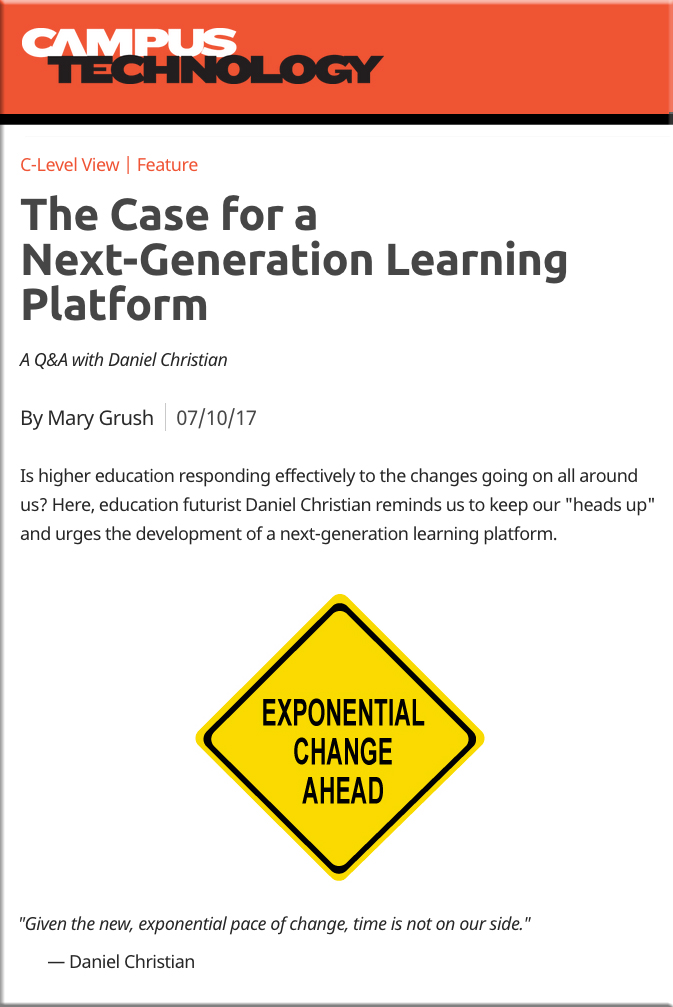
The case for a next generation learning platform [Grush & Christian]


The case for a next generation learning platform — from campustechnology.com by Mary Grush & Daniel Christian

Excerpt (emphasis DSC):

Grush: Then what are some of the implications you could draw from metrics like that one?

Christian: As we consider all the investment in those emerging technologies, the question many are beginning to ask is, “How will these technologies impact jobs and the makeup of our workforce in the future?”

While there are many thoughts and questions regarding the cumulative impact these technologies will have on our future workforce (e.g., “How many jobs will be displaced?”), the consensus seems to be that there will be massive change.

Whether our jobs are completely displaced or if we will be working alongside robots, chatbots, workbots, or some other forms of AI-backed personal assistants, all of us will need to become lifelong learners — to be constantly reinventing ourselves. This assertion is also made in the aforementioned study from McKinsey: “AI promises benefits, but also poses urgent challenges that cut across firms, developers, government, and workers. The workforce needs to be re-skilled to exploit AI rather than compete with it…”


A side note from DSC:
I began working on this vision prior to 2010…but I didn’t officially document it until 2012.


The Living [Class] Room -- by Daniel Christian -- July 2012 -- a second device used in conjunction with a Smart/Connected TV


Learning from the Living [Class] Room:

A global, powerful, next generation learning platform


What does the vision entail?

  • A new, global, collaborative learning platform that offers more choice, more control to learners of all ages – 24×7 – and could become the organization that futurist Thomas Frey discusses here with Business Insider:

“I’ve been predicting that by 2030 the largest company on the internet is going to be an education-based company that we haven’t heard of yet,” Frey, the senior futurist at the DaVinci Institute think tank, tells Business Insider.

  • A learner-centered platform that is enabled by – and reliant upon – human beings but is backed up by a powerful suite of technologies that work together in order to help people reinvent themselves quickly, conveniently, and extremely cost-effectively
  • A customizable learning environment that will offer up-to-date streams of regularly curated content (i.e., microlearning) as well as engaging learning experiences
  • Along these lines, a lifelong learner can opt to receive an RSS feed on a particular topic until they master that concept; periodic quizzes (i.e., spaced repetition) determines that mastery. Once mastered, the system will ask the learner whether they still want to receive that particular stream of content or not.
  • A Netflix-like interface to peruse and select plugins to extend the functionality of the core product
  • An AI-backed system of analyzing employment trends and opportunities will highlight those courses and streams of content that will help someone obtain the most in-demand skills
  • A system that tracks learning and, via Blockchain-based technologies, feeds all completed learning modules/courses into learners’ web-based learner profiles
  • A learning platform that provides customized, personalized recommendation lists – based upon the learner’s goals
  • A platform that delivers customized, personalized learning within a self-directed course (meant for those content creators who want to deliver more sophisticated courses/modules while moving people through the relevant Zones of Proximal Development)
  • Notifications and/or inspirational quotes will be available upon request to help provide motivation, encouragement, and accountability – helping learners establish habits of continual, lifelong-based learning
  • (Potentially) An online-based marketplace, matching learners with teachers, professors, and other such Subject Matter Experts (SMEs)
  • (Potentially) Direct access to popular job search sites
  • (Potentially) Direct access to resources that describe what other companies do/provide and descriptions of any particular company’s culture (as described by current and former employees and freelancers)
  • (Potentially) Integration with one-on-one tutoring services

Further details here >>


Addendum from DSC (regarding the resource mentioned below):
Note the voice recognition/control mechanisms on Westinghouse’s new product — also note the integration of Amazon’s Alexa into a “TV.”


Westinghouse’s Alexa-equipped Fire TV Edition smart TVs are now available — from theverge.com by Chaim Gartenberg


The key selling point, of course, is the built-in Amazon Fire TV, which is controlled with the bundled Voice Remote and features Amazon’s Alexa assistant.


Finally…also see:

  • NASA unveils a skill for Amazon’s Alexa that lets you ask questions about Mars — from geekwire.com by Kevin Lisota
  • Holographic storytelling — from jwtintelligence.com
    The stories of Holocaust survivors are brought to life with the help of interactive 3D technologies.
    New Dimensions in Testimony is a new way of preserving history for future generations. The project brings to life the stories of Holocaust survivors with 3D video, revealing raw first-hand accounts that are more interactive than learning through a history book.  Holocaust survivor Pinchas Gutter, the first subject of the project, was filmed answering over 1000 questions, generating approximately 25 hours of footage. By incorporating natural language processing from the USC Institute for Creative Technologies (ICT), people are able to ask Gutter’s projected image questions that trigger relevant responses.


6 Ways to Accelerate Learning in Your Virtual Classroom —- from td.org by Cynthia Clay

Excerpt:

When you move into the virtual classroom, whether as an instructional designer or a trainer, you quickly discover that guidelines for instruction in the traditional classroom may not help as much as you expected. You might have a bevy of questions: Should I use more slides or fewer? Should I present more content or streamline what I have? What about chat? Should I turn it on and let people talk to each other or turn it off so they focus on what I say? Should I put myself on camera throughout the session or just display a photograph at the opening?

How you answer those questions will either expedite or decelerate the learning experience. The following six accelerators make the difference between delivering learning that sticks and learning that’s forgotten by Friday.

  1. Accelerator #1: Get visual 
  2. Accelerator #2: Tell a story
  3. Accelerator #3: Establish rapport
  4. Accelerator #4: Engage continuously
  5. Accelerator #5: Hit them with a problem
  6. Accelerator #6: Facilitate learning


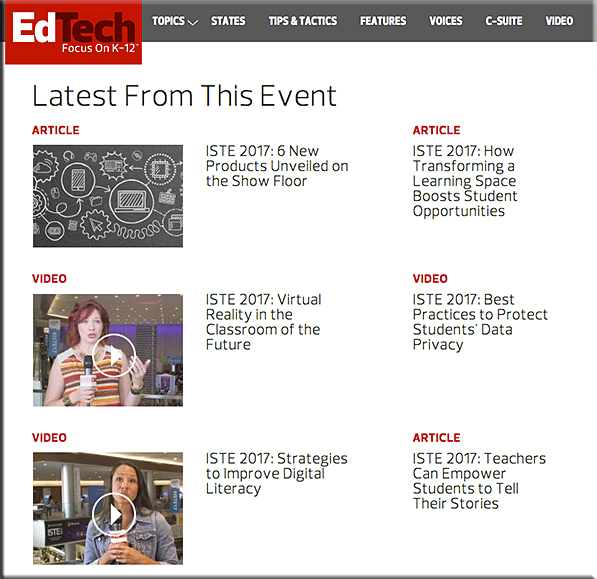
EdTech magazine covers the latest news and discussions, live from ISTE 2017 in San Antonio, Texas.


ISTE 2017: 6 New Products Unveiled on the Show Floor — from edtechmagazine.com by Jena Passut
New offerings from big tech companies highlight this year’s megaconference in San Antonio.

Excerpt:

With more than 18,000 attendees and plenty of press coverage, the annual ISTE’s 2017 Conference & Expo has become a prime place for vendors to launch new products and announce updates. This year is no different. Check out some of the latest offerings announced at the 2017 event, and then head over to EdTech’s coverage page to read and see more news from ISTE.


Also see:


How Amazon’s purchase of Whole Foods highlights the hybrid, ‘omnichannel’ future of higher ed — from edsurge.com by Sean Gallagher

Excerpt:

The expectation that students can integrate their learning experiences across channels is now arriving in higher education. Online education has reached a tipping point where almost 30 percent of all students in U.S. higher education are enrolled in at least one online college course. A significant number of students are already blending their experience across online and offline channels—and numerous data points speak to the evolving value of blending online delivery with physical presence, as suggested by Amazon.

In national surveys of prospective adult students that we have conducted regularly at Northeastern University over recent years, we have consistently found that 60 percent of students prefer a blended or hybrid learning experience. In other words, the majority of the higher education student market is neglected by today’s dominant approach that focuses on offering either online or in-person programs.
…
Like Amazon, the colleges and universities that are able to deliver across channels—leveraging the combination of physical presence and online algorithms—will be uniquely positioned to take advantage of the in-demand, destination nature of studying in certain cities; the local sourcing of faculty; and proximity to key employers, industries, and job opportunities.


Over the next decade, growth and competitive success in higher education will not be a function of who is able to offer online programs. Instead, the successful institutions will be those who can symbiotically integrate their placed-based educational operations and experiences with software-driven analytics, learning science, and machine learning to create a more personalized experience. A more Amazon-like experience.


From DSC:
A few side comments here:

  1. The future won’t be kind to those institutions who haven’t built up their “street cred” in the digital/virtual space. For example, if you are working at a traditional institution of higher education that doesn’t have online-based programs — nor does it have plans to create such programs in the future — you should get your resume up-to-date and start looking…now.
    .
  2. For data/analytics to have a significant impact and inform strategic or pedagogical decisions, one needs to collect the data. This is not hard to do online. But it’s very difficult — at least at a granular level — to do in a face-to-face environment.
    .
  3. Coursera’s MeetUps around the world — where their learners are encouraged to join study and discussion groups related to their online-only courses — make me wonder about the future of learning spaces and whether your local Starbucks might morph into a learning hub.


What a future, powerful, global learning platform will look & act like [Christian]


Learning from the Living [Class] Room:
A vision for a global, powerful, next generation learning platform

By Daniel Christian

NOTE: Having recently lost my Senior Instructional Designer position due to a staff reduction program, I am looking to help build such a platform as this. So if you are working on such a platform or know of someone who is, please let me know: danielchristian55@gmail.com.

I want to help people reinvent themselves quickly, efficiently, and cost-effectively — while providing more choice, more control to lifelong learners. This will become critically important as artificial intelligence, robotics, algorithms, and automation continue to impact the workplace.


The Living [Class] Room -- by Daniel Christian -- July 2012 -- a second device used in conjunction with a Smart/Connected TV


Learning from the Living [Class] Room:
A global, powerful, next generation learning platform


What does the vision entail?

  • A new, global, collaborative learning platform that offers more choice, more control to learners of all ages – 24×7 – and could become the organization that futurist Thomas Frey discusses here with Business Insider:

“I’ve been predicting that by 2030 the largest company on the internet is going to be an education-based company that we haven’t heard of yet,” Frey, the senior futurist at the DaVinci Institute think tank, tells Business Insider.

  • A learner-centered platform that is enabled by – and reliant upon – human beings but is backed up by a powerful suite of technologies that work together in order to help people reinvent themselves quickly, conveniently, and extremely cost-effectively
  • An AI-backed system of analyzing employment trends and opportunities will highlight those courses and “streams of content” that will help someone obtain the most in-demand skills
  • A system that tracks learning and, via Blockchain-based technologies, feeds all completed learning modules/courses into learners’ web-based learner profiles
  • A learning platform that provides customized, personalized recommendation lists – based upon the learner’s goals
  • A platform that delivers customized, personalized learning within a self-directed course (meant for those content creators who want to deliver more sophisticated courses/modules while moving people through the relevant Zones of Proximal Development)
  • Notifications and/or inspirational quotes will be available upon request to help provide motivation, encouragement, and accountability – helping learners establish habits of continual, lifelong-based learning
  • (Potentially) An online-based marketplace, matching learners with teachers, professors, and other such Subject Matter Experts (SMEs)
  • (Potentially) Direct access to popular job search sites
  • (Potentially) Direct access to resources that describe what other companies do/provide and descriptions of any particular company’s culture (as described by current and former employees and freelancers)

Further details:
While basic courses will be accessible via mobile devices, the optimal learning experience will leverage two or more displays/devices. So while smaller smartphones, laptops, and/or desktop workstations will be used to communicate synchronously or asynchronously with other learners, the larger displays will deliver an excellent learning environment for times when there is:

  • A Subject Matter Expert (SME) giving a talk or making a presentation on any given topic
  • A need to display multiple things going on at once, such as:
  • The SME(s)
  • An application or multiple applications that the SME(s) are using
  • Content/resources that learners are submitting in real-time (think Bluescape, T1V, Prysm, other)
  • The ability to annotate on top of the application(s) and point to things w/in the app(s)
  • Media being used to support the presentation such as pictures, graphics, graphs, videos, simulations, animations, audio, links to other resources, GPS coordinates for an app such as Google Earth, other
  • Other attendees (think Google Hangouts, Skype, Polycom, or other videoconferencing tools)
  • An (optional) representation of the Personal Assistant (such as today’s Alexa, Siri, M, Google Assistant, etc.) that’s being employed via the use of Artificial Intelligence (AI)

This new learning platform will also feature:

  • Voice-based commands to drive the system (via Natural Language Processing (NLP))
  • Language translation (using techs similar to what’s being used in Translate One2One, an earpiece powered by IBM Watson)
  • Speech-to-text capabilities for use w/ chatbots, messaging, inserting discussion board postings
  • Text-to-speech capabilities as an assistive technology and also for everyone to be able to be mobile while listening to what’s been typed
  • Chatbots
    • For learning how to use the system
    • For asking questions of – and addressing any issues with – the organization owning the system (credentials, payments, obtaining technical support, etc.)
    • For asking questions within a course
  • As many profiles as needed per household
  • (Optional) Machine-to-machine-based communications to automatically launch the correct profile when the system is initiated (from one’s smartphone, laptop, workstation, and/or tablet to a receiver for the system)
  • (Optional) Voice recognition to efficiently launch the desired profile
  • (Optional) Facial recognition to efficiently launch the desired profile
  • (Optional) Upon system launch, to immediately return to where the learner previously left off
  • The capability of the webcam to recognize objects and bring up relevant resources for that object
  • A built in RSS feed aggregator – or a similar technology – to enable learners to tap into the relevant “streams of content” that are constantly flowing by them
  • Social media dashboards/portals – providing quick access to multiple sources of content and whereby learners can contribute their own “streams of content”

In the future, new forms of Human Computer Interaction (HCI) such as Augmented Reality (AR), Virtual Reality (VR), and Mixed Reality (MR) will be integrated into this new learning environment – providing entirely new means of collaborating with one another.

Likely players:

  • Amazon – personal assistance via Alexa
  • Apple – personal assistance via Siri
  • Google – personal assistance via Google Assistant; language translation
  • Facebook — personal assistance via M
  • Microsoft – personal assistance via Cortana; language translation
  • IBM Watson – cognitive computing; language translation
  • Polycom – videoconferencing
  • Blackboard – videoconferencing, application sharing, chat, interactive whiteboard
  • T1V, Prsym, and/or Bluescape – submitting content to a digital canvas/workspace
  • Samsung, Sharp, LCD, and others – for large displays with integrated microphones, speakers, webcams, etc.
  • Feedly – RSS aggregator
  • _________ – for providing backchannels
  • _________ – for tools to create videocasts and interactive videos
  • _________ – for blogs, wikis, podcasts, journals
  • _________ – for quizzes/assessments
  • _________ – for discussion boards/forums
  • _________ – for creating AR, MR, and/or VR-based content


Some applications of VR from vrxone.com

Education
Virtual Reality to teach the skills needed for the future by enabling learners to explore, play, work as a team, compete, and be rewarded for their achievements through interactive lessons.

  • Virtual Field Trips
  • Immersive VRXOne Lab
  • VR for Arts & Design
  • Safe Laboratory Practicals through VR
  • Game based Learning
  • Geography, Marine Life VR Exploration
  • Astronomy & Space Research through VR
  • Architecture & Interiors
  • VR for Sports & Games
  • VR to improve Public Speech

Corporate Training
Virtual reality (VR) enhances traditional training methods through a new, practical and interactive approach. Improve Knowledge Retention by doing things in an immersive Environment.

* VR based Induction/ Onboarding
* Improving Health & Safety through VR
* Increase Knowledge Retention
* Hands-on VR Training Simulations
* Customer interactivity through VR
* VR to improve Marketing Strategy
* Special purpose training in VR
* High Risk Environment VR Simulation
* Critical National Infrastructure brief on VR
* VR for Business Planning

Healthcare
Virtual Reality has proven great results with 34% of Physical Health and 47% of Mental Health Improvements through various applications and learning programs.

* 360° Live streaming of Surgical Procedure
* Medical & Nursing Simulation
* Emergency Drill Scenario
* VR for pain & anxiety relief
* Assistive Technology for Special Education.
* Interactive Anatomy Lessons
* Yoga, Meditation and Recreational Therapy
* Virtual Medical Consultation
* Motivational Therapy for Aged Citizens
* VR for Medical Tourism


The Classroom of Tomorrow: A Panel Discussion — sponsored by Kaltura

Description:
Technology is changing the way we approach education, rapidly. But what will tomorrow’s classroom actually look like? We’ve invited some leading experts for a spirited debate about what the future holds for educational institutions. From personalization to predictive analytics to portable digital identities, we’ll explore the biggest changes coming. We’ll see how new technologies might interact with changing demographics, business models, drop out rates, and more.

Panelists:

  • David Nirenberg – Dean of the Division of the Social Sciences, University of Chicago
  • Rick Kamal – Chief Technology Officer, Harvard Business School, HBX
  • Gordon Freedman – President, National Laboratory for Education Transformation
  • Michael Markowitz – Entrepreneur and Investor, Education
  • Dr Michal Tsur – Co-founder and President, Kaltura


Also see:

  • Roadmap to the Future — by Dr Michal Tsur – Co-founder and President, Kaltura
    What are some of the leading trends emerging from the educational technology space? Michal Tsur takes you on a quick tour of big trends you should be aware of. Then, get a glimpse of Kaltura’s own roadmap for lecture capture and more.


Regarding the above items, some thoughts from DSC:
Kaltura did a nice job of placing the focus on a discussion about the future of the classroom as well as on some trends to be aware of, and not necessarily on their own company (this was especially the case in regards to the panel discussion). They did mention some things about their newest effort, Kaltura Lecture Capture, but this was kept to a very reasonable amount.


The Higher Education Technology Paradox — from edtechmagazine.com by Hank Lucas
The academic rewards system will continue to stymie technology adoption unless higher ed administrators promote organizational change.

Excerpts:

The number one paradox in higher education is that technology is both transforming and disrupting universities around the world. Institutions that adapt to the technology and become content producers will survive and flourish; those confined to being content consumers will struggle to stay in business.
…
What does it take for a university to develop the kind of materials described above? Obviously, it requires money, but more than money it needs a motivated and committed faculty. The reward system in most institutions and the inherent conservatism of faculty members create a huge barrier to adopting new technologies for education. (Many faculty members are in denial that the technology can improve student learning and that it will be widely implemented.)

How does the reward system impact technology adoption?

  • Assistant professors at research universities are rewarded for publishing scholarly articles and books, which they must do to be granted tenure. They cannot risk the time needed to master the new technologies.
  • Tenured faculty can largely do what they want, and by the time they have received tenure have fallen into a rhythm of research and teaching; once tenured they are expected to undertake more service to the institution. Where does the time come from to adopt a new approach to the classroom?
  • Non-tenure track instructors are employed because they are good, or at least adequate, teachers. Adopting new technology in the classroom is risky and could result in lower student evaluations, which in turn could affect their employment status.


From DSC:
This is one of the reasons why I believe that a new organization will arise in the future that uses a solid, team-based approach from day 1. They will have teams of experts from a variety of fields/disciplines — and they will have the types of incentive systems that one would expect to see in startup companies. They will value innovation and will see to it that ideas can be grown and supported.

Anybody come to mind? How about Amazon.com? 

Also, faculty members — like all of us — have a limited amount of time and energy. The current workplace has loaded up faculty members’ job plates — they don’t have much time to experiment with new technologies. Also — again, like all of us — they have a variety of skills and interests. Many times, those skills and interest don’t involve working with technology. 

Look for more team-based approaches to dominate the future of higher education.


Online Learning—from Innovation to Adoption: Introducing the CHLOE Survey   — from eduventures.com by Richard Garrett & Ron Legon

Excerpt:

It’s now more than 20 years since online learning came on the scene. At the outset, many skeptics questioned its quality and reliability. Online learning faced widespread resistance among faculty conditioned by centuries-old, classroom-based education and lacking in computer skills. There were substantial start-up costs, technical deficiencies, and regulatory uncertainty to overcome.

With all these obstacles, many doubted whether online learning would gain a permanent foothold in U.S. higher education. The former Babson Survey Research Group/Sloan-C survey of chief academic officers focused on the fundamental issues of counting online students and attitudes for or against its adoption.

Today, the number of online students is no longer a mystery, and there is wide acceptance of the delivery mode among administrators and faculty. This innovation, in the means of delivering higher education, is here to stay. It is no longer experimental, but a fixture in mainstream institutions, accounting for a large and still growing proportion of total postsecondary enrollment.
…
Online learning has changed higher education, but higher education has also shaped online learning. There is no doubt that online learning is here to stay, but what is far less clear is the balance between innovation and consolidation, transformation and integration within institutions and across the field as a whole going forward. The planned series of annual CHLOE Surveys will provide much-needed insight.


Signs of a Ceiling in Online Ed Market — from insidehighered.com by Carl Straumsheim
Report on online education landscape suggests potentially leaner times ahead for colleges hoping to profit in the market. Community colleges are already seeing it.

Excerpt:

Is the community college sector the canary in the coal mine for the online education market?

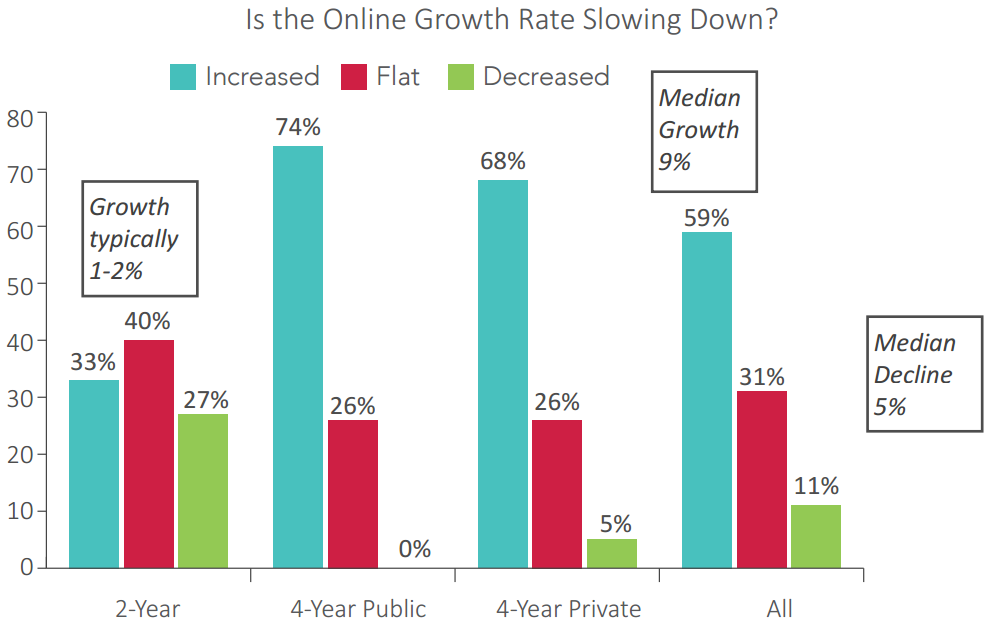
A new survey of online education administrators at 104 colleges and universities released today shows — as other studies have suggested — that public and private four-year institutions saw healthy enrollment growth in their fully online programs in spring 2016 compared to the year before, and that they are showing few signs of slowing their investments in the space.

The situation is not the same at two-year colleges. Online programs at all institutions grew on average by 9 percent year over year, but at community colleges, growth typically registered 1 to 2 percent. And while only a handful of the public or private four-year institutions surveyed said their online enrollments shrank from 2015 to 2016, findings at community colleges were mixed: 33 percent saw growth, 27 percent decline and 40 percent stability.


From DSC:
It appears that the concept of “windows of opportunity” is also true with online learning; and the key thing for all community colleges, colleges and universities to reflect upon is that these windows don’t stay open forever. 

But another thing is that the world is going increasingly digital/virtual — especially in regards to the increasingly common usage of automation, robotics, and artificial intelligence. Our forms of Human Computer Interaction (HCI) continue to morph (AR, VR, Alexa and other personal assistants, etc.)

So some questions come to my mind:

  1. If one’s institution doesn’t offer a healthy assortment of online/virtually-based courses in the future, how might that situation impact the public’s perception of that particular institution? How might that situation impact recruitment and retention?
    .
  2. What’s going to happen when online-based learning experiences provide far more personalization, customization, and efficiency than our face-to-face courses can provide? Ask any faculty member speaking to 40-250+ students if they truly know the learning preferences, academic goals, and career goals of any given student — and I’ll bet you they have no idea. There’s simply not enough time to get to that level of information in many cases, and this situation is only getting tougher to do so. Don’t get me wrong. Many people will always prefer to learn in a physical environment, surrounded by other learners. But if the innovations continue to take place in the online learning-based environments, then Clayton Christensen’s theories of disruption could prove to be spot on — especially if the most innovative institutions of the future will be able to offer degrees at significantly reduced prices.


© 2025 | Daniel Christian