Disrupting Education. The Rise Of K-12 Online And The Entrepreneurial Opportunities — from forbes.com by Bernhard Schroeder

Excerpt:

Online learning, once reserved for higher education, is now a growing trend among K-12 students nationwide. Over 2.7 million students across the United States are taking part in digital learning, and many students in grades K-12 are getting a high-quality education online through a full-time online public school.


Also related/see:


Online learning has the potential to be both high quality and significantly less expensive than its residential counterpart.


A reckoning for 2U, and OPMs? — from insidehighered.com by Lindsay McKenzie
After online program management company 2U talked openly about its challenges, the company’s stock plummeted. Analysts say the company, and others like it, are down but not out.

Excerpt:

An hour before Chip Paucek, CEO and co-founder of 2U, held an investor call late Tuesday afternoon [on 7/30/19] , the online program management company’s stock was valued at $36.50. Over the next 24 hours, as investors responded to the news he delivered, its stock plunged to $12.80 — a decrease of almost 65 percent.

In that investor call, Paucek delivered a set of messages that wouldn’t have surprised many who watch the online education space closely. Online program management is a difficult business to be in. Online education is increasingly competitive, student acquisition and marketing costs are going up, and the regulatory landscape is becoming more complex.

Offering hybrid or fee-for-service options is something many OPM companies already do, but 2U has long been resistant to this change. It’s a significant shift in strategy, said Daniel Pianko, co-founder and managing director of University Ventures.


There has been long-running disagreement about whether fee for service or revenue sharing is the better option for institutions, said Pianko. “What’s really interesting is that 2U went from being the strongest proponent of the revenue share forever camp to effectively embracing the future of fee for service,” he said. “With the 2U move, we would expect a rapid move toward fee for service across the board.”


Also see:


 “How can technology be used at scale to address the massive re-skilling that’s going to be needed in the workforce going forward?”

— Kelly Fuller, a director at BMO Capital Markets who covers the ed tech sector


Some basic HTML tips for when your LMS makes you nuts — from busynessgirl.com by Maria Andersen

Excerpt:

HTML stands for HyperText Markup Language; it is the computer code of web pages.

Many editors in blogs, wikis, online learning systems like Canvas, Brightspace, Moodle, and Blackboard have WYSIWYG editors. WYSIWYG stands for “what you see is what you get.”

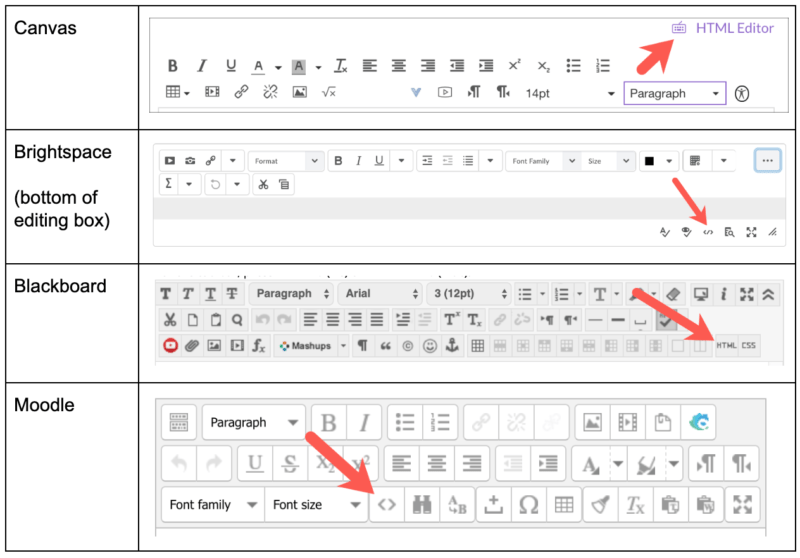
Most digital editors have an icon panel at the top with standard formatting tools. The location of the tools varies slightly from platform to platform (a few examples from common Learning Management Systems, or LMS’s, are below).

In most online editors, there is an option to switch back and forth from WYSIWYG to HTML. When you are trying to get a page to look just right and it’s not behaving, you might need to go make a few simple tweaks to the HTML. Just knowing that there is HTML code behind each page, and the basics of how it works will be helpful to figuring out why formatting is not “sticking” properly in the WYSIWYG editor.

You can go to PracticeBoard to practice some of the HTML in this post.


5 important artificial intelligence predictions (for 2019) everyone should read — from forbes.com by Bernard Marr

Excerpts:

  1. AI increasingly becomes a matter of international politics
  2. A move towards “transparent AI”
  3. AI and automation drilling deeper into every business
  4. More jobs will be created by AI than will be lost to it (for the next year at least)
  5. AI assistants will become truly useful


“…these tensions could compromise the spirit of cooperation between academic and industrial organizations across the world.”


“AI solutions for managing compliance and legal issues are also likely to be increasingly adopted. As these tools will often be fit-for-purpose across a number of organizations, they will increasingly be offered as-a-service…”


A Snapshot of Instructional Design: Talking Points for a Field in Transition — from er.educause.edu by Whitney Kilgore, Patrice Torcivia and Laura Gogia

Excerpt:

The resurgence of learning engineering as a concept and professional role in higher education has exacerbated tensions within the field of instructional design related to job titles, responsibilities, and position within academic institutions.


“World-class instructional designers can help one institution differentiate itself from others in the online learning market. I think that realization is driving the conversation on instructional design in many institutions.”

“Today, we need instructional designers who are equally fluent in learning design, faculty professional development, research methods, and technology,” Bowen elaborated. “They must be able to partner with faculty to create, experiment, and publish innovative approaches to teaching and learning. Unfortunately, this looks a lot different than what we have in many instructional design units right now.”

Kyle Bowen, director of innovation at Penn State


How tech is helping courtroom newbies become virtual pros — from law360.com by Brandon Lowrey

Excerpt:

You walk into a courtroom and a woman strides toward you with an outstretched hand, rattling off details about a new case. There’s a settlement conference this afternoon, you learn — and you’re going to be there representing your new client.

If you don’t know who this person is, just look at the words hovering over her head: “Supervising Attorney.” Nervous because you’ve never been in a courtroom before? Don’t worry — you still haven’t.

This is how a virtual-reality training video begins for some attorneys who have volunteered to handle pro bono renter-landlord cases through the San Francisco Bar Association.

They don virtual reality goggles to prepare for their first courtroom experiences. Harvard Law Access to Justice Lab researchers hope that the program will embolden attorneys who’ve only worked in front of a computer screen rather than a judge to volunteer at pro bono clinics to help out in the courtroom.

This can be a terrifying prospect for some attorneys, and it’s a big reason why many wash out when they discover what’s expected of them.


The program in San Francisco is one of several planned studies to see whether a 15-minute virtual reality experience might make attorneys usually holed up in cubicles more willing to take on pro bono work and, when they do, win better outcomes for their clients. If it works, it could become a more widely used tool used to prepare attorneys in legal-aid settings and beyond.


Also see:


Why teaching is still the best job in the world — from teachthought.com by Paul Moss

Excerpt:

…introducing students to new technologies and ways of presenting, curating, and collaborating with others with what they know is truly exciting and truly invigorating. Modern teachers are actually pioneering pedagogy, and can and will be able to hold their heads up high in the future when we look back and see how learning in this day and age took a radical but enormously beneficial turn for the better.

Engaging students in greater collaboration, and instilling initiative in curation and the promotion of information leads to truly independent learning, and setting up such learning environments is an opportunity that all teachers now have before them. There are few more gratifying feelings that being needed.


Israeli tech co. uses virtual & augmented reality tech to help Christians engage with the Bible — with thanks to Heidi McDow for the resource
Compedia Partners with U.S. Clients to Utilize Company’s Biblical Knowledge and Technological Expertise

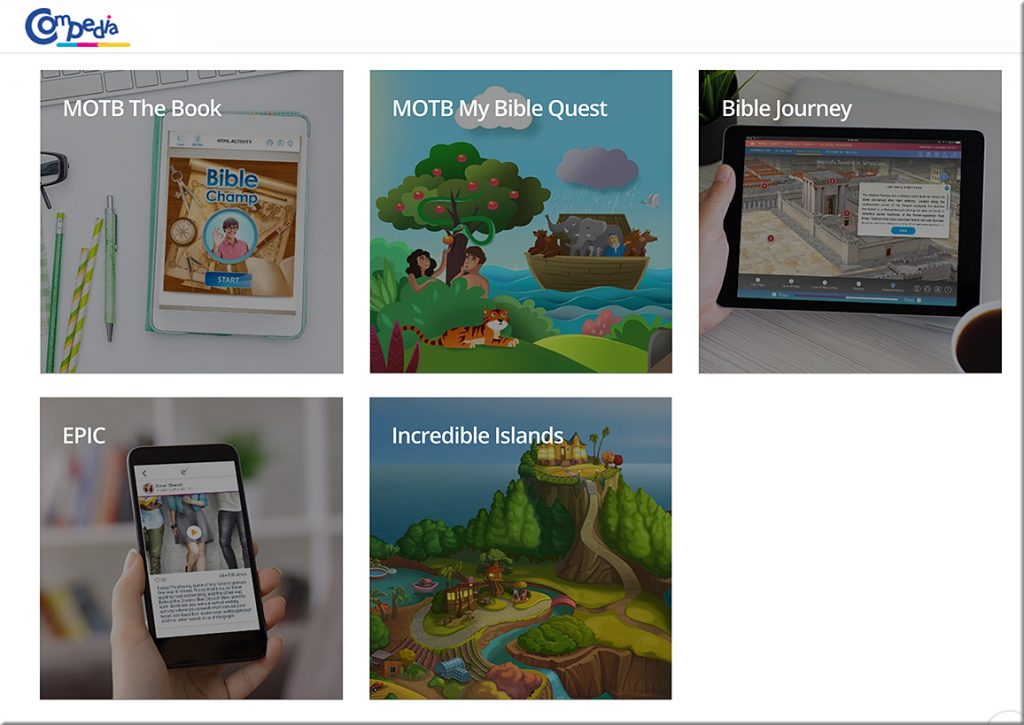
TEL AVIV, Israel, Aug. 7, 2019 – Compedia, an Israel-based business-to-business tech company, is using virtual reality technology to service Christian clients with products that help users engage with the Bible in a meaningful way.

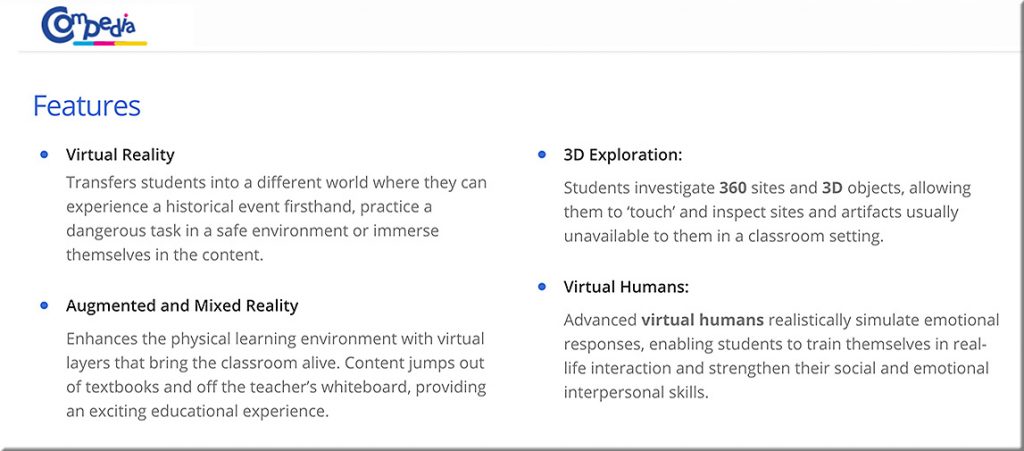
Compedia partnered with The Museum of the Bible in Washington, D.C., which attracted more than 1 million visitors during its first year of operation, to help bring the museum’s exhibits to life. With the help of Compedia’s innovation, visitors to the museum can immerse themselves in 34 different biblical sites through augmented reality tours, allowing them to soar across the Sea of Galilee, climb the stairs of the Temple Mount, explore the Holy Sepulchre and so much more. In addition to creating on-site attractions for The Museum of the Bible, Compedia also created a Bible curriculum for high-school students that includes interactive maps, 3-D guides, quizzes, trivia and more.

“Many people are dubious of augmented and virtual reality, but we see how they can be used for God’s glory,” said Illutowich. “When clients recognize how attentive users are to the Bible message when it’s presented through augmented and virtual reality, they see the power of it, too.”

In addition to their passion for furthering Bible education, Compedia is committed to developing products that help educators engage students of all types. The company is currently in partnership with a number of educational institutions and schools around the U.S. to utilize its interactive technology both in the classroom and in the online learning space. Other client collaborations include Siemens, Sony and Intel, to name a few.

About Compedia
Compedia uses cutting-edge technology to help students succeed by making education more fun, engaging, and meaningful. With over 30 years of experience in developing advanced learning solutions for millions of people in 50 countries and 35 languages, Compedia offers expertise in visual computing, augmented reality, virtual reality and advanced systems, as well as instructional design and UX.


A handful of US cities have banned government use of facial recognition technology due to concerns over its accuracy and privacy. WIRED’s Tom Simonite talks with computer vision scientist and lawyer Gretchen Greene about the controversy surrounding the use of this technology.


Alexa Skill Blueprints Publishing Now Available in Australia and New Zealand – Create and Publish a Skill, No Coding Required— from developer.amazon.com by James Ang

Excerpt:

We are excited to announce that now anyone can create and publish an Alexa skill on the Australian Alexa Skills Store using Alexa Skill Blueprints. Skill Blueprints enable you to create and share customised Alexa skills simply by filling in the blanks to one of the dozens of easy-to-use templates, with no coding required. Now you can publish skills created using Alexa Skill Blueprints to the Alexa Skills Store in Australia for customers to discover and use. We have also built new Skill Blueprints specifically for content creators, bloggers, and organisations so they can reach anyone with an Alexa-enabled device.

Create Fun Learning Tools
Whether you are a parent helping your child study or want to teach something you’re passionate about, Blueprints are easy tools to create new ways to learn. Use the QuizFlashcardsFacts, and Listening Quiz Blueprints to help teach new concepts, retain information, and prepare for the next exam. Add your content into the Skill Blueprint template without the need for any coding and make learning fun for everyone.


The most effective tech tools for lawyers? New survey says they ain’t what you think — from lawsitesblog.com by Bob Ambrogi


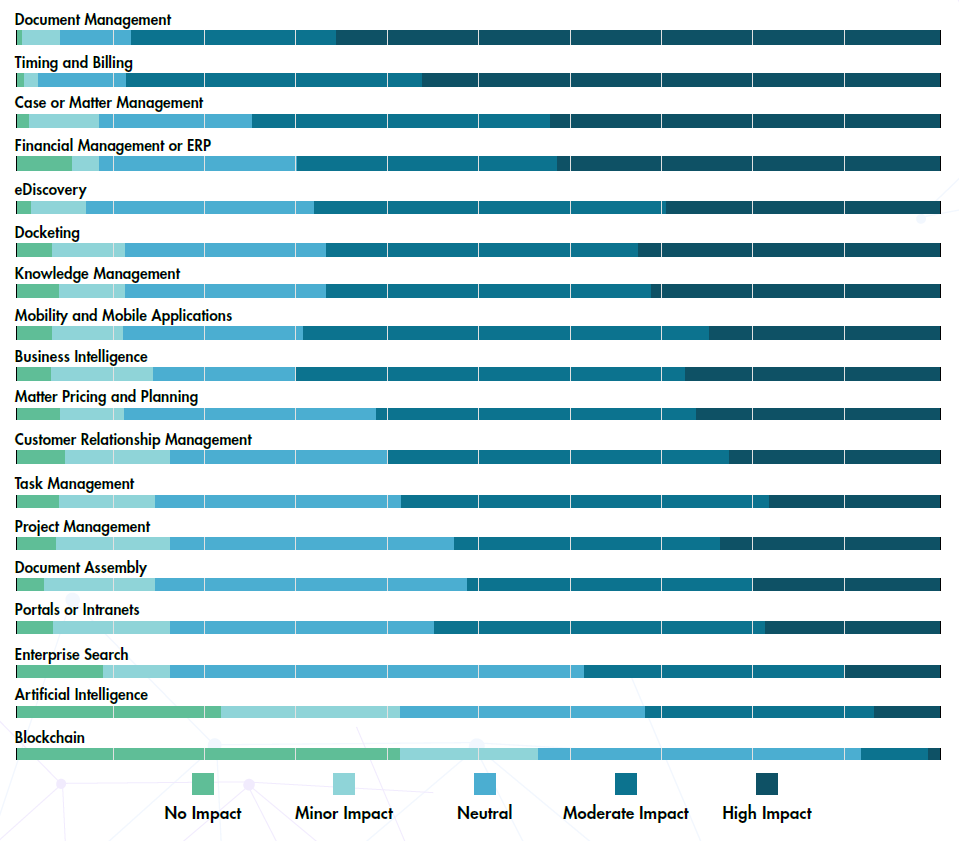
Out [on 8/7/19] is the 2019 Aderant Business of Law and Legal Technology Survey, published by Aderant, a global provider of business management software for law firms.


From DSC:
It will be very interesting to see such a chart in just 2-3 years from now…#AI will be moving up the chart, guaranteed.


Per Jacob Strom at HeraldPR.com:

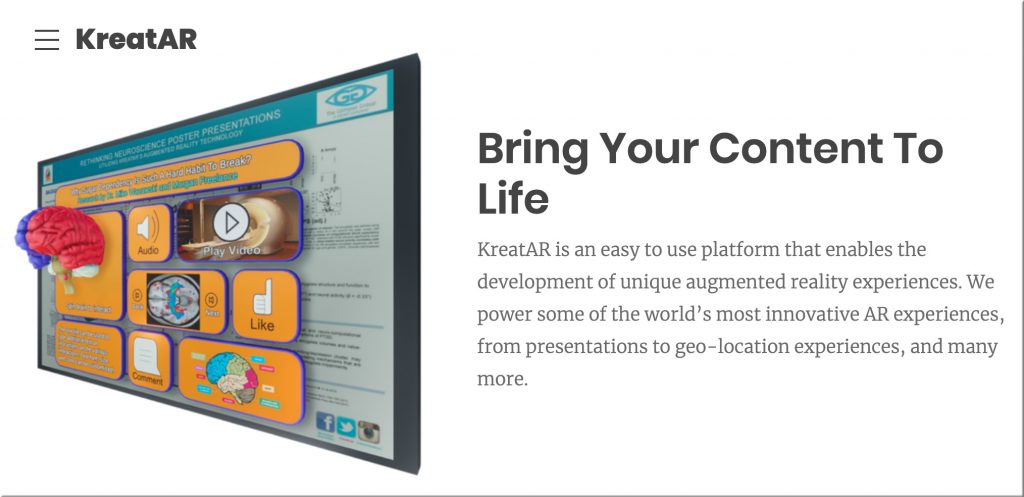
KreatAR, a subsidiary of The Glimpse Group, is helping change the way students and teachers are using augmented reality technology with PostReality, to help make learning more interactive with poster boards.

See:


Also see:


China has started a grand experiment in AI education. It could reshape how the world learns. — from technologyreview.com by Karen Hao
In recent years, the country has rushed to pursue “intelligent education.” Now its billion-dollar ed-tech companies are planning to export their vision overseas.

Excerpt:

Zhou Yi was terrible at math. He risked never getting into college. Then a company called Squirrel AI came to his middle school in Hangzhou, China, promising personalized tutoring. He had tried tutoring services before, but this one was different: instead of a human teacher, an AI algorithm would curate his lessons. The 13-year-old decided to give it a try. By the end of the semester, his test scores had risen from 50% to 62.5%. Two years later, he scored an 85% on his final middle school exam.

“I used to think math was terrifying,” he says. “But through tutoring, I realized it really isn’t that hard. It helped me take the first step down a different path.”


The strategy has fueled mind-boggling growth. In the five years since it was founded, the company has opened 2,000 learning centers in 200 cities and registered over a million students—equal to New York City’s entire public school system. It plans to expand to 2,000 more centers domestically within a year. To date, the company has also raised over $180 million in funding. At the end of last year, it gained unicorn status, surpassing $1 billion in valuation.


Salesforce completes $15.7B acquisition of Tableau Software, creating new enterprise tech force — from geekwire.com by Nat Levy; with thanks to Keesa Johnson for this resource out on LinkedIn

Excerpt:

Salesforce has wrapped up its $15.7 billion acquisition of Seattle’s Tableau Software, creating a powerful force in the lucrative enterprise software world.

The deal shakes up the Seattle tech scene and instantly makes Salesforce a major player for talent in the region. Making Seattle, and its plentiful tech talent, a key strategic part of Salesforce has long been a company goal, Salesforce Co-CEO Marc Benioff has said. The company even referred to Seattle as its new “HQ2.”

 
© 2025 | Daniel Christian