



.
Homeschool Talks is an informative podcast about all things homeschooling.
On 06/06/2023,
in Asia, Australia, bots, Canada, digital audio, emerging technologies, Europe, human-computer interaction (HCI), India, intelligent systems, law schools, legislatures / government / legal, Natural Language Processing (NLP), platforms, society, technologies for your home, UK, United States, user experience (UX), voice recognition / voice enabled interfaces,
by Daniel Christian
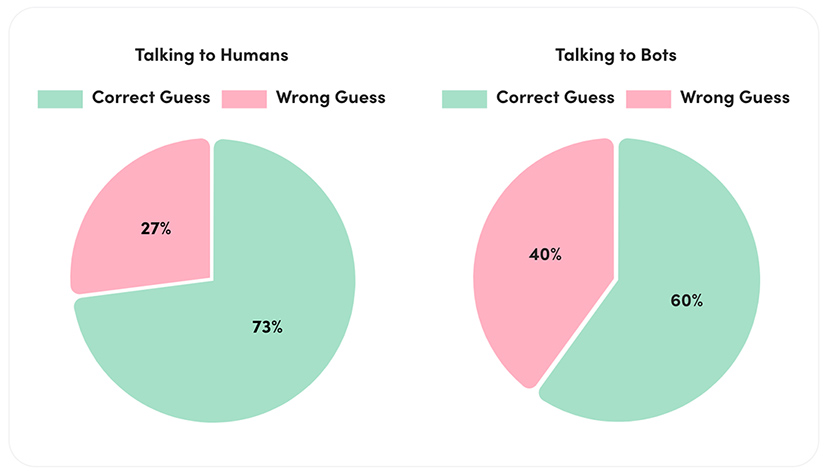
AI21 Labs concludes largest Turing Test experiment to date — from ai21.com
As part of an ongoing social and educational research project, AI21 Labs is thrilled to share the initial results of what has now become the largest Turing Test in history by scale.
.
On 06/05/2023,
in career development, corporate / business world, corporate universities / corporate training, digital learning, elearning, instructional design, learning, Learning Experience Design, professional development, skills, training / L&D, universities, vendors,
by Daniel Christian
Hire Instructional Designers: The Complete Guide — from teamedforlearning.com
Excerpt:
So you think you want to hire an instructional designer. Great choice. Instructional designers are eLearning industry superheroes. They create learning experiences and develop instructional materials to make learning accessible. Whether you’re creating training modules for your employees or building online courses for students, an instructional designer is an essential member of your eLearning team.
Addendum on 6/6/23, a somewhat relevant posting:
Professional Organizations for Instructional Designers — from christytuckerlearning.com by Christy Tucker
What professional organizations are useful for instructional designers? The Learning Guild, ATD, TLDC, Training Magazine Network, and LDA.
On 06/02/2023,
in colleges, community colleges, higher education, instructional design, mathematics, motivation, teachers, teaching & learning, universities,
by Daniel Christian
ChatGPT Prompts for Learner Motivation — from drphilippahardman.substack.com by Dr. Philippa Hardman
Three mega-prompts to motivate your learners like a pro
So, what can we – as educators and creators of ed-tech – do to build our learners’ intrinsic motivation and, in the process, drive both inclusion and achievement?
To help answer this question, I’ve put together a short guide. The guide includes:
- A whistle-stop tour of the science of intrinsic motivation.
- Three ChatGPT mega-prompts so you can apply the theory to the way you design learning experiences (and, perhaps, ed-tech products) and optimise for intrinsic motivation today.
How will Artificial Intelligence change higher education? — from chronicle.com by various
ChatGPT is just the beginning. 12 scholars and administrators explain.
Even discounting for hyperbole, the release of ChatGPT suggests that we’re at the dawn of an era marked by rapid advances in artificial intelligence, with far-reaching consequences for nearly every facet of society, including higher education. From admissions to assessment, academic integrity to scholarly research, university operations to disappearing jobs, here’s how 12 professors, administrators, and writers answer the question: How will AI change higher education?
Improving mathematical reasoning with process supervision — from openai.com
Excerpt:
We’ve trained a model to achieve a new state-of-the-art in mathematical problem solving by rewarding each correct step of reasoning (“process supervision”) instead of simply rewarding the correct final answer (“outcome supervision”). In addition to boosting performance relative to outcome supervision, process supervision also has an important alignment benefit: it directly trains the model to produce a chain-of-thought that is endorsed by humans.
On 06/02/2023,
in 21st century, 24x7x365 access, career development, Daniel S. Christian, higher education, learning ecosystem, MOOCs -- Massive Open Online Courses, online learning,
by Daniel Christian
DC: For those who say MOOCs and the like didn’t / doesn’t have an impact: 6.4 ***MILLION*** learners from this man alone might have a different perspective on that. #learningecosystems #MOOCs pic.twitter.com/mcyvAiuDY2
— Daniel Christian (he/him/his) (@dchristian5) May 30, 2023
On 06/02/2023,
in Artificial Intelligence/Agents/LLMs/and Related, bots, intelligent systems, law schools, Legal operations, legal technologies, legislatures / government / legal,
by Daniel Christian
The perils of consulting an Electric Monk — from jordanfurlong.substack.com by Jordan Furlong
Don’t blame ChatGPT for the infamous incident of the made-up cases. And don’t be too hard on the lawyer, either. We’re all susceptible to a machine that tells us exactly what we want to hear.

Excerpt:
But then the “ChatGPT Lawyer” story happened, and all hell broke loose on LawTwitter and LawLinkedIn, and I felt I needed to make three points, one of which involves an extra-terrestrial robot.
My first two points are pretty straightforward:
- The tsunami of gleeful overreaction from lawyers on social media, urging bans on the use of ChatGPT and predicting prison time for the hapless practitioner, speaks not only to their fear and loathing of generative AI, but also to their desperate hope that it’s all really nothing but hype and won’t disturb their happy status quo. Good luck with that.
- The condemnation and mockery of the lawyer himself, who made a bad mistake but who’s been buried by an utterly disproportionate avalanche of derision, speaks to the lack of compassion in this profession, whose members should pray that their worst day as a lawyer never makes it to the front page of The New York Times. There but for the grace of God.
Are you looking for evidence to support the side that’s hired you? Or are you looking for the truth? Choosing the first option has never been easier. It’s also never been more dangerous.
As referenced topic-wise by Jordan above, also see:
A lawyer used ChatGPT to prepare a court filing. It went horribly awry. — from cbsnews.com by Megan Cerullo
What I learned at CLOC 2023 — from alexofftherecord.com by Alex Su
This week I attended the premier legal operations conference. Here’s what I heard.
Excerpt:
Theme 1: Generative AI isn’t going anywhere
This was a huge theme throughout the conference. Whether it was vendors announcing GPT integrations, or panels discussing how to use AI, there was just an enormous amount of attention on generative AI. I’m certainly no stranger to all this hype, but I’d always wondered if it was all from my Silicon Valley bubble. It wasn’t.
What was driving all this interest in AI? Well, the ubiquity of ChatGPT. Everyone’s talking about it and trying to figure out how to incorporate it into the business. And not just in the U.S. It’s a worldwide trend. Word on the street is that it’s a CEO-level priority. Everywhere. So naturally it trickles down to the legal department.
We need to talk about ChatGPT — from mnbar.org by Damien Riehl
Excerpt:
How well do LLMs perform on legal tasks?
Personal experience and anecdotal evidence indicate that LLMs’ current state provides impressive output in various legal tasks. Specifically, they provide extraordinary results on the following:
- Drafting counterarguments.
- Exploring client fact inquiries (e.g., “How did you lose money?”).
- Ideating voir dire questions (and rating responses).
- Summarizing statutes.
- Calculating works’ copyright expiration.
- Drafting privacy playbooks.
- Drafting motions to dismiss.
- Responding to cease-and-desist letters.
- Crafting decision trees.
- Creating chronologies.
- Drafting contracts.
- Extracting key elements from depositions.
On 06/02/2023,
in ethics, faith, hearts -- matters of the heart, morals/values, relationships, religion, society,
by Daniel Christian
Romans 12:10
Be devoted to one another in love. Honor one another above yourselves.
Proverbs 12:22
“The Lord detests lying lips, but he delights in people who are trustworthy.”
Psalms 65:3
When we were overwhelmed by sins, you forgave our transgressions.
Proverbs 13:10
Where there is strife, there is pride, but wisdom is found in those who take advice.