Professional Baseball Coaches Are Now Available In VR — from vrscout.com by KyleMelnick


Also see:

VR Brings A Terminally Ill Girl’s Dream To Life — from vrscout.com by KyleMelnick
A group of compassionate VR developers came together for an incredible cause.

Excerpt:

This week we learned of yet another heart-warming story wherein immersive technology was used to change a life. As reported by Shacknews, a handful of talented VR developers recently joined forces to answer the wish of a terminally-ill girl with a passion for mythical sea creatures.

Organized by VR Therapies, a group dedicated to exploring the use of VR technology for psychological and physical therapy, the project brought together 10 compassionate developers to make four-year-old Zainab’s dream of swimming through the ocean as a mermaid a reality for her birthday.


Webinars from Tom Barrett regarding AI for Education — a free webinar series

  • Webinar 6 replay
    • Miriam Scott – Head of Digital Education at Hillbrook Anglican School, Brisbane, Queensland, Australia.
    • Laura Bain – Head of Emerging Technologies and Innovation, Matthew Flinders Anglican College, Sunshine Coast, Queensland, Australia.
    • Nicole Dyson – Founder & CEO, Future Anything, Brisbane, Queensland, Australia.
  • Webinar 5 replay
    • In the fifth free webinar on AI for Education, I am joined by Dean Pearman, Head of Education at Beaconhills College and Tom Oliphant, Head of Technology and Enterprise at St John’s Grammar School. We explore questions about creativity, design and the new skills that are emerging. Join us to invest in your AI Literacy. Expand your toolset, broaden your understanding, and challenge your thinking.
  • Webinar 4 replay
    • You are watching the fourth free webinar, a dialogue about AI for education with Sophie Fenton, Steve Brophy and hosted by Tom Barrett Building Blocks – key AI concepts to learn. Practical frameworks for navigating the challenges of AI for education. Be part of a dialogue on provocations about AI and human centred education, truth and identity.
  • Webinar 3 replay – Claire Amos and Philly Wintle
  • Webinar 2 replay – Gemma Rainger and Dr Nick Jackson
  • Webinar 1 replay – Chantelle Love, Pip Cleaves and Steve Brophy

Using ChatGPT in Math Lesson Planning — from edutopia.org by Kristen Moore
Artificial intelligence tools are useful beyond language arts classes. Math teachers can use them to save time and create interesting lessons.


Democratic Inputs to AI — from openai.com
Our nonprofit organization, OpenAI, Inc., is launching a program to award ten $100,000 grants to fund experiments in setting up a democratic process for deciding what rules AI systems should follow, within the bounds defined by the law.


AI Canon — from a16z.com (Andreessen Horowitz) by Derrick Harris, Matt Bornstein, and Guido Appenzeller; via The Neuron newsletter

Excerpts:

Research in artificial intelligence is increasing at an exponential rate. It’s difficult for AI experts to keep up with everything new being published, and even harder for beginners to know where to start. So, in this post, we’re sharing a curated list of resources we’ve relied on to get smarter about modern AI. We call it the “AI Canon” because these papers, blog posts, courses, and guides have had an outsized impact on the field over the past several years.

Table of contents

  • A gentle introduction
  • Foundational learning
  • Tech deep dive
  • Practical guides to building with LLMs
  • Market analysis
  • Landmark research results

Generative AI hits Adobe Photoshop!

Generative AI hits Adobe Photoshop!


How Financially Resilient Is Your College? — from bain.com; with thanks to Jeff Selingo for this resource
See how your school stacks up in our interactive database.  

Excerpt:

Use this interactive tool to explore the impact of macroeconomic, enrollment, and cost scenarios on your institution’s financial position, actions you can take boost resilience, and how your school compares with others.


NVIDIA ACE for Games is a new foundry for intelligent in-game characters powered by generative AI. Developers of middleware, tools, and games can use NVIDIA ACE for Games to build and deploy customized speech, conversation, and animation AI models in their software and games.

From DSC:
I can’t wait to see this type of thing integrated into educational games/simulations/training.


082 | Generating Voices — from thebrainyacts.beehiiv.com

Excerpts:

Conventional Use Cases

  1. Audio Document Reading:
  2. Accessibility:
  3. Training Materials:
  4. Document Proofing:
  5. Transcriptions:
  6. Blog to Podcast:

Unconventional Use Cases

  1. Voice Cloning for Client Interaction:
  2. Multilingual Services:
  3. AI-based Legal Information Hotline:
  4. Real-Time Courtroom Assistance:
  5. Engaging Jurors:
  6. Storytelling for Case Understanding:
 

From DSC:
And how long before that type of interactivity is embedded into learning-related applications/games?!


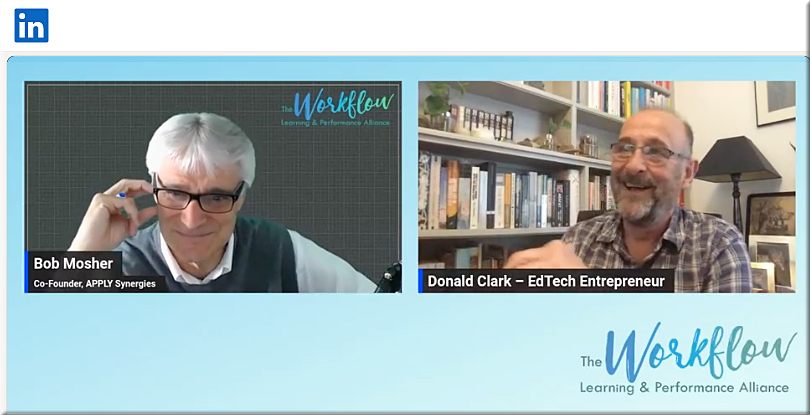
AI in Learning: The Impact of ChatGPT on L&D & Workflow Learning — from linkedin.com; this event by Bob Mosher features his conversation with Donald Clark

AI in Learning: The Impact of ChatGPT on L&D & Workflow Learning -- from linkedin.com; this event by Bob Mosher features his conversation with Donald Clark


Bill Gates says AI is poised to destroy search engines and Amazon — from futurism.com by Victor Tangermann
Who will win the AI [competition]? (DSC: I substituted the word competition here, as that’s what it is. It’s not a war, it’s a part of America’s way of doing business.)

“Whoever wins the personal agent, that’s the big thing, because you will never go to a search site again, you will never go to a productivity site, you’ll never go to Amazon again,” Gates said during a Goldman Sachs event on AI in San Francisco this week, as quoted by CNBC.

These AI assistants could “read the stuff you don’t have time to read,” he said, allowing users to get to information without having to use a search engine like Google.


EdX launches ChatGPT-powered plugin, learning assistant — from edscoop.com
The online learning firm edX introduced two new tools powered by ChatGPT, the “first of many innovations” in generative AI for the platform.

The online learning platform edX introduced two new tools on Friday based on OpenAI’s ChatGPT technology: an edX plugin for ChatGPT and a learning assistant embedded in the edX platform, called Xpert.

According to the company, its plugin will enable ChatGPT Plus subscribers to discover educational programs and explore learning content such as videos and quizzes across edX’s library of 4,200 courses.


Bing is now the default search for ChatGPT — from theverge.com by Tom Warren; via superhuman.beehiiv.com
The close partnership between Microsoft and OpenAI leads to plug-in interoperability and search defaults.

Excerpt:

OpenAI will start using Bing as the default search experience for ChatGPT. The new search functionality will be rolling out to ChatGPT Plus users today and will be enabled for all free ChatGPT users soon through a plug-in in ChatGPT.


How ChatGPT Could Help or Hurt Students With Disabilities — from chronicle.com by Beth McMurtrie

Excerpt:

  • Students with mobility challenges may find it easier to use generative AI tools — such as ChatGPT or Elicit — to help them conduct research if that means they can avoid a trip to the library.
  • Students who have trouble navigating conversations — such as those along the autism spectrum — could use these tools for “social scripting.” In that scenario, they might ask ChatGPT to give them three ways to start a conversation with classmates about a group project.
  • Students who have trouble organizing their thoughts might benefit from asking a generative AI tool to suggest an opening paragraph for an essay they’re working on — not to plagiarize, but to help them get over “the terror of the blank page,” says Karen Costa, a faculty-development facilitator who, among other things, focuses on teaching, learning, and living with ADHD. “AI can help build momentum.”
  • ChatGPT is good at productive repetition. That is a practice most teachers use anyway to reinforce learning. But AI can take that to the next level by allowing students who have trouble processing information to repeatedly generate examples, definitions, questions, and scenarios of concepts they are learning.

It’s not all on you to figure this out and have all the answers. Partner with your students and explore this together.


A new antibiotic, discovered with artificial intelligence, may defeat a dangerous superbug — from edition.cnn.com by Brenda Goodman


8 YouTube Channels to Learn AI — from techthatmatters.beehiiv.com by Harsh Makadia

  • The AI Advantage (link)
  • Jason West (link)
  • TheAIGRID (link)
  • Prompt Engineering (link)
  • Matt Wolfe (link)
  • Two-Minute Papers (link)
  • Brett Malinowski (link)
  • 10X Income (link)

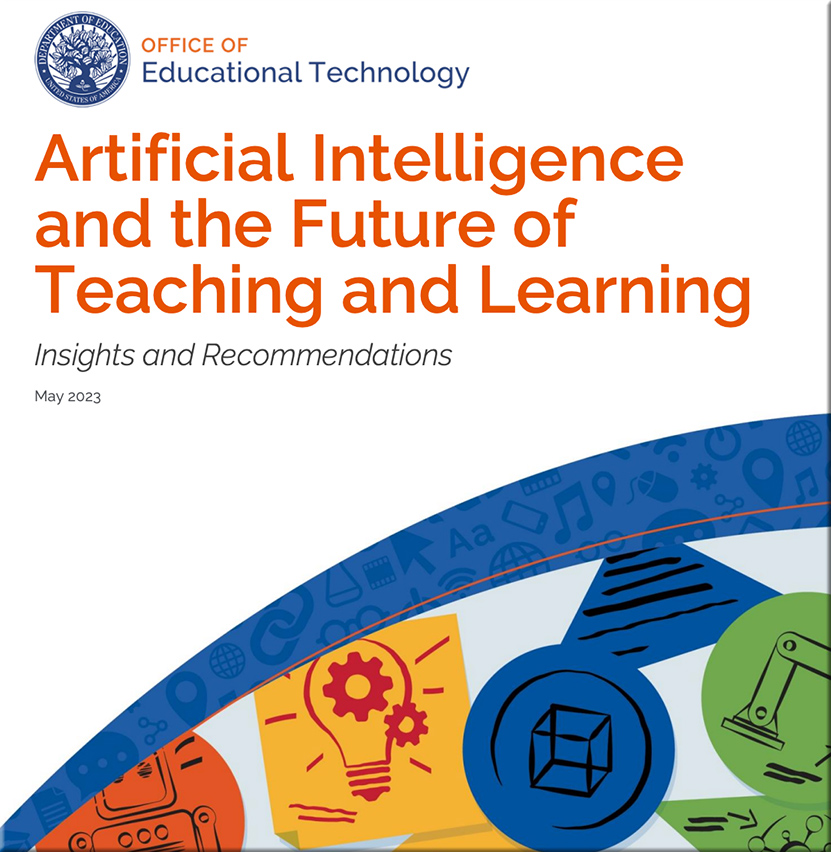
AI and the Future of Teaching and Learning | Insights and Recommendations from the Office of Educational Technology

Artificial Intelligence and the Future of Teaching and Learning | Insights and Recommendations — with thanks to Robert Gibson on LinkedIn for this resource


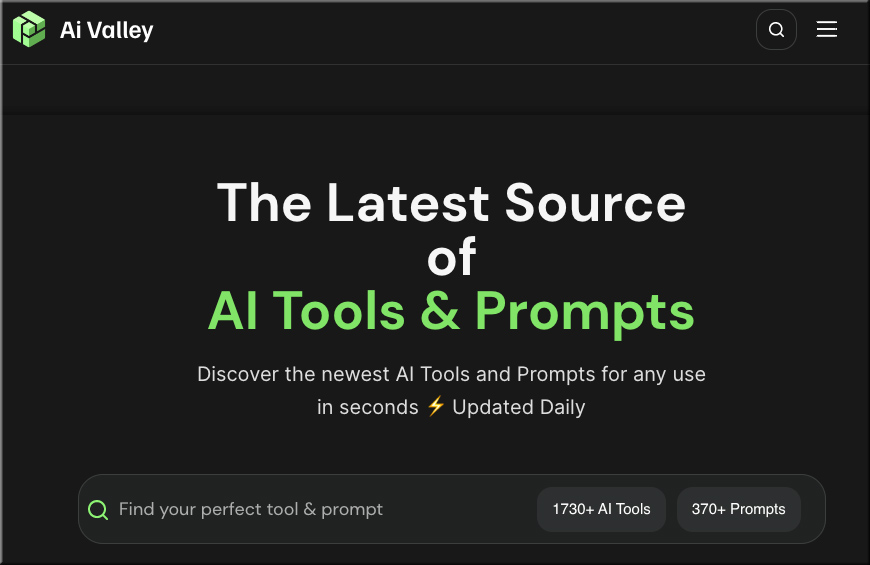
Ai Valley -- the latest source of AI tools and prompts


It takes a village… Reflections on sustainable learning design – from educationalist.substack.com; The Educationalist by Alexandra Mihai

Excerpt:

For the purpose of this article I want to look at learning design in a more holistic way, as a practice that takes place at institutional level. Because we are actually not designing the learning, we are designing for learning. It’s all about an ecosystem with many variable components, including people, institutions, pedagogy, disciplinary content, technology. Some of them more controllable or predictable, some of them less so. So learning design is (should be!) all about being adaptive, iterative, empathic, but also efficient, sustainable (from different points of view, I will come back to that later), scalable.


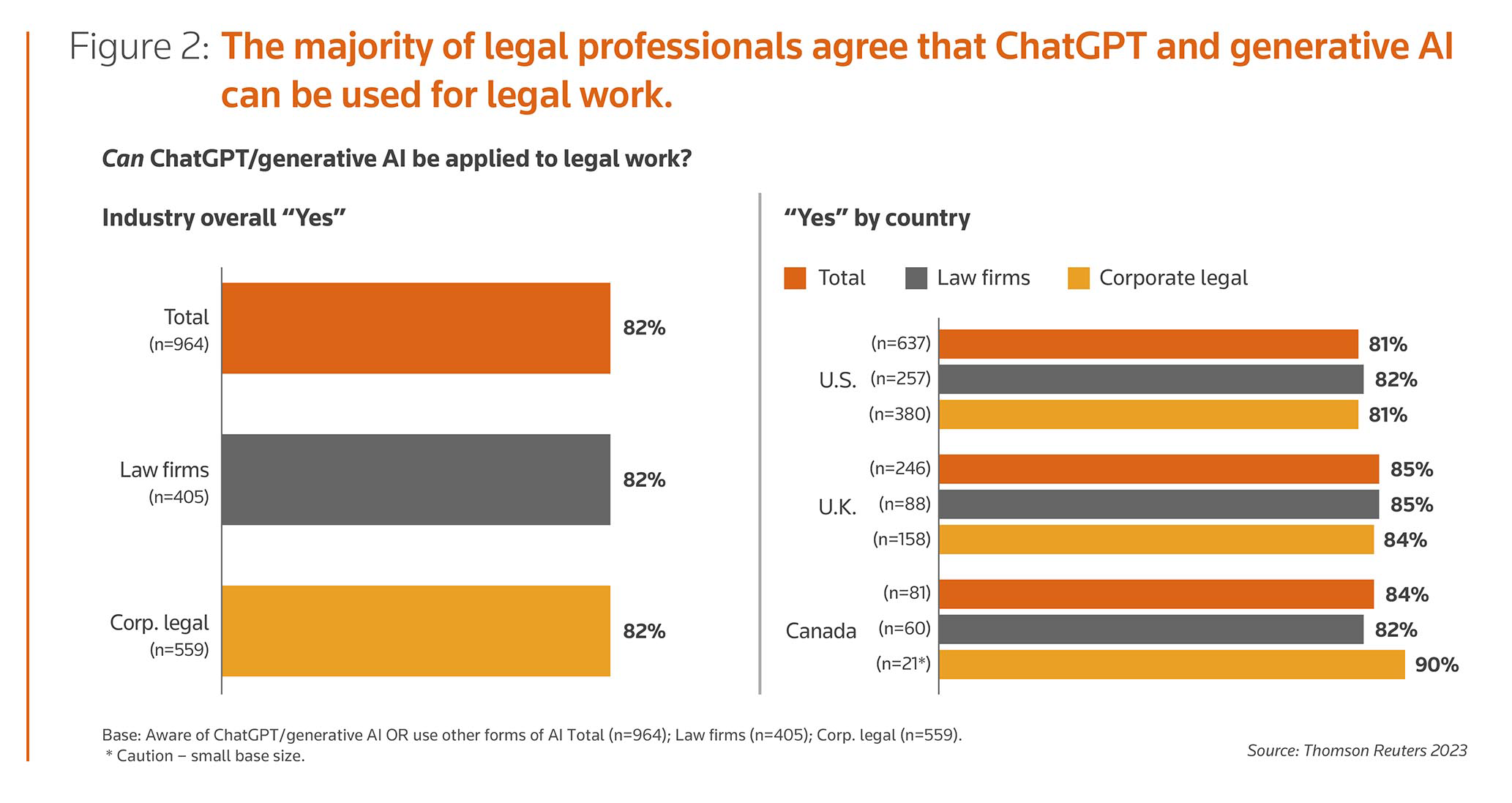
Corporate legal departments see use cases for generative AI & ChatGPT, new report finds — from thomsonreuters.com

New legal tech tools showcased at CLOC 2023 — from legaldive.comRobert Freedman
Innovations include a better way to evaluate law firm proposals, centralize all in-house legal requests in a single intake function and analyze agreements.

Guest post: CLOC 2023 – Key insights into how to drive value during changing economic times — from legaltechnology.com by Valerie Chan

Excerpt:

Typically, Legalweek has always been focused on eDiscovery, while CLOC was focused on matter management and contracts management. This time I noticed more balance in the vendor hall and sessions, with a broader range of services providers than before, including staffing providers, contracts management vendors and other new entrants in addition to eDiscovery vendors.

One theme dominated the show floor conversations: Over and over, the legal operators I talked with said if their technologies and vendors were able to develop better workflows, achieve more cost savings and report on the metrics that mattered to their GC, the GC could function as more of a business advisor to the C-suite.


AI is already being used in the legal system—we need to pay more attention to how we use it — by phys.org Morgiane Noel

Excerpt:

While ChatGPT and the use of algorithms in social media get lots of attention, an important area where AI promises to have an impact is law.

The idea of AI deciding guilt in legal proceedings may seem far-fetched, but it’s one we now need to give serious consideration to.

That’s because it raises questions about the compatibility of AI with conducting fair trials. The EU has enacted legislation designed to govern how AI can and can’t be used in criminal law.


Legal Innovation as a Service, Now Enhanced with AI — from denniskennedy.com by Dennis Kennedy

Excerpt:

Over the last semester, I’ve been teaching two classes at Michigan State University College of Law, one called AI and the Law and the other called New Technologies and the Law, and a class at University of Michigan Law School called Legal Technology Literacy and Leadership. All three classes pushed me to keep up-to-date with the nearly-daily developments in AI, ChatGPT, and LLMs. I also did quite a lot of experiments, primarily with ChatGPT, especially GPT-4, and with Notion AI.


Emerging Tech Trends: The rise of GPT tools in contract analysis — from abajournal.com by Nicole Black

Excerpt:

Below, you’ll learn about many of the solutions currently available. Keep in mind that this overview is not exhaustive. There are other similar tools currently available and the number of products in this category will undoubtedly increase in the months to come.


Politicians need to learn how AI works—fast — link.wired.com

Excerpt:

This week we’ll hear from someone who has deep experience in assessing and regulating potentially harmful uses of automation and artificial intelligence—valuable skills at a moment when many people, including lawmakers, are freaking out about the chaos that the technology could cause.


Some sharp creativity!


Orly Friedman on Red Bridge School and Educating for Agency — from gettingsmart.com

Key Points

  • Grouping is based on autonomy levels rather than grade levels and students move forward based on their own decision. This autonomy level is decoupled from academics.
  • Compliance vs Agency – Agency is what young people really need for the future.

Nobody ever washed a rented car. If you’re going to care of something, you need to feel a sense of ownership of it.

Orly Friedman


Law school students can take up to half of their credits online after ABA policy change — from highereddive.com by Jeremy Bauer-Wolf

Dive Brief:

  • Law school students can now take up to half of their classes online following a recent policy change by the American Bar Association.
  • ABA’s accrediting body voted last week to raise the ceiling on the number of credits students can earn online for their J.D., up from one-third.
  • It also struck down a prohibition on first-year law students taking no more than 10 credit hours remotely.

From DSC:
It’s almost June of 2023 and matters/impacts of Artificial Intelligence (AI) are increasingly popping up throughout our society. But WOW! Look at this recent piece of news from the American Bar Association: Law school students can now take up to 50% of their credits online! (It used to be just 30%.)

At a time when we need many more lawyers, judges, legislators, politicians, and others to be more informed about emerging technologies — as well as being more tech-savvy themselves — I don’t think the ABA should be patting themselves on the back for this policy change. It’s a step in the right direction, but why it’s not 100% is mind-boggling to me.


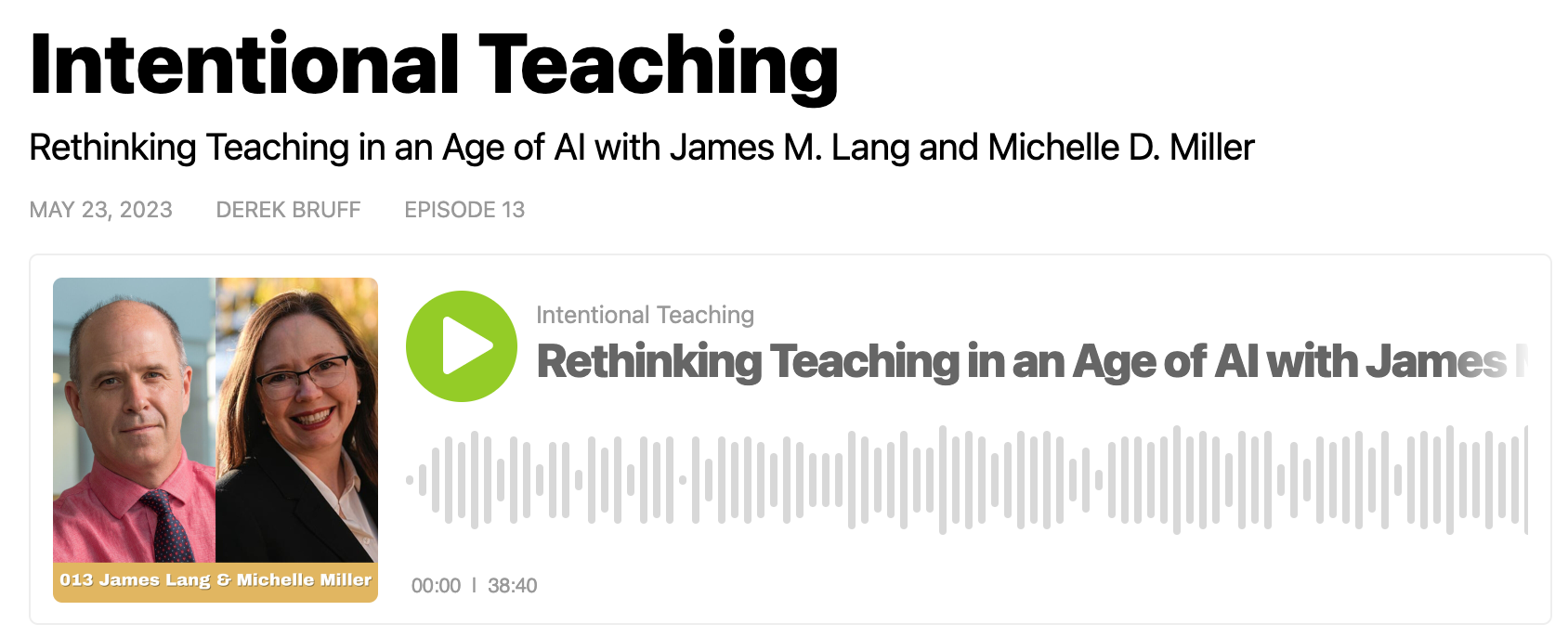
Intentional Teaching — from intentionalteaching.buzzsprout.com by Derek Bruff
Rethinking Teaching in an Age of AI with James M. Lang and Michelle D. Miller

Podcast from Derek Bruff -- Rethinking Teaching in an Age of AI with James M. Lang and Michelle D. Miller

Excerpt:

In her 2022 book Remembering and Forgetting in the Age of Technology, Michelle D. Miller writes about the “moral panics” that often happen in response to new technologies. In his 2013 book Cheating Lessons: Learning from Academic Dishonesty, James M. Lang argues that the best way to reduce cheating is through better course design. What do these authors have to say about teaching in an age of generative AI tools like ChatGPT? Lots!


Governance of superintelligence — from openai.com
Now is a good time to start thinking about the governance of superintelligence—future AI systems dramatically more capable than even AGI.

Governance of superintelligence Now is a good time to start thinking about the governance of superintelligence—future AI systems dramatically more capable than even AGI.

OpenAI leaders propose international regulatory body for AI — from techcrunch.com by Devin Coldewey

Excerpt:

AI is developing rapidly enough and the dangers it may pose are clear enough that OpenAI’s leadership believes that the world needs an international regulatory body akin to that governing nuclear power — and fast. But not too fast. In a post to the company’s blog, OpenAI founder Sam Altman, President Greg Brockman and Chief Scientist Ilya Sutskever explain that the pace of innovation in artificial intelligence is so fast that we can’t expect existing authorities to adequately rein in the technology. While there’s a certain quality of patting themselves on the back here, it’s clear to any impartial observer that the tech, most visibly in OpenAI’s explosively popular ChatGPT conversational agent, represents a unique threat as well as an invaluable asset.

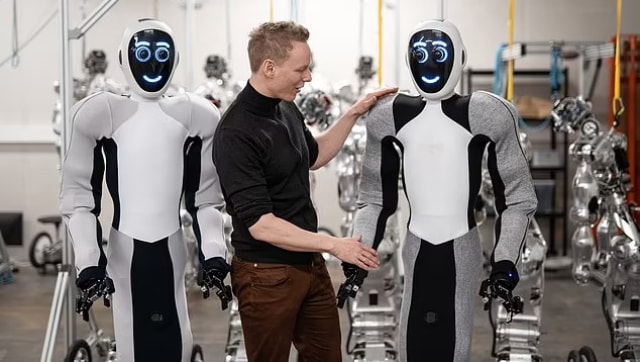
OpenAI-backed robot startup beats Elon Musk’s Tesla, deploys AI-enabled robots in real world — from firstpost.com by Mehul Reuben Das; via The Rundown
A robotics startup backed by OpenAI, the makers of ChatGPT has beaten Elon Musk’s Tesla in the humanoid robots race, and has successfully deployed humanoid robots as security guards. Next, they will be deploying the robots in hospices and assisted living facilities

A robotics startup backed by OpenAI, the makers of ChatGPT has beaten Elon Musk’s Tesla in the humanoid robots race, and has successfully deployed humanoid robots as security guards. Next, they will be deploying the robots in hospices and assisted living facilities.


From DSC:
Hmmm…given the crisis of loneliness in the United States, I’m not sure that this type of thing is a good thing. But I’m sure there are those who would argue the other side of this.


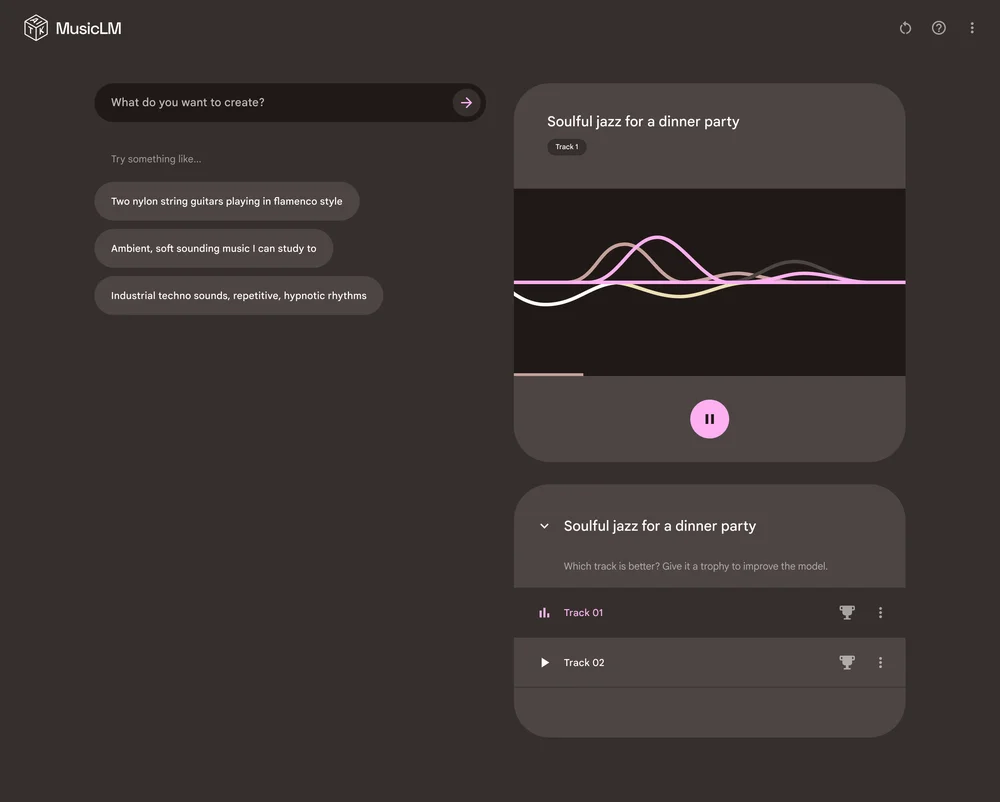
Turn ideas into music with MusicLM — from blog.google
Experiment today by describing a musical idea and hearing it come to life.

MusicLM is an experimental text-to-music model that can generate unique songs based on your ideas or descriptions.


What new grads can expect as they enter the working world — from mckinsey.com by Patrick Guggenberger, Dana Maor, Michael Park, and Patrick Simon

Excerpt:

May 21, 2023 It’s officially the season of caps, gowns, and stoles—and new grads are gearing up for entry into the world of work at a time when organizations are undergoing massive shifts. “The shifts include complex questions about how to organize for speed to shore up resilience, find the right balance between in-person and remote work models, address employees’ declining mental health, and build new institutional capabilities at a time of rapid technological change, among others,” write Patrick Guggenberger, Dana Maor, Michael Park, and Patrick Simon in a new report. These changes have significant implications for structures, processes, and people. How can new grads set themselves up for success in a quickly evolving environment? If you’re a soon-to-be new grad or know one, check out our newly refreshed special collection for insights and interviews on topics including productivity, hybrid work models, worker preferences, tech trends, and much more.


On a somewhat relevant posting (it has to do with career development as well), also see:

From Basic to Brand: How to Build and Use a Purposeful LinkedIn Profile — from er.educause.edu by Ryan MacTaggart and Laurie Burruss
Developing a professional brand helps higher education professionals establish meaningful work-related connections and build credibility in their area of expertise.


Below comments/notes are from DSC (with thanks to Roberto Ferraro for this resource):
according to Dan Pink, intrinsic motivation is very powerful — much more powerful for many types of “messy/unclear” cognitive work (vs. clear, more mechanical types of work). What’s involved here according to Pink? Autonomy, mastery, and purpose. 

Dan Pink makes his case in the video below. My question is:

  • If this is true, how might this be applied to education/training/lifelong learning?

From DSC (cont’d):

As Dan mentions, we each know this to be true. For example, for each of our kids, my wife and I introduced them to a variety of things — music, sports, art, etc. We kept waiting for them to discover which thing(s) that THEY wanted to pursue. Perhaps we’ll find out that this was the wrong thing to do. but according to Pink, it’s aligned with the type of energy and productivity that gets released when we pursue something that we want to pursue. Plus creativity flows in this type of setting. 

Again, my thanks to Roberto Ferraro for resurfacing this item as his “One ‘must read’ for this week” item of his newsletter.


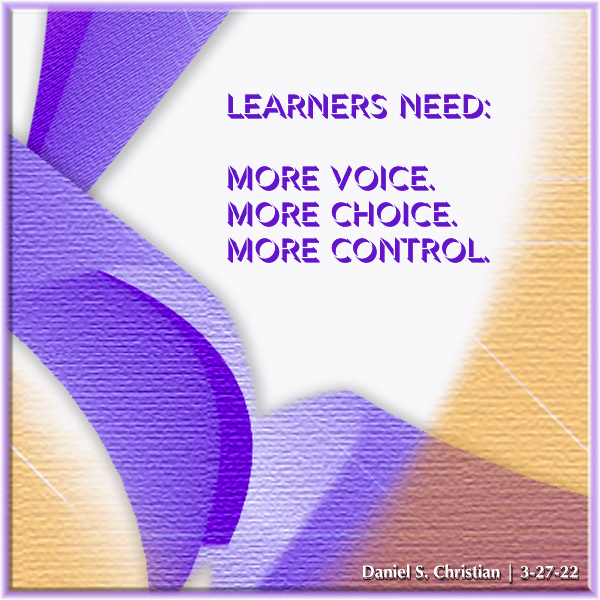
Learners need: More voice. More choice. More control. -- this image was created by Daniel Christian


© 2025 | Daniel Christian