Teaching with music can enhance learning in almost any subject area, says Sherena Small, a school social worker at Champaign Unit 4 School District in Illinois.
“It’s just such a good way to enhance what kids are learning,” says Small, who uses hip-hop and other music to teach social-emotional learning skills, including empathy and active listening. Earlier this year, Nearpod recognized Small as an Educator of the Year for her innovative efforts using Nearpod’s Flocabulary tool to incorporate music into class.
Speaking of multimedia, also see:
And here’s another interesting item from Dr. Burns:
Prepare to plant seeds of gratitude in your classroom with our collection of 15 unique activities featuring The Gratitude Tree. These creative experiences aim to nurture a culture of appreciation among your students; empowering them to recognize and celebrate the positive aspects of their lives.
As teachers, it’s our responsibility to encourage our students to be the best versions of themselves! As a spin from this, why not encourage your students to envision themselves as future presidents! The following activities are designed to foster critical thinking, develop leadership skills, and ignite a sense of civic responsibility in our young learners. Together, we’ll inspire our students to explore their ideas and values as well as the power they hold to create positive change in their communities!
Get ready to explore the enchanting world of elephants through a variety of engaging activities designed specifically for preschoolers. Our collection of 18 activities will not only ignite their imagination but also help them develop essential skills across different domains. Let’s dive right in and make learning a trunkload of fun!
Let’s make math exciting and engaging for your little learners! With the help of our 23 unique activities, you’ll be able to help your littles develop essential math skills while having a blast. We’ve covered everything from basic number concepts to shape and pattern recognition. So, without further adieu, let’s get the party started with a number hunt!
We have a massive opportunity to transform law and legal services to better serve society. We MUST AUTOMATE the majority of what lawyers do today so that we can expand access to the law and justice for EVERYONE in the future.
From DSC: I put the following comment on Dan’s posting:
I couldn’t agree more Dan. Millions of people could benefit from the considered, careful research of — and eventual application of — technologies to significantly improve/impact access to justice (#A2J).
According to a recent report from Goldman Sachs, a bank, 44% of legal tasks could be performed by AI, more than in any occupation surveyed except for clerical and administrative support. Lawyers spend an awful lot of time scrutinising tedious documents—the sort of thing that AI has already demonstrated it can do well. Lawyers use AI for a variety of tasks, including due diligence, research and data analytics. These applications have largely relied on “extractive” AI, which, as the name suggests, extracts information from a text, answering specific questions about its contents.
Ultimately this will be good news for clients. “People who go to lawyers don’t want lawyers: they want resolutions to their problems or the avoidance of problems altogether,” explains Mr Susskind. If AI can provide those outcomes then people will use AI. Many people already use software to do their taxes rather than rely on professionals; “Very few of them are complaining about the lack of social interaction with their tax advisers.”
Since 2012, 65 private colleges and universities with enrollment of 500 students or more, that I know of, have reduced their tuition, and commensurately reduced their discount rate. Several more schools are planning price resets for fall 2024. Schools use this strategy to increase the number of students who will consider them, and this approach has been successful for more than 80 percent of the schools which have reduced their published price.
From DSC: What I learned of economics in college would agree with this last bit. As the price goes down, demand goes up. And conversely, as the price goes up, demand goes down. As Lucie points out, many people don’t know about the heavily discounted prices within higher education. I’ve been fighting for price decreases for over 15 years…clearly, I haven’t had much success in that area.
AI-assisted cheating isn’t a temptation if students have a reason to care about their own learning.
Yesterday I happened to listen to two different podcasts that ended up resonating with one another and with an idea that’s been rattling around inside my head with all of this moral uproar about generative AI:
** If we trust students – and earn their trust in return – then they will be far less motivated to cheat with AI or in any other way. **
First, the question of motivation. On the Intentional Teaching podcast, while interviewing James Lang and Michelle Miller on the impact of generative AI, Derek Bruff points out (drawing on Lang’s Cheating Lessons book) that if students have “real motivation to get some meaning out of [an] activity, then there’s far less motivation to just have ChatGPT write it for them.” Real motivation and real meaning FOR THE STUDENT translates into an investment in doing the work themselves.
…
Then I hopped over to one of my favorite podcasts – Teaching in Higher Ed – where Bonni Stachowiak was interviewing Cate Denial about a “pedagogy of kindness,” which is predicated on trusting students and not seeing them as adversaries in the work we’re doing.
So the second key element: being kind and trusting students, which builds a culture of mutual respect and care that again diminishes the likelihood that they will cheat.
…
Again, human-centered learning design seems to address so many of the concerns and challenges of the current moment in higher ed. Maybe it’s time to actually practice it more consistently. #aiineducation #higheredteaching #inclusiveteaching
How liberal arts colleges can make career services a priority — from highereddive.com by John Boyer Creating internships and focusing on short-term experiences has a big impact, the longtime undergraduate dean at the University of Chicago says.
TI-ADDIE: A Trauma-Informed Model of Instructional Design — from er.educause.edu by Ali Carr-Chellman and Treavor Bogard Adjusting the ADDIE model of instructional design specifically to accommodate trauma offers an opportunity to address the collective challenges that designers, instructors, and learners have faced during the current learning moment.
From DSC: Dr. Nino makes several solid points in this article. The article won’t let me copy/paste some excerpts for you, but I would encourage you to look at it.
I would add a few things:
The huge advantage of online-based learning is that a significant amount of learning-related data is automatically captured and doesn’t need to be manually entered (if such manually entered data ever does get entered…which most of it doesn’t).
Learners have much more control over the pacing within the digital realm — i.e., which media they want to use as well as stopping/fast-forwarding/rewinding certain kinds of media.
Most people are now required to be lifelong learners — where convenience and time-savings become very important factors in continuing one’s education
And finally, as AI and other technologies continue to make their way forward, it will be hard to beat online-based and/or hybrid-based learning.
“With Vision Pro, you’re no longer limited by a display,” Apple CEO Tim Cook said, introducing the new headset at WWDC 2023. Unlike earlier mixed reality reports, the system is far more focused on augmented reality than virtual. The company refresh to this new paradigm is “spatial computing.”
“This is the first Apple product you look through and not at.” – Tim Cook
And with those famous words, Apple announced a new era of consumer tech.
Apple’s new headset will operate on VisionOS – its new operating system – and will work with existing iOS and iPad apps. The new OS is created specifically for spatial computing — the blend of digital content into real space.
Vision Pro is controlled through hand gestures, eye movements and your voice (parts of it assisted by AI). You can use apps, change their size, capture photos and videos and more.
From DSC: Time will tell what happens with this new operating system and with this type of platform. I’m impressed with the engineering — as Apple wants me to be — but I doubt that this will become mainstream for quite some time yet. Also, I wonder what Steve Jobs would think of this…? Would he say that people would be willing to wear this headset (for long? at all?)? What about Jony Ive?
I’m sure the offered experiences will be excellent. But I won’t be buying one, as it’s waaaaaaaaay too expensive.
Ernst and Young dug a little deeper. “Today’s disruptive working landscape requires organisations to largely restructure the way they are doing work,” they noted in a bulletin in March this year. “Time now spent on tasks will be equally divided between people and machines. For these reasons, workforce roles will change and so do the skills needed to perform them.”
The World Economic Forum has pointed to this global skills gap and estimates that, while 85 million jobs will be displaced, 50% of all employees will need reskilling and/or upskilling by 2025. This, it almost goes without saying, will require Learning and Development departments to do the heavy-lifting in this initial transformational phase but also in an on-going capacity.
“And that’s the big problem,” says Hardman. “2025 is only two and half years away and the three pillars of L&D – knowledge transference, knowledge reinforcement and knowledge assessment – are crumbling. They have been unchanged for decades and are now, faced by revolutionary change, no longer fit for purpose.”
ChatGPT is the shakeup education needs— from eschoolnews.com by Joshua Sine As technology evolves, industries must evolve alongside it, and education is no exception–especially when students heavily and regularly rely on edtech
Key points:
Education must evolve along with technology–students will expect it
Embracing new technologies helps education leverage adaptive technology that engage student interest
With the pilot project, Wyoming has become the final state to allow competency-based learning in some form, marking a historic point in a growing, albeit slow, movement in favor of a model that emphasizes students’ achievement rather than the set 13-year academic schedule. That movement—long championed by many high-profile education leaders—has seen a handful of states embrace competency-based education faster than others and uneven progress within those states.
In Wyoming, it’s part of a three-pronged effort to move the state toward what State Superintendent of Public Instruction Megan Degenfelder calls “student-centered learning,” which is heavier on personalized and project-based learning that emphasize the development of problem-solving skills and letting students test-drive different career pathways.
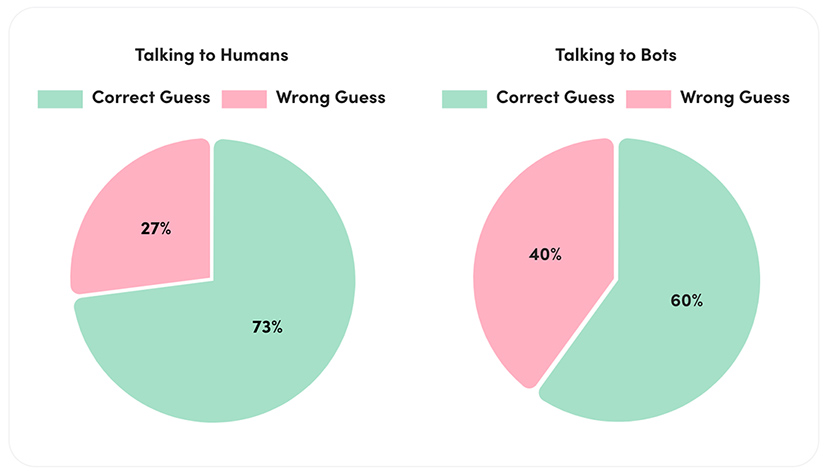
AI21 Labs concludes largest Turing Test experiment to date — from ai21.com As part of an ongoing social and educational research project, AI21 Labs is thrilled to share the initial results of what has now become the largest Turing Test in history by scale. .
What are the most common causes for teacher burnout?
There are plenty of reasons for teacher burnout. Teachers report:
Heavy workloads
A poor education landscape of Individual Education Program (IEP) plans
Staff shortages
Social media issues
Safety issues
Low salaries
Mental health
A deficit of education funds
And more
From DSC: Our oldest daughter teaches third grade. She and all of the other third-grade teachers at her school are not returning next year. Ouch! The school system that she works for asks teachers to serve as daycare providers before and after the official school day. Plus, the workloads require 6-7 days a week, especially for first-year teachers and/or other teachers who needed to teach different grade levels (i.e., increased prep times).
So you think you want to hire an instructional designer. Great choice. Instructional designers are eLearning industry superheroes. They create learning experiences and develop instructional materials to make learning accessible. Whether you’re creating training modules for your employees or building online courses for students, an instructional designer is an essential member of your eLearning team.
Addendum on 6/6/23, a somewhat relevant posting:
Professional Organizations for Instructional Designers — from christytuckerlearning.com by Christy Tucker What professional organizations are useful for instructional designers? The Learning Guild, ATD, TLDC, Training Magazine Network, and LDA.
DC: A heads up to us as emerging techs continue to hit the radar. We need to ask “should we build this?” or “how should we build this to ensure benefits to society?” — & not just build/develop things because we can. AI offers powerful pros as well as cons. https://t.co/JcrZqzDhzH
— Daniel Christian (he/him/his) (@dchristian5) June 1, 2023
ChatGPT Prompts for Learner Motivation — from drphilippahardman.substack.com by Dr. Philippa Hardman Three mega-prompts to motivate your learners like a pro
So, what can we – as educators and creators of ed-tech – do to build our learners’ intrinsic motivation and, in the process, drive both inclusion and achievement?
To help answer this question, I’ve put together a short guide. The guide includes:
A whistle-stop tour of the science of intrinsic motivation.
Three ChatGPT mega-prompts so you can apply the theory to the way you design learning experiences (and, perhaps, ed-tech products) and optimise for intrinsic motivation today.
Even discounting for hyperbole, the release of ChatGPT suggests that we’re at the dawn of an era marked by rapid advances in artificial intelligence, with far-reaching consequences for nearly every facet of society, including higher education. From admissions to assessment, academic integrity to scholarly research, university operations to disappearing jobs, here’s how 12 professors, administrators, and writers answer the question: How will AI change higher education?
We’ve trained a model to achieve a new state-of-the-art in mathematical problem solving by rewarding each correct step of reasoning (“process supervision”) instead of simply rewarding the correct final answer (“outcome supervision”). In addition to boosting performance relative to outcome supervision, process supervision also has an important alignment benefit: it directly trains the model to produce a chain-of-thought that is endorsed by humans.
But whereas Finland’s schools are still characterized by a culture of teaching, Oodi stands as a beacon of learning — self-organizing, emergent, and overflowing with the life force of its inhabitants. .
From DSC: As the above got me to thinking about learning spaces, here’s another somewhat relevant item from Steelcase:
Addendum on 6/6/23:
Also relevant to the first item in this posting, see:
Looking for Miracles in the Wrong Places — from nataliewexler.substack.com by Natalie Wexler An “edutourist” in Finland finds the ideal school, but it isn’t a school at all.
Counterpoint/excerpt:
It sounds appealing, but any country following that route is not only likely to find itself at the bottom of the PISA heap. It’s also likely to do a profound disservice to many of its children, particularly those from less highly educated families, who depend on teachers to impart information they don’t already have and to systematically build their knowledge.
Of course it’s possible for explicit, teacher-directed instruction to be soul-crushing for students. But it certainly doesn’t have to be, and there’s no indication from Mr. X’s account that the students in the schools he visited felt their experience was oppressive. When teachers get good training—of the kind apparently provided in Finland—they know how to engage students in the content they’re teaching and guide them to think about it deeply and analytically.
That’s not oppressive. In fact, it’s the key to enabling students to reach their full potential. In that sense, it’s liberating.
Thanks for dropping by my Learning Ecosystems blog!
My name is Daniel Christian and this blog seeks to cover the teaching and learning environments within the K-12 (including homeschooling, learning pods/micro-schools), collegiate, and corporate training spaces -- whether those environments be face-to-face, blended, hyflex, or 100% online.
Just as the organizations that we work for have their own learning ecosystems, each of us has our own learning ecosystem. We need to be very intentional about enhancing those learning ecosystems -- as we all need to be lifelong learners in order to remain marketable and employed. It's no longer about running sprints (i.e., getting a 4-year degree or going to a vocational school and then calling it quits), but rather, we are all running marathons now (i.e., we are into lifelong learning these days).







AI-assisted cheating isn’t a temptation if students have a reason to care about their own learning.
Yesterday I happened to listen to two different podcasts that ended up resonating with one another and with an idea that’s been rattling around inside my head with all of this moral uproar about generative AI:
** If we trust students – and earn their trust in return – then they will be far less motivated to cheat with AI or in any other way. **
First, the question of motivation. On the Intentional Teaching podcast, while interviewing James Lang and Michelle Miller on the impact of generative AI, Derek Bruff points out (drawing on Lang’s Cheating Lessons book) that if students have “real motivation to get some meaning out of [an] activity, then there’s far less motivation to just have ChatGPT write it for them.” Real motivation and real meaning FOR THE STUDENT translates into an investment in doing the work themselves.
…
Then I hopped over to one of my favorite podcasts – Teaching in Higher Ed – where Bonni Stachowiak was interviewing Cate Denial about a “pedagogy of kindness,” which is predicated on trusting students and not seeing them as adversaries in the work we’re doing.
So the second key element: being kind and trusting students, which builds a culture of mutual respect and care that again diminishes the likelihood that they will cheat.
…
Again, human-centered learning design seems to address so many of the concerns and challenges of the current moment in higher ed. Maybe it’s time to actually practice it more consistently. #aiineducation #higheredteaching #inclusiveteaching