Though college enrollment seems to be stabilizing after the pandemic disruptions, predictions for the next 15 years are grim. Colleges will be hurt financially by fewer tuition-paying students, and many will have to merge with other institutions or make significant changes to the way they operate if they want to keep their doors open.
At least 30 colleges closed their only or final campus in the first 10 months of 2023, including 14 nonprofit colleges and 16 for-profit colleges, according to an analysis of federal data by the State Higher Education Executive Officers Association, or SHEEO. Among nonprofits, this came on the heels of 2022, when 23 of them closed, along with 25 for-profit institutions. Before 2022, the greatest number of nonprofit colleges that closed in a single year was 13.
BIG RAPIDS, MI – A Michigan university is believed to be the first in the country to use artificial intelligence (AI) to create virtual students that will enroll in classes and participate in lessons and assignments.
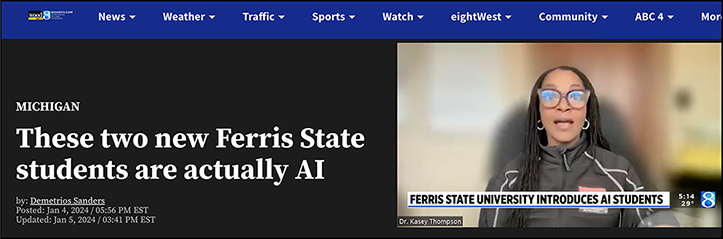
Ferris State University, which has one of just three undergraduate AI programs in the U.S., has developed two AI students who are enrolling at Ferris State as freshmen this semester and taking classes alongside human classmates.
At first, Ann and Fry will only be able to observe the class, but the goal is for the AI students to soon be able to speak during classroom discussions and have two-way conversations with their classmates, Thompson said.
BIG RAPIDS, Mich. (WOOD) — As Ferris State University gets ready for its spring semester, two virtual students will begin classes as part of a new artificial intelligence experiment.
Ferris State University offers one of three AI undergraduate programs in the entire country.
“We are leaders in the artificial intelligence area, and why not put us to the test?” said Dr. Kasey Thompson, special assistant to the president for innovation and entrepreneurship at Ferris State.
Students at Ferris State University in Michigan will soon be sharing the classroom with AI-powered freshman “students” who will enroll in classes alongside them, MLive reports.
And no, they won’t have humanoid robot bodies — they’ll be interacting with students via computers, microphones, and speakers.
In an experiment led by associate professor Kasey Thompson, AI students dubbed Ann and Fry will be listening — or scanning through? — lectures, work on assignments, and even actively participate in discussions with other students, per the report.
AI & “Un-Personalised” Learning — from drphilippahardman.substack.com by Dr. Philippa Hardman Exploring the full potential of AI to improve human learning, beyond the 1:1 AI tutor
In this week’s blog post we will look at AI from a different angle and ask: what are the pros and cons of using AI for personalisation? And what’s the potential impact of using AI to optimise and scale more connected, communal learning experiences?
…
TL;DR: while personalised learning has some benefits for some learner outcomes, the social interaction and connected aspects of communal learning are proven to offer similar academic benefits, as well as additional socio-cultural benefits for a broader range of students.
…
AI for “Un-Personalised” Learning
The next question is, of course: how could we use AI to scale the positive outcomes of “un-personalised”, communal learning?
New York Governor Kathy Hochul wants to make New York the nation’s leader in artificial intelligence research and development. As part of her State of the State address on Tuesday, Hochul proposed the creation of Empire AI – a consortium of the state’s research universities and other institutions that would form an artificial intelligence computing center in upstate New York.
Empire AI would include seven founding institutions—Columbia University, Cornell University, New York University, Rensselaer Polytechnic Institute, the State University of New York (SUNY), the City University of New York (CUNY), and the Simons Foundation.
North Carolina AI Education Guidance Release — from stefanbauschard.substack.com by Stefan Bauschard “A” grade in my mind; it just needs to anticipate the near future a bit more
TLDR The Guidance
*North Carolina has arguably issued the best AI guidance to date (IMHO), and I explain why below (my highlighted version is here). This is in no way a knock on the other guidance reports, as I think they offer a lot them of very important and essential guidance. I just really like how NC packages it and the emphasis they put on certain things.
The Emerging Role of Smart TVs Boothe and Comiskey claim that our TVs will become even smarter and better connected to the web and the internet. Our TVs will become an intelligent center for a variety of applications powered through our smartphone. TVs will be able to direct things like appliances and security cameras. Perhaps even more importantly, our TVs can become e-commerce centers, allowing us to speak with them and conduct business.
…
This increased TV capability means that the TV could become a more dominant mode of working and computing for lawyers. As TVs become more integrated with the internet and capable of functioning as communication hubs, they could potentially replace traditional computing devices in legal settings. With features like voice control and pattern recognition, TVs could serve as efficient tools for such things as document preparation and client meetings.
From DSC: Now imagine the power of voice-enabled chatbots and the like. We could be videoconferencing (or holograming) with clients, and be able to access information at the same time. Language translation — like that in the Timekettle product — will be built in.
As we step into 2024, the legal industry continues to be reshaped by technological advancements. This year promises to bring new developments that could revolutionize how legal professionals work and interact with clients. Here are key predictions for legal tech in 2024:
Last Friday was Legaltech Week’s year-end show, in which our panel of journalists and bloggers picked the year’s top stories in legal tech and innovation.
So what were the top stories? Well, if you missed it, no worries. Here’s the video:
One-third of K-12 teachers say they have used artificial intelligence-driven tools in their classroom, according to an EdWeek Research Center survey of educators conducted between Nov. 30 and Dec. 6, 2023.
Of those who said they’ve used AI tools, 21 percent said they’ve used them a little, 10 percent said they’ve used them some, and 2 percent said they’ve used them a lot, according to the survey, which included 498 teachers.
…
Here’s how and why some educators say they’ve been using AI tools in the classroom:
Path 1 — We keep telling the teachers AI cannot do their jobs because it can’t do everything humans can do, and we keep telling kids that learning with AI is cheating and that they will amount to nothing if they use AIs to help do their work. This path is a path toward the irrelevance of educational institutions. AIs can and will be able to do most of what we do. AIs may not be able to do everything as well as us, but at least a lot of the things we do, they will be able to do better.
Path 2 — We help students and teachers understand the world that is emerging around them. Level with them. Explain that the future ofevery single job is uncertain.Explain that in past technological revolutions that occurred over a much longer period of time than this, many people lost their jobs. Explain that society is about to be substantially disrupted, probably in greater ways than it ever has been before, and certainly faster than ever before. Inform them that every “future of employment” report identifies soft/ durable skills and AI technology skills as the known job skills of the future. Let them know that the future economic value of all knowledge work is uncertain.
From DSC: Though this next item is not about AI in our learning ecosystems, it caught my eye because having educators use their networks to help sponsor their students seems like a great way to help marginalized students get employed and ahead.
Ana Homayoun, an early career development expert and author of Erasing the Finish Line: The New Blueprint for Success Beyond Grades and College Admission, said that educators can support students from marginalized identities by proactively providing resources and support. “Our role as sponsors is really important,” said Homayoun. “That’s a term that I use to describe this idea of creating opportunities for economic growth.” She added that sponsorship includes identifying students that might be facing barriers and leveraging one’s network to give them a leg up.
ChatGPT Gold Rush Of 2024 — from newsletter.thedailybite.co GPT marketplace, McAfee’s anti-deepfake tech, and more…
Forget pickaxes and panning for nuggets; the new frontier of wealth lies in lines of code.
OpenAI just announced that their GPT Store is launching this week, and it allows ChatGPT Plus and Enterprise customers to create and sell their own custom AI models –no coding required. ?
Translation for those sleeping in the back:
This is the beginning of the GPT Gold Rush.
Opens AI’s move allows users to create a GPT for essentially any need. Imagine a specific GPT for anything from a fitness coach to a master chef recipe generator AND you get paid when people use it.
Excerpt from OpenAI’s GPT Store: A Game-Changer or a Gamble? section:
But before you dive in to Custom GPTs, there are a few things you should know.
Access to these custom GPTs is exclusive to ChatGPT Plus paid accounts. This could be a strategic move by OpenAI to increase Plus account adoption, and it could deter potential users.
OpenAI hasn’t been forthcoming about the revenue sharing model. This lack of transparency could definitely discourage creators from sharing their custom GPTs.
Some of the data uploaded to and chat transcripts in custom GPTs are shared back with OpenAI for future AI model training.
Building a lawyer support ecosystem — from jordanfurlong.substack.com by Jordan Furlong Pro sports teams invest serious resources to maximize the performance of their highly skilled, uniquely specialized professionals. Why don’t law firms do the same?
So my advice to law firms here is simple: Create more support for your lawyers and other professionals. Design and build ecosystems for the training, support, and personal and professional development of these highly skilled, uniquely specialized, and strategically critical human assets. Hire more full-time business coaches, skill trainers, and relationship managers. Spend money on these supportive measures now, or face massive bills down the road for the repair and replacement of the people you worked so hard to recruit.
Katherine discusses her unique approach to problem-solving in the legal field, which involves design thinking and project management principles. Katherine explains the importance of lawyers understanding client needs, the process of workflow mapping, and the challenges of implementing new processes in law firms.
Katherine also emphasizes that empathy and understanding the client journey is a must when designing effective legal services. In the end, she also gives some real world tips about where to begin working in project management principles into legal practice.
Like every year, I end 2023 with a blog featuring all the other people you should be reading (or listening to) as part of your day-to-day in-house life. For me, the hard part is choosing just a few to highlight. There are so many great content generators out there fighting for your (and my) attention. Unfortunately, I cannot list everyone (and I rarely repeat listing anyone I have listed in the past, i.e., I just assume you know they are still worth your time – they are!). [2] And, if you are interested in past winners, you can start by reading last year’s edition of “Best Blogs (and Other Media) for In-House Lawyers.” Instead, I try to list some new voices for you to check out. And, same as always, there is no particular order to my list (literally I am just typing as I find things in my Post-it notes, faulty memory, and Google Keep folders). Okay, where was I…? Right, enough yakking, let’s get on with the 2023 edition of Best Blogs and Other Media for In-House Counsel!
6 in-house legal trends to watch in 2024 — from legaldive.com from Lyle Moran and Robert Freedman AI, labor, antitrust, bankruptcies, women GCs and cross-collaboration are among the headlines in-house counsel can expect this year.
Discover a learner-centric curriculum at Embark Education, where learners recently co-designed a transformative project centered around family narratives and recipes.
Explore the intersection of culinary traditions, empathy, and critical analysis as learners delve into the complexities of cultural revitalization, shifting demographics, and systemic inequities in their communities.
Engage with a hands-on approach to competency-based education, culminating in the creation of a culturally rich product in collaboration with local community partners, fostering a deep sense of pride and ownership among learners and their respective communities, alike.
From DSC: I especially like the learner-centered approach, along with the collaboration with local community partners here. As described in Getting Smart’s Smart Update:
Microschool Spotlight: Embark Education
Getting Smart admires Embark Education’s innovative approach for reimagining the middle school experience, recognizing the pivotal nature of adolescence. With a commitment to providing personalized and relevant learning experiences, Embark supports learners in courageously exploring, engaging, and discovering their sense of self, contributing to the broader mission of revolutionizing education.
“We are anchored in the unwavering belief that by simply trusting learners, both youth and adults, we create the conditions for them to curiously and confidently unlock their potential – and that their potential is limitless.” – Brian Hyosaka, Head of School
OpenAI plans to launch a store for GPTs, custom apps based on its text-generating AI models (e.g. GPT-4), sometime in the coming week.
…
The GPT Store was announced last year during OpenAI’s first annual developer conference, DevDay, but delayed in December — almost certainly due to the leadership shakeup that occurred in November, just after the initial announcement.
How Workers Rise— from the-job.beehiiv.com by Paul Fain A look forward at skills-based hiring and AI’s impacts on education and work.
Impacts of AI: Fuller is optimistic about companies making serious progress on skills-based hiring over the next five to 10 years. AI will help drive that transformation, he says, by creating the data to better understand the skills associated with jobs.
The technology will allow for a more accurate matching of skills and experiences, says Fuller, and for companies to “not rely on proxies like degrees or grade point averages or even the proxy of what someone currently makes or how fast they’ve gotten promoted on their résumé.”
Change is coming soon, Fuller predicts, particularly as AI’s impacts accelerate. And the disruption will affect wealthier Americans who’ve been spared during previous shifts in the labor market.
The Kicker: “When people in bedroom suburbs are losing their six-figure jobs, that changes politics,” Fuller says. “That changes the way people are viewing things like equity and where that leads. It’s certainly going to put a lot of pressure on the way the system has worked.”
After the Jewish people had been exiled to various places, the walls of Jerusalem lay in ruins until the fifth century B.C.E.. At that point, a man named Nehemiah returned to Jerusalem as the provincial governor and completed the repairs of the walls. The verses below really stuck out at me in regards to what a leader should behave/look/be like. He was a servant leader, not demanding choice treatment, not squeezing the people for every last drop, and not using his position to treat himself extra right.
I don’t like to get political on this blog, as I already lose a great deal of readership due to including matters of faith. But today’s leaders (throughout all kinds of organizations) need to learn from Nehemiah’s example, regardless of whatever their beliefs/faiths may be.
14 Moreover, from the twentieth year of King Artaxerxes, when I was appointed to be their governor in the land of Judah, until his thirty-second year—twelve years—neither I nor my brothers ate the food allotted to the governor.15 But the earlier governors—those preceding me—placed a heavy burden on the people and took forty shekels[a] of silver from them in addition to food and wine. Their assistants also lorded it over the people. But out of reverence for God I did not act like that.16 Instead, I devoted myself to the work on this wall. All my men were assembled there for the work; we[b] did not acquire any land.
17 Furthermore, a hundred and fifty Jews and officials ate at my table, as well as those who came to us from the surrounding nations.18 Each day one ox, six choice sheep and some poultry were prepared for me, and every ten days an abundant supply of wine of all kinds. In spite of all this, I never demanded the food allotted to the governor, because the demands were heavy on these people.
19 Remember me with favor, my God, for all I have done for these people.
That’s the point of Linda Flanagan’s Take Back the Game, a book about the corruption of youth sports. It should be required reading for every parent. It should be handed out in the hospital along with What to Expect the First Year and Healthy Sleep Habits, Happy Child.
Flanagan, a journalist and former running coach, has pulled off a rare trick: she diagnoses a societal sickness, traces the roots of the malady, and prescribes a cure.
The problem is that we have a Youth Sports Industrial Complex that forces kids into single-sport specialization before they hit middle school. It demands that children be involved in (expensive) club and travel sports programs starting in elementary school.
Her first dictum is to delay entry into organized sports as long as possible. Don’t sign them up for pee-wee soccer to get a jump on the club scene—send them out into the yard to kick the ball around. Have a catch with them. Shoot baskets. Let them tumble and do cartwheels in the grass. As Flanagan says, “Just let them play.”
…
Another key precept from Flanagan: The family is more important than kids’ sports.
…
Perhaps the most valuable lesson from Take Back the Game is that parents have agency.
In the 2023 Litigation Support Trend Survey, U.S. Legal Support asked lawyers and legal professionals what technology trends they observed in 2023, and how they expect their use of technology to change in 2024.
Now, the results are in—check out the findings below.
Topics included:
Use of Artificial Intelligence
Prevalence of Remote Depositions
Digital Reporting
Speaking of legaltech and/or how emerging technologies are impacting the legal realm, also see:
? Voice Cloning in Law: ? A Brave New World of Sound!
In my latest blog, “The Deepfake Dilemma: Navigating Voice Cloning in the Legal System,” I tackle the complex challenges posed by voice cloning technology in the justice system. Discover the challenges, risks, and ethical… pic.twitter.com/Jj5u51u1Ia
Thanks for dropping by my Learning Ecosystems blog!
My name is Daniel Christian and this blog seeks to cover the teaching and learning environments within the K-12 (including homeschooling, learning pods/micro-schools), collegiate, and corporate training spaces -- whether those environments be face-to-face, blended, hyflex, or 100% online.
Just as the organizations that we work for have their own learning ecosystems, each of us has our own learning ecosystem. We need to be very intentional about enhancing those learning ecosystems -- as we all need to be lifelong learners in order to remain marketable and employed. It's no longer about running sprints (i.e., getting a 4-year degree or going to a vocational school and then calling it quits), but rather, we are all running marathons now (i.e., we are into lifelong learning these days).