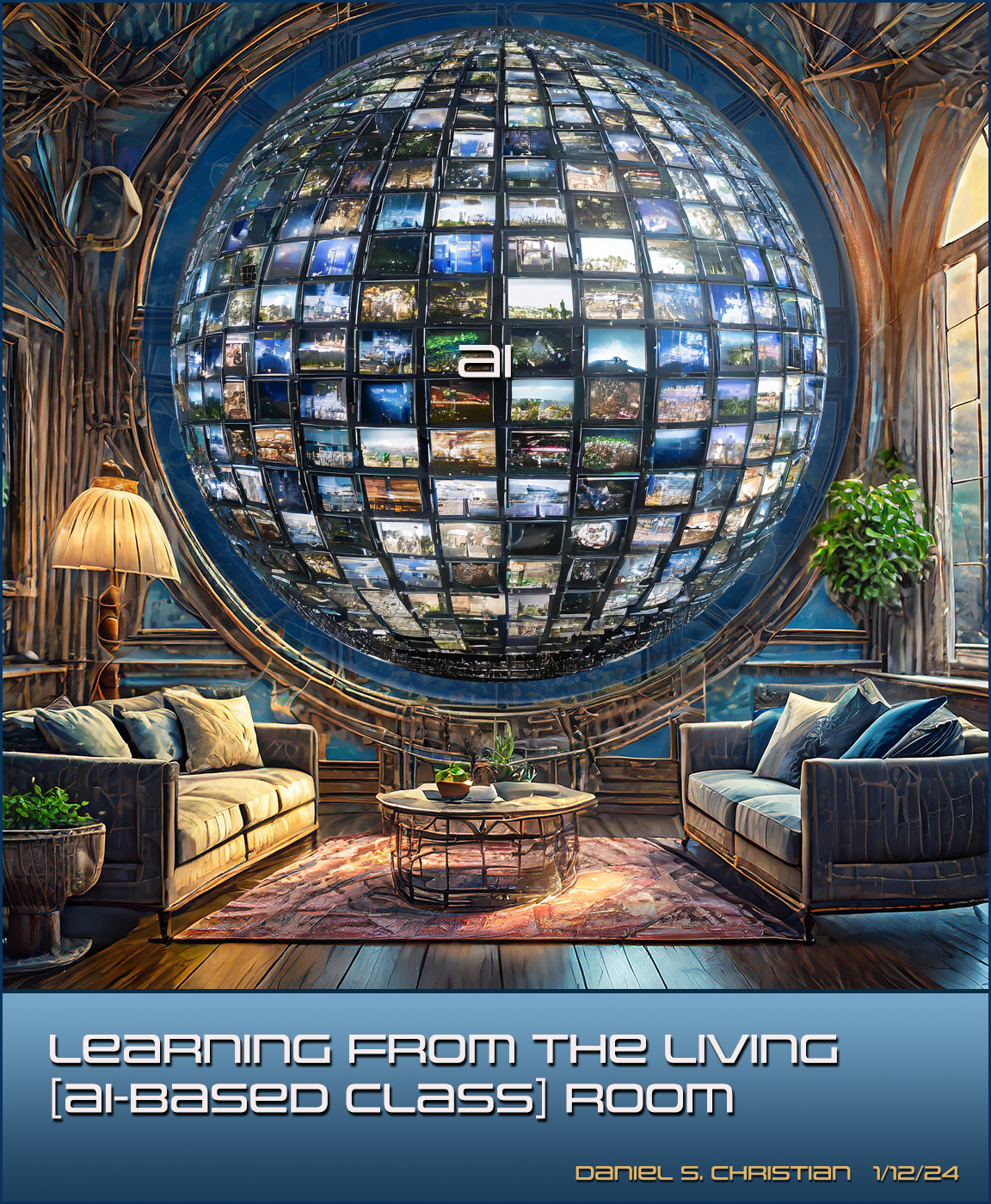
Make class prep easy with 8 flexible prompts for retrieval practice — from retrievalpractice.org by Pooja K. Agarwal, Ph.D.

Here are 8 flexible prompts you can customize for your students:

  • What would you like to remember about [topic]? Why is this important to you?
  • What was really memorable for you about [topic]? Why did it stand out to you?
  • What is one thing that’s surprising or confusing to you about [topic]?
  • What is one thing I didn’t ask you about [topic] that you learned?
  • What is an example of [topic] from your own life?
  • …plus three others
 

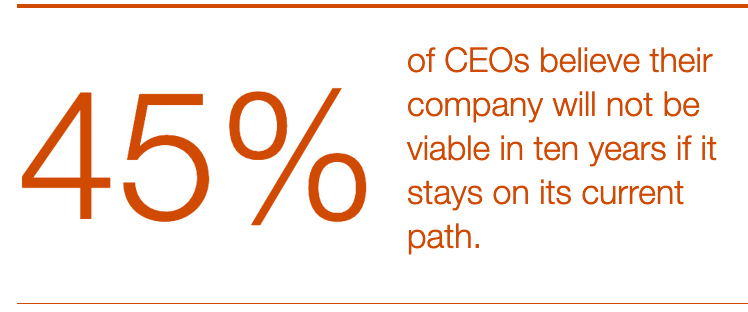
Thriving in an age of continuous reinvention — from pwc.com
As existential threats converge, many companies are taking steps to reinvent themselves. Is it enough? And what will it take to succeed?
.

.


The future of learning — from moodle.com by Sonya Trivedi

Self-directed and continuous learning
The concept of self-directed and continuous learning is becoming increasingly popular, reshaping our approach to knowledge and skill acquisition in both formal education and workplace settings. This evolving landscape reflects a world where traditional career paths are being replaced by more dynamic and flexible models, compelling learners to adapt and grow continuously.

The Future of Learning Report 2022 highlights this shift, noting the diminishing concept of a ‘career for life.’ With regular job switching and the expansion of the gig economy, there is an increasing need for a workforce equipped with a broad range of skills and the ability to gain qualifications throughout their careers. This shift is underlined by learners increasingly seeking control over their educational journeys, understanding that the ongoing acquisition of knowledge and skills is essential for staying relevant in the rapidly changing world of work. Reflecting this trend, a significant portion of learners, 33%, are choosing online platforms for their flexibility and ability to cater to individual needs and schedules.

From DSC:
The next paragraph after the above excerpt says:

Much like how companies such as Uber and Airbnb have reshaped their respective industries without owning traditional assets, the future of education might see universities functioning as the ‘Netflix of learning.’ In this model, learners comfortably source their educational experiences from various platforms, assembling their qualifications to create a personalised and continuously evolving portfolio of skills??.

But I don’t think it will be universities that function as the “Netflix of learning” as I don’t think the cultures of most institutions of traditional higher education can deal with that kind of innovation. I hope I’m wrong.

I think it will be a new, global, lifelong learning platform that originates outside of higher education. It will be bigger than higher education, K12, corporate training, or vocational training — as such a 21st-century, AI-based platform will offer all of the above and more.
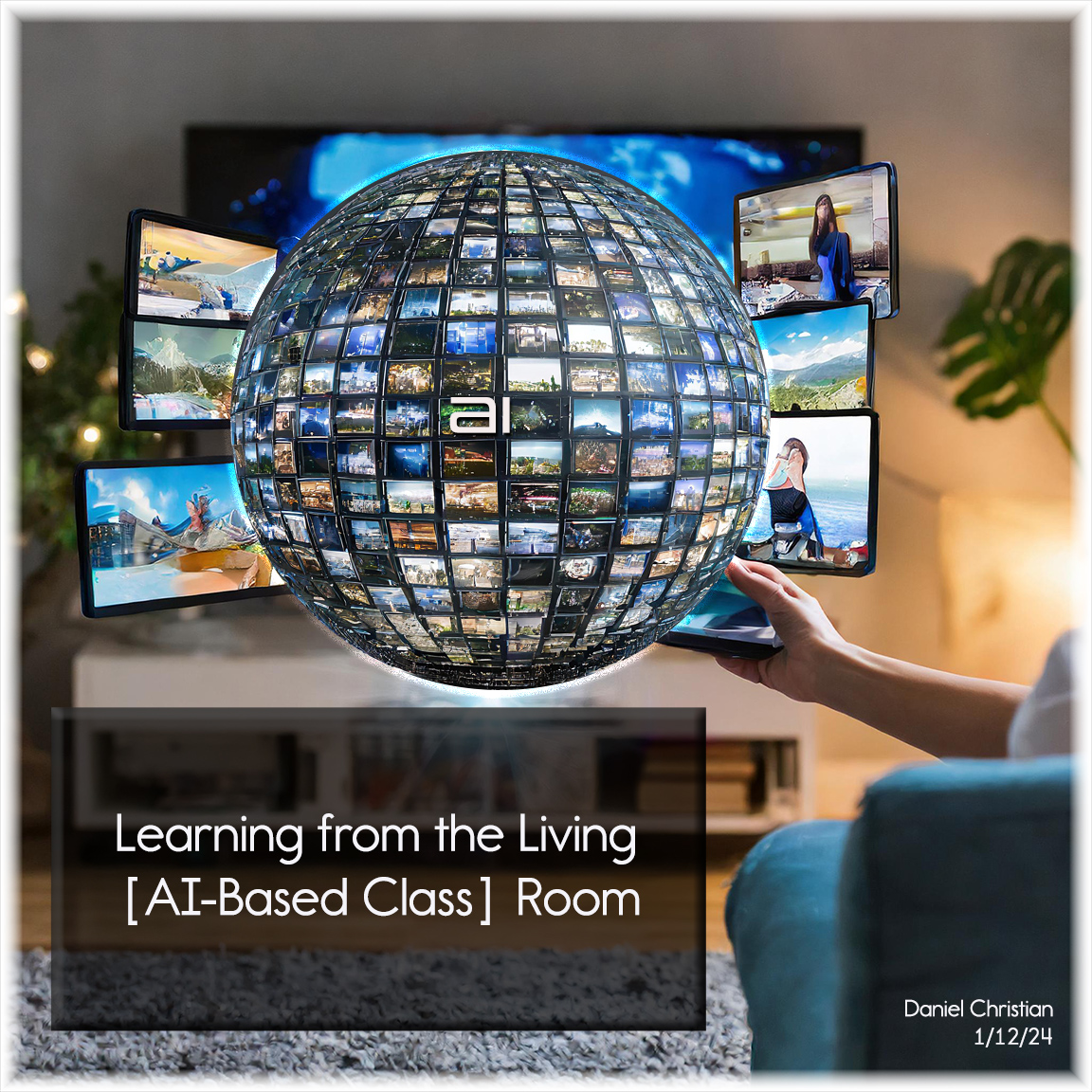
Learning from the living AI-based class room


Slow Shift to Skills — from the-job.beehiiv.com by Paul Fain

Real progress in efforts to increase mobility for nondegree workers is unlikely during the next couple years, Joseph Fuller, a professor at Harvard University’s business school who co-leads its Managing the Future of Work initiative, recently told me.

Yet Fuller is bullish on skills-based hiring becoming a real thing in five to 10 years. That’s because he predicts that AI will create the data to solve the skills taxonomy problem Kolko describes. And if skills-based hiring allows for serious movement for workers without bachelor’s degrees, Fuller says the future will look like where Texas is headed.


Report: Microcredentials Not a Strategic Priority for Many Colleges — from insidehighered.com by Kathryn Palmer
A new report finds that while most colleges surveyed embrace alternative credentials, many have a decentralized approach for creating and managing them.

While the majority of colleges focused on online, professional and continuing education have embraced alternative credentials, a significant number of those institutions haven’t made them a strategic priority.

That’s one of the key takeaways from a new study released Monday by UPCEA, the organization previously known as the University Professional and Continuing Education Association. University Professional and Continuing Education Association.

“While a lot of institutions want this, they don’t necessarily all know how” to deliver alternative credentials, said Bruce Etter, UPCEA’s senior director of research and consulting. “Embracing it is great, but now it needs to be part of the strategic plan.”


The Higher Learning Commission’s Credential Lab — from hlcommission.org
HLC’s Credential Lab


10 higher ed trends to watch in 2024 — from insidetrack.org by

Trend 1.
Linking education to career paths

Trend 2.
Making sense of the AI explosion

Trend 3.
Prioritizing mental health on campus

…plus 7 other trends


North Carolina’s Community Colleges Make a Big Bid to Stay Relevant — from workshift.opencampusmedia.org by Margaret Moffett
The system is poised to ask state legislators to overhaul its funding formula to focus on how well colleges prepare students for high-demand, well-paying jobs.

The new formula would pay a premium to each college based on labor-market outcomes: the more students enrolled in courses in high-demand, high-paying workforce sectors, the more money the college receives.

Importantly, the proposed formula makes no distinction between curricular courses that count toward degree programs and noncredit continuing education classes, which historically offer fewer slots for students because of their lower FTE reimbursement rates.


Supporting Career and Technical Education — from bloomberg.org via Paul Fain

The American job market is changing. A high school diploma is no longer a ticket to a good job now, an increasing number of employers are offering “middle-skill jobs” that require more than a high school diploma but less than a bachelor’s degree. Industries like health care, IT, advanced manufacturing, and financial services continue to see sustained growth at all levels, and they need workers with the experience and the credentials to fill new positions. Bloomberg Philanthropies is investing in programs that help young people get the specialized training they need through internships, apprenticeships, academics, and work-based learning.


Firms must continue to evolve to remain relevant — from lawyersweekly.com.au by Emma Musgrave
Law firms of all shapes and sizes must continue to reinvent themselves beyond the COVID-19 pandemic, according to two senior leaders at Piper Alderman.

“So [it’s] not saying, ‘We’re going to roll out ChatGPT across the board and use that’; it’s finding some particular cases that might be useful,” he explained.

“We’ve had, for example, [instances] where lawyers have said, ‘We’ve got a bunch of documents we use on a regular basis or a bunch of devices we use on a regular basis. Can we put these into ChatGPT and see if we can [find a] better way of pulling data out of things?’ And so use cases like that where people are coming up with ideas and trying them out and seeing how they go and [questioning whether] we roll this out more widely? I think that’s the approach that seems to be the best.”


Is Legal Technology the Future of Legal Services? — from lawfuel.com by Kelli Hall

Impact of Legal Technology on the Legal Industry

  • Virtual simulations and unrecognizable deep-fakes
  • eDiscovery investigations and the potential for cyberattacks
  • Enhancing efficiency, but potential risk for data leakage
  • Automation of administrative tasks and rapid data research

Revolutionizing Law Firm Strategies With AI And SEO — from abovethelaw.com by Annette Choti
Explore how AI and SEO are transforming law firm strategies, from automated keyword research to predictive SEO and voice recognition technology.

AI and SEO are two powerful technologies transforming the digital world for legal offices. AI can enhance SEO strategies, offering a competitive edge in search engine rankings. AI can streamline your content creation process. Learn about machine learning’s role in enhancing content optimization, contributing to more targeted and effective marketing efforts.


Navigating Gen AI In Legal: Insights From CES And A Dash Of Tequila Thinking — from abovethelaw.com by Stephen Embry
What should be our true north in making decisions about how to use technology?

Embracing Gen AI in Legal
So in all the Gen AI smoke and handwringing, lets first identify what we excel at as lawyers. What only we as lawyers are qualified to do. Then, when it comes to technology and the flavor of the day, Gen AI, let’s look relentlessly at how we can eliminate the time we spend on anything else. Let technology free us up for the work only we can do.

That’s Satya Nadella’s advice. And Microsoft has done pretty well under his leadership.


From Gavels to Algorithms: Judge Xavier Rodriguez Discusses the Future of Law and AI — from jdsupra.com by

It’s a rare privilege to converse with a visionary like Judge Xavier Rodriguez, who has seamlessly blended the realms of justice, law, and technology. His journey from a medieval history enthusiast to a United States district court judge specializing in eDiscovery and AI is inspiring.

Judge Rodriguez provides an insightful perspective on the need for clear AI regulations. He delves into the technical aspects and underscores the potential of AI to democratize the legal system. He envisions AI as a transformative force capable of simplifying the complexities that often make legal services out of reach for many.

Judge Rodriguez champions a progressive approach to legal education, emphasizing the urgency of integrating technology competence into the curriculum. This foresight will prepare future lawyers for a world where AI tools are as commonplace as legal pads, fostering a sense of anticipation for the future of legal practice.


Speak up for those who cannot speak for themselves,
    for the rights of all who are destitute.
Speak up and judge fairly;
    defend the rights of the poor and needy.

Psalm 145:8-14 New International Version

8 The Lord is gracious and compassionate,
slow to anger and rich in love.

9 The Lord is good to all;
he has compassion on all he has made.
10 All your works praise you, Lord;
your faithful people extol you.
11 They tell of the glory of your kingdom
and speak of your might,
12 so that all people may know of your mighty acts
and the glorious splendor of your kingdom.
13 Your kingdom is an everlasting kingdom,
and your dominion endures through all generations.

The Lord is trustworthy in all he promises
and faithful in all he does.[a]
14 The Lord upholds all who fall
and lifts up all who are bowed down.


From voice synthesis to fertility tracking, here are some actually helpful AI products at CES — from techcrunch.com by Devin Coldewey

But a few applications of machine learning stood out as genuinely helpful or surprising — here are a few examples of AI that might actually do some good.

The whole idea that AI might not be a total red flag occurred to me when I chatted with Whispp at a press event. This small team is working on voicing the voiceless, meaning people who have trouble speaking normally due to a condition or illness.

Whispp gives a voice to people who can’t speak


CES 2024: Everything revealed so far, from Nvidia and Sony to the weirdest reveals and helpful AI — from techcrunch.com by Christine Hall

Kicking off the first day were some bigger announcements from companies, including Nvidia, LG, Sony and Samsung. Those livestreams have ended, but you can watch most of their archives and catch up right here. And with the event still ongoing, and the show floor open, here’s how you can follow along with our team’s coverage.

Or, to dive into each day’s updates directly, you can follow these links:


My Honest Review of AI Art Tools I Used In 2023 — from theaigirl.substack.com by Diana Dovgopol
Here’s what I think of every AI art tool I used in 2023.

Today, I want to give my honest review of every AI art tool I used and why I love/hate some of them. I’ll highlight the best features they have and how the impact they had on me as an AI artist.

Midjourney v4: The first AI art tool I loved
While Lensa had its moment and offered users the chance to turn their selfies into stylized AI art effortlessly, Midjourney v4 meant a world of new possibilities. You could create anything you wanted with a prompt!


Speaking of art and creativity, here are two other items to check out!

An Italian Basilica, Mountain, and the Moon Magically Align in an Extraordinary Photo — from thisiscolossal.com by Grace Ebert and Valerio Minato

***


Introducing the GPT Store

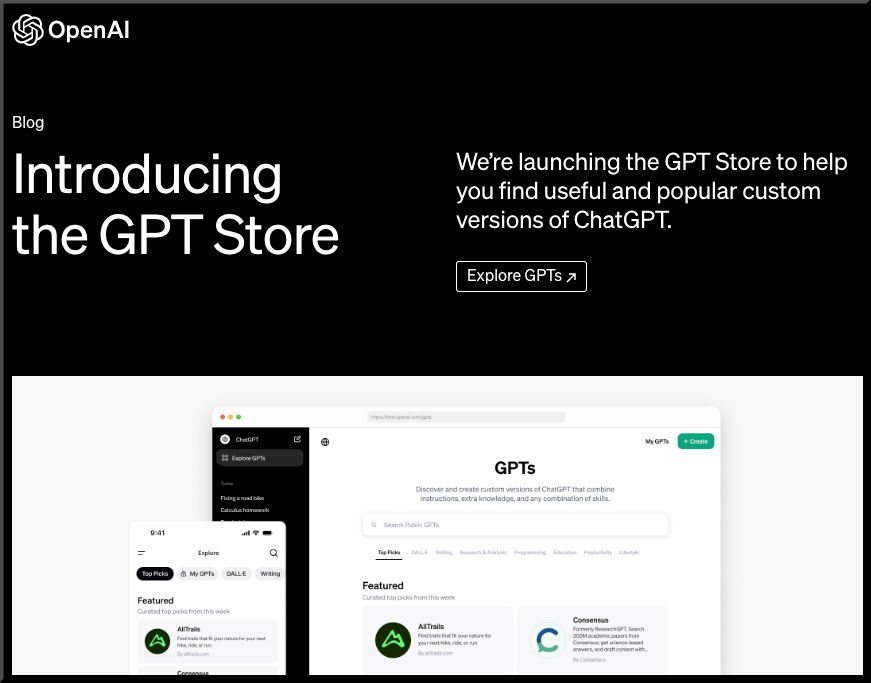
Introducing the GPT Store — from OpenAI
We’re launching the GPT Store to help you find useful and popular custom versions of ChatGPT.

It’s been two months since we announced GPTs, and users have already created over 3 million custom versions of ChatGPT. Many builders have shared their GPTs for others to use. Today, we’re starting to roll out the GPT Store to ChatGPT Plus, Team and Enterprise users so you can find useful and popular GPTs. Visit chat.openai.com/gpts to explore.


Introducing ChatGPT Team — from openai.com
We’re launching a new ChatGPT plan for teams of all sizes, which provides a secure, collaborative workspace to get the most out of ChatGPT at work.

ChatGPT Team offers access to our advanced models like GPT-4 and DALL·E 3, and tools like Advanced Data Analysis. It additionally includes a dedicated collaborative workspace for your team and admin tools for team management. As with ChatGPT Enterprise, you own and control your business data—we do not train on your business data or conversations, and our models don’t learn from your usage. More details on our data privacy practices can be found on our privacy page and Trust Portal.


GPT Store — from theneurondaily.com by Noah Edelman & Pete Huang

The App Store for ChatGPTs is here.

OpenAI finally launched its GPT Store—a hub offering access to over 3 million GPTs, for paid users (#sorrynotsorry).
If you missed pt. 1, pt. 2, and pt. 3 of our GPTs analysis, here’s the TLDR: GPTs are customized versions of ChatGPT pre-loaded with prompts or context, each designed to be good at specific tasks.

There’s a GPT for everything, like one for lesson plans, one that crunches numbers, and one that recommends books you’ll buy but never read.

The GPT Store is a game-changer.


OpenAI Just Released The GPT Store. Here’s How To Use It And Make Money With Your GPT — from artificialcorner.com by The Pycoach
Learn how to publish your GPT to the store and monetize it.

How to stand out on the GPT Store
The low barrier to entry for making GPTs will make earning money on the GPT store difficult. Not everyone will make tons of money off their GPT, but I think those with more chances of success will:

  • Use custom actions: This is a feature that allows your GPT to connect to an API. Connecting to APIs gives your GPT new functionalities that others won’t be able to replicate unless they have access to the API (here you can see my tutorial on how to add custom action to your GPT)
  • Use knowledge: Knowledge is a feature that allows you to add files to your GPT. Adding exclusive information could enrich your GPT and help it stand out from the pack. Just remember that files can be downloaded when the code interpreter is enabled.

OpenAI releases the app store of AI — from superhuman.ai by Zain Kahn

App stores are ginormous businesses. According to CNBC’s estimates, Apple’s App Store grossed north of $70 Billion in 2022. That’s more revenue than Spotify, Shopify and Airbnb generated in the same year — combined.

When you look at the size of the opportunity that app stores built on top of popular platforms unlock, OpenAI’s latest move to launch a GPT Store is another bold bet by the startup that’s already leading the LLM and chatbot markets with GPT-4 and ChatGPT.

Announced [on 1/10/24], the GPT Store is a place for ChatGPT users to find custom versions of the chatbot that are designed for specific use cases.


Four Disruptive Trends For Higher Ed In 2024 — from michaelbhorn.substack.com by Michael B. Horn

  1. More colleges will close or merge.
  2. Online learning will continue to have its moment, but a shakeout is beginning.
  3. Big colleges and universities will get bigger.
  4. Apprenticeships will gain more traction outside of the trades.

Speaking of higher education and disruptions, also see the following item — via Ray Schroeder on LinkedIn:


Experts predicted dozens of colleges would close in 2023 – and they were right — from hechingerreport.org by Olivia Sanchez
Even more colleges will likely close in coming years as enrollment problems worsen

Though college enrollment seems to be stabilizing after the pandemic disruptions, predictions for the next 15 years are grim. Colleges will be hurt financially by fewer tuition-paying students, and many will have to merge with other institutions or make significant changes to the way they operate if they want to keep their doors open.

At least 30 colleges closed their only or final campus in the first 10 months of 2023, including 14 nonprofit colleges and 16 for-profit colleges, according to an analysis of federal data by the State Higher Education Executive Officers Association, or SHEEO. Among nonprofits, this came on the heels of 2022, when 23 of them closed, along with 25 for-profit institutions. Before 2022, the greatest number of nonprofit colleges that closed in a single year was 13.


Your classmate could be an AI student at this Michigan university  — from mlive.com by Melissa Frick

BIG RAPIDS, MI – A Michigan university is believed to be the first in the country to use artificial intelligence (AI) to create virtual students that will enroll in classes and participate in lessons and assignments.

Ferris State University, which has one of just three undergraduate AI programs in the U.S., has developed two AI students who are enrolling at Ferris State as freshmen this semester and taking classes alongside human classmates.

At first, Ann and Fry will only be able to observe the class, but the goal is for the AI students to soon be able to speak during classroom discussions and have two-way conversations with their classmates, Thompson said.

Also relevant, see:

These two new Ferris State students are actually AI

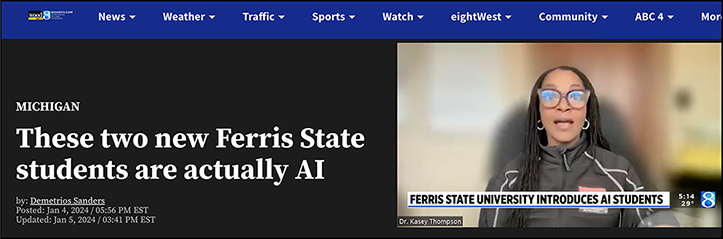
These two new Ferris State students are actually AI — from woodtv.com by Demetrios Sanders

BIG RAPIDS, Mich. (WOOD) — As Ferris State University gets ready for its spring semester, two virtual students will begin classes as part of a new artificial intelligence experiment.

Ferris State University offers one of three AI undergraduate programs in the entire country.

“We are leaders in the artificial intelligence area, and why not put us to the test?” said Dr. Kasey Thompson, special assistant to the president for innovation and entrepreneurship at Ferris State.

University enrolling AI-powered “Students” who will turn in assignments, participate in class discussions — from futurism.com
Even students aren’t safe from AI.

Students at Ferris State University in Michigan will soon be sharing the classroom with AI-powered freshman “students” who will enroll in classes alongside them, MLive reports.

And no, they won’t have humanoid robot bodies — they’ll be interacting with students via computers, microphones, and speakers.

In an experiment led by associate professor Kasey Thompson, AI students dubbed Ann and Fry will be listening — or scanning through? — lectures, work on assignments, and even actively participate in discussions with other students, per the report.


AI & “Un-Personalised” Learning — from drphilippahardman.substack.com by Dr. Philippa Hardman
Exploring the full potential of AI to improve human learning, beyond the 1:1 AI tutor

In this week’s blog post we will look at AI from a different angle and ask: what are the pros and cons of using AI for personalisation? And what’s the potential impact of using AI to optimise and scale more connected, communal learning experiences?

TL;DR: while personalised learning has some benefits for some learner outcomes, the social interaction and connected aspects of communal learning are proven to offer similar academic benefits, as well as additional socio-cultural benefits for a broader range of students.

AI for “Un-Personalised” Learning
The next question is, of course: how could we use AI to scale the positive outcomes of “un-personalised”, communal learning?

Here are some initial ideas:


How to make the most of ChatGPT in 2024 — from wondertools.substack.com by Jeremy Caplan
A Wonder Tools guide


N.Y. Governor Hochul Proposes $400 Million To Launch University AI Consortium — from forbes-com.cdn.ampproject.org by Michael T. Nietzel

New York Governor Kathy Hochul wants to make New York the nation’s leader in artificial intelligence research and development. As part of her State of the State address on Tuesday, Hochul proposed the creation of Empire AI – a consortium of the state’s research universities and other institutions that would form an artificial intelligence computing center in upstate New York.

Empire AI would include seven founding institutions—Columbia University, Cornell University, New York University, Rensselaer Polytechnic Institute, the State University of New York (SUNY), the City University of New York (CUNY), and the Simons Foundation.


North Carolina AI Education Guidance Release — from stefanbauschard.substack.com by Stefan Bauschard
“A” grade in my mind; it just needs to anticipate the near future a bit more

TLDR
The Guidance

*North Carolina has arguably issued the best AI guidance to date (IMHO), and I explain why below (my highlighted version is here). This is in no way a knock on the other guidance reports, as I think they offer a lot them of very important and essential guidance. I just really like how NC packages it and the emphasis they put on certain things.


Video, Images and Sounds – Good Tools #14 — from goodtools.substack.com by Robin Good

Specifically in this issue:

  • Free Image Libraries
  • Image Search Engines
  • Free Illustrations
  • Free Icons
  • Free Stock Video Footage
  • Free Music for Video and Podcasts
 

CES 2024: Unveiling The Future Of Legal Through Consumer Innovations — from abovethelaw.com by Stephen Embry
The ripple effects on the legal industry are real.

The Emerging Role of Smart TVs
Boothe and Comiskey claim that our TVs will become even smarter and better connected to the web and the internet. Our TVs will become an intelligent center for a variety of applications powered through our smartphone. TVs will be able to direct things like appliances and security cameras. Perhaps even more importantly, our TVs can become e-commerce centers, allowing us to speak with them and conduct business.

This increased TV capability means that the TV could become a more dominant mode of working and computing for lawyers. As TVs become more integrated with the internet and capable of functioning as communication hubs, they could potentially replace traditional computing devices in legal settings. With features like voice control and pattern recognition, TVs could serve as efficient tools for such things as document preparation and client meetings.

From DSC:
Now imagine the power of voice-enabled chatbots and the like. We could be videoconferencing (or holograming) with clients, and be able to access information at the same time. Language translation — like that in the Timekettle product — will be built in.

I also wonder how this type of functionality will play out in lifelong learning from our living rooms.

Learning from the Living AI-Based Class Room


Also, some other legaltech-related items:


Are Tomorrow’s Lawyers Prepared for Legal’s Tech Future? 4 Recent Trends Shaping Legal Education | Legaltech News — from law.com (behind paywall)

Legal Tech Predictions for 2024: Embracing a New Era of Innovation — from jdsupra.com

As we step into 2024, the legal industry continues to be reshaped by technological advancements. This year promises to bring new developments that could revolutionize how legal professionals work and interact with clients. Here are key predictions for legal tech in 2024:

Miss the Legaltech Week 2023 Year-in-Review Show? Here’s the Recording — from lawnext.com by Bob Ambrogi

Last Friday was Legaltech Week’s year-end show, in which our panel of journalists and bloggers picked the year’s top stories in legal tech and innovation.

So what were the top stories? Well, if you missed it, no worries. Here’s the video:


Teachers Told Us They’ve Used AI in the Classroom. Here’s Why — from edweek.org by Lauraine Langreo

One-third of K-12 teachers say they have used artificial intelligence-driven tools in their classroom, according to an EdWeek Research Center survey of educators conducted between Nov. 30 and Dec. 6, 2023.

Of those who said they’ve used AI tools, 21 percent said they’ve used them a little, 10 percent said they’ve used them some, and 2 percent said they’ve used them a lot, according to the survey, which included 498 teachers.


Here’s how and why some educators say they’ve been using AI tools in the classroom:


What will the world look like when AI can do in minutes what we can do in 3 weeks (or longer)? That time is here. — from stefanbauschard.substack.com by Stefan Bauschard
Are we preparing students for a world where most existing knowledge work will be done by machines?

I see education heading down one of two paths.

Path 1 — We keep telling the teachers AI cannot do their jobs because it can’t do everything humans can do, and we keep telling kids that learning with AI is cheating and that they will amount to nothing if they use AIs to help do their work. This path is a path toward the irrelevance of educational institutions. AIs can and will be able to do most of what we do. AIs may not be able to do everything as well as us, but at least a lot of the things we do, they will be able to do better.

Path 2 — We help students and teachers understand the world that is emerging around them. Level with them. Explain that the future of every single job is uncertain. Explain that in past technological revolutions that occurred over a much longer period of time than this, many people lost their jobsExplain that society is about to be substantially disrupted, probably in greater ways than it ever has been beforeand certainly faster than ever before. Inform them that every “future of employment” report identifies soft/ durable skills and AI technology skills as the known job skills of the future. Let them know that the future economic value of all knowledge work is uncertain.


From DSC:
Though this next item is not about AI in our learning ecosystems, it caught my eye because having educators use their networks to help sponsor their students seems like a great way to help marginalized students get employed and ahead.

The job market is changing. Here’s how educators can help students keep up. — from kqed.org by Nimah Gobir

Ana Homayoun, an early career development expert and author of Erasing the Finish Line: The New Blueprint for Success Beyond Grades and College Admission, said that educators can support students from marginalized identities by proactively providing resources and support. “Our role as sponsors is really important,” said Homayoun. “That’s a term that I use to describe this idea of creating opportunities for economic growth.” She added that sponsorship includes identifying students that might be facing barriers and leveraging one’s network to give them a leg up.


ChatGPT Gold Rush Of 2024 — from newsletter.thedailybite.co
GPT marketplace, McAfee’s anti-deepfake tech, and more…

Forget pickaxes and panning for nuggets; the new frontier of wealth lies in lines of code.

OpenAI just announced that their GPT Store is launching this week, and it allows ChatGPT Plus and Enterprise customers to create and sell their own custom AI models – no coding required. ?

Translation for those sleeping in the back:

This is the beginning of the GPT Gold Rush.

Opens AI’s move allows users to create a GPT for essentially any need. Imagine a specific GPT for anything from a fitness coach to a master chef recipe generator AND you get paid when people use it.


Are We All In On OpenAI’s GPT Store? — from news.theaiexchange.com
Custom GPTs: A new revenue stream?; DIY AI sales development rep

Excerpt from OpenAI’s GPT Store: A Game-Changer or a Gamble? section:

But before you dive in to Custom GPTs, there are a few things you should know.

  1. Access to these custom GPTs is exclusive to ChatGPT Plus paid accounts. This could be a strategic move by OpenAI to increase Plus account adoption, and it could deter potential users.
  2. OpenAI hasn’t been forthcoming about the revenue sharing model. This lack of transparency could definitely discourage creators from sharing their custom GPTs.
  3. Some of the data uploaded to and chat transcripts in custom GPTs are shared back with OpenAI for future AI model training.


On a somewhat related note, also see:

Building a lawyer support ecosystem — from jordanfurlong.substack.com by Jordan Furlong
Pro sports teams invest serious resources to maximize the performance of their highly skilled, uniquely specialized professionals. Why don’t law firms do the same?

So my advice to law firms here is simple: Create more support for your lawyers and other professionals. Design and build ecosystems for the training, support, and personal and professional development of these highly skilled, uniquely specialized, and strategically critical human assets. Hire more full-time business coaches, skill trainers, and relationship managers. Spend money on these supportive measures now, or face massive bills down the road for the repair and replacement of the people you worked so hard to recruit.


How to Include Design Thinking and Project Management Principles in Legal Work (Katherine Porter, The Resourceful Lawyer) — from tlpodcast.com

Katherine discusses her unique approach to problem-solving in the legal field, which involves design thinking and project management principles. Katherine explains the importance of lawyers understanding client needs, the process of workflow mapping, and the challenges of implementing new processes in law firms.

Katherine also emphasizes that empathy and understanding the client journey is a must when designing effective legal services. In the end, she also gives some real world tips about where to begin working in project management principles into legal practice.


TEN THINGS: BEST BLOGS (AND OTHER MEDIA) FOR IN-HOUSE LAWYERS (2023 EDITION) — from tenthings.blog by

Like every year, I end 2023 with a blog featuring all the other people you should be reading (or listening to) as part of your day-to-day in-house life. For me, the hard part is choosing just a few to highlight. There are so many great content generators out there fighting for your (and my) attention. Unfortunately, I cannot list everyone (and I rarely repeat listing anyone I have listed in the past, i.e., I just assume you know they are still worth your time – they are!). [2] And, if you are interested in past winners, you can start by reading last year’s edition of “Best Blogs (and Other Media) for In-House Lawyers.” Instead, I try to list some new voices for you to check out. And, same as always, there is no particular order to my list (literally I am just typing as I find things in my Post-it notes, faulty memory, and Google Keep folders). Okay, where was I…? Right, enough yakking, let’s get on with the 2023 edition of Best Blogs and Other Media for In-House Counsel!


6 in-house legal trends to watch in 2024 — from legaldive.com from Lyle Moran and Robert Freedman
AI, labor, antitrust, bankruptcies, women GCs and cross-collaboration are among the headlines in-house counsel can expect this year.


© 2025 | Daniel Christian