Adobe previews new cutting-edge generative AI tools for crafting and editing custom audio — from blog.adobe.com by Adobe Research Team

New experimental work from Adobe Research is set to change how people create and edit custom audio and music. An early-stage generative AI music generation and editing tool, Project Music GenAI Control allows creators to generate music from text prompts, and then have fine-grained control to edit that audio for their precise needs.


World’s largest projection mapping snags Guinness World Record — from inavateonthenet.net
A nightly projection mapping display at the Tokyo metropolitan government headquarters has been recognised by Guinness World Records as the largest in the world.


This Teaching Routine Takes Just 5 Minutes. Its Impact Lasts Much Longer — from edweek.org by Elizabeth Heubeck

Second grade teacher Kaylee Hutcheson greets her students as they enter their classroom to start their day at Hawthorne Elementary School in Mexico, Mo., on Feb. 14, 2024.


How a Hollywood Director Uses AI to Make Movies — from every.to by Dan Shipper
Dave Clarke shows us the future of AI filmmaking

Dave told me that he couldn’t have made Borrowing Time without AI—it’s an expensive project that traditional Hollywood studios would never bankroll. But after Dave’s short went viral, major production houses approached him to make it a full-length movie. I think this is an excellent example of how AI is changing the art of filmmaking, and I came out of this interview convinced that we are on the brink of a new creative age.

We dive deep into the world of AI tools for image and video generation, discussing how aspiring filmmakers can use them to validate their ideas, and potentially even secure funding if they get traction. Dave walks me through how he has integrated AI into his movie-making process, and as we talk, we make a short film featuring Nicolas Cage using a haunted roulette ball to resurrect his dead movie career, live on the show.


Online Teaching Is Improving In-Person Instruction on Campus — from edsurge.com by Robert Ubell (Columnist)

In fact a slew of research over the past two decades has found that teaching online makes professors better teachers in their classrooms, so much so that one 2009 study recommended that “faculty should be trained in distance education methods and technologies and should be encouraged to use those methods back in the classroom.”

It’s a message I’ve been arguing for a while. But now that so many educators and students have had direct experience with online formats, it’s a narrative that seems to be sinking in.

Now is the time to fully embrace how physical classrooms can be improved by online techniques.

When professors teaching face-to-face adopt online pedagogy, the classroom is transformed into a “blended” experience, moving from conventional to active learning. And that helps students turn from passive to engaged participants in their own intellectual excursions.


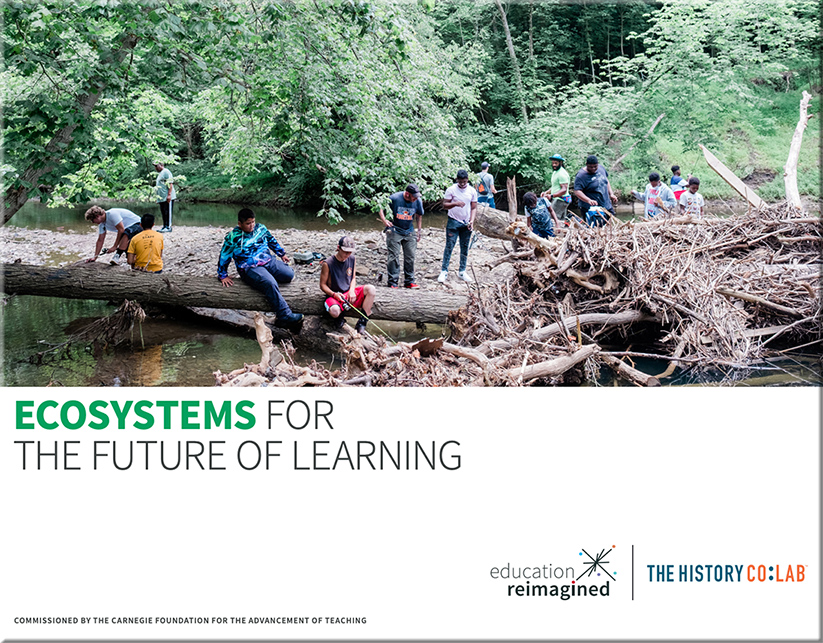
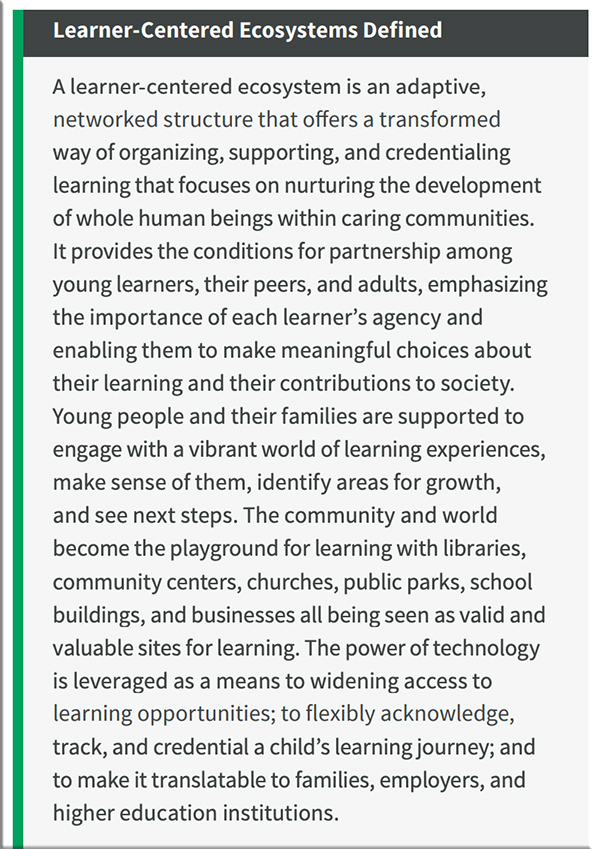
Ecosystems for the future of learning — from thebigidea.education-reimagined.org by Education Reimagined and the History Co:Lab

The intent of this report is to help communities build their capacity for transformation of education, advancing toward what our society needs most—a system that works for young people. It draws on the experiences and insights of innovators across the United States who are already answering this challenge—creating learner-centered, community-based ecosystems.

This report includes:

  • a landscape analysis of select communities creating learning ecosystems;
  • a framework that emerged from the analysis and can be used by communities to consider their readiness and appetite for this transformation;
  • an invitation to communities to explore and discover their own path for reimagining education; and
  • a call for national and regional institutions to listen, learn from, and create the conditions for communities to pursue their visions.

From DSC:
The above items was accessed via the article below:

Where Does Work to Imagine a Learner-Centered Ecosystem Begin? — from gettingsmart.com by Alin Bennett

Key Points

  • The Norris School District in Wisconsin exemplifies how learner profiles and community connections can enhance authentic learning experiences for young people, fostering a culture of belonging and responsibility.
  • Purdue Polytechnic High School demonstrates the importance of enabling conditions, such as creating microschools with access to shared services, to support a learner-centered approach while ensuring scalability and access to a variety of resources.
 

Career-Connected Learning: Preparing Students for a Dynamic Future — from gettingsmart.com by Tom Vander Ark and Victoria Andrews

Key Points

  • Connecting young people with career awareness needs to start at an early age to provide them with the necessary landscape view of opportunity and skills.
  • Whether young people engage client-focused opportunities, internships, or endure academically challenging coursework, career-connected learning is an environment to cultivate a sense of self-awareness, determination, and direction, essential for their success in both education and life.

Also from Getting Smart, see:

CHILD: A Microschool Unlocking the Potential for Unique Learners — by Maureen O’Shaughnessy

Key Points

  • The success of adaptive learning is not solely based on the program, but rather on the people behind it.
  • Clarity on “who you serve” is critical to success.
 

Programs, Services, and More: A Map of CTL Tactics — from derekbruff.org

My colleagues and I at the Center for Excellence in Teaching and Learning (CETL) have been reading and discussing Mary C. Wright’s new book Centers for Teaching and Learning: The New Landscape in Higher Education (Johns Hopkins University Press, 2023). Wright identified all the centers for teaching and learning (CTLs) in the United States and then did a content analysis of their websites to see what they were all about. For someone like me, who has spent his career working in CTLs, Wright’s work is a fascinating look at my own field and how it represents itself through mission statements, listings of programs and services, and annual reports.

Also from Derek, see:

Recap: Study skills, flipped learning, and more at spring STEM teaching lunches — from umcetl.substack.com
With the final spring STEM teaching lunch coming up on March 4th, here’s a recap of what you missed at the first two lunches.

    • February 8th – Helping students learn how to learn
    • February 20th – Reconsidering class time through flipped learning
 

Using Generative AI throughout the Institution — from aiedusimplified.substack.com by Lance Eaton
8 lightning talk on generative AI and how to use it through higher education


The magic of AI to help educators with saving time. — from magicschool.ai; via Mrs. Kendall Sajdak


Getting Better Results out of Generative AI — from aiedusimplified.substack.com by Lance Eaton
The prompt to use before you prompt generative AI

Last month, I discussed a GPT that I had created around enhancing prompts. Since then, I have been actively using my Prompt Enhancer GPT to much more effective outputs. Last week, I did a series of mini-talks on generative AI in different parts of higher education (faculty development, human resources, grants, executive leadership, etc) and structured it as “5 tips”. I included a final bonus tip in all of them—a tip that I heard from many afterwards was probably the most useful tip—especially because you can only access the Prompt Enhancer GPT if you are paying for ChatGPT.


Exploring the Opportunities and Challenges with Generative AI — from er.educause.edu by Veronica Diaz

Effectively integrating generative AI into higher education requires policy development, cross-functional engagement, ethical principles, risk assessments, collaboration with other institutions, and an exploration of diverse use cases.


Creating Guidelines for the Use of Gen AI Across Campus — from campustechnology.com by Rhea Kelly
The University of Kentucky has taken a transdisciplinary approach to developing guidelines and recommendations around generative AI, incorporating input from stakeholders across all areas of the institution. Here, the director of UK’s Center for the Enhancement of Learning and Teaching breaks down the structure and thinking behind that process.

That resulted in a set of instructional guidelines that we released in August of 2023 and updated in December of 2023. We’re also looking at guidelines for researchers at UK, and we’re currently in the process of working with our colleagues in the healthcare enterprise, UK Healthcare, to comb through the additional complexities of this technology in clinical care and to offer guidance and recommendations around those issues.


From Mean Drafts to Keen Emails — from automatedteach.com by Graham Clay

My experiences match with the results of the above studies. The second study cited above found that 83% of those students who haven’t used AI tools are “not interested in using them,” so it is no surprise that many students have little awareness of their nature. The third study cited above found that, “apart from 12% of students identifying as daily users,” most students’ use cases were “relatively unsophisticated” like summarizing or paraphrasing text.

For those of us in the AI-curious bubble, we need to continually work to stay current, but we also need to recognize that what we take to be “common knowledge” is far from common outside of the bubble.


What do superintendents need to know about artificial intelligence? — from k12dive.com by Roger Riddell
District leaders shared strategies and advice on ethics, responsible use, and the technology’s limitations at the National Conference on Education.

Despite general familiarity, however, technical knowledge shouldn’t be assumed for district leaders or others in the school community. For instance, it’s critical that any materials related to AI not be written in “techy talk” so they can be clearly understood, said Ann McMullan, project director for the Consortium for School Networking’s EmpowerED Superintendents Initiative.

To that end, CoSN, a nonprofit that promotes technological innovation in K-12, has released an array of AI resources to help superintendents stay ahead of the curve, including a one-page explainer that details definitions and guidelines to keep in mind as schools work with the emerging technology.


Affordability and Microcredentials — from the-job.beehiiv.com by Paul Fain
Cutting costs for short-term credentials with course sharing and, perhaps, federal money.

‘Bespoke, e-Commerce-Enabled Storefronts’
Demand for nondegree credentials has risen. But it can be expensive and tricky for colleges to create their own workforce-relevant courses and certifications. Homegrown microcredentials also may be more likely to fall flat with students and employers, particularly in competition with professional certificates from big brands like Salesforce or AWS.

Acadeum, an online course-sharing company, is betting that a networked marketplace will be a better option for its 460 college and university partners, which include a growing number of community colleges. Beginning last month, those colleges can tap into 380+ online certificates, certifications, and skills-training courses.

“Skills Marketplace lowers the barrier of entry for institutions to self-select only the certifications that align their program offerings to meet student and workforce demand,” says David Daniels, Acadeum’s president and CEO.


Generative AI’s environmental costs are soaring — and mostly secret — from nature.com by Kate Crawfold
First-of-its-kind US bill would address the environmental costs of the technology, but there’s a long way to go.

Last month, OpenAI chief executive Sam Altman finally admitted what researchers have been saying for years — that the artificial intelligence (AI) industry is heading for an energy crisis. It’s an unusual admission. At the World Economic Forum’s annual meeting in Davos, Switzerland, Altman warned that the next wave of generative AI systems will consume vastly more power than expected, and that energy systems will struggle to cope. “There’s no way to get there without a breakthrough,” he said.

I’m glad he said it. I’ve seen consistent downplaying and denial about the AI industry’s environmental costs since I started publishing about them in 2018. Altman’s admission has got researchers, regulators and industry titans talking about the environmental impact of generative AI.


Get ready for the age of sovereign AI | Jensen Huang interview— from venturebeat.com by Dean Takahashi

Yesterday, Nvidia reported $22.1 billion in revenue for its fourth fiscal quarter of fiscal 2024 (ending January 31, 2024), easily topping Wall Street’s expectations. The revenues grew 265% from a year ago, thanks to the explosive growth of generative AI.

He also repeated a notion about “sovereign AI.” This means that countries are protecting the data of their users and companies are protecting data of employees through “sovereign AI,” where the large-language models are contained within the borders of the country or the company for safety purposes.


Yikes, Google — from theneurondaily.com by Noah Edelman
PLUS: racially diverse nazis…WTF?!

Google shoots itself in the foot.
Last week was the best AND worst week for Google re AI.

The good news is that its upcoming Gemini 1.5 Pro model showcases remarkable capabilities with its expansive context window (details forthcoming).

The bad news is Google’s AI chatbot “Gemini” is getting A LOT of heat after generating some outrageous responses. Take a look:

Also from the Daily:

  • Perplexity just dropped this new podcast, Discover Daily, that recaps the news in 3-4 minutes.
  • It already broke into the top #200 news pods within a week.
  • AND it’s all *100% AI-generated*.

Daily Digest: It’s Nvidia’s world…and we’re just living in it. — from bensbites.beehiiv.com

  • Nvidia is building a new type of data centre called AI factory. Every company—biotech, self-driving, manufacturing, etc will need an AI factory.
  • Jensen is looking forward to foundational robotics and state space models. According to him, foundational robotics could have a breakthrough next year.
  • The crunch for Nvidia GPUs is here to stay. It won’t be able to catch up on supply this year. Probably not next year too.
  • A new generation of GPUs called Blackwell is coming out, and the performance of Blackwell is off the charts.
  • Nvidia’s business is now roughly 70% inference and 30% training, meaning AI is getting into users’ hands.

Gemma: Introducing new state-of-the-art open models  — from blog.google


From DSC:
This first item is related to the legal field being able to deal with today’s issues:

The Best Online Law School Programs (2024) — from abovethelaw.com by Staci Zaretsky
A tasty little rankings treat before the full Princeton Review best law schools ranking is released.

Several law schools now offer online JD programs that have become as rigorous as their on-campus counterparts. For many JD candidates, an online law degree might even be the smarter choice. Online programs offer flexibility, affordability, access to innovative technologies, students from a diversity of career backgrounds, and global opportunities.

Voila! Feast your eyes upon the Best Online JD Programs at Law School for 2024 (in alphabetical order):

  • Mitchell Hamline School of Law – Hybrid J.D.
  • Monterey College of Law – Hybrid Online J.D.
  • Purdue Global Law School – Online J.D.
  • Southwestern Law School – Online J.D.
  • Syracuse University – J.D. Interactive
  • University of Dayton School of Law – Online Hybrid J.D.
  • University of New Hampshire – Hybrid J.D.

DSC: FINALLY!!! Online learning hits law schools (at least in a limited fashion)!!! Maybe there’s hope yet for the American Bar Association and for America’s legal system to be able to deal with the emerging technologies — and the issues presented therein — in the 21st century!!! Because if we can’t even get caught up to where numerous institutions of higher education were back at the turn of this century, we don’t have as much hope in the legal field being able to address things like AI, XR, cryptocurrency, blockchain, and more.


Meet KL3M: the first Legal Large Language Model. — from 273ventures.com
KL3M is the first model family trained from scratch on clean, legally-permissible data for enterprise use.


Advocate, advise, and accompany — from jordanfurlong.substack.com by Jordan Furlong
These are the three essential roles lawyers will play in the post-AI era. We need to start preparing legal education, lawyer licensing, and law practices to adapt.

Consider this scenario:

Ten years from now, Generative AI has proven capable of a stunning range of legal activities. Not only can it accurately write legal documents and conduct legal research and apply law to facts, it can reliably oversee legal document production, handle contract negotiations, monitor regulatory compliance, render legal opinions, and much more. Lawyers are no longer needed to carry out these previously billable tasks or even to double-check the AI’s performance. Tasks that once occupied 80% of lawyers’ billable time have been automated.

What are the chances this scenario unfolds within the next ten years? You can decide that likelihood for yourself, but I think anything above 1% represents the potential for major disruption to the legal profession.

Also from Jordan, see:


Top 5 Strategies to Excel in the 2024 Legal Sector with Colin Levy — from discrepancyai.com by Lisen Kaci

We have gathered, from Colin Levy’s insights, the top five strategies that legal professionals can implement to excel in this transformational era – bringing them together with technology.


Legal Tech’s Predictions for AI, Workflow Automation, and Data Analytics in 2024 — from jdsupra.com by Mitratech Holdings, Inc.

They need information like:

  • Why did we go over budget?
  • Why did we go to trial?
  • How many invoices sat with each attorney?

Going further than just legal spend, analytics on volume of work and diversity metrics can help legal teams make the business case they need to drive important initiatives and decisions forward. And a key differentiator of top-performing companies is the ability to get all of this data in one place, which is why Mitratech was thrilled to unveil PlatoBI, an embedded analytics platform powered by Snowflake, earlier this year with several exciting AI and Analytic enhancements.


DOJ appoints first-ever chief AI officer – Will law firms follow? — from legaltechnology.com by Emma Griffiths


AI’s promise and problem for law and learning — from reuters.com by John Bandler

Also worrisome is that AI will be used as a crutch that short circuits learning. Some people look for shortcuts. What effect of AI on that learning process and the result, for students and when lawyers use AI to draft documents and research?


Adobe Brings Conversational AI to Trillions of PDFs with the New AI Assistant in Reader and Acrobat — from news.adobe.com; via AI Secret

.

SAN JOSE, Calif. – [On 2/20/23], Adobe (Nasdaq:ADBE) introduced AI Assistant in beta, a new generative AI-powered conversational engine in Reader and Acrobat.

Simply open Reader or Acrobat and start working with the new capabilities, including:

  • AI Assistant: AI Assistant recommends questions based on a PDF’s content and answers questions about what’s in the document – all through an intuitive conversational interface.
  • Generative summary: Get a quick understanding of the content inside long documents with short overviews in easy-to-read formats.
  • Intelligent citations: Adobe’s custom attribution engine and proprietary AI generate citations so customers can easily verify the source of AI Assistant’s answers.
  • Easy navigation:
  • Formatted output:
  • Respect for customer data:  
  • Beyond PDF: Customers can use AI Assistant with all kinds of document formats (Word, PowerPoint, meeting transcripts, etc.)

Along these lines, also see:


5 ways Sora AI will change the creator economy and how to take advantage of that — from techthatmatters.beehiiv.com by Harsh Makadia

Essential skills to thrive with Sora AI
The realm of video editing isn’t about cutting and splicing.

A Video Editor should learn a diverse set of skills to earn money, such as:

  • Prompt Writing
  • Software Mastery
  • Problem-solving skills
  • Collaboration and communication skills
  • Creative storytelling and visual aesthetics

Invest in those skills that give you a competitive edge.


The text file that runs the internet — from theverge.com by David Pierce
For decades, robots.txt governed the behavior of web crawlers. But as unscrupulous AI companies seek out more and more data, the basic social contract of the web is falling apart. 


AI fast-tracks research to find battery material that halves lithium use — from inavateonthenet.net

Using AI, the team was able to plow through 32.6 million possible battery materials in 80 hours, a task the team estimates would have taken them 20 years to do.


Other interesting items from inavateonthenet.net:

Medical ‘hologram’ market to reach 6.8 bn by 2029

Providing audio for open spaces


AI-related tools and tips dominate ’60 in 60′ Techshow session — from abajournal.com by Danielle Braff

Four days of seminars, lectures and demonstrations at the 39th annual ABA Techshow boiled down to Saturday morning’s grand finale, where panelists rounded up their favorite tech tips and apps. The underlying theme: artificial intelligence.

“It’s an amazing tool, but it’s kind of scary, so watch out,” said Cynthia Thomas, the Techshow co-chair, and owner of PLMC & Associates, talking about the new tool from OpenAI, Sora, which takes text and turns it into video.

Other panelists during the traditional Techshow closer, “60 sites, 60 tips and gadgets and gizmos,” highlighted a wide of AI-enabled or augmented tools to help users perform a large range of tasks, including quickly sift through user reviews for products, generate content, or keep up-to-date on the latest AI tools. For those looking for a non-AI tips and tools, they also suggested several devices, websites, tips and apps that have helped them with their practice and with life in general.


ABA Techshow 2024: Ethics in the Age of Legal Technology — from bnnbreaking.com by Rafia Tasleem

ABA Techshow 2024 stressed the importance of ethics in legal technology adoption. Ethics lawyer Stuart I. Teicher warned of the potential data breaches and urged attorneys to be proactive in understanding and supervising new tools. Education and oversight are key to maintaining data protection and integrity.


Startup Alley Competition Proves It Continues To Be All About AI — from abovethelaw.com by Joe Patrice

Though it might be more accurate to call TECHSHOW an industry showcase because with each passing year it seems that more and more of the show involves other tech companies looking to scoop up enterprising new companies. A tone that’s set by the conference’s opening event: the annual Startup Alley pitch competition.

This year, 15 companies presented. If you were taking a shot every time someone mentioned “AI” then my condolences because you are now dead. If you included “machine learning” or “large language model” then you’ve died, come back as a zombie, and been killed again.


Here Are the Winners of ABA Techshow’s 8th Annual Startup Alley Pitch Competition — from lawnext.com by Bob Ambrogi

Here were the companies that won the top three spots:

  1. AltFee, a product that helps law firms replace the billable hour with fixed-fee pricing.
  2. Skribe.ai, an alternative to traditional court reporting that promises “a better way to take testimony.”
  3. Paxton AI, an AI legal assistant.

Class action firms ask US federal courts to encourage virtual testimony — from reuters.com by Nate Raymond

Summary:

  • Lawyers at Hagens Berman are leading charge to change rules
  • Proposal asks judiciary to ‘effectuate a long overdue modernization’ of rules

 
© 2025 | Daniel Christian