Text to video via OpenAI’s Sora. (I had taken this screenshot on the 15th, but am posting it now.)

We’re teaching AI to understand and simulate the physical world in motion, with the goal of training models that help people solve problems that require real-world interaction.

Introducing Sora, our text-to-video model. Sora can generate videos up to a minute long while maintaining visual quality and adherence to the user’s prompt.
Along these lines, also see:

Pika; via Superhuman AI



An Ivy League school just announced its first AI degree — from qz.com by Michelle Cheng; via Barbara Anna Zielonka on LinkedIn
It’s a sign of the times. At the same time, AI talent is scarce

At the University of Pennsylvania, undergraduate students in its school of engineering will soon be able to study for a bachelor of science degree in artificial intelligence.

What can one do with an AI degree? The University of Pennsylvania says students will be able to apply the skills they learn in school to build responsible AI tools, develop materials for emerging chips and hardware, and create AI-driven breakthroughs in healthcare through new antibiotics, among other things.


Google Pumps $27 Million Into AI Training After Microsoft Pledge—Here’s What To Know — from forbes.com by Robert Hart

Google on Monday announced plans to help train people in Europe with skills in artificial intelligence, the latest tech giant to invest in preparing workers and economies amid the disruption brought on by technologies they are racing to develop.


The Exhausting Pace of AI: Google’s Ultra Leap — from marcwatkins.substack.com by Marc Watkins

The acceleration of AI deployments has gotten so absurdly out of hand that a draft post I started a week ago about a new development is now out of date.

The Pace is Out of Control
A mere week since Ultra 1.0’s announcement, Google has now introduced us to Ultra 1.5, a model they are clearly positioning to be the leader in the field. Here is the full technical report for Gemini Ultra 1.5, and what it can do is stunning.


Maryville Announces $21 Million Investment in AI and New Technologies Amidst Record Growth — from maryville.edu; via Arthur “Art” Fredrich on LinkedIn

[St. Louis, MO, February 14, 2024] – In a bold move that counters the conventions of more traditional schools, Maryville University has unveiled a substantial $21 million multi-year investment in artificial intelligence (AI) and cutting-edge technologies. This groundbreaking initiative is set to transform the higher education experience to be powered by the latest technology to support student success and a five-star experience for thousands of students both on-campus and online.


The Transformative Trends Reshaping Higher Education in 2024 — from evolllution.com by Janet Spriggs; via Amrit Ahluwalia on LinkedIn

  • Artificial Intelligence: Embrace It or Fall Behind
  • Reassessing Value: Tackling Confidence and ROI in Higher Education
  • Innovating for the Future: Adapting to Changing Needs
  • Fostering Strategic Partnerships: Collaboration for Progress
  • Leadership Matters: Driving Innovation and Inclusivity


Announcing the 2024 GSV 150: The Top Growth Companies in Digital Learning & Workforce Skills — from prnewswire.com with information provided by ASU+GSV Summit

“The world is adapting to seismic shifts from generative AI,” says Luben Pampoulov, Partner at GSV Ventures. “AI co-pilots, AI tutors, AI content generators—AI is ubiquitous, and differentiation is increasingly critical. This is an impressive group of EdTech companies that are leveraging AI and driving positive outcomes for learners and society.”

Workforce Learning comprises 34% of the list, K-12 29%, Higher Education 24%, Adult Consumer Learning 10%, and Early Childhood 3%. Additionally, 21% of the companies stretch across two or more “Pre-K to Gray” categories. A broader move towards profitability is also evident: the collective gross and EBITDA margin score of the 2024 cohort increased 5% compared to 2023.

See the list at https://www.asugsvsummit.com/gsv-150

Selected from 2,000+ companies around the world based on revenue scale, revenue growth, user reach, geographic diversification, and margin profile, this impressive group is reaching an estimated 3 billion people and generating an estimated $23 billion in revenue.


From DSC:
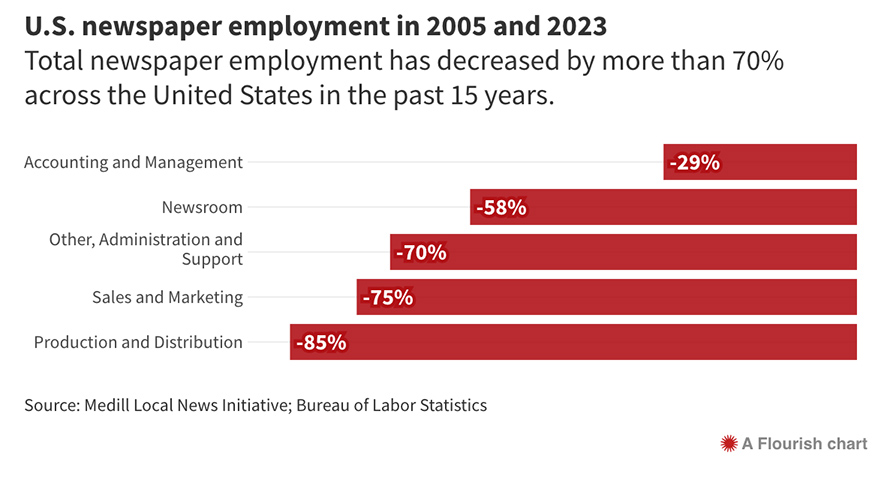
Late last week, I ran into several items re: the state of the journalism industry in America. The bottom line is not encouraging. And this should concern every citizen who wants to see our democracy do well.

Here are some items that got me to reflect on this issue/situation:

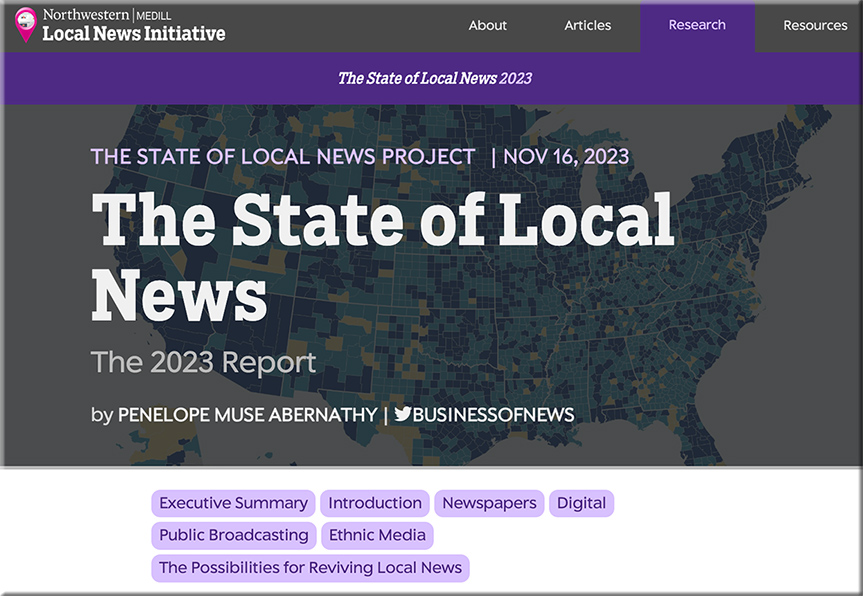
The State of Local News — from localnewsinitiative.northwestern.edu (Northwestern University); via Ryan Craig’s Gap Letter from last week

Executive Summary (emphasis DSC)
There was both good news and bad news for local journalism this past year. The good news raised the possibility that a range of proposals and programs could begin to arrest the steep loss of local news over the past two decades and, perhaps, revive journalism in some places that have lost their news. The headlines on the bad news resoundingly conveyed the message that urgent action is needed in many venues — from boardrooms to the halls of Congress — and by many, including civic-minded organizations and entrepreneurs.

At the same time, however, the number of local news outlets continued to contract at an even steeper rate in 2023. On the current trajectory, by the end of next year, the country will have lost a third of its newspapers since 2005. Discouragingly, the growth in alternative local news sources — digital and ethnic news outlets, as well as public broadcasting — has not kept pace with what’s being lost.

Newspapers are continuing to vanish at an average rate of more than two a week.

In addition to losing almost a third of its newspapers, the country has lost almost two-thirds of its newspaper journalists — 43,000 — since 2005.


Opinion: Local news can seize the moment — from crainsdetroit.com by Sue Ellen Christian

Excerpts (emphasis DSC):

Our society isn’t short on news, we’re short on attention. How do we get honest reporting on local events and issues noticed by readers, viewers and listeners in our digital age of content saturation, misinformation and online chaos? Plus, not only are adults overall consuming less news, but many also now intentionally avoid any news and its attendant hyperbole, negativity and fear-mongering.

Local news is an oasis from the national muck. The Gallup/Knight study from last year showed that adults in the U.S. trust local news organizations two times more than national news outlets (44% to 21%), and perceive local journalists as caring more about the impact of their reporting.

For the collaborative and the nation’s many struggling local news outlets, there was this hope-giving finding: “When Americans perceive that local news organizations do not have the resources to report the news accurately and fairly, they are more likely to say they would consider paying for news in the future,” stated the report.

The future is now, people.

A healthy democracy depends on an informed citizenry. Local news is essential, and today’s financially struggling outlets need local paying subscribers.

From DSC: Also as a relevant aside:
Wonder Media
This website is dedicated to helping you learn more about how to use
the media for your purposes, and not to be used by media. Explore
the site to learn about media literacy and news media literacy
through games, videos, quizzes, and more.


Opinion: Stronger democracy is worth the investment — from crainsdetroit.com by Hugh Dellios

Excerpt (emphasis DSC):

By itself, philanthropy isn’t the ultimate solution. But it can be a bridge to a moment when this generation’s media entrepreneurs have had a chance to solve the puzzle of a more sustainable business model, one that serves audience needs, counts on a variety of solid revenue streams, and restores value in producing news.

A strong, free press is essential to the functioning of our society – and that’s why it’s the only private industry specifically protected by the U.S. Constitution. But unless we invest in real newsrooms, we’ll continue to see the disappearance of real reporters who ask the tough, informed questions that help forge good policy and hold our leaders accountable.

The return on that investment? A better-functioning, more stable democracy. The alternative? Maybe waking up one day without one. 


With local journalism ‘in crisis,’ Michigan newsrooms get creative to fill the gap — from crainsdetroit.com by Julie Mack

Local journalism is “in crisis,” said Tim Franklin, who heads Northwestern’s Local News Initiative and is a former top editor at the Indianapolis Star, Orlando Sentinel and Baltimore Sun.

“I equate the local news crisis to being journalism’s climate change. It’s this grinding attrition,” he said. “We’re at a real inflection point for local news in America. The question is, how are we going to get out of this?”
.

“I really do believe there’s never been a better time to be a corrupt local politician because nobody is watching the henhouse,” said Sue Ellen Christian, a former Chicago Tribune reporter and now a Western Michigan University journalism professor. “There are very few local reporters now, few local news outlets with the bandwidth to pull the documents, go to obscure committee meetings — that’s where you find the story, the string that you pull that becomes a really good, important local news story.” 


Skills-Based Hiring: The Long Road from Pronouncements to Practice— from burningglassinstitute.org

While headlines trumpet the demise of the college degree, our joint report with Harvard Business School Project on Managing the Future of Work reveals a different reality. Many companies have announced dropping degree requirements, but sustained hiring changes remain elusive for most. This report identifies where the reality of Skills-Based Hiring is lagging well-meaning ambitions, and shows which companies are getting it right.


From DSC:
I recently ran into the following item:


UK university opens VR classroom — from inavateonthenet.net

Students at the University of Nottingham will be learning through a dedicated VR classroom, enabling remote viewing and teaching for students and lecturers.

Based in the university’s Engineering Science and Learning Centre (ELSC), this classroom, believed to be the first in the UK to use a dedicated VR classroom, using 40 VR headsets, 35 of which are tethered overhead to individual PCs, with five available as traditional, desk-based systems with display screens.


I admit that I was excited to see this article and I congratulate the University of Nottingham on their vision here. I hope that they can introduce more use cases and applications to provide evidence of VR’s headway.

As I look at virtual reality…

  • On the plus side, I’ve spoken with people who love to use their VR-based headsets for fun workouts/exercises. I’ve witnessed the sweat, so I know that’s true. And I believe there is value in having the ability to walk through museums that one can’t afford to get to. And I’m sure that the gamers have found some incredibly entertaining competitions out there. The experience of being immersed can be highly engaging. So there are some niche use cases for sure.
  • But on the negative side, the technologies surrounding VR haven’t progressed as much as I thought they would have by now. For example, I’m disappointed Apple’s taken so long to put a product out there, and I don’t want to invest $3500 in their new product. From the reviews and items on social media that I’ve seen, the reception is lukewarm. At the most basic level, I’m not sure people want to wear a headset for more than a few minutes.

So overall, I’d like to see more use cases and less nausea.


Addendum on 2/27/24:

Leyard ‘wall of wonder’ wows visitors at Molecular Biology Lab — from inavateonthenet.net


From DSC:
After reading the book entitled “Love & Hate” by Bill Halamandaris — a book about Henri Landwirth, the founder of the Give Kids the World Village — and “On Purpose” by Pamela Landwirth, I was struck with several thoughts. Below are just some of them:

  • There is enormous power in a vision.
  • People want purpose and meaning in their lives. They want their lives to count. To matter.
  • People want to work for an organization that is concretely making the world a better place in which to live.
  • People want to buy from businesses that are making a positive contribution to the world.
  • Both love and hate are powerful. But let’s choose to go forward with love.
  • Parents, grandparents, and/or other guardians of critically-ill children carry enormous, hidden burdens. Let’s try to notice those burdens and help them out.
  • Life is precious.

Let's remember this -- Despite what we may hear and see, life is precious.


From DSC:
Recently, a group from our church went to serve down at the Give Kids the World Village, in Kissimee, Florida. I wanted to relay the specialness of this place and say a few words about the Founder of the Give Kids the World Village: a man by the name of Henri Landwirth. Over the last few weeks in the Orlando area, the Holy Spirit helped me to think about the power of a vision, as both Walt Disney and Henri Landwirth were visionaries.

But first, it’s important to note that Henri survived FIVE concentration camps during WWII. He had no name there. He was known only as B4343.

Henri:

  • Was in concentration camps from ages 13-18
  • He lost both of his parents to acts of mass murder
  • Henri survived FIVE YEARS of hunger, torture, and horrendous conditions
  • He faced what looked like certain death several times

Yet as I was reading the book entitled “Love & Hate”, I kept wondering if I was seeing the fingerprints of God on Henri’s life.

After the war, Henri went in search of former Nazis, for whom he was filled with hatred. And while I don’t have time to relay the fateful day that changed Henri’s perspective and his life, the bottom line was that he didn’t want to become like his former captors the Nazis. Surprisingly and amazingly, he chose love, not hate.

Fast forward to Henri’s coming to America, working very hard, and climbing up the ladder of the Holiday Inn organization.

Then fast forward even further to the time Henri was looking for a location to build his vision. Quoting from page 139:

Henri took his checkbook and began looking for a location for Give Kids the World Village. He found it almost immediately in Kissimmee. When Henry looked at the lot, he could already see the Village there. Where others might have seen rows of burned orange trees and wetlands, Henri saw villages, a place for kids to fish, and a castle. “I could see it all,” Henri says, “as if my dream had already come to life.”

A few last notable things about the Give Kids the World Village:

  • According to the book by Bill Halamandaris, the Village was built with ZERO CONTRACTS and NO ADVERTISEMENTS from those who helped create the village! This is underheard of for $60+ million worth of facilities and the millions of dollars’ worth of donated services.
  • The Village has thousands of volunteers and it takes 160 volunteers per day to keep it running
  • Since 1986, Give Kids The World Village has welcomed more than 188,000 families from all 50 states and 77 countries.

So I want to leave you with the idea that we were witnesses of – and participants in – the tremendous power of a vision.


.

Per Donald Taylor this morning:

The results of this year’s L&D Global Sentiment Survey are now live online!

They are unlike anything else I’ve seen in the 11-history of the Survey.

Over 3,000 people from nearly 100 countries shared their views, and you can see my summary of them on LinkedIn:


6 work and workplace trends to watch in 2024 — from weforum.org by Kate Whiting; via Melanie Booth on LinkedIn

Excerpts (emphasis DSC):

The world of work is changing fast.

By 2027, businesses predict that almost half (44%) of workers’ core skills will be disrupted.

Technology is moving faster than companies can design and scale up their training programmes, found the World Economic Forum’s Future of Jobs Report.

The Forum’s Global Risks Report 2024 found that “lack of economic opportunity” ranked as one of the top 10 biggest risks among risk experts over the next two years.

5. Skills will become even more important
With 23% of jobs expected to change in the next five years, according to the Future of Jobs Report, millions of people will need to move between declining and growing jobs.


A Community Micro-Credentials Effort Connects Students to Local Employers — from gettingsmart.com by David McCool

Key Points

  • Partnering credentialing opportunities alongside pre-existing regional initiatives is a great way to get buy-in and create momentum.

***

When Polk County schools began focusing on career and technical education in the spring of 2023, one of their goals was to help students succeed in the workplace by offering the opportunity to develop soft skills and earn micro-credentials to communicate with potential employers. The district collaborated with Education Design Lab, Muzzy Lane, Polk Vision, the Central Florida Development Council, and Southern New Hampshire University to make this dream a reality.

In its first few years, this collaboration has not only taught students valuable skills but has also provided employers with new recruitment opportunities and a linkage to a talent pipeline that they otherwise wouldn’t have had.


From DSC:
This would be huge for all of our learning ecosystems, as the learning agents could remember where a particular student or employee is at in terms of their learning curve for a particular topic.


Say What? Chat With RTX Brings Custom Chatbot to NVIDIA RTX AI PCs — from blogs.nvidia.com
Tech demo gives anyone with an RTX GPU the power of a personalized GPT chatbot.


States bet big on career education, but struggle to show it works — from hechingerreport.org by Patrick Hall
Adult employment outcomes are disconnected from K-12 data sets

As college costs soar and demand for skilled labor rises, programs that prepare students for well-paid work are gaining popularity. About 85 percent of high school graduates in 2019 had taken at least one course in career and technical education, or CTE. In 2018, Congress increased annual funding for CTE, which now exceeds $1.4 billion. And in 2022, 36 states enacted policies promoting career training for high schoolers, college students, and adults, according to Advance CTE, a professional organization for state CTE leaders.

Yet many states struggle to answer a basic question: Is career education working?


For the word of the Lord is right and true;
he is faithful in all he does.
The Lord loves righteousness and justice;
the earth is full of his unfailing love.

Proverbs 31:8-9 New International Version

8 Speak up for those who cannot speak for themselves,
for the rights of all who are destitute.
9 Speak up and judge fairly;
defend the rights of the poor and needy.

16 For God so loved the world that he gave his one and only Son, that whoever believes in him shall not perish but have eternal life.
John 13:34-35 (New International Version)

34 “A new command I give you: Love one another. As I have loved you, so you must love one another. 35 By this everyone will know that you are my disciples, if you love one another.”


K-12 students learned a lot last year, but they’re still missing too much school — from npr.org by Cory Turner and  Sequoia Carrillo

1. Students are starting to make up for missed learning
From spring 2022 to spring 2023, students made important learning gains, making up for about one-third of the learning they had missed in math and a quarter of the learning they had missed in reading during the pandemic.

2. Despite that progress, very few states are back to pre-pandemic learning levels


The Results Are In: Parents Favor School Choice — from realcleareducation.com by Hanna Skandera; via GSV

Parents want a choice when it comes to their children’s education.

A new report published by The National School Choice Awareness Foundation reveals that 72% of parents considered new schools for their children in 2023 — a massive 35% increase from 2022. Additionally, more than 70% of parents in nearly every state support the implementation of school choice policies.

This momentum has caught the attention of state legislatures across the country.


Why Doesn’t Every Office Building Have A Microschool? — from fee.org by Kerry McDonald; via GSV
“We are breaking down walls between communities and classrooms,” said Revolution School founder, Gina Moore.

Today, intrepid educators continue to try to make change within the traditional schooling system, but increasingly entrepreneurial teachers and parents are working outside the system to create innovative, accessible K-12 learning models that push beyond the four walls of a conventional classroom—literally and figuratively.

One such program is Revolution School, a private, accredited high school located in a downtown office building in Philadelphia that draws students from more than 25 zip codes across the city.

Revolution School focuses on meaningful internships where students, known as “Rev-terns,” partner with local businesses to learn workplace skills and gain valuable experience. Students also take advantage of dual enrollment opportunities at the nearby Community College of Philadelphia, accumulating college credits while being mentored by Revolution School teachers.


PROOF POINTS: Tracking student data falls short in combating absenteeism at school — from hechingerreport.org by Jill Barshay
A post-pandemic study of an early warning system indicated that family income makes a difference

Chronic absenteeism has surged across the country since the pandemic, with more than one out of four students missing at least 18 days of school a year. That’s more than three lost weeks of instruction a year for more than 10 million school children. An even higher percentage of poor students, more than one out of three, are chronically absent.

Nat Malkus, a senior fellow at the American Enterprise Institute, a conservative think tank, calls chronic absenteeism – not learning loss – “the greatest challenge for public schools.” At a Feb. 8, 2024 panel discussion, Malkus said, “It’s the primary problem because until we do something about that, academic recovery from the pandemic, which is significant, is a pipe dream.”

 
© 2025 | Daniel Christian