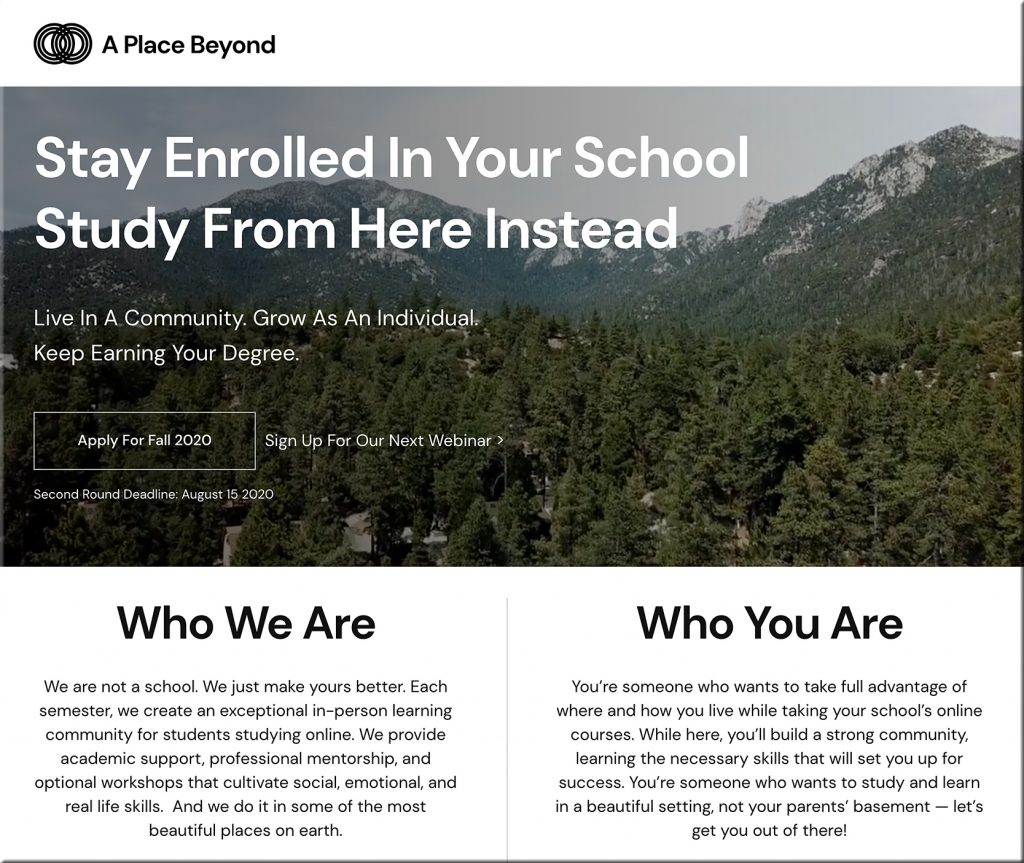
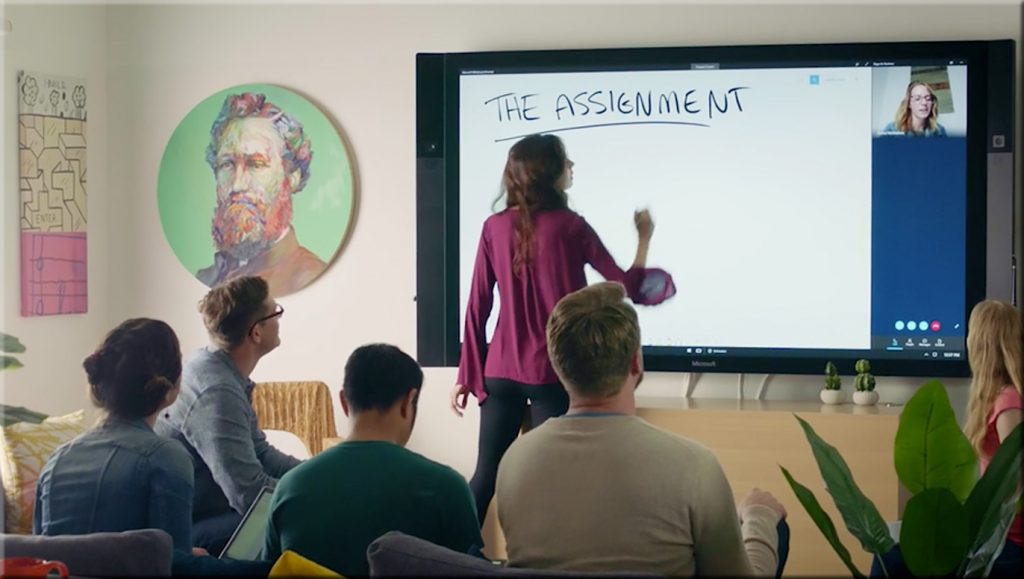
From DSC: I instantly see the inequities involved here — as only those with the resources can choose this route. Also, one would have to be careful about how many others are around you choosing to do the same thing. (Otherwise, it defeats the purpose of social distancing, and one might as well be back in a physical classroom.)
All that said, I post this because I’m intrigued by the different ways people are enhancing their learning ecosystems. The creativity out there is wonderful to see. Learning should be fun.
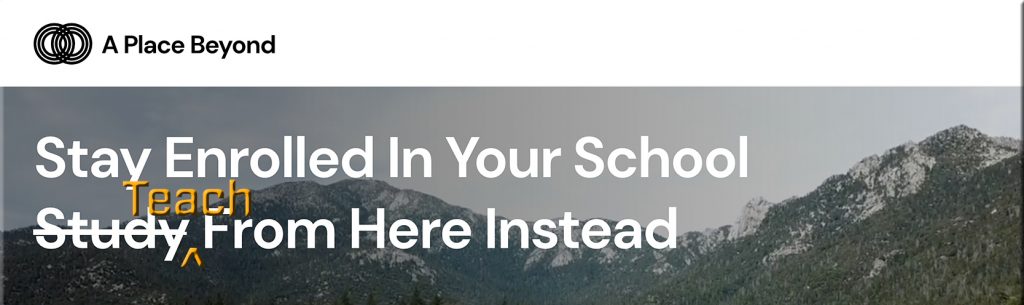
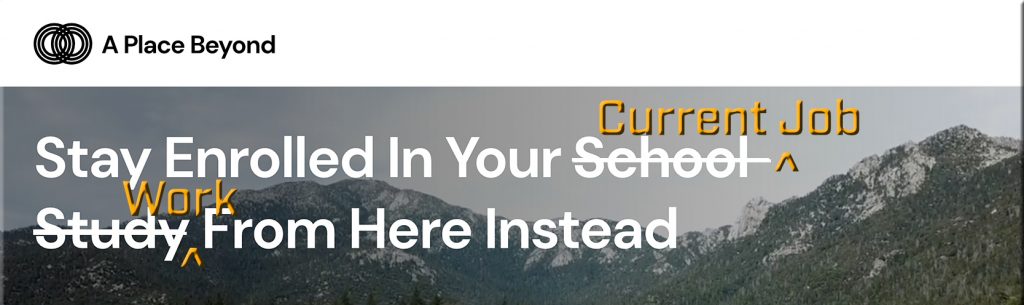
For that matter, a few words could be interchanged to create a slightly different perspective here…
Tracking the factors that will determine if a campus can operate, such as testing for the virus, will prove complex. So colleges may try to avoid boxing themselves in by creating hard benchmarks that dictate when they must shut down. But they’re also answerable to families, who want to know the circumstances under which schools will send students away.
Few colleges have established these triggers. But more concrete campus closure scenarios are likely coming in the next few weeks.
“Colleges and universities follow each other’s lead,” said Sam Owusu, a student and research analyst at Davidson College’s College Crisis Initiative (C2i), which studies institutional responses to the pandemic. “We’ll see more of this.”
Last week, the Colorado district where I teach announced schools would return August 18 for a hybrid of in-person and remote learning. That means that teachers must face the reality of walking into a school building where little of what we were taught about being a teacher will apply. We will be expected at school five days a week, teaching alternating groups of students while also providing remote instruction for those learning from home.
What happens when, instead of getting the virus, we see educators experience anxiety, panic attacks, or stress-induced ailments? Do schools have the necessary supports in place to care for the mental health of its educators?
From DSC: Which brings up some important questions re: teacher education / student teaching:
How are schools of education dealing with the Coronavirus? For example, can a student-teacher get the appropriate credits if they teach a learning pod?
How are schools of education modifying how they prepare the teachers of tomorrow? Are they (hopefully) introducing more training in how to teach online?
What curriculum changes are in the works (hopefully) as I write this?
Will many teachers leave this area of work and pursue other pathways/opportunities?
How to Ace an Online Job Interview— from nytimes.com by Julie Weed A handful of classic techniques and some tips unique to the work-from-home era can help you land that next job.
Excerpt:
Double-Check the Tech Technical difficulties are understandable, but do all you can to avoid them, said Eliot Kaplan, a former vice present of talent acquisition at Hearst Magazines who is now a career coach. Start by ensuring your Wi-Fi is as strong and reliable as possible. That might mean setting up your video call in the part of your home that gets the best reception, asking housemates to stay off the network during your interview or even paying for better Wi-Fi for a few months while you are job hunting.
Radar trends to watch: August 2020 — from oreilly.com Trends in COVID-19, AI, data, robotics, programming, VR, technology and society, and security.
Excerpt:
A promising new voice separation model allows voice recognition to distinguish up to five voices speaking simultaneously without knowing the number of speakers in advance.
Resolutions regarding distance-education programs, the adoption of emergency policies by law schools, teach-out plans and provisional program approval were approved this week by the American Bar Association’s House of Delegates.
To the editor: One problem frequently cited as a reason not to open schools is space. Social distancing requirements would be difficult to meet if students congregated in classrooms.
Hotels and motels were opened to homeless people and healthcare providers. This arrangement helped those businesses stay open.
Similarly, why not use restaurants as classrooms? They have tables and chairs that can be spaced far apart, restrooms that can be supplemented with portable units in the parking lot, food services, water and air conditioning.
Renting the spaces might help keep these businesses alive too. Movie theaters might also be considered as facilities that could meet our educational needs.
With millions of Americans unemployed, hundreds of thousands sick, and a recession on the horizon, states across the country need to pivot quickly in order to figure out how to create more accessible—and affordable—legal services. https://t.co/MneMA3nUoU
From DSC: Perhaps faculty members and their students in Computer Science Departments across the nation could unleash some excellent products/projects/ideas to make this happen! Talk about Project Based Learning (PBL)! Students and faculty members could have immediate positive impacts on the nation for their work.
Christ, He requires still, wheresoe’er He comes,
To feed, or lodge, to have the best of rooms:
Give Him the choice; grant Him the nobler part,
Of all the house:, the best of all’s the heart.
Two roads diverged in a yellow wood,
And sorry I could not travel both
And be one traveler, long I stood
And looked down one as far as I could
To where it bent in the undergrowth;
Then took the other, as just as fair,
And having perhaps the better claim,
Because it was grassy and wanted wear;
Though as for that the passing there
Had worn them really about the same,
And both that morning equally lay
In leaves no step had trodden black.
Oh, I kept the first for another day!
Yet knowing how way leads on to way,
I doubted if I should ever come back.
I shall be telling this with a sigh
Somewhere ages and ages hence:
Two roads diverged in a wood, and I—
I took the one less traveled by,
And that has made all the difference.
And that has made all the difference.
LATIN TEXT:
Ubi caritas et amor, Deus ibi est.
Congregavit nos in unum Christi amor.
Exsultemus, et in ipso jucundemur.
Timeamus, et amemus Deum vivum.
Et ex corde diligamus nos sincero.
ENGLISH TRANSLATION:
Where charity and love are, there God is.
The love of Christ has gathered us into one.
Let us exult, and in Him be joyful.
Let us fear and let us love the living God.
And from a sincere heart let us love each other (and Him).
ECAR Study of Community College Faculty and Information Technology, 2020 — from by Joseph Galanek and Dana C. Gierdowski Community colleges have historically positioned themselves as institutions that respond to local and regional educational needs. Understanding community college faculty technology preferences and experiences can aid institutional efforts to increase student success.
Excerpt:
ECAR Study of Community College Faculty and Information Technology, 2020 provides community college technology and higher education leaders with recommendations for addressing the most pressing technology support and solution needs for faculty, with the goal of enriching faculty teaching experiences on campus and helping advance student success.
Former Google CEO Eric Schmidt is leading a federal initiative to launch a university that would train a new generation of tech workers for the government, according to a OneZero report.
The school, named the US Digital Service Academy, looks to rival Stanford and MIT, two established tech talent pools.
The National Security Commission on Artificial Intelligence — an organization created to push the US ahead in the race for artificial intelligence — voted unanimously in a meeting Monday to recommend the university to Congress.
Schmidt left his role as a technical adviser at Google in February amid his increased involvement in affairs pertaining to military technology.
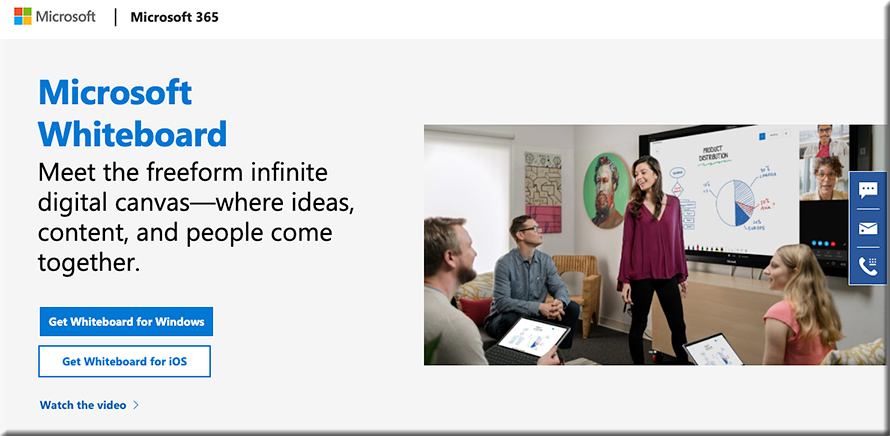
Will assistants such as the Webex Assistant for Meetings (WAM) be integrated into such tools (i.e., would such tools provide translation, transcripts, closed captioning, and more)?
How might this type of tool be used in telehealth? Telelegal? In online-based courtrooms? In presentations?
Learning ecosystems across the country — especially those involving K-12 — are morphing once again.
Have you heard about the explosive interest and potential growth involving “learning pods” — also called “pandemic pods”!?! It’s amazing to see how quickly things are changing in this fluid situation. This is another great example of how the macro-learning ecosystem for K-12 is changing — as well as the changes happening at more of a micro-level. (To see how true this is, put a Google Alert or two out there for “learning pods,” “pod learning,” and/or “pandemic pods.”)
For some information about these changes, see some of the example articles below:
The Pros and Cons of Pandemic Learning Pods— from people.howstuffworks.com by Carrie Whitney Excerpt: What Is a Learning Pod? The idea of learning pods and micro-schools didn’t arise in response to the COVID-19 pandemic, though the concept has gained popularity because of it. Maureen O’Shaughnessy, Ed.D. published the book “Creating Micro-Schools for Colorful Mismatched Kids” in 2019. She’s also founder of the Micro-School Coalition, and believes micro-schools and learning pods should be unique and “reflect the values of the community that they serve.” Rather than acting as a specific model, the coalition serves only as an example of how to feature small classrooms with multi-age students; and innovative teaching models with personalized learning and holistic curriculums.
“This is real. This is not just a niche interest anymore.”
As school starts online, parents need to study up on ‘pandemic pods’ – and what they mean for equity— from usatoday.com by Wyatte Grantham-Philips Excerpt:
Some families are “poding up.” Learning pods, also dubbed “pandemic pods,” are small groups of families that agree to do supplementary learning or complete at-home coursework together. Sometimes they hire a tutor. Sometimes they share the supervision among parents.
POD Learning. Parents, Let’s Work Together to Form Family Pods — from tapinto.net by Jessica Bush Excerpts:
As students and parents prepare for an uncertain back-to-school season, the concept of pandemic pods has risen in popularity, and in practice. But these pods are likely to exacerbate preexisting inequality, and intensify the loaded debate over “school choice,” which has a complex history when it comes to race and class.
From DSC: Though very interesting to see what occurs here, I, too, am concerned about the inequalities and the potential for expanding the learning gaps across the country (between the folks who have the resources and those folks who do not). For example, consider that the cost ranges from $1,500 to $2,500 dollars per student — per month — in the San Francisco Bay Area. (SeeCOVID-19 learning pods: Here’s how they work and what Bay Area schools say about themby Luz Pena.) Or see
They both note that while the Great Recession was a substantial shock to the economic system, COVID-19 has resulted in the sudden upheaval of society at large. This includes changing how members of the public can access the court system or connect with a lawyer.
“It is really fundamentally disrupting overnight every single component of the legal system, and that is very different than 2008-2009,” says Leonard, who is also Penn Law’s chief innovation officer. “I think it creates enormous opportunities for changing many of the ways we work as lawyers, the ways we provide legal services to our clients and also the ways the justice system as a whole works.”
In the short term, Leonard says the pandemic has resulted in massive “forced experimentation.”
In June, Michigan Supreme Court Chief Justice McCormack swore in a cohort of law students via a Zoom conference. Photo courtesy of the Michigan Supreme Court; Shutterstock.
Thanks for dropping by my Learning Ecosystems blog!
My name is Daniel Christian and this blog seeks to cover the teaching and learning environments within the K-12 (including homeschooling, learning pods/micro-schools), collegiate, and corporate training spaces -- whether those environments be face-to-face, blended, hyflex, or 100% online.
Just as the organizations that we work for have their own learning ecosystems, each of us has our own learning ecosystem. We need to be very intentional about enhancing those learning ecosystems -- as we all need to be lifelong learners in order to remain marketable and employed. It's no longer about running sprints (i.e., getting a 4-year degree or going to a vocational school and then calling it quits), but rather, we are all running marathons now (i.e., we are into lifelong learning these days).