Trump signs order closing Education Department to ‘maximum extent appropriate’ — from highereddive.com by Naaz Modan
The directive comes on the heels of U.S. Education Secretary Linda McMahon’s decision to gut half the agency as its “final mission.”

President Donald Trump on Thursday afternoon ordered U.S. Secretary of Education Linda McMahon to “take all necessary steps to facilitate the closure of the Department of Education,” marking the boldest push from the president to shut down the agency since its establishment under the Carter administration over four decades ago.

Trump also said prior to the signing that he intends to disperse the department’s core functions — such as Pell Grants, Title I funding, and providing funding and resources for students with disabilities — to other parts of the government.


Also related see:


Essential AI tools for better work — from wondertools.substack.com by Jeremy Caplan
My favorite tactics for making the most of AI — a podcast conversation

AI tools I consistently rely on (areas covered mentioned below)

  • Research and analysis
  • Communication efficiency
  • Multimedia creation

AI tactics that work surprisingly well 

1. Reverse interviews
Instead of just querying AI, have it interview you. Get the AI to interview you, rather than interviewing it. Give it a little context and what you’re focusing on and what you’re interested in, and then you ask it to interview you to elicit your own insights.”

This approach helps extract knowledge from yourself, not just from the AI. Sometimes we need that guide to pull ideas out of ourselves.


OpenAI’s Deep Research Agent Is Coming for White-Collar Work — from wired.com by Will Knight
The research-focused agent shows how a new generation of more capable AI models could automate some office tasks.

Isla Fulford, a researcher at OpenAI, had a hunch that Deep Research would be a hit even before it was released.

Fulford had helped build the artificial intelligence agent, which autonomously explores the web, deciding for itself what links to click, what to read, and what to collate into an in-depth report. OpenAI first made Deep Research available internally; whenever it went down, Fulford says, she was inundated with queries from colleagues eager to have it back. “The number of people who were DMing me made us pretty excited,” says Fulford.

Since going live to the public on February 2, Deep Research has proven to be a hit with many users outside the company too.


Nvidia to open quantum computing research center in Boston — from seekingalpha.com by Ravikash Bakolia

Nvidia (NASDAQ:NVDA) will open a quantum computing research lab in Boston which is expected to start operations later this year.

The Nvidia Accelerated Quantum Research Center, or NVAQC, will integrate leading quantum hardware with AI supercomputers, enabling what is known as accelerated quantum supercomputing, said the company in a March 18 press release.

Nvidia’s CEO Jensen Huang also made this announcement on Thursday at the company’s first-ever Quantum Day at its annual GTC event.


French quantum computer firm Pasqal links up with NVIDIA — from reuters.com

PARIS, March 21 (Reuters) – Pasqal, a fast-growing French quantum computer start-up company, announced on Friday a partnership with chip giant Nvidia (NVDA.O), opens new tab whereby Pasqal’s customers would gain access to more tools to develop quantum applications.

Pasqal said it would connect its quantum computing units and cloud platform onto NVIDIA’s open-source platform called CUDA-Q.


Introducing next-generation audio models in the API — from openai.com
A new suite of audio models to power voice agents, now available to developers worldwide.

Today, we’re launching new speech-to-text and text-to-speech audio models in the API—making it possible to build more powerful, customizable, and intelligent voice agents that offer real value. Our latest speech-to-text models set a new state-of-the-art benchmark, outperforming existing solutions in accuracy and reliability—especially in challenging scenarios involving accents, noisy environments, and varying speech speeds. These improvements increase transcription reliability, making the models especially well-suited for use cases like customer call centers, meeting note transcription, and more.


8 Weeks Left to Prepare Students for the AI-Enhanced Workplace — from insidehighered.com by Ray Schroeder
We are down to the final weeks left to fully prepare students for entry into the AI-enhanced workplace. Are your students ready?

The urgent task facing those of us who teach and advise students, whether they be degree program or certificate seeking, is to ensure that they are prepared to enter (or re-enter) the workplace with skills and knowledge that are relevant to 2025 and beyond. One of the first skills to cultivate is an understanding of what kinds of services this emerging technology can provide to enhance the worker’s productivity and value to the institution or corporation.

Given that short period of time, coupled with the need to cover the scheduled information in the syllabus, I recommend that we consider merging AI use into authentic assignments and assessments, supplementary modules, and other resources to prepare for AI.


Learning Design in the Era of Agentic AI — from drphilippahardman.substack.com by Dr Philippa Hardman
Aka, how to design online async learning experiences that learners can’t afford to delegate to AI agents

The point I put forward was that the problem is not AI’s ability to complete online async courses, but that online async courses courses deliver so little value to our learners that they delegate their completion to AI.

The harsh reality is that this is not an AI problem — it is a learning design problem.

However, this realisation presents us with an opportunity which we overall seem keen to embrace. Rather than seeking out ways to block AI agents, we seem largely to agree that we should use this as a moment to reimagine online async learning itself.


8 Schools Innovating With Google AI — Here’s What They’re Doing — from forbes.com by Dan Fitzpatrick

While fears of AI replacing educators swirl in the public consciousness, a cohort of pioneering institutions is demonstrating a far more nuanced reality. These eight universities and schools aren’t just experimenting with AI, they’re fundamentally reshaping their educational ecosystems. From personalized learning in K-12 to advanced research in higher education, these institutions are leveraging Google’s AI to empower students, enhance teaching, and streamline operations.


Essential AI tools for better work — from wondertools.substack.com by Jeremy Caplan
My favorite tactics for making the most of AI — a podcast conversation

AI tools I consistently rely on (areas covered mentioned below)

  • Research and analysis
  • Communication efficiency
  • Multimedia creation

AI tactics that work surprisingly well 

1. Reverse interviews
Instead of just querying AI, have it interview you. Get the AI to interview you, rather than interviewing it. Give it a little context and what you’re focusing on and what you’re interested in, and then you ask it to interview you to elicit your own insights.”

This approach helps extract knowledge from yourself, not just from the AI. Sometimes we need that guide to pull ideas out of ourselves.


AI Can’t Fix Bad Learning — from nafez.substack.com by Nafez Dakkak
Why pedagogy and good learning design still come first, and why faster isn’t always better.

I’ve followed Dr. Philippa Hardman’s work for years, and every time I engage with her work, I find it both refreshing and deeply grounded.

As one of the leading voices in learning design, Philippa has been able to cut through the noise and focus on what truly matters: designing learning experiences that actually work.

In an era where AI promises speed and scale, Philippa is making a different argument: faster isn’t always better. As the creator of Epiphany AI—figma for learning designers—Philippa is focused on closing the gap between what great learning design should look like and what’s actually being delivered.

While many AI tools optimize for the average, she believes the future belongs to those who can leverage AI without compromising on expertise or quality. Philippa wants learning designers to be more ambitious using AI to achieve what wasn’t possible before.

In this conversation, we explore why pedagogy must lead technology, how the return on expertise is only increasing in an AI-driven world, and why building faster doesn’t always mean building better.

An excerpted graphic:


Pearson, AWS Collaborate to Enhance AI-Powered Learning Functionality — from cloudwars.com

Pearson, the global educational publisher, and AWS have expanded their existing partnership to enhance AI-driven learning. AWS will help Pearson to deliver AI-powered lesson generation and more for educators, support workforce skilling initiatives, and continue an ongoing collaboration with Pearson VUE for AWS certification.


How can businesses stay ahead of trends and technologies that are rapidly changing their industries? — from linkedin.com by Tanja Schindler; via her Dancing with Uncertainty newsletter

Companies need to develop a sense of curiosity about both the observable trends in the present and the unobserved factors that could significantly influence their futures. While current trends can drive us in certain directions, we also need to imagine possible futures that could either disrupt our industry or offer tremendous opportunities for growth.

To stay ahead of the game, companies should focus on recognising weak signals in the present – subtle hints of emerging trends – and deciding whether to encourage or discourage these signals to avoid undesirable futures and encourage desirable ones. This process is a constant dance between the push of the present (existing trends) and the pull of the future (visions of the future we want to create).


From DSC:
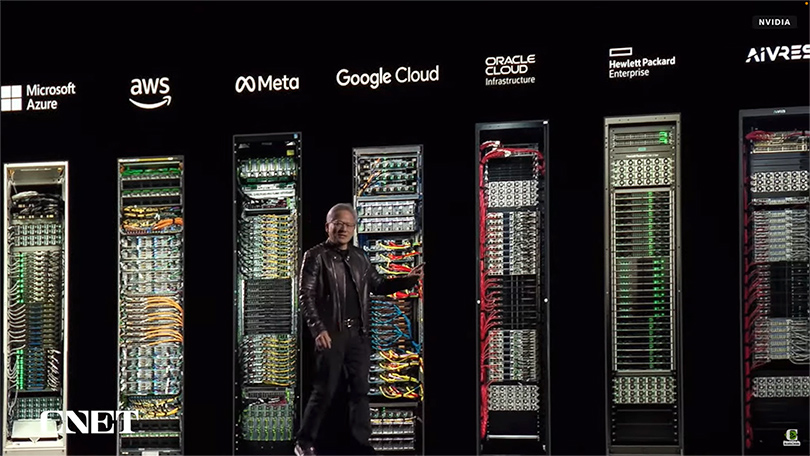
Look out Google, Amazon, and others! Nvidia is putting the pedal to the metal in terms of being innovative and visionary! They are leaving the likes of Apple in the dust.

The top talent out there is likely to go to Nvidia for a while. Engineers, programmers/software architects, network architects, product designers, data specialists, AI researchers, developers of robotics and autonomous vehicles, R&D specialists, computer vision specialists, natural language processing experts, and many more types of positions will be flocking to Nvidia to work for a company that has already changed the world and will likely continue to do so for years to come. 


NVIDIA’s AI Superbowl — from theneurondaily.com by Noah and Grant
PLUS: Prompt tips to make AI writing more natural

That’s despite a flood of new announcements (here’s a 16 min video recap), which included:

  1. A new architecture for massive AI data centers (now called “AI factories”).
  2. A physics engine for robot training built with Disney and DeepMind.
  3. partnership with GM to develop next-gen vehicles, factories and robots.
  4. A new Blackwell chip with “Dynamo” software that makes AI reasoning 40x faster than previous generations.
  5. A new “Rubin” chip slated for 2026 and a “Feynman” chip set for 2028.

For enterprises, NVIDIA unveiled DGX Spark and DGX Station—Jensen’s vision of AI-era computing, bringing NVIDIA’s powerful Blackwell chip directly to your desk.


Nvidia Bets Big on Synthetic Data — from wired.com by Lauren Goode
Nvidia has acquired synthetic data startup Gretel to bolster the AI training data used by the chip maker’s customers and developers.


Nvidia, xAI to Join BlackRock and Microsoft’s $30 Billion AI Infrastructure Fund — from investopedia.com by Aaron McDade
Nvidia and xAI are joining BlackRock and Microsoft in an AI infrastructure group seeking $30 billion in funding. The group was first announced in September as BlackRock and Microsoft sought to fund new data centers to power AI products.


Nvidia CEO Jensen Huang says we’ll soon see 1 million GPU data centers visible from space — from finance.yahoo.com by Daniel Howley
Nvidia CEO Jensen Huang says the company is preparing for 1 million GPU data centers.


Nvidia stock stems losses as GTC leaves Wall Street analysts ‘comfortable with long term AI demand’ — from finance.yahoo.com by Laura Bratton
Nvidia stock reversed direction after a two-day slide that saw shares lose 5% as the AI chipmaker’s annual GTC event failed to excite investors amid a broader market downturn.


Microsoft, Google, and Oracle Deepen Nvidia Partnerships. This Stock Got the Biggest GTC Boost. — from barrons.com by Adam Clark and Elsa Ohlen


The 4 Big Surprises from Nvidia’s ‘Super Bowl of AI’ GTC Keynote — from barrons.com by Tae Kim; behind a paywall

AI Super Bowl. Hi everyone. This week, 20,000 engineers, scientists, industry executives, and yours truly descended upon San Jose, Calif. for Nvidia’s annual GTC developers’ conference, which has been dubbed the “Super Bowl of AI.”


20 AI Agent Examples in 2025 — from autogpt.net

AI Agents are now deeply embedded in everyday life and?quickly transforming industry after industry. The global AI market is expected to explode up to $1.59 trillion by 2030! That is a?ton of intelligent agents operating behind the curtains.

That’s why in this article, we explore?20 real-life AI Agents that are causing a stir today.


Top 100 Gen AI apps, new AI video & 3D — from eatherbcooper.substack.com by Heather Cooper
Plus Runway Restyle, Luma Ray2 img2vid keyframes & extend

?In the latest edition of Andreessen Horowitz’s “Top 100 Gen AI Consumer Apps,” the generative AI landscape has undergone significant shifts.

Notably, DeepSeek has emerged as a leading competitor to ChatGPT, while AI video models have advanced from experimental stages to more reliable tools for short clips. Additionally, the rise of “vibecoding” is broadening the scope of AI creators.

The report also introduces the “Brink List,” highlighting ten companies poised to enter the top 100 rankings.?


AI is Evolving Fast – The Latest LLMs, Video Models & Breakthrough Tools — from heatherbcooper.substack.com by Heather Cooper
Breakthroughs in multimodal search, next-gen coding assistants, and stunning text-to-video tech. Here’s what’s new:

I do these comparisons frequently to measure the improvements in different models for text or image to video prompts. I hope it is helpful for you, as well!

I included 6 models for an image to video comparison:

  • Pika 2.1 (I will do one with Pika’s new 2.2 model soon)
  • Adobe Firefly Video
  • Runway Gen-3
  • Kling 1.6
  • Luma Ray2
  • Hailuo I2V-01


Why Smart Companies Are Granting AI Immunity to Their Employees — from builtin.com by Matt Almassian
Employees are using AI tools whether they’re authorized or not. Instead of cracking down on AI usage, consider developing an AI amnesty program. Learn more.

But the smartest companies aren’t cracking down. They’re flipping the script. Instead of playing AI police, they’re launching AI amnesty programs, offering employees a safe way to disclose their AI usage without fear of punishment. In doing so, they’re turning a security risk into an innovation powerhouse.

Before I dive into solutions, let’s talk about what keeps your CISO or CTO up at night. Shadow AI isn’t just about unauthorized tool usage — it’s a potential dirty bomb of security, compliance and operational risks that could explode at any moment.

6 Steps to an AI Amnesty Program

  1. Build your AI governance foundation.
  2. Transform your IT department from gatekeeper to innovation partner.
  3. Make AI education easily accessible.
  4. Deploy your technical safety net.
  5. Create an AI-positive culture.
  6. Monitor, adapt and evolve.

A first-ever study on prompts… — from theneurondaily.com
PLUS: OpenAI wants to charge $20K a month to replace you?!

What they discovered might change how you interact with AI:

  • Consistency is a major problem. The researchers asked the same questions 100 times and found models often give different answers to the same question.
  • Formatting matters a ton. Telling the AI exactly how to structure its response consistently improved performance.
  • Politeness is… complicated. Saying “please” helped the AI answer some questions but made it worse at others. Same for being commanding (“I order you to…”).
  • Standards matter. If you need an AI to be right 100% of the time, you’re in trouble.

That’s also why we think you, an actual human, should always place yourself as a final check between whatever your AI creates and whatever goes out into the world.


Leave it to Manus
“Manus is a general AI agent that bridges minds and actions: it doesn’t just think, it delivers results. Manus excels at various tasks in work and life, getting everything done while you rest.”

From DSC:
What could possibly go wrong?!


AI Search Has A Citation Problem — from cjr.org (Columbia Journalism Review) by Klaudia Ja?wi?ska and Aisvarya Chandrasekar
We Compared Eight AI Search Engines. They’re All Bad at Citing News.

We found that…

Chatbots were generally bad at declining to answer questions they couldn’t answer accurately, offering incorrect or speculative answers instead.

  • Premium chatbots provided more confidently incorrect answers than their free counterparts.
  • Multiple chatbots seemed to bypass Robot Exclusion Protocol preferences.
  • Generative search tools fabricated links and cited syndicated and copied versions of articles.
  • Content licensing deals with news sources provided no guarantee of accurate citation in chatbot responses.

Our findings were consistent with our previous study, proving that our observations are not just a ChatGPT problem, but rather recur across all the prominent generative search tools that we tested.


5 new AI tools you’ll actually want to try — from wondertools.substack.com by Jeremy Kaplan
Chat with lifelike AI, clean up audio instantly, and reimagine your career

Hundreds of AI tools emerge every week. I’ve picked five new ones worth exploring. They’re free to try, easy to use, and signal new directions for useful AI.

Example:

Career Dreamer
A playful way to explore career possibilities with AI


Who does need college anymore? About that book title … — from Education Design Lab

As you may know, Lab founder Kathleen deLaski just published a book with a provocative title: Who Needs College Anymore? Imagining a Future Where Degrees Won’t Matter.

Kathleen is asked about the title in every media interview, before and since the Feb. 25 book release. “It has generated a lot of questions,” she said in our recent book chat. “I tell people to focus on the word, ‘who.’ Who needs college anymore? That’s in keeping with the design thinking frame, where you look at the needs of individuals and what needs are not being met.”

In the same conversation, Kathleen reminded us that only 38% of American adults have a four-year degree. “We never talk about the path to the American dream for the rest of folks,” she said. “We currently are not supporting the other really interesting pathways to financial sustainability — apprenticeships, short-term credentials. And that’s really why I wrote the book, to push the conversation around the 62% of who we call New Majority Learners at the Lab, the people for whom college was not designed.” Watch the full clip

She distills the point into one sentence in this SmartBrief essay:  “The new paradigm is a ‘yes and’ paradigm that embraces college and/or other pathways instead of college or bust.”

What can colleges do moving forward?
In this excellent Q&A with Inside Higher Ed, Kathleen shares her No. 1 suggestion: “College needs to be designed as a stepladder approach, where people can come in and out of it as they need, and at the very least, they can build earnings power along the way to help afford a degree program.”

In her Hechinger Report essay, Kathleen lists four more steps colleges can take to meet the demand for more choices, including “affordability must rule.”

From white-collar apprenticeships and micro-credential programs at local community colleges to online bootcamps, self-instruction using YouTube, and more—students are forging alternative paths to GREAT high-paying jobs. (source)


2025 College Hopes & Worries Survey Report — from princetonreview.com
We surveyed 9,317 college applicants and parents about their dream schools and their biggest college admission and financial aid challenges.
.


Education Department Fires 1,300 Workers, Gutting Its Staff — from nytimes.com by Michael C. Bender and Dana Goldstein. From DSC: I’m gifting this article to you.
The layoffs mean that the department will now have a work force of about half the size it did when President Trump took office.

The Education Department announced on Tuesday that it was firing more than 1,300 workers, effectively gutting the agency that manages federal loans for college, tracks student achievement and enforces civil rights laws in schools.

The layoffs mean that the department, which started the year with 4,133 employees, will now have a work force of about half that size after less than two months with President Trump in office. In addition to the 1,315 workers who were fired on Tuesday, 572 employees accepted separation packages offered in recent weeks and 63 probationary workers were terminated last month.


The $100 billion disruption: How AI is reshaping legal tech — from americanbazaaronline.com by Rohan Hundia and Rajesh Mehta

The Size of the Problem: Judicial Backlog and Inefficiencies
India has a massive backlog of more than 47 million pending cases, with civil litigation itself averaging 1,445 days in resolution. In the United States, federal courts dispose of nearly 400,000 cases a year, and complex litigations take years to complete. Artificial intelligence-driven case law research, contract automation, and predictive analytics will cut legal research times by 90%, contract drafting fees by 60%, and hasten case settlements, potentially saving billions of dollars in legal costs.

This is not just an evolution—it is a permanent change toward data-driven jurisprudence, with AI supplementing human capabilities, speeding up delivery of justice, and extending access to legal services. The AI revolution for legal tech is not on its way; it is already under way, dismantling inefficiencies and transforming the legal world in real time.


Scaling and Improving Legal Tech Projects — from legaltalknetwork.com by Taylor Sartor, Luigi Bai, David Gray, and Cat Moon

Legal tech innovators discuss how they are working to scale and improve their successful projects on Talk Justice. FosterPower and Legal Aid Content Intelligence (LACI) leverage technology to make high-quality legal information available to people for free online. Both also received Technology Initiative Grants (TIG) from the Legal Services Corporation to launch their projects. Then, in 2024 they were both selected for a different TIG, called the Sustainability, Enhancement and Adoption (SEA) grant. This funding supports TIG projects that have demonstrated excellent results as they improve their tools and work to increase uptake.


Introducing NextGenAI: A consortium to advance research and education with AI — from openai.com; via Claire Zau
OpenAI commits $50M in funding and tools to leading institutions.

Today, we’re launching NextGenAI, a first-of-its-kind consortium with 15 leading research institutions dedicated to using AI to accelerate research breakthroughs and transform education.

AI has the power to drive progress in research and education—but only when people have the right tools to harness it. That’s why OpenAI is committing $50M in research grants, compute funding, and API access to support students, educators, and researchers advancing the frontiers of knowledge.

Uniting institutions across the U.S. and abroad, NextGenAI aims to catalyze progress at a rate faster than any one institution would alone. This initiative is built not only to fuel the next generation of discoveries, but also to prepare the next generation to shape AI’s future.


 ‘I want him to be prepared’: why parents are teaching their gen Alpha kids to use AI — from theguardian.com by Aaron Mok; via Claire Zau
As AI grows increasingly prevalent, some are showing their children tools from ChatGPT to Dall-E to learn and bond

“My goal isn’t to make him a generative AI wizard,” White said. “It’s to give him a foundation for using AI to be creative, build, explore perspectives and enrich his learning.”

White is part of a growing number of parents teaching their young children how to use AI chatbots so they are prepared to deploy the tools responsibly as personal assistants for school, work and daily life when they’re older.


Are Entry-Level Jobs Going Away? The Hidden Workforce Shift — from forbes.com by Dr. Diane Hamilton; via Ryan Craig

The problem is that these new roles demand a level of expertise that wasn’t expected from entry-level candidates in the past. Where someone might have previously learned on the job, they are now required to have relevant certifications, AI proficiency, or experience with digital platforms before they even apply.

Some current and emerging job titles that serve as entry points into industries include:

  • Digital marketing associate – This role often involves content creation, social media management, and working with AI-driven analytics tools.
  • Junior AI analyst – Employees in this role assist data science teams by labeling and refining machine learning datasets.
  • Customer success associate – Replacing traditional customer service roles, these professionals help manage AI-enhanced customer support systems.
  • Technical support specialist – While this role still involves troubleshooting software, it now often includes AI-driven diagnostics and automation oversight.
 
© 2025 | Daniel Christian