ABA Tech Survey Finds Growing Adoption of AI in Legal Practice, with Efficiency Gains as Primary Driver — from lawnext.com by Bob Ambrogi

There has been a significant increase in the adoption of artificial intelligence-based tools among law firms, with 30% of respondents now using AI technology compared to just 11% in 2023, according to the just-released 2024 edition of the American Bar Association’s Legal Technology Survey Report.

It finds that time savings and increased efficiency remain the dominant perceived benefits of AI implementation in legal practice.

The report, published Wednesday by the ABA’s Legal Technology Resource Center, is based on a survey that gathered responses from 512 attorneys in private practice across various firm sizes.


Also re: the legal world:

Why The GC-Legal Ops Partnership Is More Critical Than Ever — from abovethelaw.com by Stephanie Corey
The future of in-house legal isn’t about working in silos — it’s about working together.

AI is rapidly changing the way legal work gets done. Legal Ops can help GCs navigate this shift — identifying the right tools, ensuring responsible AI adoption, and optimizing processes so legal teams can focus on high-value work.
 

All of the articles listed below are from edutopia.org


4 Ways to Boost Students’ Self-Efficacy — by Tyler Rablin
These strategies help students see what they have learned so they believe they can be successful in school in the future.

Self-efficacy, on the other hand, focuses on outcomes to drive beliefs. In essence, self-efficacy involves intentionally providing students with evidence of early success to help them build the belief that they can be successful in the future.

Self-efficacy has been a powerful focus for me because it helps me to be more intentional as a teacher. It requires me to be mindful of how I structure assessments, feedback, etc., to provide students with evidence of their successes early on to help them see potential future successes.

Maintaining Students’ Focus in the Spring — by Miriam Plotinsky
Teachers can use these small ‘upgrades’ or tweaks to their regular practices to help keep students focused and involved.

As a recent MindShift article notes, “The second semester brings a lot of potential challenges to teachers’ regularly scheduled programming because of standardized testing, graduation events, and student burnout.” These challenges may be complex, but they are not insurmountable. With subtle shifts in practice, classrooms can remain safe and productive spaces—even in the spring.

She recommends a “coping jar” to help students identify moments of angst and manage their feelings. Fagell explains that when students find an effective coping mechanism, they write their idea on one side of a Popsicle stick and explain how it works on the other side. As students add ideas to the jar, they have an increased awareness of coping strategies and the importance of helping one another.

10 Picture Books That Showcase Collaboration — by Kristin Rydholm
These entertaining stories feature collaboration and social-emotional skills to highlight the benefit of working together to accomplish a goal.

Are you an early childhood teacher in search of relationship-building resources to help unify your classroom? Have I got a book list for you! In the verbiage of 1970s infomercials: “This collection has everything!” The main characters are early childhood students, the setting is the school, and each plot requires the class to work collaboratively. The characters are united in curiosity, determination, and mission to work on accomplishing projects together that they couldn’t possibly do alone.

What a 30-Day Break From AI Taught Me About My Teaching — by James Bedford
Using AI became second nature for this educator. A month without the tools gave him an opportunity to pause, reflect, and recalibrate.

My goal is to try to preserve the messy, creative core of what it means to be an educator: curiosity, critical thinking, and the grit and energy to solve problems without always resorting to shortcuts—technological or otherwise. My hope is that my students will do the same.

Unplug and reconnect: Challenge yourself and your students to embark on an AI detox. Step away from AI tools where possible, and rediscover the power of human creativity and independent thought. Start a journal to document the journey, exploring questions like “How does it feel to rely solely on my own intellect?” or “What challenges arise when AI isn’t there to assist? This activity can foster resilience, raise self-awareness, and cultivate a deeper appreciation for the human capacity to think, create, problem-solve, and innovate.


Blind Spot on AI — from the-job.beehiiv.com by Paul Fain
Office tasks are being automated now, but nobody has answers on how education and worker upskilling should change.

Students and workers will need help adjusting to a labor market that appears to be on the verge of a historic disruption as many business processes are automated. Yet job projections and policy ideas are sorely lacking.

The benefits of agentic AI are already clear for a wide range of organizations, including small nonprofits like CareerVillage. But the ability to automate a broad range of business processes means that education programs and skills training for knowledge workers will need to change. And as Chung writes in a must-read essay, we have a blind spot with predicting the impacts of agentic AI on the labor market.

“Without robust projections,” he writes, “policymakers, businesses, and educators won’t be able to come to terms with how rapidly we need to start this upskilling.”


Drive Continuous Learning: AI Integrates Work & Training — from learningguild.com by George Hanshaw

Imagine with me for a moment: Training is no longer confined to scheduled sessions in a classroom, an online module or even a microlearning you click to activate during your workflow. Imagine training being delivered because the system senses what you are doing and provides instructions and job aids without you having to take an action.

The rapid evolution of artificial intelligence (AI) and wearable technology has made it easier than ever to seamlessly integrate learning directly into the workflow. Smart glasses, earpieces, and other advanced devices are redefining how employees gain knowledge and skills by delivering microlearning moments precisely when and where they are needed.

AI plays a crucial role in this transformation by sensing the optimal moment to deliver the training through augmented reality (AR).


These Schools Are Banding Together to Make Better Use of AI in Education — from edsurge.com by Emily Tate Sullivan

Kennelly and Geraffo are part of a small team at their school in Denver, DSST: College View High School, that is participating in the School Teams AI Collaborative, a year-long pilot initiative in which more than 80 educators from 19 traditional public and charter schools across the country are experimenting with and evaluating AI-enabled instruction to improve teaching and learning.

The goal is for some of AI’s earliest adopters in education to band together, share ideas and eventually help lead the way on what they and their colleagues around the U.S. could do with the emerging technology.

“Pretty early on we thought it was going to be a massive failure,” says Kennelly of last semester’s project. “But it became a huge hit. Students loved it. They were like, ‘I ran to second period to build this thing.’”


Transactional vs. Conversational Visions of Generative AI in Teaching — from elmartinsen.substack.com by Eric Lars Martinsen
AI as a Printer, or AI as a Thought Partner

As writing instructors, we have a choice in how we frame AI for our students. I invite you to:

  1. Experiment with AI as a conversation partner yourself before introducing it to students
  2. Design assignments that leverage AI’s strengths as a thought partner rather than trying to “AI-proof” your existing assignments
  3. Explicitly teach students how to engage in productive dialogue with AI—how to ask good questions, challenge AI’s assumptions, and use it to refine rather than replace their thinking
  4. Share your experiences, both positive and negative, with colleagues to build our collective understanding of effective AI integration


Learning as a Learning Professional: Unlock Hidden Opportunities — from learningguild.com by Will Thalheimer

As learning professionals, we help others grow—but how well are we developing ourselves? And does it really matter? Absolutely! In this article, I’ll explore why mastering the art of learning is crucial for our success and share strategies that go beyond traditional professional development.

Why learning matters for us
We need to be strong learners because our work demands broad expertise. We must understand the learning sciences, instructional design, project management, technology, evaluation, organizational dynamics, and business strategy. We also need to navigate a sea of learning frameworks, approaches, and models.


Also from learningguild.com, see:

Microlearning: The Key to Capturing Modern Learners’ Attention — by Sergiy Movchan

This shift in how we consume and process information is challenging traditional learning methods, which are finding it increasingly difficult to keep learners’ attention.

Microlearning is a bridge to the attention of today’s learners, delivering complex topics in short, manageable pieces. Whether it’s a five-minute video, a quick quiz, or a short lesson, microlearning makes it easier for students to stay engaged. Microlearning often holds learners’ attention better and for longer compared to standard learning methods.

Typical low completion rates clearly show the need for innovative approaches to content delivery and student engagement. Microlearning offers the answer to this need.

Cultivating Creativity as an L&D Professional — by Katie Belle (Curry) Nelson

Instructional designers and learning professionals are creative by nature. We are called upon to be creative with technology like Articulate, Camtasia, or Captivate. More often than we would like, organizations, red tape, and clients require us to be creative with timelines and budgets. Being creative is a core qualification and requirement of our work. So, what do we do when we feel like the creative river has run to a trickle or dried up entirely?


From DSC:
Two of our small groups at church have been watching The Chosen. The discussions have been deep and valuable. The series gives us a clear picture of the cultural things that were going on when Jesus Christ came into our world, in the flesh. We have grown closer to the LORD and to each other. If you haven’t checked it out, I highly recommend this professionally done video series. The LORD’s fingerprints are all over it!
.

.


Matthew 22:37-39

Jesus replied: “‘Love the Lord your God with all your heart and with all your soul and with all your mind.’ This is the first and greatest commandment. And the second is like it: ‘Love your neighbor as yourself.’

Romans 8:35

Who shall separate us from the love of Christ? Shall trouble or hardship or persecution or famine or nakedness or danger or sword?

Proverbs 17:9

Whoever would foster love covers over an offense, but whoever repeats the matter separates close friends.

Deuteronomy 6: 6-7 

These commandments that I give you today are to be on your hearts. Impress them on your children. Talk about them when you sit at home and when you walk along the road, when you lie down and when you get up.

 2 Corinthians 1:3-4

Praise to the God of All Comfort
3 Praise be to the God and Father of our Lord Jesus Christ, the Father of compassion and the God of all comfort, 4 who comforts us in all our troubles, so that we can comfort those in any trouble with the comfort we ourselves receive from God.


Ableism 101: What it is, what it looks like, and how to become a better ally — from accessliving.org

Ableism is the discrimination of and social prejudice against people with disabilities based on the belief that typical abilities are superior. At its heart, ableism is rooted in the assumption that disabled people require ‘fixing’ and defines people by their disability. Like racism and sexism, ableism classifies entire groups of people as ‘less than,’ and includes harmful stereotypes, misconceptions, and generalizations of people with disabilities.
.


The ‘Gulf of America’ feud is about something bigger: Trump wants to control the media — from theguardian.com by Margaret Sullivan
The president punished the AP for choosing its own language, but that’s just the tip of the iceberg. The press must show unity

Even more broadly, it is about Donald Trump’s wide-ranging effort to control the media and be able to spread propaganda and interfere with the flow of accurate information.

The disagreement started soon after the president decided unilaterally that the Gulf of Mexico was to be called the Gulf of America*. The executive order was one more display of Trump’s capricious and imperious way of doing things; his first month has been a relentless exercise in chaos and norm-destruction.

After the Associated Press, the global news organization, decided to stick with using the long-established name which makes sense to its international readership, the Trump White House determined that punishment was in order.

What’s happening is ugly. In the US, the government doesn’t get to dictate the language journalists use in their stories. There’s a little thing called the first amendment to the US constitution that prohibits this. But the Trump administration, as usual, has its own – often unconstitutional and sometimes illegal – ideas.

The actions against the AP are “retribution, plain and simple, and a shameful attempt to bully the press into ideological compliance”, said Tim Richardson of PEN America.

*Insert from DSC, not from The Guardian:
This was an incredibly arrogant thing to do — something a dictator who is drunk on power and wanting even more power, territory, and wealth would do.

To Mexico and to the rest of the world: Please forgive America for what we’ve become. Then pray for us. Our hearts, minds, perspectives, expectations, and behaviors need a lot of help. 


2025 Survey of College and University Presidents
Learn about presidents’ takes on topics such as financial confidence, the 2024 election’s impact on higher ed & more.

Inside Higher Ed’s 2025 Survey of College and University Presidents was conducted by Hanover Research. The survey asked presidents from 298 public and private, largely nonprofit two- and four-year institutions timely questions on the following issues:

  • General financial and economic confidence, plus mergers and acquisitions
  • Politics, policy and the 2024 election’s impact on higher education
  • Public perceptions of higher ed and the value of a degree
  • Campus speech
  • Race on campus
  • Artificial intelligence
  • Environmental sustainability goals
  • Campus health and wellness, including student mental health
  • Management, governance and the hardest part about being a president
 

You can now use Deep Research without $200 — from flexos.work


Accelerating scientific breakthroughs with an AI co-scientist — from research.google by Juraj Gottweis and Vivek Natarajan

We introduce AI co-scientist, a multi-agent AI system built with Gemini 2.0 as a virtual scientific collaborator to help scientists generate novel hypotheses and research proposals, and to accelerate the clock speed of scientific and biomedical discoveries.


Now decides next: Generating a new future — from Deloitte.com
Deloitte’s State of Generative AI in the Enterprise Quarter four report

There is a speed limit. GenAI technology continues to advance at incredible speed. However, most organizations are moving at the speed of organizations, not at the speed of technology. No matter how quickly the technology advances—or how hard the companies producing GenAI technology push—organizational change in an enterprise can only happen so fast.

Barriers are evolving. Significant barriers to scaling and value creation are still widespread across key areas. And, over the past year regulatory uncertainty and risk management have risen in organizations’ lists of concerns to address. Also, levels of trust in GenAI are still moderate for the majority of organizations. Even so, with increased customization and accuracy of models—combined with a focus on better governance— adoption of GenAI is becoming more established.

Some uses are outpacing others. Application of GenAI is further along in some business areas than in others in terms of integration, return on investment (ROI) and expectations. The IT function is most mature; cybersecurity, operations, marketing and customer service are also showing strong adoption and results. Organizations reporting higher ROI for their most scaled initiatives are broadly further along in their GenAI journeys.


6 Characteristics of an Education that Students Want — from gettingsmart.com by IDEA (School of Industrial Design, Engineering and Arts) Students in Tacoma Washington

As current high school students, we want:

  1. Education for the Real World
  2. Personalized and Flexible Education
  3. Cultivating Agency
  4. Creativity and Divergent Thinking
  5. Joyful Learning and Community Building
  6. Empathy and Emotional Growth

Also from gettingsmart.com

Diving into the Evidence: Virtual and Hybrid Models as High-Quality School Choice Options

Key Points

  • The Learning Accelerator is building an evidence base of what high-quality virtual and hybrid learning looks like and how it can be a catalyst for expanding access to powerful learning opportunities.
  • An analysis of 64 high-quality models revealed that virtual and hybrid learning occurs in various contexts, from state-based, fully-virtual programs to individual, hybrid schools and meets the needs of different student populations, including those underserved or disengaged by traditional education systems as well as looking for increased flexibility and course access.
 

Nvidia helps launch AI platform for teaching American Sign Language — from venturebeat.com by Dean Takahashi; via Claire Zau

Nvidia has unveiled a new AI platform for teaching people how to use American Sign Language to help bridge communication gaps.

The Signs platform is creating a validated dataset for sign language learners and developers of ASL-based AI applications.

Nvidia, the American Society for Deaf Children and creative agency Hello Monday are helping close this gap with Signs, an interactive web platform built to support ASL learning and the development of accessible AI applications.


Using Gen AI to Design, Implement, and Assess PBL — from gettingsmart.com by David Ross

Key Points

  • Generative AI can significantly reduce the time and effort required in designing PBL by providing tools for research, brainstorming, and organization.
  • AI tools can assist educators in managing project implementation and assessment, providing formative feedback and organizing resources efficiently.

I usually conclude blogs with some pithy words, but this time I’ll turn the microphone over to Rachel Harcrow, a high school English/Language Arts teacher at Young Women’s College Prep Charter School of Rochester, NY: “After years of struggling to call myself a PBL practitioner, I finally feel comfortable saying I am, thanks to the power of Gen AI,” Harcrow told me. “Initial ideas now turn into fully fledged high-quality project plans in minutes that I can refine, giving me the space and energy to focus on what truly matters: My students.”


AI Resources for District Leaders — from techlearning.com by Steve Baule
Educational leaders aiming to effectively integrate generative AI into their schools should consider several key resources

To truly harness the transformative power of generative AI in education, district leaders must navigate a landscape rich with resources and opportunities. By delving into state and national guidelines, exploring successful case studies, utilizing innovative planning tools, and engaging in professional development, educational leaders can craft robust implementation plans. These plans can then assist in integrating AI seamlessly into their schools and elevate the learning experience to new heights.


Anthropic brings ‘extended thinking’ to Claude, which can solves complex physics problems with 96.5% accuracy — from rdworldonline.com by Brian Buntz

Anthropic, a favorite frontier AI lab among many coders and genAI power users has unveiled Claude 3.7 Sonnet, its first “hybrid reasoning” AI model. It is capable of both near-instant answers and in-depth, step-by-step reasoning within a single system.

Users can toggle an extended thinking mode where the model self-reflects before answering, considerably improving performance on complex tasks like math, physics and coding. In early testing by the author, the model largely succeeded in creating lines of Python (related to unsupervised learning) that were close to 1,000 lines long that ran without error on the first or second try, including the unsupervised machine learning task shown below:


New Tools. Old Complaints. Why AI Won’t Kill Education or Fix it  — from coolcatteacher.com by Vicki Davis; via Stephen Downes

AI won’t kill education. But will it kill learning? The challenge isn’t AI itself—it’s whether students can still think for themselves when the answers are always one click away.

Wait. Before you go, let me ask you one thing.
AI has opportunities to help learning. But it also won’t fix it. The real question isn’t whether students can use AI—but whether they’re still learning without it.

Whether the learning is happening between the ears.

And so much of what we teach in schools isn’t the answers on a test. It answers questions like “What is my purpose in life?” “How do I make friends?” and “How can I help my team be stronger.” Questions that aren’t asked on a test but are essential to living a good life. These questions aren’t answered between the ears but within the heart.

That, my friends, is what teaching has always been about.

The heart.

And the heart of the matter is we have new challenges, but these are old complaints. Complaints since the beginning of time and teaching. And in those days, you didn’t need kids just to be able to talk about how to build a fire, they had to make one themselves. Their lives depend on it.

And these days, we need to build another kind of fire. A fire that sparks the joy of learning. The joy of the opportunities that await us sparked by some of the most powerful tools ever invented. Kids need to not be able to just talk about making a difference, they need to know how to build a better world tomorrow. Our lives depend on it.


How Debating Skills Can Help Us In The Fight Against AI — from adigaskell.org by Adi Gaskell

Debating skills have a range of benefits in the workplace, from helping to improve our communication to bolstering our critical thinking skills. Research from the University of Mississippi suggests it might also help us in the battle with AI in the workplace.

We can often assume that debate teaches us nothing more than how to argue our point, but in order to do this, we have to understand both our own take on a subject and that of our opponent. This allows us to see both sides of any issue we happen to be debating.

“Even though AI has offered a shortcut through the writing process, it actually still is important to be able to write and speak and think on your own,” the researchers explain. “That’s what the focus of this research is: how debate engenders those aspects of being able to write and speak and study and research on your own.”


The Education Exchange: Big Money Comes to High School Sports — from educationnext.org by Paul E. Peterson (podcast)
Expansion of NIL to secondary level creates competition between public and private schools

Andrew Perloff, a freelance writer and producer and the co-host of the nationally syndicated sports-radio program “The Maggie and Perloff Show,” joins Paul E. Peterson to discuss how the name, image and likeness space is making its way from college athletics into the high school realm.

From DSC:
What could go wrong? Time will tell.


How can college leaders navigate mergers and closures in 2025? — from highereddive.com by Ricardo Azziz
A consolidation expert urges officials to face the facts, explore their strategic options and be willing to accept external help.

This work leads me to desire three wishes for higher education leaders in 2025, namely that they:

  • Be disposed to accepting the facts.
  • Be willing to explore all strategic options.
  • Be agreeable to accepting external help.

Northland College to close after turnaround falls short — from highereddive.com by Ben Unglesbee
Despite recent restructuring efforts, the Wisconsin nonprofit’s board chair said it couldn’t weather “economic and demographic storms” hitting the sector.


12 Trump moves in 4 weeks: What college leaders need to know— from highereddive.com by Natalie Schwartz
The new administration has implemented several policies that have sparked outcry from university researchers and student advcocates.


.
Building an AI-Ready Workforce: A look at College Student ChatGPT Adoption in the US — from cdn.openai.com

One finding from our student survey that stood out to us: Many college and university students are teaching themselves and their friends about AI without waiting for their institutions to provide formal AI education or clear policies about the technology’s use. The education ecosystem is in an important moment of exploration and learning, but the rapid adoption by students across the country who haven’t received formalized instruction in how and when to use the technology creates disparities in AI access and knowledge.

The enclosed snapshot of how young people are using ChatGPT provides insight into the state of AI use among America’s college-aged students. We also include actionable proposals to help address adoption gaps. We hope these insights and proposals can inform research and policy conversation across the nation’s education ecosystem about how to achieve outcomes that support our students, our workforce, and the economy. By improving literacy, expanding access, and implementing clear policies, policymakers and educators can better integrate AI into our educational infrastructure and ensure that our workforce is ready to both sustain and benefit from our future with AI.

Leah Belsky | Vice President, Education | OpenAI


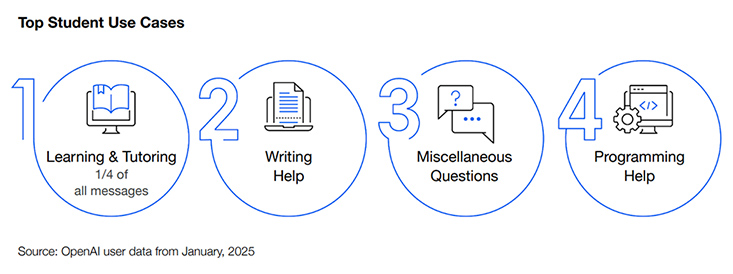
Top student use cases of ChatGPT -- learning and tutoring, writing help, miscellaneouc questions, and programming help

 
© 2025 | Daniel Christian