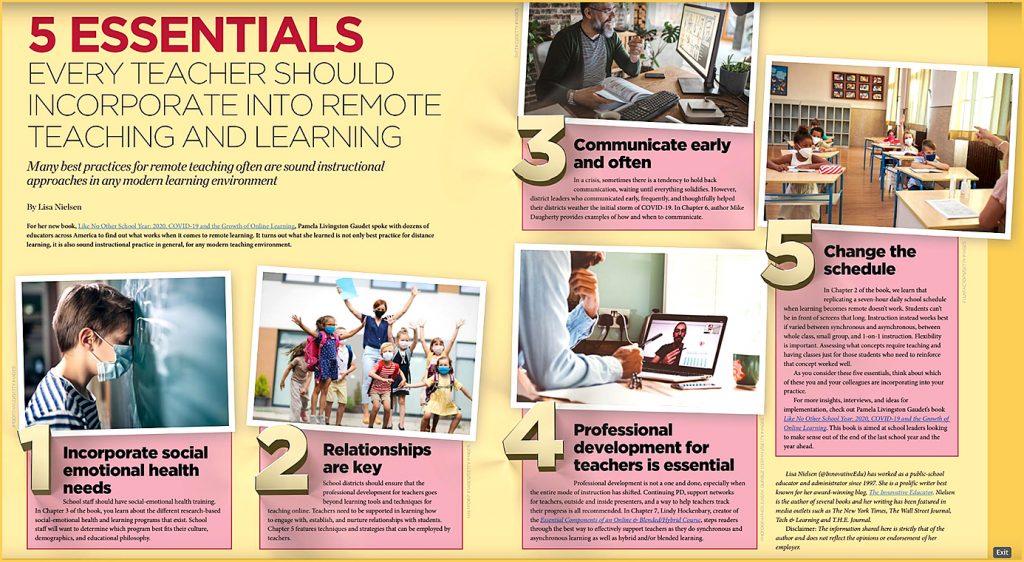
Present and accounted for? Coronavirus-related school closures create attendance challenges — from educationdive.com by Linda Jacobson
Experts say regardless of the method used to track e-learning participation, ongoing contact with students will be essential.

Excerpt:

Alisa Belzer, an education professor at Rutgers University, says K-12 teachers can learn from those who teach online in higher education.

“When instructors stay on top of evaluating the work they are asking learners to complete, they can easily determine who is ‘there’ and who’s not. A key ingredient in this process is creating engaging assignments with clear deliverables,” she says. “When instructors give feedback that is specific, clear, and actionable, students know their instructors are very much a part of their learning process. This also encourages ‘attendance.’”

From DSC:
I also think the more choice we give students will help with their levels of motivation — their sense of purpose. They will chose what’s relevant, enjoyable to them — what they are curious about and want to learn more about. I’ve witnessed this with our daughter, whose spark for writing has ignited. Her imagination is great, and she loves to write. She is going to start her own blog, which will allow her to practice. It’s highly motivating/exciting to her — to have a voice and to be able to share her work with a wider audience.

I think that if we could give students some more leeway to study what they want to study, we wouldn’t have to worry nearly as much about attendance and lack of learning. Naive? Maybe. But I’ve witnessed the K-12 runaway train that won’t stop for anyone. It travels fast, and it doesn’t stop, no matter if mastery is achieved or not.

K-12 education in America is a like a quickly moving train that stops for no one.

I’ve also seen controlling K-12 environments that create gameplayers (our son is one of them).

In these rough times, I hope we don’t throw away the chance to change what’s not working within our K-12 systems. Let not this pain go to waste. My vote is to give students more agency.
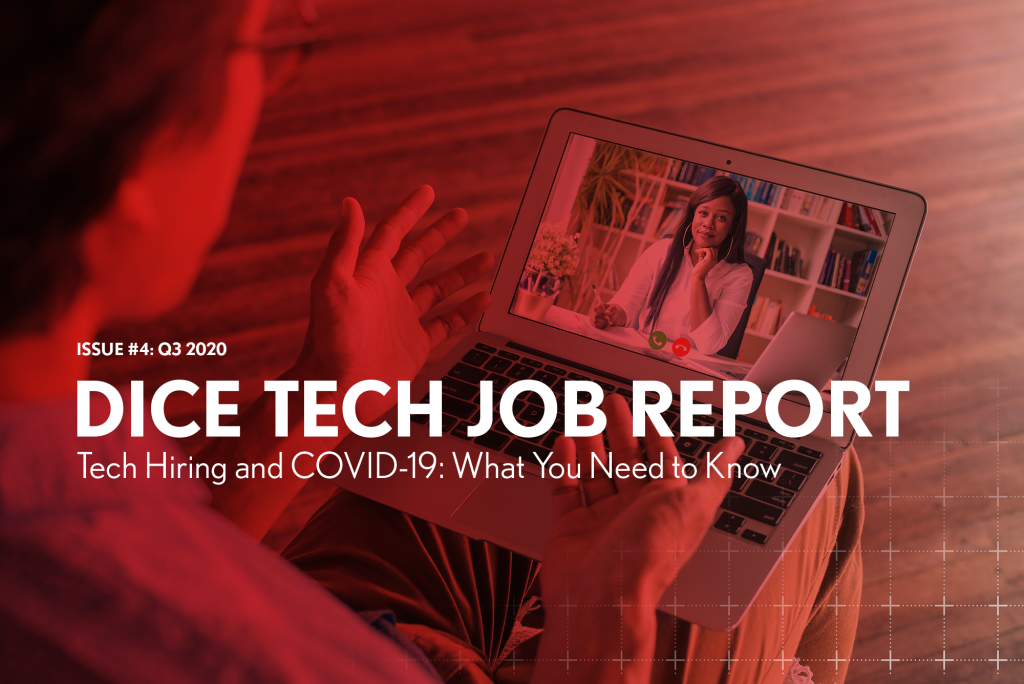


The Dice Q3 Tech Job Report Tech Hiring and COVID-19: What You Need to Know

The Dice Q3 Tech Job Report: Tech Hiring and COVID-19: What You Need to Know — from techhub.dice.com
The report, issued quarterly by Dice, provides exclusive statistics and analysis on the tech hiring landscape, including top cities and states, top employers and the most sought-after skills and occupations.

From DSC:
One can quickly see how valuable this information would be as a data feed into an AI-based, next-generation learning platform.

The platform would connect the marketable skills with the courses, websites, blogs, RSS feeds/streams of content, etc. that would help a learner quickly and affordably build such in-demand skills. Given the shortening half-lives of many kinds of information, such a service is needed desperately…especially now with the impact of the Coronavirus.

Also relevant: See how ISTE built its upcoming virtual event!


Temperament-Inclusive Pedagogy: Helping Introverted and Extraverted Students Thrive in a Changing Educational Landscape — from onlinelearningconsortium.org by Mary R. Fry

Excerpt (emphasis DSC):

So how do we take these different approaches to learning into account and foster a classroom environment that is more inclusive of the needs of both extraverts and introverts? Let’s first distinguish between how extraverts and introverts most prefer to learn, and then discuss ways to meet the needs of both. Extraverts tend to learn through active and social engagement with the material (group work, interactive learning experiences, performing and discussing). Verbalizing typically helps extraverts to think through their ideas and to foster new ones. They often think quickly on their feet and welcome working in large groups. It can be challenging for extraverts to generate ideas in isolation (talking through ideas is often needed) and thus working on solitary projects and writing can be challenging.

In contrast, introverts thrive with solitary/independent work and typically need this time to sort through what they are learning before they can formulate their thoughts and articulate their perspectives. Introverted learners often dislike group work (or at least the group sizes and structures that are often used in the classroom (more on this in a moment)) and find their voice drowned out in synchronous discussions as they don’t typically think as fast as their extroverted counterparts and don’t often speak until they feel they have something carefully thought out to share. Introverted learners are often quite content, and can remain attentive, through longer lectures and presentations and prefer engaging with the material in a more interactive way only after a pause or break.

From DSC:
Could/would a next-generation learning platform that has some Artificial Intelligence (AI) features baked into it — working in conjunction with a cloud-based learner profile — be of assistance here?

That is, maybe a learner could self-select the type of learning that they are: introverted or extroverted. Or perhaps they could use a sliding scaled to mix learning activities up to a certain degree. Or perhaps if one wasn’t sure of their preferences, they could ask the AI-backed system to scan for how much time they spent doing learning activities X, Y, and Z versus learning activities A, B, and C…then AI could offer up activities that meet a learner’s preferences.

(By the way, I love the idea of the “think-ink-pair-share” — to address both extroverted and introverted learners. This can be done digitally/virtually as well as in a face-to-face setting.)

All of this would further assist in helping build an enjoyment of learning. And wouldn’t that be nice? Now that we all need to learn for 40, 50, 60, 70, or even 80 years of our lives?

The 60-Year Curriculum: A Strategic Response to a Crisis


Lincoln Financial CIO: How to build a learning culture – even in a pandemic — from enterprisersproject.com by Ken Solon
Lincoln Financial CIO Ken Solon shares how he’s bringing a virtual perspective to his longtime commitment to prioritizing the people behind the technology

Excerpt (emphasis DSC):

In the spirit of test-and-learn, we created “Lean In and Learn IT,” an interactive digital program that provides a deep dive into one key IT strategy each month. Topics include digital and architecture, agile and DevOps, cloud, big data, and cybersecurity.

Based in our virtual collaboration platform, each topic features a kick-off video followed by a drip of content and interaction, including snackable articles, video clips, quizzes, and prizes to keep the team engaged. The month wraps up with a webcast focused on a key business application of the strategy, featuring subject matter experts both from within the IT organization and our business partners.

The involvement of partners is key, as our surveys tell us that few things motivate our teams as effectively as seeing the impact of their work.

From DSC:
Love their use of “streams of content.”


Digital transformation: 5 ways to balance creativity and productivity — from enterprisersproject.com by Andrew Parker
Creativity and productivity shouldn’t be opposing forces in your digital transformation efforts. Consider these tips to tap the power of both

Excerpt:

Creativity and productivity might sound like they’re poles apart: One is about thinking in new ways; the other is about making things happen.

But in successful digital transformation programs, the two go hand in hand – a perfect marriage of creative thinking that takes the latest technology innovations into account and productive action that brings those new ideas to life.

Today, creativity is more important than ever. As a result of the pandemic, organizations have been forced to think differently and to adapt quickly in order to stay relevant and survive. It’s a case of do or die.

In the wake of the pandemic, creativity is more important than ever.

From DSC:
Another important element here is developing/establishing a culture that is willing to innovate, adapt, experiment, and change. That is SO key in this type of transformation.

It’s clear to me that our people, and their willingness to be agile, innovate, test, and learn, were one of the “secrets” behind those successes. (source)

Also see:

By decentralizing the workforce, companies can attract talent anywhere in the world.

From DSC:
This means that our students must be able to collaborate and to create their deliverables — digitally/virtually/online.


From DSC:
Giving credit to Whom credit is due.


Thank you LORD for my vision — help me to “see” more fully. 
Thank you LORD for my sense of smell — especially for the coffee beans in the morning!
Thank you LORD for my sense of taste — and the variety of foods and drinks that are available to savor.
Thank you LORD for my sense of touch.
Thank you LORD that I can hear.
Thank you LORD for music.
Thanks LORD for the creation you gave to us — it’s absolutely amazing, beautiful, gorgeous, intricate, and creative.
Thanks LORD for your patience, forgiveness, love, grace, mercy, and for caring for me/us — in spite all of the failures, mishaps, and times of disobedience.
Thanks LORD for being active, caring, and good.
Thanks for all of the things that I don’t even recognize and know about to thank you for.
And most of all LORD, thank you for YOU!


We are fearfully and wonderfully made, indeed (Psalm 139:14). It’s absolutely mind-blowing to me. 


The new digital platform Van Gogh Worldwide [was launched 11/5/20]. It is a unique, innovative platform publishing information to a high academic standard, and brings together art-historical and technical information about the work of Vincent van Gogh (1853-1890).

The RKD – Netherlands Institute for Art History, the Van Gogh Museum and the Kröller-Müller Museum are the three founding partners of Van Gogh Worldwide. They each possess detailed information on Van Gogh’s work, and they have pooled their expertise to make data available in digital form. The platform has been constructed in collaboration with a large number of partners including museums, private individuals and research institutions, especially the Cultural Heritage Laboratory of the Cultural Heritage Agency of the Netherlands.

Van Gogh Worldwide dot org

From DSC:
I remember doing a major paper on Vincent Van Gogh in high school. So I thought this was pretty cool. It surely would have helped me at that time…and the site should help many other students in the future.

Addendum on 11/14/20:


New Resource for Inclusive and Equitable Teaching

New Resource for Inclusive and Equitable Teaching — from community.acue.org

Excerpt:

Achieving equity requires that we teach with practices that embrace the diversity of our students’ backgrounds. We must also thoughtfully review our instructional approaches to identify—and change—any unintended practices that might limit student expectations and achievements. Just as we approach our disciplines with prior assumptions and theoretical orientations, we must ensure that we approach our teaching, and our students, with equitable beliefs about their ability to learn and the opportunity gaps that we have the ability to close. As ACUE research shows, doing so leads to stronger levels of academic achievement indistinguishable by race, ethnicity and income level.


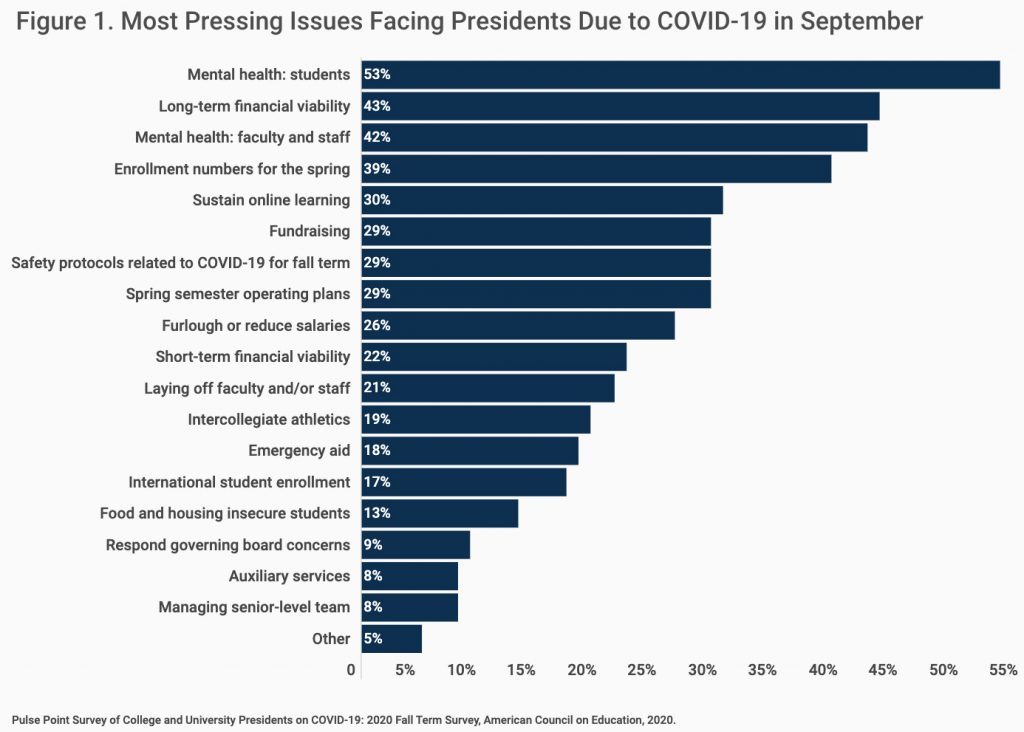
College and University presidents respond to Covid-19: 2020 fall term survey — from acenet.edu by Jonathan Turk, Maria Claudia Soler Salazar, and Anna Marie Ramos

Excerpt:

 Figure 1. Most Pressing Issues Facing Presidents Due to COVID-19 in September


“Especially given that these systems replicate and amplify the harms of structural racism and historical discrimination, which fall predominantly on Black, brown, and poor communities.”

From DSC:
Some serious fodder for thought in this article. I’d like to see
#computerscience students and faculty members debate and/or weigh in on this type of topic.


After the Pandemic, a Revolution in Education and Work Awaits — from nytimes.com by Thomas Friedman
Providing more Americans with portable health care, portable pensions and opportunities for lifelong learning is what politics needs to be about post-Nov. 3.

No job, no K-12 school, no university, no factory, no office will be spared. 

Excerpt:

Your children can expect to change jobs and professions multiple times in their lifetimes, which means their career path will no longer follow a simple “learn-to-work’’ trajectory, as Heather E. McGowan, co-author of “The Adaptation Advantage,” likes to say, but rather a path of “work-learn-work-learn-work-learn.”

“Learning is the new pension,” Ms. McGowan said. “It’s how you create your future value every day.”

The most critical role for K-12 educators, therefore, will be to equip young people with the curiosity and passion to be lifelong learners who feel ownership over their education.


The Gap Between What C-Suite Leaders Think And What HR Executives And Employees Know About Their Workplaces — from forbes.com by Kathy Caprino

Excerpt:

  • C-suite executives now rank organizational complexity, inadequate skills and employee burnout as the top 3 greatest challenges their businesses will face in the next 2 years, and 84% of CHROs say over the next two years they will prioritize agility and flexibility in the workforce. Yet only 19% of HR executives say their HR function has the proper business acumen or capabilities to do so
  •  74% of executives believe they’re helping their employees learn new skills needed to work during the pandemic yet only 38% of their employees believe the same
  • Despite nearly 80% of C-suite executives say they’re supporting the physical and emotional health of their workers right now, only 46% of employees agree
 

How to Work Remotely as a Lawyer: A Guide — from clio.com by Teresa Matich; with thanks to Nelson Miller for this resource

Excerpt:

Whether you’ve looked at working remotely as a lawyer in the past (or as a paralegal, legal assistant, legal professional) with dreams of traveling the world, or whether you’re looking into it for the first time now, this guide contains clear, practical tips for opening a remote legal practice without interruption. We’ll cover:

  • 10 steps to follow for successful remote work
  • What to do if you still need to meet clients in person
  • Tips for how larger legal teams can succeed when transitioning to remote work
  • A basic list of tools to use for remote lawyering
  • Examples of law firms that have worked remotely in some capacity (or are currently doing so)
 

From DSC:
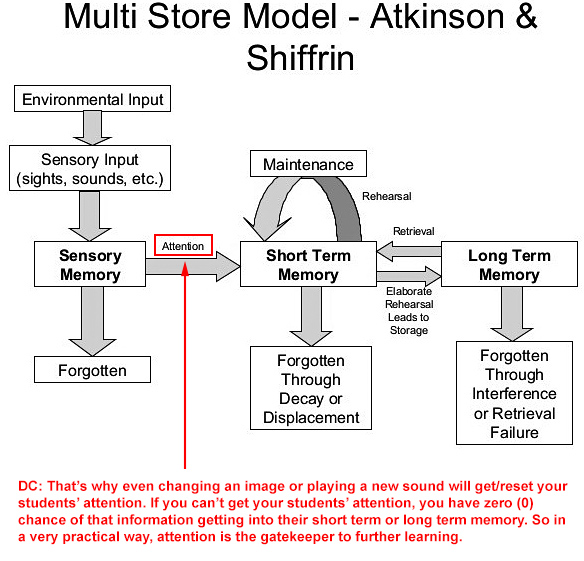
Many people talk about engagement when they discuss learning, and with good reason. It seems to me that what they are really getting at is the topic of getting and maintaining someone’s *attention.* Attention is the gatekeeper to further learning. I wonder if some of the next generation learning platforms that employ some level of Artificial Intelligence (AI)-enabled features, will look to a learner’s preferences (as stored in their cloud-based learner’s profile) in order to help gain/maintain such attention.

And this also helps explain why allowing more learner agency — i.e., more choice, more control — in pursuing their own interests and passions really helps: A motivated learner is paying closer attention to what’s going on.


Attention is the gatekeeper to further learning.


From DSC:
And along these lines, that’s one of the key reasons I’d like to see more involvement from the Theatre Departments, Computer Science Departments, and from those involved with creative writing across the land — in terms of helping develop content for remote and online-based education. Actors, actresses, set designers, costumer designers, audio/video editors, programmers/software developers, and more who could collaborate on these kinds of ideas.

Last comment on this. I don’t mean that we should present our classes like many advertisements do (i.e., running a thousand images by me within 30 seconds). But changing things up periodically — both visually and audibly —  can help regain/reset your students’ attentions.

 
© 2025 | Daniel Christian