Thomson Reuters Survey: Over 95% of Legal Professionals Expect Gen AI to Become Central to Workflow Within Five Year — from lawnext.com by Bob Ambrogi

Thomson Reuters today released its 2025 Generative AI in Professional Services Report, and it reveals that legal professionals have become increasingly optimistic about generative AI, with adoption rates nearly doubling over the past year and a growing belief that the technology should be incorporated into legal work.

According to the report, 26% of legal organizations are now actively using gen AI, up from 14% in 2024. While only 15% of law firm respondents say gen AI is currently central to their workflow, a striking 78% believe it will become central within the next five years.


AI-Powered Legal Work Redefined: Libra Launches Major Update for Legal Professionals — from lawnext.com by Bob Ambrogi

Berlin, April 14, 2025 – Berlin-based Legal Tech startup Libra is launching its most comprehensive update to date, leveraging AI to relieve law firms and legal departments of routine tasks, accelerate research, and improve team collaboration. “Libra v2” combines highly developed AI, a modern user interface, and practical tools to set a new standard for efficient and precise work in all legal areas.

“We listened intently to feedback from law firms and in-house teams,” said Viktor von Essen, founder of Libra. “The result is Libra v2: an AI solution that intelligently supports every step of daily legal work – from initial research to final contract review. We want legal experts to be able to fully concentrate on what is essential: excellent legal advice.”


The Three Cs of Teaching Technology to Law Students — from lawnext.com by Bob Ambrogi

In law practice today, technology is no longer optional — it’s essential. As practicing attorneys increasingly rely on technology tools to serve clients, conduct research, manage documents and streamline workflows, the question is often debated: Are law schools adequately preparing students for this reality?

Unfortunately, for the majority of law schools, the answer is no. But that only begs the question: What should they be doing?

A coincidence of events last week had me thinking about law schools and legal tech, chief among them my attendance at LIT Con, Suffolk Law School’s annual conference to showcase legal innovation and technology — with a portion of it devoted to access-to-justice projects developed by Suffolk Law students themselves.


While not from Bob, I’m also going to include this one here:

Your AI Options: 7 Considerations Before You Buy — from artificiallawyer.com by Liza Pestillos-Ocat

But here’s the problem: not all AI is useful and not all of it is built for the way your legal team works.

Most firms aren’t asking whether they should use AI because they already are. The real question now is what comes next? How do you expand the value of AI across more teams, more matters, and more workflows without introducing unnecessary risk, complexity, or cost?

To get this right, legal professionals need to understand which tools will solve real problems and deliver the most value to their team. That starts with asking better questions, including the ones that follow, before making your next investment in AI for lawyers.


From DSC:
We had better not lose the rule of law in the United States! Donald Trump is an enormous threat to our constitutional democracy! He has NO respect for the rule of law, the judicial branch of our government, our constitution, telling the truth, or having virtues and strong character. He is a threat to the entire world. People are already feeling that in their wallets, purses, and 401(k)s. Supply chains throughout the globe have been negatively impacted. Many have lost their jobs, and more people will likely lose their jobs as a recession is becoming increasingly likely as each day passes.

At minimum, the USA has lost the respect and goodwill of many nations. And I understand why


From Bloomberg on 4/11/25:

The Trump administration, which admitted to wrongly sending a man to a notorious prison in El Salvador (violating a court order in the process) and declined to try and get him back, on Friday went a step further. Lawyers for Trump, despite an order by the US Supreme Court, refused to tell a federal judge where the man was or what it’s doing to get him back. A federal judge, following the Supreme Court’s direction, set a deadline today for Trump’s lawyers to explain how the government planned to follow the high court’s ruling. Trump’s lawyers rejected the court’s order, saying it didn’t have enough time, and questioned her authority.

The Supreme Court ruling against Trump was one of his first defeats tied to the administration’s attempt to broadly expand executive powers. It followed a series of recent procedural rulings that saw the Republican-appointee controlled court rule in his favor. But this latest refusal by Justice Department lawyers to fully comply with court orders, unlike previous cases tied to Trump policies, directly implicates a ruling from the highest court in the land, intensifying an ongoing and unprecedented constitutional crisis between the two branches of government.


Link to this item on LinkedIn


Addendum on 4/17 from DSC:
And speaking of the rule of law…what in the world does a President of the U.S. have to do with which cases law firms can and can’t take up? That’s not his job. Yet he threatens people, law firms, universities, and others to do his will or face the consequences (normally, that has to do with withdrawing funding or getting fired). One billion dollars worth of legal services donated to causes that Trump supports?!?!?! WHAT? 

Trump announces deals with more law firms for a combined $600 million — from washingtonpost.com by Mark Berman
Firms seeking to avoid sanctions from President Donald Trump have agreed to provide nearly ***$1 billion*** in legal services to causes he supports.

President Donald Trump on Friday announced that he had reached agreements with five more law firms pledging to provide a combined $600 million in legal services for causes he supports, the latest deals firms have struck with him in apparent bids to avoid punishment.

Since February, Trump has issued several executive orders sanctioning prominent law firms with ties to his political adversaries or that had opposed his policies, seeking to strip them of government contracts and block them from federal buildings. Three firms targeted by Trump have sued to fight back, while several others made deals with Trump that some framed as necessary to keep their businesses afloat. A fourth firm filed a lawsuit Friday evening challenging Trump’s actions.


Addendum from Above the Law on 4/17/25:

Biglaw Is Under Attack. Here’s What The Firms Are Doing About It.
Introducing the Biglaw Spine Index.

The President of the United States is using the might and power of the office to attack Biglaw firms and the rule of law. It’s pretty chilling stuff that is clearly designed to break major law firms and have them bend a knee to Trump or extract a tremendous financial penalty. This is an assault not just on the firms in the crosshairs, but on the very rule of law that is the backbone of our nation, without which there’s little to check abuses of power.

But in the face of financial harm, too many firms are willing to proactively seek out Trump’s seal of approval and provide pro bono payola, that is, free legal services on behalf of conservative clients or causes in order to avoid Trumpian retribution. So we here at Above the Law have decided to track what exact Biglaw firms are doing in response to the bombardment on Biglaw and the legal system. Some have struck a deal with Trump, some are fighting in court, some have signed an amicus brief in the Perkins Coie case, but the overwhelming majority have stayed silent.


Addendum from Bloomberg on 4/16/25:

The Trump administration’s resistance to and in some cases rejection of the federal judiciary’s constitutional powers has earned it its first finding of contempt, a grave escalation in the deepening crisis at the heart of American government. A federal judge who had been repeatedly attacked by Trump and his aides found there is “probable cause” to hold administration officials in criminal contempt of court for sending scores of men and boys to an El Salvador prison despite his order to halt the deportations. The administration has claimed without providing evidence that the deportees are gang members. A Bloomberg investigation revealed the vast majority had never been charged in the US with anything other than immigration or traffic violations. A Maryland US senator meanwhile was turned away from meeting with a man imprisoned in El Salvador who the Trump administration illegally deported and now refuses to bring back—despite a US Supreme Court order that it facilitate his return.


The following resource was from Roberto Ferraro:

Micromanagement — from psychsafety.com by Jade Garratt

Psychological Safety and Micromanagement
Those who have followed our work at Psych Safety for a while will know that we believe exploring not just what to do – the behaviours and practices that support psychological safety – but also what to avoid can be hugely valuable. Understanding the behaviours that damage psychological safety, what not to do, and even what not to say can help us build better workplaces.

There are many behaviours that damage psychological safety, and one that almost always comes up in our workshops when discussing cultures of fear is micromanagement. So we thought it was time we explored micromanagement in more detail, considering how and why it damages psychological safety and what we can do instead.

Micromanagement is a particular approach to leadership where a manager exhibits overly controlling behaviours or an excessive and inappropriate focus on minor details. They might scrutinise their team’s work closely, insist on checking work, refrain from delegating, and limit the autonomy people need to do their jobs well. It can also manifest as an authoritarian leadership style, where decision-making is centralised (back to themselves) and employees have little say in their work.


From DSC:
I was fortunate to not have a manager who was a micromanager until my very last boss/supervisor of my career. But it was that particular manager who made me call it quits and leave the track. She demeaned me in front of others, and was extremely directive and controlling. She wanted constant check-ins and progress reports. And I could go on and on here. 

But suffice it to say that after having worked for several decades, that kind of manager was not what I was looking for. And you wouldn’t be either. By the way…my previous boss — at the same place — and I achieved a great deal in a very short time. She taught me a lot and was a great administrator, designer, professor, mentor, and friend. But that boss was moved to a different role as upper management/leadership changed. Then the micromanagement began after I reported to a different supervisor.

Anyway, don’t be a micromanager. If you are a recent graduate or are coming up on your graduation from college, learn that lesson now. No one likes to work for a micromanager. No one. It can make your employees’ lives miserable and do damage to their mental health, their enjoyment (or lack thereof) of work, and several other things that this article mentions. Instead, respect your employees. Trust your employees. Let them do their thing. See what they might need, then help meet those needs. Then get out of their way.


Organizing Teams for Continuous Learning: A Complete Guide — from intelligenthq.com

In today’s fast-paced business world, continuous learning has become a vital element for both individual and organizational growth. Teams that foster a culture of learning remain adaptable, innovative, and competitive. However, simply encouraging learning isn’t enough; the way teams are structured and supported plays a huge role in achieving long-term success. In this guide, we’ll explore how to effectively organize teams for continuous learning, leveraging tools, strategies, and best practices.


.

2025 EDUCAUSE Students and Technology Report: Shaping the Future of Higher Education Through Technology, Flexibility, and Well-Being — from library.educause.edu

The student experience in higher education is continually evolving, influenced by technological advancements, shifting student needs and expectations, evolving workforce demands, and broadening sociocultural forces. In this year’s report, we examine six critical aspects of student experiences in higher education, providing insights into how institutions can adapt to meet student needs and enhance their learning experience and preparation for the workforce:

  • Satisfaction with Technology-Related Services and Supports
  • Modality Preferences
  • Hybrid Learning Experiences
  • Generative AI in the Classroom
  • Workforce Preparation
  • Accessibility and Mental Health

DSC: Shame on higher ed for not preparing students for the workplace (see below). You’re doing your students wrong…again. Not only do you continue to heap a load of debt on their backs, but you’re also continuing to not get them ready for the workplace. So don’t be surprised if eventually you’re replaced by a variety of alternatives that students will flock towards.
.


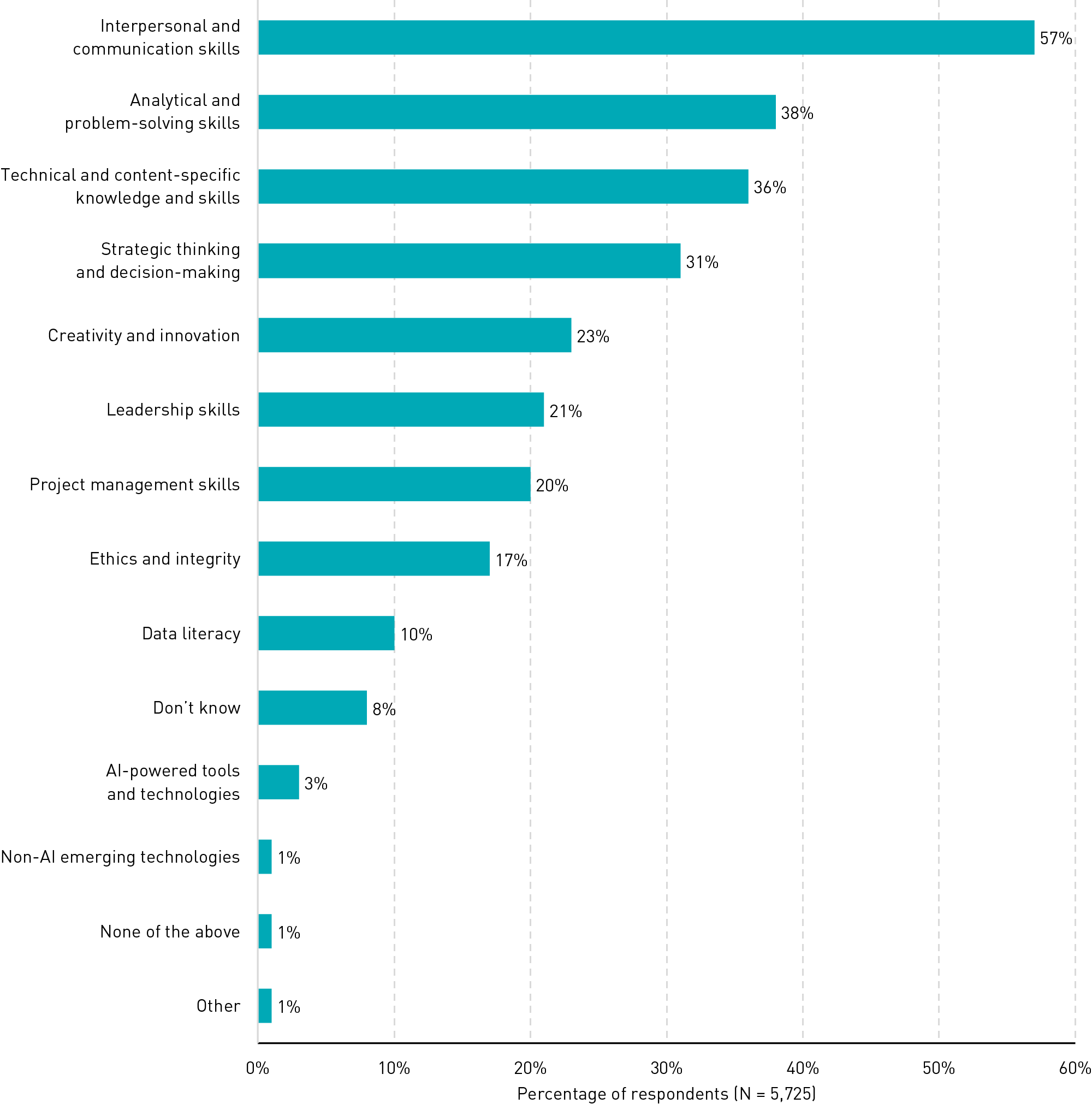
DSC: And students don’t have a clue as to what awaits them in the workplace — they see AI-powered tools and technologies at an incredibly low score of only 3%. Yeh, right. You’ll find out. Here’s but one example from one discipline/field of work –> Thomson Reuters Survey: Over 95% of Legal Professionals Expect Gen AI to Become Central to Workflow Within Five Years

.

Figure 15. Competency Areas Expected to Be Important for Career


Why agency is becoming a new buzzword in educational circles — from jerseyeveningpost.com by by Megan Davies
When people believe that they can effectively navigate life challenges, it’s easier to find the resilience and persistence that is needed

The term agency has gained increasing attention as educators and researchers emphasise the importance of providing students with a greater sense of ownership and competence in their learning journeys. Equally, agency has relevance to anyone who seeks to become more self-directed, confident, and be able to adapt to the challenges of a volatile, uncertain, complex and ambiguous world. There is no running away from the fact that, for most people, there is a need for a mindset that facilitates the capabilities for lifelong learning, personal responsibility and resilience.


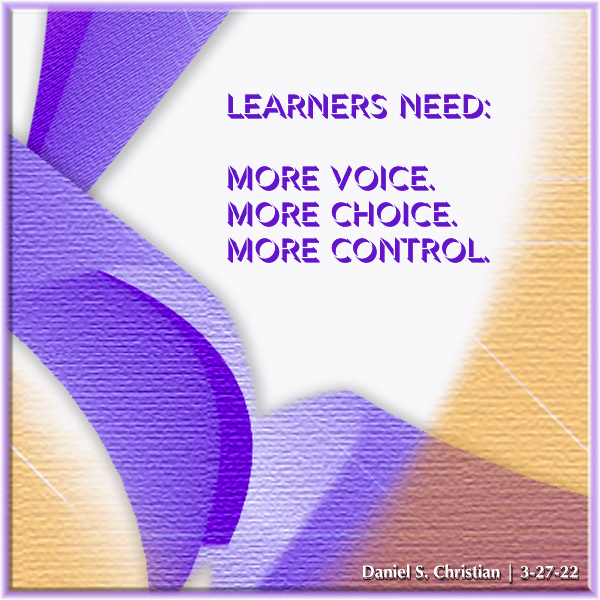
Learners need: More voice. More choice. More control. -- this image was created by Daniel Christian


From DSC:
After seeing Sam’s posting below, I can’t help but wonder:

  • How might the memory of an AI over time impact the ability to offer much more personalized learning?
  • How will that kind of memory positively impact a person’s learning-related profile?
  • Which learning-related agents get called upon?
  • Which learning-related preferences does a person have while learning about something new?
  • Which methods have worked best in the past for that individual? Which methods didn’t work so well with him or her?


Do I Need a Degree in Instructional Design? It Depends. — from teamedforlearning.com

It’s a common question for those considering a career in instructional design: Do I need a degree to land a job? The answer? It depends.

Hiring managers aren’t just looking for a degree—they want proof that you have the knowledge, skills, and abilities to succeed. In fact, most employers focus on 3 key factors when assessing candidates. You typically need at least 2 of these to be considered:

  1. A Credential – A degree or certification in instructional design, learning experience design, or a related field.
  2. Relevant Work Experience – Hands-on experience designing and developing learning solutions.
  3. Proof of Abilities – A strong portfolio showcasing eLearning modules, course designs, or learning strategies.

The good news? You don’t have to spend years earning a degree to break into the field. If you’re resourceful, you can fast-track your way in through volunteer projects, contract work, and portfolio building.

Whether you’re a recent graduate, a career changer, or a working professional looking for your next opportunity, focusing on these key factors can help you stand out and get hired.


Reflections on “Are You Ready for the AI University? Everything is about to change.” [Latham]

.
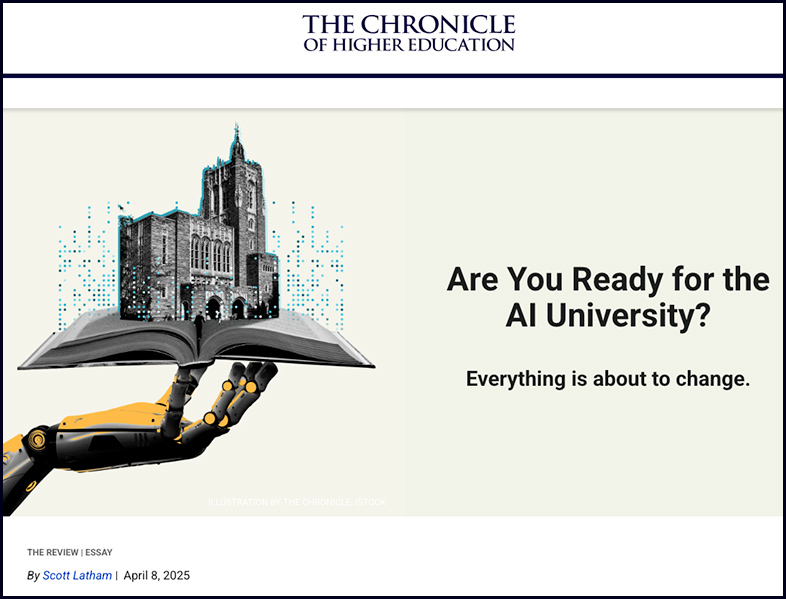
Are You Ready for the AI University? Everything is about to change. — from chronicle.com by Scott Latham

Over the course of the next 10 years, AI-powered institutions will rise in the rankings. US News & World Report will factor a college’s AI capabilities into its calculations. Accrediting agencies will assess the degree of AI integration into pedagogy, research, and student life. Corporations will want to partner with universities that have demonstrated AI prowess. In short, we will see the emergence of the AI haves and have-nots.

What’s happening in higher education today has a name: creative destruction. The economist Joseph Schumpeter coined the term in 1942 to describe how innovation can transform industries. That typically happens when an industry has both a dysfunctional cost structure and a declining value proposition. Both are true of higher education.

Out of the gate, professors will work with technologists to get AI up to speed on specific disciplines and pedagogy. For example, AI could be “fed” course material on Greek history or finance and then, guided by human professors as they sort through the material, help AI understand the structure of the discipline, and then develop lectures, videos, supporting documentation, and assessments.

In the near future, if a student misses class, they will be able watch a recording that an AI bot captured. Or the AI bot will find a similar lecture from another professor at another accredited university. If you need tutoring, an AI bot will be ready to help any time, day or night. Similarly, if you are going on a trip and wish to take an exam on the plane, a student will be able to log on and complete the AI-designed and administered exam. Students will no longer be bound by a rigid class schedule. Instead, they will set the schedule that works for them.

Early and mid-career professors who hope to survive will need to adapt and learn how to work with AI. They will need to immerse themselves in research on AI and pedagogy and understand its effect on the classroom. 

From DSC:
I had a very difficult time deciding which excerpts to include. There were so many more excerpts for us to think about with this solid article. While I don’t agree with several things in it, EVERY professor, president, dean, and administrator working within higher education today needs to read this article and seriously consider what Scott Latham is saying.

Change is already here, but according to Scott, we haven’t seen anything yet. I agree with him and, as a futurist, one has to consider the potential scenarios that Scott lays out for AI’s creative destruction of what higher education may look like. Scott asserts that some significant and upcoming impacts will be experienced by faculty members, doctoral students, and graduate/teaching assistants (and Teaching & Learning Centers and IT Departments, I would add). But he doesn’t stop there. He brings in presidents, deans, and other members of the leadership teams out there.

There are a few places where Scott and I differ.

  • The foremost one is the importance of the human element — i.e., the human faculty member and students’ learning preferences. I think many (most?) students and lifelong learners will want to learn from a human being. IBM abandoned their 5-year, $100M ed push last year and one of the key conclusions was that people want to learn from — and with — other people:

To be sure, AI can do sophisticated things such as generating quizzes from a class reading and editing student writing. But the idea that a machine or a chatbot can actually teach as a human can, he said, represents “a profound misunderstanding of what AI is actually capable of.” 

Nitta, who still holds deep respect for the Watson lab, admits, “We missed something important. At the heart of education, at the heart of any learning, is engagement. And that’s kind of the Holy Grail.”

— Satya Nitta, a longtime computer researcher at
IBM’s Watson
Research Center in Yorktown Heights, NY
.

By the way, it isn’t easy for me to write this. As I wanted AI and other related technologies to be able to do just what IBM was hoping that it would be able to do.

  • Also, I would use the term learning preferences where Scott uses the term learning styles.

Scott also mentions:

“In addition, faculty members will need to become technologists as much as scholars. They will need to train AI in how to help them build lectures, assessments, and fine-tune their classroom materials. Further training will be needed when AI first delivers a course.”

It has been my experience from working with faculty members for over 20 years that not all faculty members want to become technologists. They may not have the time, interest, and/or aptitude to become one (and vice versa for technologists who likely won’t become faculty members).

That all said, Scott relays many things that I have reflected upon and relayed for years now via this Learning Ecosystems blog and also via The Learning from the Living [AI-Based Class] Room vision — the use of AI to offer personalized and job-relevant learning, the rising costs of higher education, the development of new learning-related offerings and credentials at far less expensive prices, the need to provide new business models and emerging technologies that are devoted more to lifelong learning, plus several other things.

So this article is definitely worth your time to read, especially if you are working in higher education or are considering a career therein!


Addendum later on 4/10/25:

U-M’s Ross School of Business, Google Public Sector launch virtual teaching assistant pilot program — from news.umich.edu by Jeff Karoub; via Paul Fain

Google Public Sector and the University of Michigan’s Ross School of Business have launched an advanced Virtual Teaching Assistant pilot program aimed at improving personalized learning and enlightening educators on artificial intelligence in the classroom.

The AI technology, aided by Google’s Gemini chatbot, provides students with all-hours access to support and self-directed learning. The Virtual TA represents the next generation of educational chatbots, serving as a sophisticated AI learning assistant that instructors can use to modify their specific lessons and teaching styles.

The Virtual TA facilitates self-paced learning for students, provides on-demand explanations of complex course concepts, guides them through problem-solving, and acts as a practice partner. It’s designed to foster critical thinking by never giving away answers, ensuring students actively work toward solutions.


The 2025 AI Index Report — from Stanford University’s Human-Centered Artificial Intelligence Lab (hai.stanford.edu); item via The Neuron

Top Takeaways

  1. AI performance on demanding benchmarks continues to improve.
  2. AI is increasingly embedded in everyday life.
  3. Business is all in on AI, fueling record investment and usage, as research continues to show strong productivity impacts.
  4. The U.S. still leads in producing top AI models—but China is closing the performance gap.
  5. The responsible AI ecosystem evolves—unevenly.
  6. Global AI optimism is rising—but deep regional divides remain.
  7. …and several more

Also see:

The Neuron’s take on this:

So, what should you do? You really need to start trying out these AI tools. They’re getting cheaper and better, and they can genuinely help save time or make work easier—ignoring them is like ignoring smartphones ten years ago.

Just keep two big things in mind:

  1. Making the next super-smart AI costs a crazy amount of money and uses tons of power (seriously, they’re buying nuclear plants and pushing coal again!).
  2. Companies are still figuring out how to make AI perfectly safe and fair—cause it still makes mistakes.

So, use the tools, find what helps you, but don’t trust them completely.

We’re building this plane mid-flight, and Stanford’s report card is just another confirmation that we desperately need better safety checks before we hit major turbulence.


Addendum on 4/16:


Jeremiah 31:33-34

33 “This is the covenant I will make with the people of Israel
    after that time,” declares the Lord.
“I will put my law in their minds
    and write it on their hearts.
I will be their God,
    and they will be my people.
34 No longer will they teach their neighbor,
    or say to one another, ‘Know the Lord,’
because they will all know me,
    from the least of them to the greatest,”
declares the Lord.
“For I will forgive their wickedness
    and will remember their sins no more.”

12 Salvation is found in no one else, for there is no other name under heaven given to mankind by which we must be saved.”

Therefore tell the people: This is what the Lord Almighty says: ‘Return to me,’ declares the Lord Almighty, ‘and I will return to you,’ says the Lord Almighty.

Hebrews 1:3

The Son is the radiance of God’s glory and the exact representation of his being, sustaining all things by his powerful word. After he had provided purification for sins, he sat down at the right hand of the Majesty in heaven.
 

The 2025 ABA Techshow Startup Alley Pitch Competition Ended In A Tie – Here Are The Winners — from lawnext.com by Bob Ambrogi

This year, two startups ended up with an equal number of votes for the top spot:

  • Case Crafter, a company from Norway that helps legal professionals build compelling visual timelines based on case files and evidence.
  • Querious, a product that provides attorneys with real-time insights during client conversations into legal issues, relevant content, and suggested questions and follow-ups.
    .


AI academy gives law students a head start on legal tech, says OBA innovator — from canadianlawyermag.com by Branislav Urosevic

The Ontario Bar Association has recently launched a hands-on AI learning platform tailored for lawyers. Called the AI Academy, the initiative is designed to help legal professionals explore, experiment with, and adopt AI tools relevant to their practice.

Colin Lachance, OBA’s innovator-in-residence and the lead designer of the platform, says that although the AI Academy was built for practising lawyers, it is also well-suited for law students.


Is collaboration the key to digital accessibility? — from timeshighereducation.com by Sal Jarvis and George Rhodes
Digital accessibility is ethically important, and a legal requirement, but it’s also a lot of work. Here’s how universities can collaborate and pool their expertise to make higher education accessible for all

How easy do you find it to navigate your way around your university’s virtual estate – its websites, virtual learning environment and other digital aspects? If the answer is “not very”, we suspect you may not be alone. And for those of us who might access it differently – without a mouse, for example, or through a screen reader or keyboard emulator – the challenge is multiplied. Digital accessibility is the wide-ranging work to make these challenges a thing of the past for everyone. It is a legal requirement and a moral imperative.

Make Things Accessible is the outcome of a collaboration, initially between the University of Westminster and UCL, but now incorporating many other universities. It is a community of practice, a website and an archive of resources. It aims to make things accessible for all.


Job hunting and hiring in the age of AI: Where did all the humans go? — from washingtonpost.com by Taylor Telford
The proliferation of artificial intelligence tools and overreliance on software such as ChatGPT is making the job market increasingly surreal.

The speedy embrace of AI tools meant to make job hunting and hiring more efficient is causing headaches and sowing distrust in these processes, people on both sides of the equation say. While companies embrace AI recruiters and application scanning systems, many job seekers are trying to boost their odds with software that generates application materials, optimizes them for AI and applies to hundreds of jobs in minutes.

Meanwhile, recruiters and hiring managers are fielding more applicants than they can keep up with, yet contend that finding real, qualified workers amid the bots, cheaters and deepfakes is only getting tougher as candidates use AI to write their cover letters, bluff their way through interviews and even hide their identities.

“I’m pro-AI in the sense that it allows you to do things that were impossible before … but it is being misused wildly,” Freire said. The problem is “when you let it do the thinking for you, it goes from a superpower to a crutch very easily.”


From DSC:
I value our constitutional democracy and I want to help preserve it. If you are an American, I encourage you to do the same. I’m not interested in living under an authoritarian government. The founders of this great nation developed an important document that integrated a system of checks and balances between the legislative, judicial, and executive branches of government. The rule of law was important then, and it should still be important now. That’s why I’m posting the following two items.


Several Hundred Law Professors File Amicus Brief Defending Biglaw Firms Against Trump’s Executive Order Attacks — from jdjournal.com by Maria Lenin Laus

In an unprecedented show of solidarity, over 300 law professors from leading American law schools have filed an amicus brief condemning former President Donald Trump’s executive orders targeting major law firms. The professors argue that the orders—issued in retaliation for the firms’ clients, diversity initiatives, and legal work opposing Trump policies—represent a dangerous abuse of executive power and a direct violation of constitutional protections.

The amicus brief, filed in support of the law firms’ challenge, was signed by professors from nearly every top-tier U.S. law school, including Harvard, Yale, Stanford, Columbia, NYU, and the University of Chicago. The professors argue that Trump’s orders:

  • Violate the First Amendment by penalizing firms for the viewpoints they express through advocacy and representation;
  • Undermine the rule of law by discouraging legal professionals from taking on controversial or unpopular clients;
  • Set a dangerous precedent for political retaliation against attorneys and the institutions of justice.

Law school deans around the country react to Trump’s undercutting the legal foundations/principles of our nation — from linkedin.com by Georgetown University Law Center

“We write to reaffirm basic principles: The government should not punish lawyers and law firms for the clients they represent, absent specific findings that such representation was illegal or unethical. Punishing lawyers for their representation and advocacy violates the First Amendment and undermines the Sixth Amendment.

We thus speak as legal educators, responsible for training the next generation of lawyers, in condemning any government efforts to punish lawyers or their firms based on the identity of their clients or for their zealous lawful and ethical advocacy.”


For related postings, also see:

President’s Third Term Talk Defies Constitution and Tests Democracy — from nytimes.com by Peter Baker (DSC: This is a free/gifted article for you.)
The 22nd Amendment is clear: President Trump has to give up his office after his second term. But his refusal to accept that underscores how far he is willing to consider going to consolidate power.

“This is in my mind a culmination of what he has already started, which is a methodical effort to destabilize and undermine our democracy so that he can assume much greater power,” Representative Daniel Goldman, Democrat of New York and lead counsel during Mr. Trump’s first impeachment, said in an interview.

“A lot of people are not talking about it because it’s not the most pressing issue of that particular day,” he said on Friday as stock markets were plunging in reaction to Mr. Trump’s newly declared trade war. But an attack on democracy, he added, “is actually in motion and people need to recognize that it is not hypothetical or speculative anymore.”

Mr. Trump’s autocratic tendencies and disregard for constitutional norms are well documented. In this second term alone, he has already sought to overrule birthright citizenship embedded in the 14th Amendment, effectively co-opted the power of Congress to determine what money will be spent or agencies closed, purged the uniformed leadership of the armed forces to enforce greater personal loyalty and punished dissent in academia, the news media, the legal profession and the federal bureaucracy.

BigLaw gives up on its future — from jordanfurlong.substack.com by Jordan Furlong
By putting business ahead of the rule of law when faced with assaults on their independence, many large US law firms have tarnished their reputations. Tomorrow’s lawyers could make them pay the price.

Two young Skadden associates, Rachel Cohen and Brenna Trout Frey, resigned from the firm, the former before its deal with Trump and the latter afterwards. “If my employer cannot stand up for the rule of law,” wrote Ms. Frey, “then I cannot ethically continue to work for them.” There might’ve been other public resignations I haven’t seen, but I’m confident there have been private ones from both firms, as well as intense efforts by other associates to find positions elsewhere.

This is the risk these firms are taking: It matters to young lawyers when their law firms fail to defend the rule of law. And it matters especially to young lawyers who are women and members of visible minorities when law firms jettison their vaunted diversity, equity, and inclusion programs under pressure from the government.

 
© 2025 | Daniel Christian