Bitcoin – The Currency Of The Future — from bitrebels.com by Faizan Javaid

Excerpt:

In its relatively short lifespan, Bitcoin has managed to grow from only a small movement of computer fanatics, Cypherpunks, and cryptographers into an increasingly mainstream phenomenon. Not only that but it is supported by a blueprint and ethos that could very well lead to a redesign of the internet and the financial system we know today. In its wake, many financial analysts, supporters as well as skeptics seem to be faced with the same question: Could Bitcoin be the currency of the future?

From DSC:
I like the last sentence. That should have been the title of the article — i.e., “Could Bitcoin be the currency of the future?”


What is it like to use a screen reader? — from knowbility.org by Anthony Vasquez

Excerpt:

In January, I, along with Texas State University computer science student Su Park, demonstrated screen reader interactions as part of Knowbility’s Screen Readers in the Wild webinar. Both Su and I are blind and have used screen readers since childhood. We weren’t able to answer all attendee questions during the webinar, so I’m continuing the discussion here. I hope that after reading this, you’ll better understand the roles that screen readers and accessible content play in the lives of blind people, and learn of a few easy ways you can improve the user experience. So, let’s jump right in!

If you missed Screen Readers in the Wild, you can still watch the demos!


A New York Lawmaker Wants to Ban Police Use of Armed Robots — from wired.com by Sidney Fussell
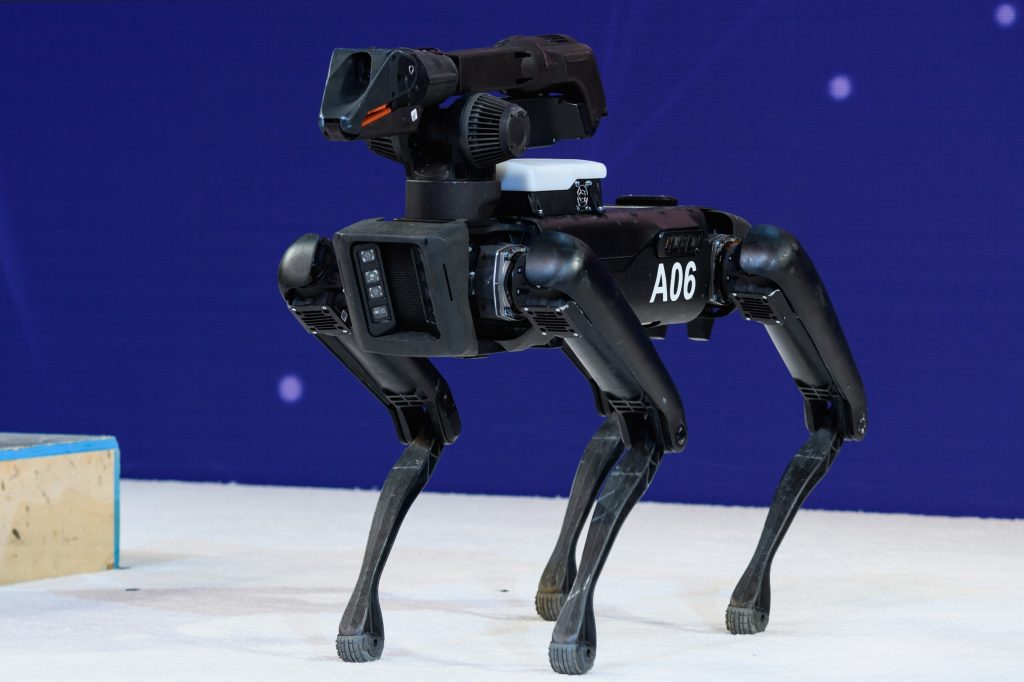
Officers’ use of Boston Robotics’ Digidog intensifies concerns about militarization of the police.

A robot dog is pictured here.

Excerpt:

NEW YORK CITY councilmember Ben Kallos says he “watched in horror” last month when city police responded to a hostage situation in the Bronx using Boston Dynamics’ Digidog, a remotely operated robotic dog equipped with surveillance cameras. Pictures of the Digidog went viral on Twitter, in part due to their uncanny resemblance with world-ending machines in the Netflix sci-fi series Black Mirror.


A New Online Tutoring Market Has Emerged — In Construction. It Requires a Surprising Number of Books. — from edsurge.com by Rebecca Koenig

Excerpt:

There’s a high-stakes exam that’s created an entire industry selling test-preparation products and services to people willing to shell out big bucks for help honing their skills and strategies.

It’s not the SAT, or the MCAT. In fact, it’s not related to academic admissions at all. Yet it has generated lots of online guides and courses, and studying for it requires many, many books.

It’s the exam to become a licensed construction contractor. And companies that offer remote instruction to help tradespeople get ready to take the test say business has been booming during the pandemic—perhaps driven by the fact that demand for construction workers is high.


More Employers Are Awarding Credentials. Is A Parallel Higher Education System Emerging? — from edsurge.com by Sean Gallagher and Holly Zanville

Excerpt:

As the acceptance of new types of credentials grows, a number of employers have become learning providers in their own right, in a way that could shake up the broader higher education landscape.

A growing number of companies have moved beyond training their own employees or providing tuition assistance programs to send staff members to higher education. Many of these employers are also developing their own curricula and rapidly expanding their publicly-facing credential offerings.

But the current boom in employer-issued credentials is different—and potentially transformational. Unlike the traditional IT certifications of decades past, these new credentials are less focused on proprietary technologies related to a given tech vendor, and are instead more focused on broadly applicable tech skill sets such as IT support, cloud computing and digital marketing.


Altered Work Landscape Points to New Directions for L&D — from learningsolutionsmag.com by Pamela Hogel

Excerpt:

Learning and development (L&D) leaders emerged from 2020 with increased respect and influence in their organizations—presenting opportunities to shape workers and drive readiness for further changes. Many organizations emerged from 2020 with an increased openness to digital transformation and an accelerated timetable for achieving online learning maturity.

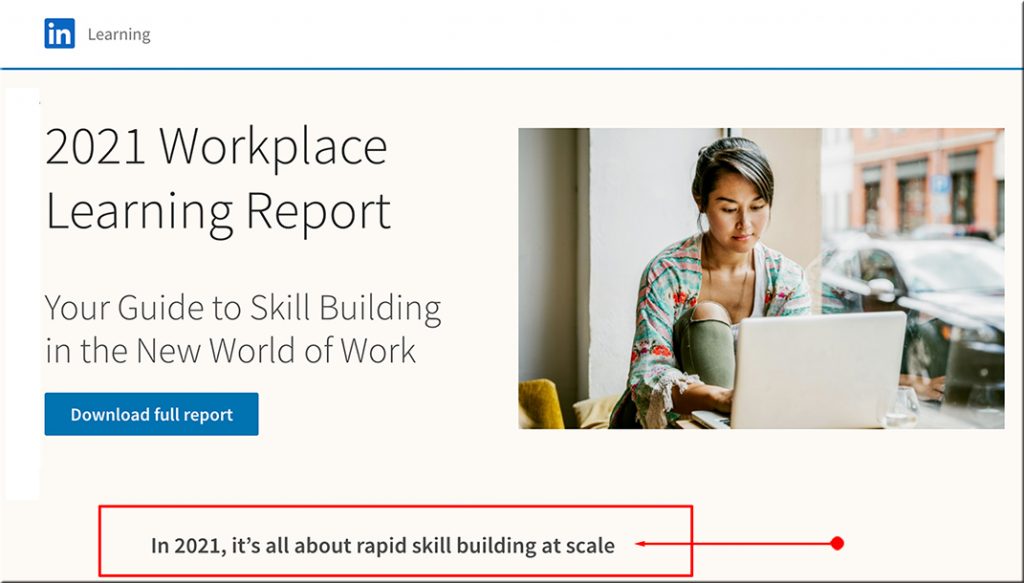
The 2021 LinkedIn Learning Workplace Learning Report, released in early March, bears this out.


From DSC:
Which fits nicely into this vision. 


It’s Time to Rethink Higher Education: What if our goal was creating social impact, not preserving the status quo? — from chronicle.com by Brian Rosenberg (president emeritus of Macalester College and president in residence of the Harvard Graduate School of Education)

Excerpts (emphasis DSC):

Higher education should in its ideal form lead to more economic security for more people, a more equitable and innovative society, and a well-functioning democracy. Add whatever goals you would like, but these seem like a reasonable starting point and, given the present state of the country, more than a little aspirational.

But if we fail to explore — if we fail to go beyond superficial change and interrogate our most fundamental assumptions about how and what we teach, how and why we organize ourselves in the current way — we will have no one but ourselves to blame if the system as we know it shrivels to the point where it collapses from within or is painfully disrupted from without.

Also see:

The Pandemic May Have Permanently Altered Campuses. Here’s How. — from chronicle.com by Francie Diep
Trends accelerated by Covid-19 may make more sense than ever in the future, experts say.

Excerpt:

The Covid-19 crisis has transformed all aspects of higher education, and the physical campus is no exception. The Chronicle recently released a special report, Rethinking Campus Spaces, that offers strategies for doing more with less space, to save money and prepare for an uncertain future. Here is an adapted excerpt from the report.

The Chronicle asked more than 40 architects, campus planners, and leaders in student life and housing about how several categories of campus spaces might look different in the future. As colleges navigate difficult financial straits, many interviewees predicted more public-private partnerships, and renovations instead of new construction — which can be less costly and more environmentally friendly. Overall, their answers paint a picture of future campuses that are more adaptable, perhaps smaller, and focused on what’s most valuable about seeing one’s peers in person.


Self-Assessment (emphasis DSC)

Turn each of your learning outcomes or objectives into a question. Then, ask each student to self-score how confident they feel about being able to demonstrate that outcome or task.

Example:
Learning outcome: Students will be able to compare bacteria vs. viruses.

Change it to a question:  How confident are you in comparing bacteria vs. viruses based on today’s lesson?

Now ask students to score their confidence or ability to do this outcome using a simple scale such as:  “1 = I’m not confident that I can do it” to “5 = I am very confident that I can do it.”


If equity is a priority, UDL is a must — from cultofpedagogy.com by Katie Novak

Once you identify the firm goal, ask yourself, “Based on the variability in my class, what barriers may prevent learners from working toward that goal and how can I eliminate those barriers through design?”

Excerpt:

When we design the same learning pathways for all learners, we might tell ourselves we are being fair, but in fact, single pathways are exclusionary.  Beverly Daniel Tatum, author of the critically acclaimed book, Why Are All The Black Kids Sitting Together in the Cafeteria? And Other Conversations About Race, challenges us to focus on impact over intentions. It may not be our intent to exclude our learners, but the reality is that many students do not have opportunities to learn at high levels or to access curriculum and instruction that is accessible, engaging, culturally sustaining, and linguistically appropriate.

Luckily, there is a framework that rejects these one-size-fits-all solutions and empowers educators to proactively design learning experiences so all students can increase their brainpower and accelerate and own their learning. The framework is Universal Design for Learning (UDL).

UDL is a framework for designing learning experiences so students have options for how they learn, what materials they use, and how they demonstrate their learning. 

From DSC:
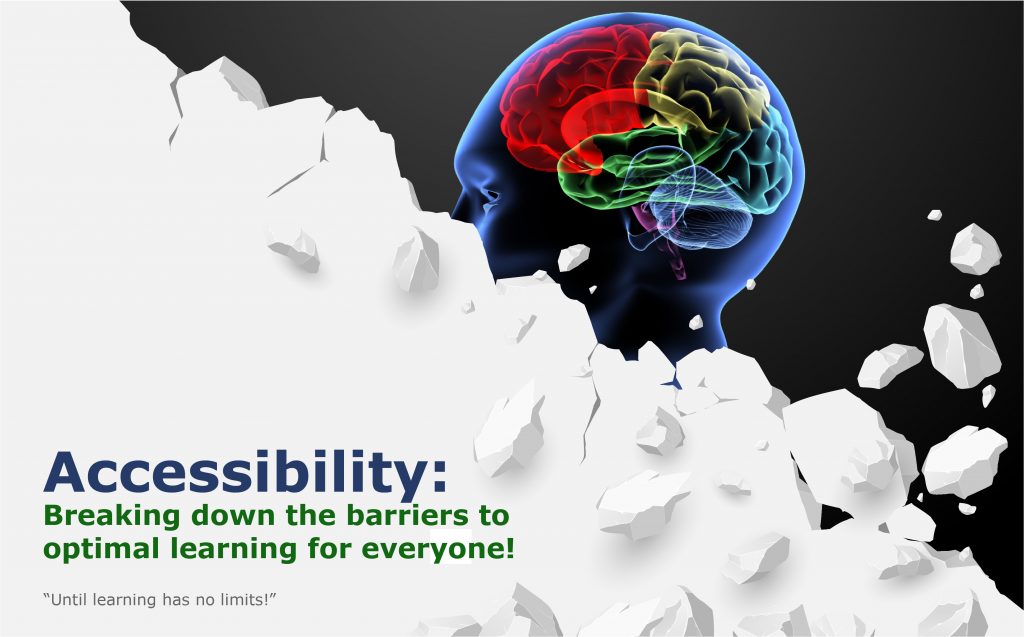
I put together this graphic as I’m working on a Module (for Canvas) to address the topic of accessibility:

An image of a barrier being torn down -- revealing a human mind behind it. This signifies the need to tear down any existing barriers that might hinder someone's learning experience.
By Daniel Christian March 2021
 

How a Discriminatory Algorithm Wrongly Accused Thousands of Families of Fraud — from vice.com by Gabriel Geiger; with thanks to Sam DeBrule for this resource
Dutch tax authorities used algorithms to automate an austere and punitive war on low-level fraud—the results were catastrophic.

Excerpt:

Last month, Prime Minister of the Netherlands Mark Rutte—along with his entire cabinet—resigned after a year and a half of investigations revealed that since 2013, 26,000 innocent families were wrongly accused of social benefits fraud partially due to a discriminatory algorithm.

Forced to pay back money they didn’t owe, many families were driven to financial ruin, and some were torn apart. Others were left with lasting mental health issues; people of color were disproportionately the victims.

On a more positive note, Sam DeBrule (in his Machine Learnings e-newsletter) also notes the following article:

Can artificial intelligence combat wildfires? Sonoma County tests new technology — from latimes.com by Alex Wigglesworth


16 Historical Roman Inventions That Helped Shape the Modern World — from interestingengineering.com by Kashyap Vyas
The technologically-advanced ancient Roman Empire has a rich history of inventions, some of which are still used today.

Picture of ancient road -- as part of an article entitled 16 Historical Roman Inventions That Helped Shape the Modern World


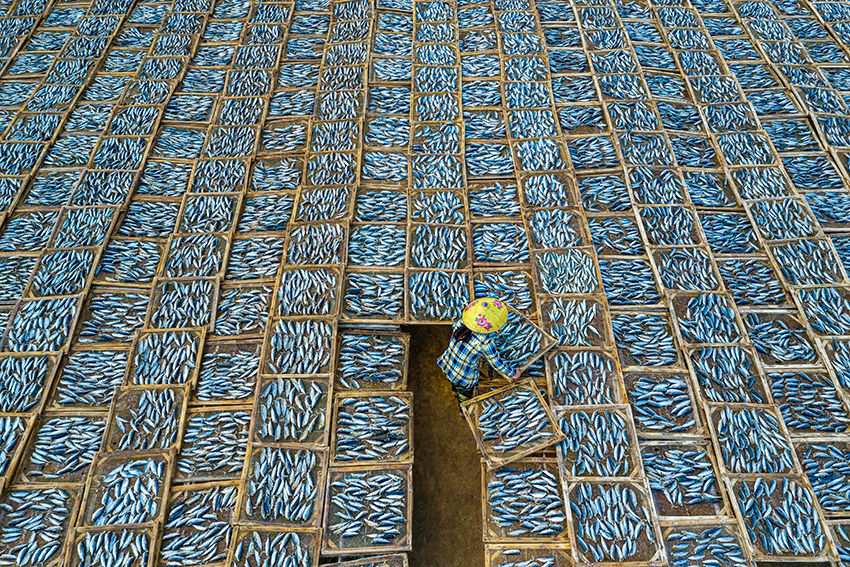
The Winners of the Sony World Open Contest 2021 — from fubiz.net

The Winners of the Sony World Open Contest 2021

.

.

The Winners of the Sony World Open Contest 2021

.

The Winners of the Sony World Open Contest 2021

.

Also see:

Lines, Forms and Surfaces of Milanese Architecture— from fubiz.net

 Lines, Forms and Surfaces of Milanese Architecture -- this image portrays a beautifully designed church

.

Also see:

Dolomites in 50 Shades of Gray— from fubiz.net

Dolomites in 50 Shades of Gray

.

Dolomites in 50 Shades of Gray

.

Also see:

Color-Drenched Island of Burano, Italy— from fubiz.net

Color-Drenched Island of Burano, Italy

.

Color-Drenched Island of Burano, Italy


Two items from faculty focus.com by Jenae Cohn, PhD, and Courtney Plotts, PhD:

  1. How to Structure Your Online Class for Inclusion, Part 1 
  2. How to Structure Your Online Class for Inclusion: Two Principles for Fostering Engagement, Part 2 

Excerpt:

A strong sense of community begins with faculty designing and planning for the sense of community in the course. In order to build a strong sense of community within an online course, instructors should start by identifying the type of community they want to create. In other words, what is the common thread that runs through an online course: Inquiry, information giving, information gathering, and/or active listening?

Although not intuitive to all instructors, this question surrounding the idea of a sense of community is imperative for creating cohesion and a sense of belonging to a learning environment. Here are some ways that instructors might start to think about what community might mean for their class context:


Resistance to legal tech ‘fast evaporating’ — from lawyersweekly.com.au by Jerome Doraisamy

Excerpt:

Thomson Reuters’ 2021 Report on the State of the Legal Market was recently released, which found that 85 per cent of law firms of all stripes are planning to increase their investments in technology this year, in the wake of the upheaval caused by 2020.

The past year, the multinational corporation said, really emphasised just how much attitudes have evolved about day-to-day legal practice, particularly with regards to digital workflow tools and solutions using the cloud.

The report also surmised that the legal profession, on the whole, absorbed five to 10 years’ worth of technology adoption into 12 months, by virtue of the age of coronavirus.

In light of this, “longstanding resistance” by lawyers to adopt cutting-edge technology is “fast evaporating”, said Thomson Reuters Legal Professionals interim president Paul Fischer.

Also see:

According to Butler, lawyers hoping to transform the profession should ask themselves: if they were designing the system from scratch, what would it look like? “The client has a legal need — what’s the best way of meeting it?” he said. This ‘blank sheet’ approach, popularised by legal futurist Richard Susskind, offers “huge potential” for those entering law, he concluded.


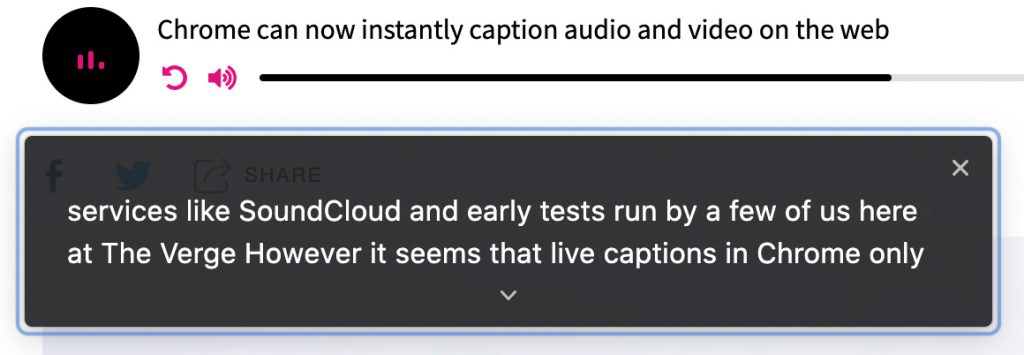
Chrome now instantly captions audio and video on the web — from theverge.com by Ian Carlos Campbell
The accessibility feature was previously exclusive to some Pixel and Samsung Galaxy phones

Excerpt:

Google is expanding its real-time caption feature, Live Captions, from Pixel phones to anyone using a Chrome browser, as first spotted by XDA Developers. Live Captions uses machine learning to spontaneously create captions for videos or audio where none existed before, and making the web that much more accessible for anyone who’s deaf or hard of hearing.

Chrome’s Live Captions worked on YouTube videos, Twitch streams, podcast players, and even music streaming services like SoundCloud in early tests run by a few of us here at The Verge. Google also says Live Captions will work with audio and video files stored on your hard drive if they’re opened in Chrome. However, Live Captions in Chrome only work in English, which is also the case on mobile.


Chrome now instantly captions audio and video on the web -- this is a screen capture showing the words being said in a digital audio-based file

 
© 2025 | Daniel Christian