eLearning has improved in the last 7 years… — from elearningindustry.com by Mary Burns
A student in 2014 and a student in 2021 would probably have the same fundamental online learning experience. Yet online learning has changed dramatically in the last 7 years. In my 50th article, I look back at online learning and enumerate 5 drivers that have led to its improvement.

Excerpt:

COVID/remote learning has expanded our understanding of online learning. Teachers are far more adept at using technology and designing with technology to help students learn online. They know which online learning modalities—synchronous or asynchronous—work best with which eLearning platform. Students too have had a year-long internship in online learning—its tools and pedagogies.

COVID has diversified our understanding of online learning. In 2014, when I began writing for eLearning Industry, eLearning meant one thing—a class held in a virtual learning environment or Learning Management System. In 2021, online learning is any learning we do online, whether via free or fee-based subscription services (like Khan Academy and DreamBox, respectively), web conferencing, or Web 2.0 platforms (Edmodo, YouTube channels)—another overlooked candidate for this list.

And COVID has constrained our understanding of online learning. In 2014, when I began writing for eLearning Industry, eLearning was largely asynchronous and done in an LMS. In 2021, for a plurality of teachers and students across the globe, eLearning means one thing: Zoom and it means learning that is live and synchronous.



From DSC:
In my senior year at college, it was on a Maundy Thursday that I came out of one of the deepest, loneliest deserts that I’ve been in during this lifetime. I’ve been in others, but not like that one. In the fall of my senior year, I had to see if all of this faith stuff was a hoax. So I went into a 7-8 month time in the desert. I questioned the LORD’s existence. Everyone felt a million miles away…even my closest friends.  The LORD felt a million miles away too. After having three good years on the court, the sport that I played in college did not go well — at all. I couldn’t wait to get off the court.

But as it turned out — and looking in the rearview mirror — I could see that He was at work. How I saw myself, the LORD, and the world changed that year. My identity changed that year.

On that Maundy Thursday, I went to the Alice Millar Chapel on NU’s campus. Normally, I would have been with my family, but they were away that year. I was sitting alone, in the back of the church…it was dark. I watched the pastor get down on his knees, reach for a wet towel, and wash the feet of a dozen or so people from the congregation. The pastor was doing what Christ had done to His disciples, many years prior.

All of the sudden, the many years’ worth of singing the doxology around the family table came flooding back into my mind. And what I can only describe as a sort of full-body warmth came over me. I have never doubted the LORD’s existence since that time. It was nice to be out of the desert.

(My pastor at that time, Rev. David Handley, used to say that the Holy Spirit was active on Maundy Thursday…and I believe it.  🙂 

All that said, I hope that once we make it through Maundy Thursday and Good Friday, that those of you who celebrate Easter have a great one this year!

Thank you LORD for your love, grace, forgiveness, patience, gentleness, and kindness. Thank you for your creation. Thank you for your provision. Thank you for our work. Thank you for running, clean water. Thank you for all the food and drinks we have. Thank you for roofs over our heads and clothes on our backs.

2 Corinthians 5:17-19
Therefore, if anyone is in Christ, the new creation has come: The old has gone, the new is here! All this is from God, who reconciled us to himself through Christ and gave us the ministry of reconciliation: that God was reconciling the world to himself in Christ, not counting people’s sins against them. And he has committed to us the message of reconciliation.

And from Isaiah Chapter 53:

Isaiah 53:3-6
He was despised and rejected by mankind, a man of suffering, and familiar with pain. Like one from whom people hide their faces he was despised, and we held him in low esteem. Surely he took up our pain and bore our suffering, yet we considered him punished by God, stricken by him, and afflicted. –

But he was pierced for our transgressions, he was crushed for our iniquities; the punishment that brought us peace was on him, and by his wounds we are healed. We all, like sheep, have gone astray, each of us has turned to our own way; and the LORD has laid on him the iniquity of us all.


Instructure: Building an Effective Learning Ecosystem — a recorded webinar from instructure.com from 3-4-21 (NOTE: You will need to provide some basic contact information to view it.)

Excerpt:

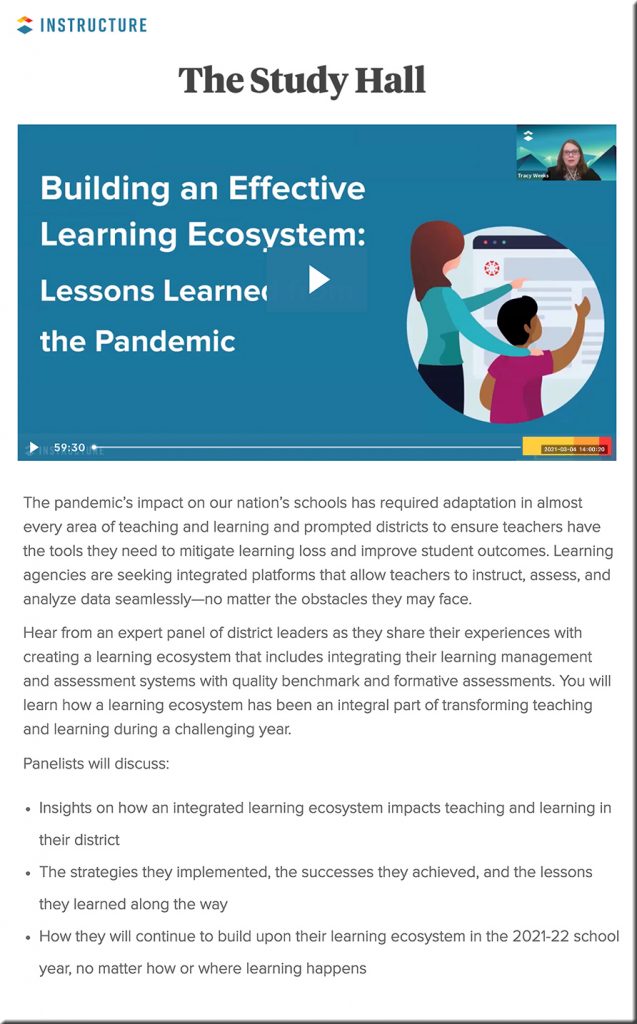
Hear from an expert panel of district leaders as they share their experiences with creating a learning ecosystem that includes integrating their learning management and assessment systems with quality benchmark and formative assessments. You will learn how a learning ecosystem has been an integral part of transforming teaching and learning during a challenging year.

Webinar from Instructure -- on 3-4-2021 -- Building an effective learning ecosystem


NJ High School Adds New Recording Studio to Learning Spaces — from spaces4learning.com by Matt Jones

Excerpt:

A career and technical high school in New Jersey has added new professional recording gear to one of its teaching spaces. County Prep High School, part of Hudson County Schools of Technology, added hardware from Solid State Logic (SSL), a UK-based company that manufactures analog and digital audio consoles for music and audio production. Students in the music and audio technology program learn how to write their own songs and produce their own music. The senior project involves putting a label together and releasing songs.


The Studio at County Prep High School in New Jersey installed at the front of a teaching space with seating for about 16 students -- it overlooks a tracking room with a piano and two soundproof booths.

The new studio at County Prep High School features professional equipment from Solid State Logic.
Source: Solid State Logic

Also see:

A different view on the console at this New Jersey High School

Addendum on 4/1/21:

  • Control Room 42 ushers in the future of broadcasting — from derivative.ca
    Excerpt:
    Control Room 42 (CR42) a project from RTBF, public broadcaster for the French speaking part of Belgium, gives broadcasting’s traditionally hardware-based control room a radical makeover enabled by TouchDesigner in ways its designer Hugo Ortiz thought impossible a few years ago. Recipient of The European Broadcasting Union’s Technology and Innovation Award 2020, this new software-based control room prototype that also integrates Artisto for audio and Smode for real-time graphics brings game-changing innovation to the broadcasting industry.
 

Improved Student Engagement in Higher Education’s Next Normal — from er.educause.edu by Ed Glantz, Chris Gamrat, Lisa Lenze and Jeffrey Bardzell
Five pandemic-introduced innovative teaching adaptations can improve student engagement in the next normal for higher education.

Excerpt (emphasis DSC):

The five teaching enhancements/adaptations discussed above—collaborative technologies for sense-making, student experts in learning and technology, back channels, digital breakout rooms, and supplemental recording—are well positioned to expand the definition of “student engagement” beyond traditional roll call and attendance tracking. Opportunities to include students at a distance have permitted inclusion of students who are reticent to speak publicly, students whose first language is not English, students with disabilities, and students less engaged through “traditional” channels. With these new conceptions of engagement in mind, we are prepared to be more inclusive of all students in the next normal of higher education.


The metaverse: real world laws give rise to virtual world problems — from cityam.com by Gregor Pryor

Legal questions
Like many technological advances, from the birth of the internet to more modern-day phenomena such as the use of big data and artificial intelligence (AI), the metaverse will in some way challenge the legal status quo.

Whilst the growth and adoption of the metaverse will raise age-old legal questions, it will also generate a number of unique legal and regulatory obstacles that need to be overcome.

From DSC:
I’m posting this because this is another example of why we have to pick up the pace within the legal realm. Organizations like the American Bar Association (ABA) are going to have to pick up the pace big time. Society has been being impacted by a variety of emerging technologies such as these. And such changes are far from being over. Law schools need to assess their roles and responsibilities in this new world as well.

Addendum on 3/29/21:
Below are some more examples from Jason Tashea’s “The Justice Tech Download” e-newsletter:

  • Florida prisons buy up location data from data brokers. (Techdirt) A prison mail surveillance company keeps tabs on those on the outside, too. (VICE)
  • Police reform requires regulating surveillance tech. (Patch) (h/t Rebecca Williams) A police camera that never tires stirs unease at the US First Circuit Court of Appeals. (Courthouse News)
  • A Florida sheriff’s office was sued for using its predictive policing program to harass residents. (Techdirt)
  • A map of e-carceration in the US. (Media Justice) (h/t Upturn)
  • This is what happens when ICE asks Google for your user information. (Los Angeles Times)
  • Data shows the NYPD seized 55,000 phones in 2020, and it returned less than 35,000 of them. (Techdirt)
  • The SAFE TECH Act will make the internet less safe for sex workers. (OneZero)
  • A New York lawmaker wants to ban the use of armed robots by police. (Wired)
  • A look at the first wave of government accountability of algorithms. (AI Now Institute) The algorithmic auditing trap. (OneZero)
  • The (im)possibility of fairness: Different value systems require different mechanisms for fair decision making. (Association for Computing Machinery)
  • A new open dataset has 510 commercial legal contracts with 13,000+ labels. (Atticus Project)
  • JusticeText co-founder shares her experience building tech for public defenders. (Law360)


Are virtual public meetings here to stay? — from jdsupra.com by Michael Maurer & William Shepherd

From DSC:
I just thought this was an interesting question/idea…


Bitcoin – The Currency Of The Future — from bitrebels.com by Faizan Javaid

Excerpt:

In its relatively short lifespan, Bitcoin has managed to grow from only a small movement of computer fanatics, Cypherpunks, and cryptographers into an increasingly mainstream phenomenon. Not only that but it is supported by a blueprint and ethos that could very well lead to a redesign of the internet and the financial system we know today. In its wake, many financial analysts, supporters as well as skeptics seem to be faced with the same question: Could Bitcoin be the currency of the future?

From DSC:
I like the last sentence. That should have been the title of the article — i.e., “Could Bitcoin be the currency of the future?”


What is it like to use a screen reader? — from knowbility.org by Anthony Vasquez

Excerpt:

In January, I, along with Texas State University computer science student Su Park, demonstrated screen reader interactions as part of Knowbility’s Screen Readers in the Wild webinar. Both Su and I are blind and have used screen readers since childhood. We weren’t able to answer all attendee questions during the webinar, so I’m continuing the discussion here. I hope that after reading this, you’ll better understand the roles that screen readers and accessible content play in the lives of blind people, and learn of a few easy ways you can improve the user experience. So, let’s jump right in!

If you missed Screen Readers in the Wild, you can still watch the demos!


A New York Lawmaker Wants to Ban Police Use of Armed Robots — from wired.com by Sidney Fussell
Officers’ use of Boston Robotics’ Digidog intensifies concerns about militarization of the police.

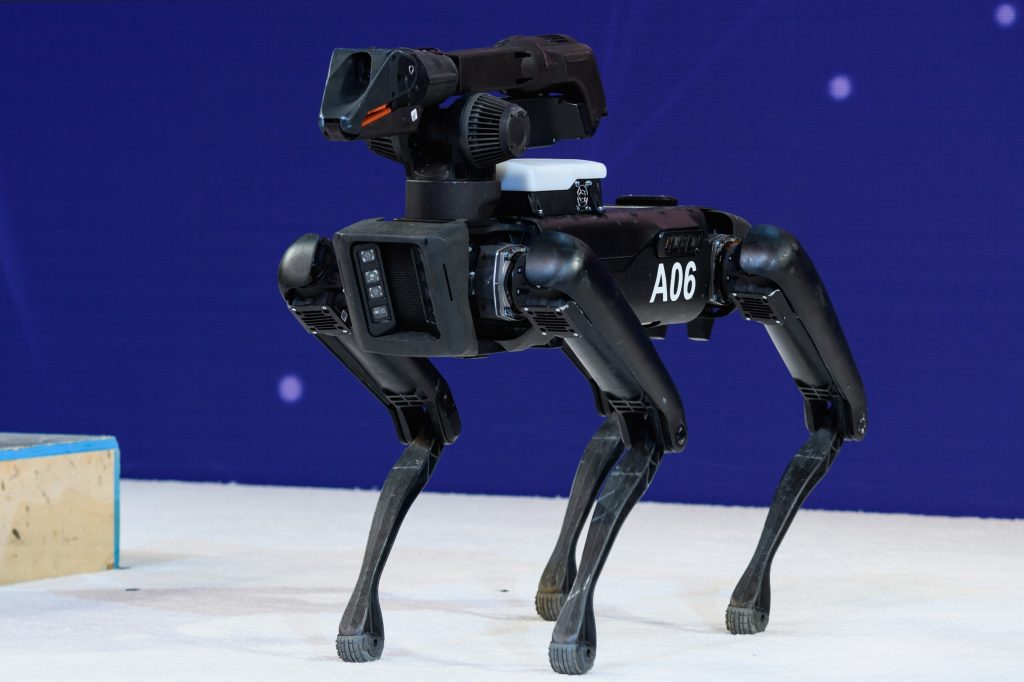
A robot dog is pictured here.

Excerpt:

NEW YORK CITY councilmember Ben Kallos says he “watched in horror” last month when city police responded to a hostage situation in the Bronx using Boston Dynamics’ Digidog, a remotely operated robotic dog equipped with surveillance cameras. Pictures of the Digidog went viral on Twitter, in part due to their uncanny resemblance with world-ending machines in the Netflix sci-fi series Black Mirror.


A New Online Tutoring Market Has Emerged — In Construction. It Requires a Surprising Number of Books. — from edsurge.com by Rebecca Koenig

Excerpt:

There’s a high-stakes exam that’s created an entire industry selling test-preparation products and services to people willing to shell out big bucks for help honing their skills and strategies.

It’s not the SAT, or the MCAT. In fact, it’s not related to academic admissions at all. Yet it has generated lots of online guides and courses, and studying for it requires many, many books.

It’s the exam to become a licensed construction contractor. And companies that offer remote instruction to help tradespeople get ready to take the test say business has been booming during the pandemic—perhaps driven by the fact that demand for construction workers is high.


More Employers Are Awarding Credentials. Is A Parallel Higher Education System Emerging? — from edsurge.com by Sean Gallagher and Holly Zanville

Excerpt:

As the acceptance of new types of credentials grows, a number of employers have become learning providers in their own right, in a way that could shake up the broader higher education landscape.

A growing number of companies have moved beyond training their own employees or providing tuition assistance programs to send staff members to higher education. Many of these employers are also developing their own curricula and rapidly expanding their publicly-facing credential offerings.

But the current boom in employer-issued credentials is different—and potentially transformational. Unlike the traditional IT certifications of decades past, these new credentials are less focused on proprietary technologies related to a given tech vendor, and are instead more focused on broadly applicable tech skill sets such as IT support, cloud computing and digital marketing.


Altered Work Landscape Points to New Directions for L&D — from learningsolutionsmag.com by Pamela Hogel

Excerpt:

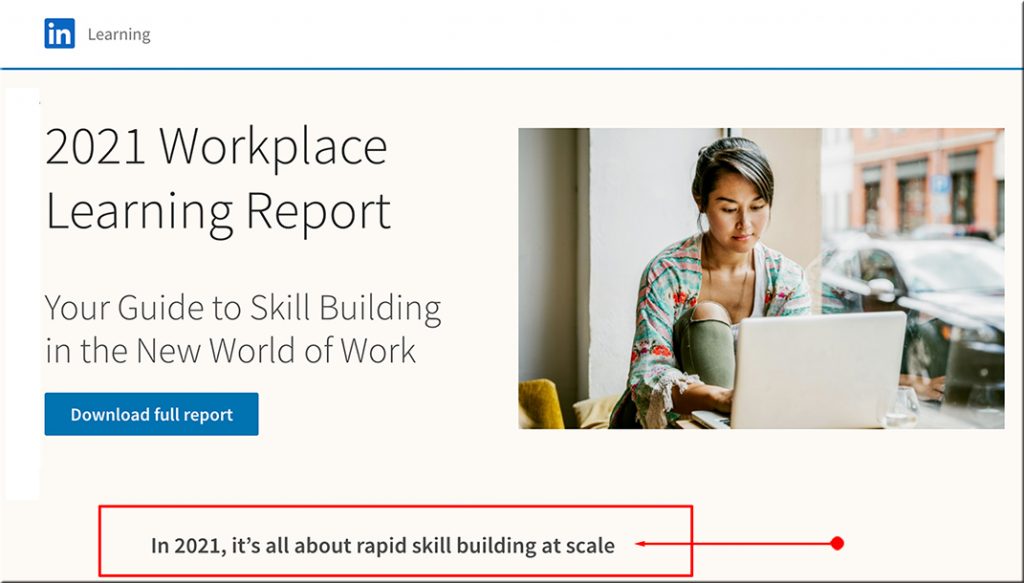
Learning and development (L&D) leaders emerged from 2020 with increased respect and influence in their organizations—presenting opportunities to shape workers and drive readiness for further changes. Many organizations emerged from 2020 with an increased openness to digital transformation and an accelerated timetable for achieving online learning maturity.

The 2021 LinkedIn Learning Workplace Learning Report, released in early March, bears this out.


From DSC:
Which fits nicely into this vision. 


It’s Time to Rethink Higher Education: What if our goal was creating social impact, not preserving the status quo? — from chronicle.com by Brian Rosenberg (president emeritus of Macalester College and president in residence of the Harvard Graduate School of Education)

Excerpts (emphasis DSC):

Higher education should in its ideal form lead to more economic security for more people, a more equitable and innovative society, and a well-functioning democracy. Add whatever goals you would like, but these seem like a reasonable starting point and, given the present state of the country, more than a little aspirational.

But if we fail to explore — if we fail to go beyond superficial change and interrogate our most fundamental assumptions about how and what we teach, how and why we organize ourselves in the current way — we will have no one but ourselves to blame if the system as we know it shrivels to the point where it collapses from within or is painfully disrupted from without.

Also see:

The Pandemic May Have Permanently Altered Campuses. Here’s How. — from chronicle.com by Francie Diep
Trends accelerated by Covid-19 may make more sense than ever in the future, experts say.

Excerpt:

The Covid-19 crisis has transformed all aspects of higher education, and the physical campus is no exception. The Chronicle recently released a special report, Rethinking Campus Spaces, that offers strategies for doing more with less space, to save money and prepare for an uncertain future. Here is an adapted excerpt from the report.

The Chronicle asked more than 40 architects, campus planners, and leaders in student life and housing about how several categories of campus spaces might look different in the future. As colleges navigate difficult financial straits, many interviewees predicted more public-private partnerships, and renovations instead of new construction — which can be less costly and more environmentally friendly. Overall, their answers paint a picture of future campuses that are more adaptable, perhaps smaller, and focused on what’s most valuable about seeing one’s peers in person.

 
© 2025 | Daniel Christian