Apple CEO Tim Cook: AR Is “Critically Important” For The Company’s Future — from vrscout.com by Bobby Carlton

Excerpts:

When the subject of AR and it’s potential came up, Cook said “You and I are having a great conversation right now. Arguably, it could even be better if we were able to augment our discussion with charts or other things to appear.”

In Cook’s opinion, AR will change the way we communicate with our friends, colleagues, and family. It’ll reshape communication in fields such as health, education, gaming, and retail. “I’m already seeing AR take off in some of these areas with use of the phone. And I think the promise is even greater in the future,” said Cook.

Also see:

Woman using Augmented Reality to further learn about something.

And it is not enough to try to use existing VR/XR applications and tailor them to educational scenarios. These tools can and should be created with pedagogy, student experience, and learning outcomes as the priority.

 

Pro:

AI-powered chatbots automate IT help at Dartmouth — from edscoop.com by Ryan Johnston

Excerpt:

To prevent a backlog of IT requests and consultations during the coronavirus pandemic, Dartmouth College has started relying on AI-powered chatbots to act as an online service desk for students and faculty alike, the school said Wednesday.

Since last fall, the Hanover, New Hampshire, university’s roughly 6,600 students and 900 faculty have been able to consult with “Dart” — the virtual assistant’s name — to ask IT or service-related questions related to the school’s technology. More than 70% of the time, their question is resolved by the chatbot, said Muddu Sudhakar, the co-founder and CEO of Aisera, the company behind the software.

Con:

The Foundations of AI Are Riddled With Errors — from wired.com by Will Knight
The labels attached to images used to train machine-vision systems are often wrong. That could mean bad decisions by self-driving cars and medical algorithms.

Excerpt:

“What this work is telling the world is that you need to clean the errors out,”says Curtis Northcutt, a PhD student at MIT who led the new work.“Otherwise the models that you think are the best for your real-world business problem could actually be wrong.”


Nearly Half of Faculty Say Pandemic Changes to Teaching Are Here to Stay — from campustechnology.com by Rhea Kelly

Among the findings:

  • Fifty-one percent of faculty said they feel more positive about online learning today than pre-pandemic. Faculty were most satisfied with how efficiently they were able to communicate with students — but across the board, a majority of faculty were also satisfied with how efficiently the technology worked, how well students learned and how well students engaged in class.
  • Fifty-seven percent of faculty said they feel more positive about digital learning materials than pre-pandemic.
  • Seventy-one percent of faculty reported they make considerable use of digital materials today, compared to 25 percent pre-pandemic. And 81 percent said they expect digital material use to remain the same or increase post-pandemic.
  • Fifty-eight percent reported considerable use of online homework and courseware systems, more than doubling the pre-pandemic share of 22 percent. Seventy-four percent expected the use of those systems to remain the same or increase post-pandemic.
  • Only 8 percent of faculty said they would revert to their pre-pandemic teaching practices after the pandemic is over.

Also see:

Two-thirds of people in the education sector expect to see a continuation of remote work post-pandemic. Sixty-five percent of respondents in education agreed that due to the success of remote collaboration, facilitated by videoconferencing, their organizations are considering a flexible remote working model.


DC: Yet another reason for Universal Design for Learning’s multiple means of presentation/media:

Encourage faculty to presume students are under-connected. Asynchronous, low-bandwidth approaches help give students more flexibility in accessing course content in the face of connectivity challenges.

— as excerpted from campustechnology.com’s article entitled, “4 Ways Institutions Can Meet Students’ Connectivity and Technology Needs


Reimagining Higher Education: The Post-Covid Classroom — from er.educause.edu by Rob Curtin
As we prepare to return to campus, many of the technologies that helped us simply survive and sustain classroom continuity will become permanently embedded in our educational methods and play a pivotal role in the refinement of practices consistent with an ongoing shift to more student-centered learning.

Videoconferencing -- a professor teaching a class of virtual students

Credit: as-artmedia / Shutterstock.com © 2021

As learning practices continue to evolve, new remote learning and collaboration technologies, in concert with pedagogy, will be critical to enabling inclusive, personalized, and engaging hybrid learning experiences to bring students together beyond simple videoconferencing and recording of lectures. 


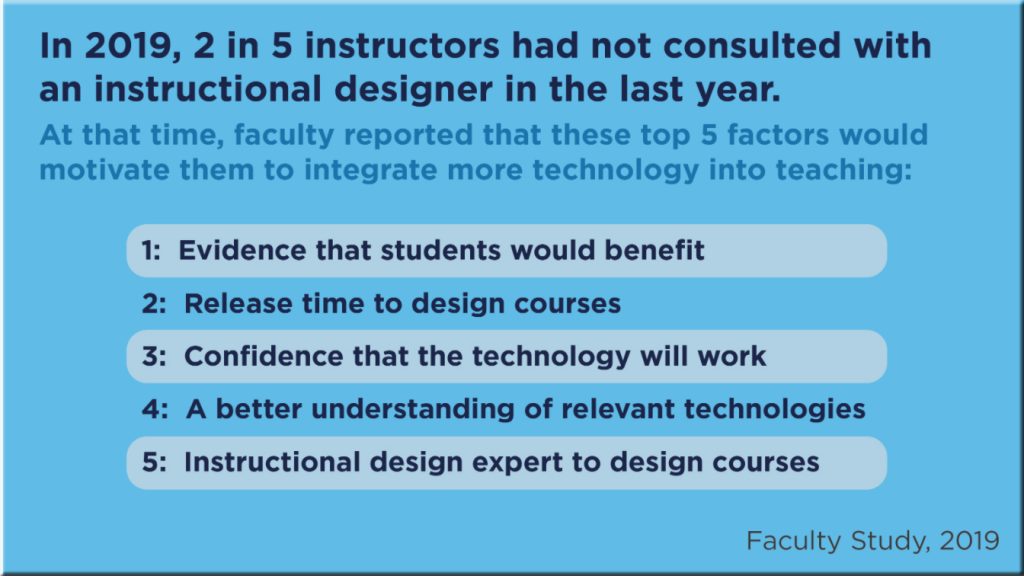
In 2019, 2 in 5 instructors had not consulted with an Instructional Designer in the last year -- from Educause

Also see:

EDUCAUSE QuickPoll Results: Assessment and Learning Design — by Mark McCormack

Excerpt:

Respondents expressed confidence that recent increases in faculty engagement with instructional design and technology will continue in future academic years, as will institutions’ adoption of hybrid/online education. Respondents are less confident that larger changes in institutional policy and practice will persist, and they do not anticipate that institutions will be investing in key instructional needs in the future. Increases in cross-department collaboration hold great promise for leaders seeking to engage faculty and make wider and more lasting strategic changes. Long-term success for new approaches to teaching and learning may rely at least in part on clear and consistent policies and practices across the institution, as well as a shift in institutional narrative from “short-term crisis mitigation” to “innovation for the future.”


Supreme Court sides with Google in Oracle’s API copyright case — from theverge.com by Russell Brandom and Adi Robertson
The ruling overturns a federal circuit decision favoring Oracle

Excerpt:

The court’s opinion concludes that APIs — which let programmers access other code — are significantly different from other kinds of computer programs. “As part of an interface, the copied lines are inherently bound together with uncopyrightable ideas … and the creation of new creative expression,” Justice Stephen Breyer writes in his opinion. Unlike many other computer programs, Breyer wrote, much of the copied lines’ value came from developers being invested in the ecosystem, rather than the actual operations of the program. Google used the API to let Java programmers build Android apps, which the court declared is a fundamentally transformative use.

“Google copied only what was needed to allow programmers to work in a different computing environment without discarding a portion of a familiar programming language. Google’s purpose was to create a different task-related system for a different computing environment (smartphones) and to create a platform — the Android platform — that would help achieve and popularize that objective.”

Also see:

SUPREME COURT OF THE UNITED STATES
Syllabus | GOOGLE LLC v. ORACLE AMERICA, INC. — from supremecourt.gov
CERTIORARI TO THE UNITED STATES COURT OF APPEALS FOR THE FEDERAL CIRCUIT No. 18–956.
Argued October 7, 2020—Decided April 5, 2021

Excerpt (emphasis DSC):

Held: Google’s copying of the Java SE API, which included only those lines of code that were needed to allow programmers to put their accrued talents to work in a new and transformative program, was a fair use of that material as a matter of law. Pp. 11–36.


Teacher Makes Beautiful Illustrations of Your Favorite Physics Formulas — from interestingengineering.com by Loukia Papadopoulos
From electromagnetism to the law of conservation of energy, this teacher illustrates all your favorite physics formulas.

From electromagnetism to the law of conservation of energy, this teacher illustrates all your favorite physics formulas.

From DSC:
Not all of us have these kinds of skills — but how cool to see this creative, artistic, multidisciplinary approach to teaching and learning. The use of teams comes to mind for the rest of us! 🙂 


How to Mitigate Accessibility & Digital Inclusion Obstacles for the d/Deaf Community — from inclusionhub.com by Christina Claus
To mitigate accessibility and digital inclusion obstacles for the d/Deaf and hard of hearing, developers must conduct critical research to understand these ongoing hurdles. This guide outlines the many challenges facing this community, shares useful insights, and provides meaningful inclusion solutions.

Excerpt:

Several commonly accepted characterizations include:

  • Deaf: When using the capital D, the individual conveys they communicate with sign language and have either been deaf since birth or shortly after.
  • deaf: The lowercase d is often utilized by those who do not identify as part of Deaf culture and typically become deaf later in life.
  • Hard of Hearing (HoH): Individuals who don’t experience total hearing loss or deafness often identify as hard of hearing.
  • Late-Deafened: This indicates the individual became deaf later in life.
  • Deaf-Blind: In addition to being deaf or hard of hearing, this individual also has a degree of vision loss.

These diversities can impact the individual’s ability to experience digital and online services. To create an inclusive experience for the entire community, developers must understand the obstacles each faces.


Over 27,000 students share how colleges and universities could improve digital learning — from jisc.ac.uk

Excerpt:

A Jisc survey of 27,069 higher and further education students reveals that most are pleased with their digital learning, but areas such as wellbeing, mental health and staff digital skills need more attention.

Between October and December 2020, 21,697 higher education (HE) students and 5,372 in further education (FE) took part in Jisc’s digital experience insights student survey. The surveys seek to support the sector in adapting and responding to the changing situation as a result of COVID–19 policies.


eBook Release: The Needs Analysis Playbook—How To Make L&D A Trusted Partner In Your Organization — from elearningindustry.com by Christopher Pappas
You need buy-in to achieve success and enhance your business infrastructure. This needs analysis guide highlights the importance of gathering stakeholder and learner audience feedback, as well as red flags to look for throughout the process.

Excerpt:

The conundrum that many organizations face is whether to invest in needs analysis or skip right to development. After all, identifying gaps and realigning objectives takes time, organization, and planning. The truth is that it creates a solid framework for your L&D initiatives moving forward so that you target pain points instead of just brushing the surface of employee development. This needs analysis guide is designed to help you analyze stakeholders and get buy-in using a step-by-step methodology. Before we dive into the content, let’s look at why needs analysis is imperative for modern organizations.


Picture of an empty tomb -- so glad the tomb was empty! Happy Easter to those who celebrate it!


Adjunct college faculty taking the biggest hit from pandemic job losses — from highereddive.com by Hallie Busta

Dive Brief:

  • Higher education institutions employed 5% fewer adjunct faculty during the current academic year compared to the year before, according to the latest annual data from the College and University Professional Association for Human Resources.
  • All faculty groups experienced job losses during the year, though adjuncts were hit the hardest. The cuts didn’t affect the share of women and people from racial and ethnic minority groups among tenure-track faculty.
  • Salaries for full-time faculty posted the lowest median annual increase since 2010, at less than 1%, as colleges grappled with budget cuts and revenue loss.

From DSC:
And a potentially-relevant item for the future if these trends continue:

How To Pre-Sell Your Online Course And Make Money Before You Launch It — from elearningindustry.com Kathy Alameda
In this article, I’m going to explain why pre-selling your online course is important as an online course creator.


Survey: Share Your Experience with the Judicial System During COVID-19 — from legaltechmonitor.com by Laura Bagby

Excerpt: 

A team of researchers wants to know how COVID-19 has impacted your experience with the judicial system. The COVID-19 and the Courts?Survey will examine how the pandemic has affected access to justice and the operation of the courts for attorneys, judges, litigants, court staff, and other members of the community.

The researchers seek to learn which changes in court operations during the pandemic worked well and should be kept in place and which didn’t. The results of the study will help plan for future emergencies and provide a basis for thinking about more permanent reforms to how courts work.

 
© 2025 | Daniel Christian