The best advice I can give you: Become a student of your child — from raisinglifelonglearners.com by Colleen Kessler

Excerpt:

One of the best pieces of advice I give a parent is to become a student of their child. To really pay attention and discover what your child is interested in, passionate about, or wants to explore further so you can use that information to design the best homeschool ever. In today’s episode, we revisit a conversation with Andrew Peterson all about how to practically become students of our children. You will also find all of our best resources for becoming a student of your child…

A young girl looking at some artwork.


20 Best Websites to Help Kids Learn From Home in 2021 — from wizcase.com by Julia Olech

Excerpt:

That’s why I rounded up a list of the 20 best free websites that provide engaging and fun learning experiences for you and your children. I made sure each website caters to a wide range of ages with games and interactive lessons that won’t bore even the most fidgety kids. The best part is that you can use them all at no cost!


One wonders what this type of tech will do for online-based learning, &/or hybrid/blended learning, &/or hyflex-based learning in the future [Christian]

From DSC:
It will be interesting to see — post Covid19 — how vendors and their platforms continue to develop to allow for even greater degrees of web-based collaboration. I recently saw this item re: what Google is doing with their Project Starline. Very interesting indeed. Google is trying to make it so that the other person feels like they are in the same space with you.

.
Time will tell what occurs in this space...but one does wonder what this type of technology will do for online-based learning, and/or hybrid/blended learning, and/or hyflex-based learning in the future…?


Career Tracker: Virtual firms hit an industry milestone as hires continue — from reuters.com by Sara Merken & Arriana Mclymore

Virtual law firm FisherBroyles announced Tuesday that it has cracked the Am Law 200, saying it’s the first non-traditional, so-called distributed law firm to rank among the top 200 highest-grossing U.S. firms.

The 300-partner firm said its annual gross revenue reached $113 million in 2020, adding that in the last year alone it added 51 new partners “almost entirely from Am Law 100 and 200 ranked firms.” It cited the role of the pandemic, which upended expectations about remote work, in spurring its growth and accelerating the adoption of its mostly cloud-based approach to legal services.


States and School Systems Can Act Now to Dismantle Silos Between High School, College, and Career — from crpe.org by Georgia Heyward, Sarah McCann, & Betheny Gross | May 2021

We offer four ways states can engage K–12:

  • Invest in virtual platforms that support college and career navigation.
  • Incentivize bold experimentation with hybrid learning to design new models that blend school and workplace learning or connect with postsecondary microcredentials.
  • Step in to encourage and regulate high-quality, postsecondary microcredentials that stack toward associate and bachelor degrees.
  • Combine policy with technical assistance to help districts credit out-of-school learning.
 

Let’s Teach Computer Science Majors to Be Good Citizens. The Whole World Depends on It. — from edsurge.com by Anne-Marie Núñez, Matthew J. Mayhew, Musbah Shaheen and Laura S. Dahl

Excerpt:

To mitigate the perpetuation of these and related inequities, observers have called for increased diversification of the technology workforce. However, as books like “Brotopia” by Emily Chang and “Race after Technology” by Ruha Benjamin indicate, the culture of tech companies can be misogynistic and racist and therefore unwelcoming to many people. Google’s firing of a well-regarded Black scientist for her research on algorithmic bias in December 2020 suggests that there may be limited capacity within the industry to challenge this culture.

Change may need to start earlier in the workforce development pipeline. Undergraduate education offers a key opportunity for recruiting students from historically underrepresented racial and ethnic, gender, and disability groups into computing. Yet even broadened participation in college computer science courses may not shift the tech workforce and block bias from seeping into tech tools if students aren’t taught that diversity and ethics are essential to their field of study and future careers.

Also mentioned/see:

  • Teaching Responsible Computing Playbook
    The ultimate goal of Teaching Responsible Computing is to educate a new wave of students who bring holistic thinking to the design of technology products. To do this, it is critical for departments to work together across computing, humanistic studies, and more, and collaborate across institutions. This Playbook offers the lessons learned from the process of adapting and enhancing curricula to include responsible computing in a broad set of institutions and help others get started doing the same in their curricula. 
 

A second demographic cliff adds to urgency for change — from insidehighered.com by Ray Schroeder
The demographic cliff we have been anticipating since the drop in births with the 2008 recession now has a younger sibling — the COVID-19 cliff is coming with another deep drop in recent births.

Excerpts:

In sum, competition is rapidly growing; the pool of “traditional” students is evaporating; employers are dropping degree requirements; and, with student debt now surpassing $1.7 trillion, we all know that families are looking for more cost-effective paths to the knowledge and skills they seek. “The fundamental business model for delivering education is broken,” said Rick Beyer, a senior fellow and practice area lead for mergers and affiliations at the Association of Governing Boards of Universities and Colleges. “The consolidation era started a few years ago. It will continue. We will see more closures.”

What, then, are the bright spots for postsecondary learning?

Online learning tops the list despite some bad press for the hastily put-together remote learning of last year. Adult students, in particular, prefer the flexibility and mobility of online. Enrollment in online programs has continued to increase while overall higher ed enrollments have declined each of the past dozen years.


Zoom in on interview success — from JPMorgan Chase & Co.; with thanks to Scott Christian out on LinkedIn for this resource
Our hiring managers and recruiters share their top tips to have a successful virtual interview

Excerpt:

Interviews can be a daunting experience, and in an age of virtual interviews we’re all getting used to a new way of connecting with our potential employers.

What’s the best way to make a strong impression through a screen? What hasn’t changed about a winning interview presence? We asked some of our hiring managers and recruitment leads across the globe to share their top tips.


Video Lectures: 4 Tips for Teachers — from techlearning.com by Erik Ofgang
Creating short and engaging video lectures for students is a growing trend at education institutions

Excerpt:

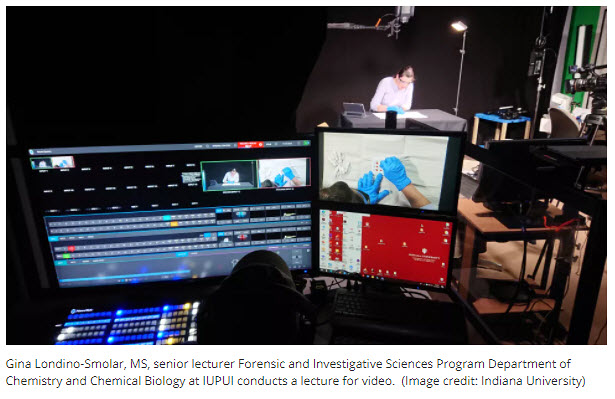
To encourage a more professional type of evergreen video resource, the institution has invested in lecture capture studios, adding five new ones over the past year so each campus has at least one. Some of these studios are DIY, others require a crew, but all enable professors to record lectures in a professional recording environment, complete with green screens and high-quality lighting and audio. The recordings are then edited by the studio team who can help the professor follow the best pedagogical practices for video recordings, including keeping videos short and engaging.

Picture of a recording studio setup to record a professor at IUPUI

From DSC:
A great example of using of teams to create higher-quality, engaging, interactive learning content. 


Also see:

Adorama Business Solutions Equips New Classroom Studio for West Coast Baptist College Creative Arts Department — from svconline.com
Workspace Allows Department to Expand Video Production and Editing Course Offerings

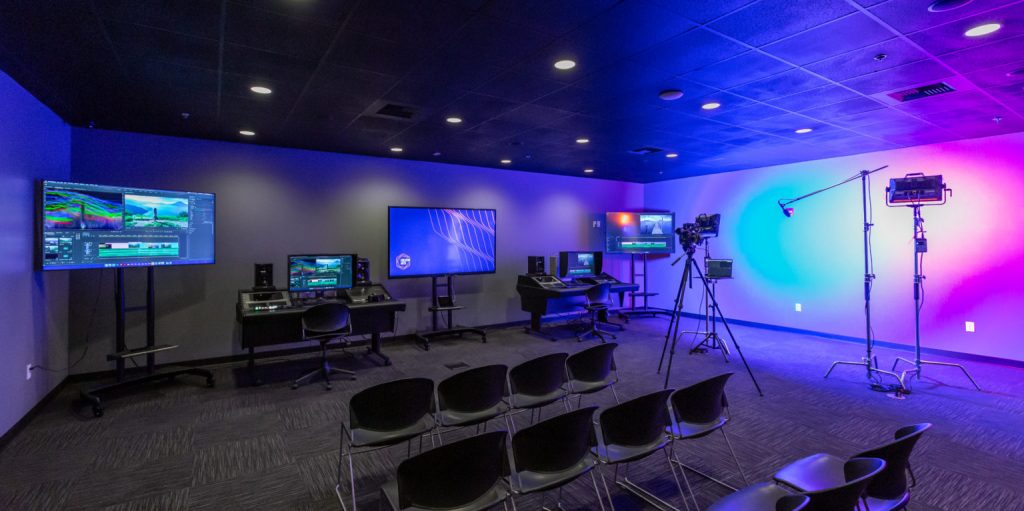
Picture of a new classroom studio within a learning space

Picture of a new classroom studio within a learning space


Counting U.S. Postsecondary and Secondary Credentials — from Credential Engine; with thanks to Will Richardson  for this resource
February 2021

Excerpt (emphasis DSC):

Learners, educators and policymakers understand that high school completion and education beyond high school are critical to thrive in the workforce. However, until recently an inventory of the number or type of secondary and postsecondary credential opportunities in the United States did not exist. This is the third annual report from Credential Engine that attempts to count all these credentials. The report identifies 967,734 unique credentials in the U.S. in 16 detailed credential categories across four types
of credential providers:

  • Postsecondary educational institutions—359,713 degrees and certificates
  • Massive open online course (MOOC) providers—9,390 course completion certificates, micro-credentials, and online degrees from foreign universities
  • Non-academic providers—549,712 badges, course completion certificates, licenses, certifications, and apprenticeships
  • Secondary schools—48,919 diplomas from public and private secondary schools

Also see:

NLET Releases “Newest Economy” Paper

In The Newest Economy: Welcome to the Credential Currency Revolution, Gordon Freedman, NLET’s president, examines the discontinuity between high schools, community colleges, career and technical education, and workforce development programs and their alignment and linkages to high demand jobs and careers. The paper suggests moving beyond the current array of offerings and labor market tools to a marketplace solution using modern technology and data analytics to link credentials (badges, certifications, degrees) to hiring outcomes.

The paper is a collaboration among NLET, Credential Engine, Southern Regional Economic Board (SREB) and GoEducate, Inc. who together are building a Credential Alliance to further the work described in the report.

Press Release
Executive Summary
Download the Report


Chip funding of $50B would boost domestic jobs in construction, design, study says — from fierceelectronics.com by Matt Hamblen

Excerpt:

A new study projects a $50 billion federal investment in domestic chip plants would create 185,000 temporary American jobs and add nearly $25 billion to the U.S. economy each year until 2026 as new fabs are built.

The semiconductor industry currently employs 277,000 people in 49 states in the U.S. and supports 1.6 million U.S. jobs, according to the study by the Semiconductor Industry Association and Oxford Economics. In 2020, the industry’s total impact on the U.S. economy surpassed $246 billion.


Global Accessibility Awareness Day is today!
Help us celebrate the tenth Global Accessibility Awareness Day (GAAD)! The purpose of GAAD is to get everyone talking, thinking and learning about digital access and inclusion, and the more than One Billion people with disabilities/impairments.
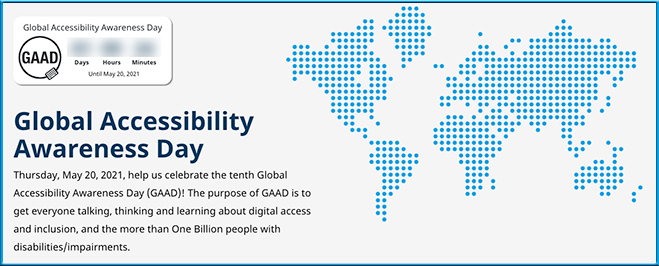
Global Accessibility Awareness Day is is Thursday, May 20th 2021

Also see:

Global Accessibility Awareness Day is Thursday, May 20, 2021

Also see:

Professional Development for Digital Accessibility: A Needs Assessment — from qualitymatters.org

As the EdTech article, “Improving Accessibility for Students and Faculty with Disabilities,” points out, the approach to accommodations for many institutions is still reactive instead of proactive.

So what can institutions do to become more proactive in their approach to digital accessibility? A 2019 survey of Higher Education Quality Matters Coordinators conducted by Barbara Frey, D.Ed., Point Park University, and Rae Mancilla, Ed.D., the University of Pittsburgh, identified the need for more professional development on the topic. Now, in the final white paper from their three-part series on digital accessibility, Drs. Frey and Mancilla provide a summary and analysis of the survey data on digital accessibility professional development needs.

Highlights include:

    • The key training areas that course developers can focus on to help faculty
    • How administrators can address common barriers to participation in digital accessibility training
    • How faculty can contribute to a meaningful accessibility training curriculum

Also see:


73 percent of students prefer some courses be fully online post-pandemic — from campustechnology.comby Rhea Kelly

“When three-fourths of students and more than half of faculty want to experience at least some courses fully online, the key takeaway is that the pandemic did not threaten but in fact accelerated the long-term growth, acceptance, and desirability of online learning, and those numbers will only improve, as emergency remote offerings are rebuilt as modern online courses and programs.”

 
© 2025 | Daniel Christian