Google revives RSS — from techcrunch.com by Frederic Lardinois

Excerpt:

Chrome, at least in its experimental Canary version on Android (and only for users in the U.S.), is getting an interesting update in the coming weeks that brings back RSS, the once-popular format for getting updates from all the sites you love in Google Reader and similar services.

In Chrome, users will soon see a “Follow” feature for sites that support RSS and the browser’s New Tab page will get what is essentially a (very) basic RSS reader — I guess you could almost call it a “Google Reader.”

From DSC:
I have been using RSS feed aggregators for years as I find them highly effective, efficient ways to keep pulse-checks on a variety of items. When Google Reader left the scene years ago, I switched to Feedly. Regardless of the tool, I hope the functionalities that the RSS protocol gives us will be enhanced…not removed. RSS feeds help me tap into — and contribute towards — the streams of content that are always flowing by us.


From DSC:
Again, as you can see from the items below…there are various plusses and minuses regarding the use of Artificial Intelligence (AI). Some of the items below are neither positive or negative, but I found them interesting nonetheless.


How Amazon is tackling the A.I. talent crunch — from fortune.com by Jonathan Vanian

Excerpt:

“One way Amazon has adapted to the tight labor market is to require potential new programming hires to take classes in machine learning, said Bratin Saha, a vice president and general manager of machine learning services at Amazon. The company’s executives believe they can teach these developers machine learning basics over a few weeks so that they can work on more cutting-edge projects after they’re hired.”

“These are not formal college courses, and Saha said the recruits aren’t graded like they would be in school. Instead, the courses are intended to give new developers a foundation in machine learning and statistics so they can understand the theoretical underpinnings.”

Machine Learning Can Predict Rapid Kidney Function Decline — from sicklecellanemianews.com by Steve Bryson PhD; with thanks to Sam DeBrule for this resource

Excerpt:

Machine learning tools can identify sickle cell disease (SCD) patients at high risk of progressive kidney disease as early as six months in advance, a study shows.  The study, “Using machine learning to predict rapid decline of kidney function in sickle cell anemia,” was published in the journal eJHaem.

NYPD’s Sprawling Facial Recognition System Now Has More Than 15,000 Cameras — from vice.com by Todd Feathers; with thanks to Sam DeBrule for this resource
The massive camera network is concentrated in predominantly Black and brown neighborhoods, according to a new crowdsourced report.

Excerpt:

The New York City Police Department has built a sprawling facial recognition network that may include more than 15,000 surveillance cameras in Manhattan, Brooklyn, and the Bronx, according to a massive crowdsourced investigation by Amnesty International.

“This sprawling network of cameras can be used by police for invasive facial recognition and risk turning New York into an Orwellian surveillance city,” Matt Mahmoudi, an artificial intelligence and human rights researcher at Amnesty, wrote in the group’s report. “You are never anonymous. Whether you’re attending a protest, walking to a particular neighbourhood, or even just grocery shopping—your face can be tracked by facial recognition technology using imagery from thousands of camera points across New York.”

Related to that article is this one:

The All-Seeing Eyes of New York’s 15,000 Surveillance Cameras — from wired.com by Sidney Fussell
Video from the cameras is often used in facial-recognition searches. A report finds they are most common in neighborhoods with large nonwhite populations.

Excerpt:

A NEW VIDEO from human rights organization Amnesty International maps the locations of more than 15,000 cameras used by the New York Police Department, both for routine surveillance and in facial-recognition searches. A 3D model shows the 200-meter range of a camera, part of a sweeping dragnet capturing the unwitting movements of nearly half of the city’s residents, putting them at risk for misidentification. The group says it is the first to map the locations of that many cameras in the city.

Don’t End Up on This Artificial Intelligence Hall of Shame — from wired.com by Tom Simonite
A list of incidents that caused, or nearly caused, harm aims to prompt developers to think more carefully about the tech they create.

Excerpt:

The AI Incident Database is hosted by Partnership on AI, a nonprofit founded by large tech companies to research the downsides of the technology. The roll of dishonor was started by Sean McGregor, who works as a machine learning engineer at voice processor startup Syntiant. He says it’s needed because AI allows machines to intervene more directly in people’s lives, but the culture of software engineering does not encourage safety.


3 Education Trends to Watch for the Upcoming School Year — from techlearning.com by Dr. Kecia Ray
Education trends in the year ahead include micro lessons, integrated whole classrooms, and reconsidering assessments

Excerpts:

The study was conducted at the university level but can apply to all levels K-20. Polling, response apps, small group instruction, collaborative activities, and peer instruction are some of the effective strategies identified in active learning.

Thinking about classroom design as having all the necessary technologies — interactive panels, individual devices for students and teachers, integrated software, integrated hardware solutions, accessible high quality digital content, interactive applications — along with a teacher who is well equipped to design classes that incorporate effective instructional strategies will yield high performing students, no matter who you are teaching!


It’s like Netflix for education: UND considers subscription tuition model — from grandforksherald.com by Sydney Mook; with thanks to Ray Schroeder for this resource out on LinkedIn
Think of it as Netflix or Hulu – popular television subscription services – but for a UND education. Students could pay a flat rate and take as many (or as few) online courses as preferred, so long as they aren’t considered a full-time, degree-seeking student.

Excerpts:

UND wants to add a flat-rate subscription option to its tuition model.

Think of it as Netflix or Hulu – popular television subscription services – but for a UND education. Students could pay a flat rate and take as many (or as few) online courses as preferred, so long as they aren’t considered a full-time, degree-seeking student.

“You enroll, you have a subscription and during that subscription, you can binge watch,” said Jeff Holm, vice provost for online education and strategic planning at UND.

UND says it wants to “provide competency-based, online education that provides ‘micro-pathways’ or smaller targeted units of learning to individuals as a way to enhance their skill set and knowledge for advancing in the labor market or reskilling for a new employment opportunity.”


Radar trends to watch: June 2021 — from oreilly.com
Trends in AI, Security, Programming, and More

Excerpt:

Security
Morpheus is a microprocessor that randomly changes its architecture to foil attackers: This is a fascinating idea. In a 3-month long trial, 525 attackers were unable to crack it.


The Short-term Credentials Landscape — from newamerica.org by Monique O. Ositelu, PhD, Clare McCann, and Amy Laitinen
What We See and What Remains Unseen

Abstract

Given the rapid growth in short-term programs, and policymakers’ fast-growing interest to invest federal higher education dollars into very-short-term credentials, we explore what the research does—and does not— show us about such credentials’ utility in the labor market. With concerns about equity, our review of the literature guides us towards caution, as a strong push for short-term certificates may run the risk of reifying socioeconomic stratification.

From DSC:
I wonder…will accreditation move towards the use of crowd-sourced methods? Similar to rating one’s driver or one’s experience with a product, will microcredentials get into more reviews and recommendations from the users of various learning/training-related sites and services?

Will users of a service comment on whether the credential helped them (with a salary increase, with practical knowledge, with an expanded scope of projects at work, etc.)?


6 Emerging Technology Trends in Higher Education — from edtechmagazine.com by Amelia Pang
From artificial intelligence to microcredentials, here’s a look at the future.

Excerpts:

1. The Growth of Artificial Intelligence in Higher Ed
2. Actualizing the Potential of Data Analytics to Improve Education
3. A Permanent Place for Blended and Hybrid Course Models
4. The Expansion of Open Educational Resources
5. Microcredentials Provide Business Opportunities for Higher Ed
6. More Investments in Quality Online Learning


5 Learning Gains Made During the Pandemic — from techlearning.com by Erik Ofgang
Despite the challenges, there have been useful learning gains made during the pandemic

Excerpts:

  1. Increased Communication Skills
  2. Students Taking Ownership of their Own Learning
  3. Resilience and Learning Outside of School
  4. Time Management
  5. Teachers Learning to Be Guide On the Side
 

Drawing on Ancient Arts and New Technology, Husson U. Launches Degree in Extended Reality — from edsurge.com by Rebecca Koenig

Excerpt:

The origins of the experience may come from an ancient artform: theater.

“As a set designer, I would think about experiences that are recreating augmented reality, essentially,” says Brave Williams, an associate professor at Husson University in Maine. “It is an augmentation of reality that has been done for thousands of years.”

Now, Williams is helping his institution push the boundaries of Shakespeare’s famous line that “all the world’s a stage.”

To expand the center’s reach, university leaders decided to build extended reality into the college curriculum. One example was the development of AR Stagecraft, an app that translates student set designs into an immersive experience of what the scenery would look and feel like if built on an empty stage.

Also see:

IEX CENTER — from husson.edu

An Innovation HubThe iEX Center /ai,?ks/ is an innovation hub that develops solutions using extended reality (XR) experiences such as virtual and augmented reality. Through the iEX Center, students learn how to solve real-world problems using the advanced technology associated with the emerging XR field.

These immersive and interactive experiences are developed with the involvement of students and faculty within the School of Technology and Innovation, as well as those from other colleges across campus as they work together on interdisciplinary XR projects.


Planning for a blended future: A research-driven guide for educators — from everylearnereverywhere.org by Every Learner Everywhere in partnership with Online Learning Consortium (OLC) & National Research Center for Distance Education and Technological Advancements (DETA)

Excerpt:

The purpose of this guide
This resource is a collaboration among the National Research Center for Distance Education and Technological Advances (DETA), the Online Learning Consortium (OLC), and the Every Learner Everywhere Network. It is designed to serve as a resource for educators — faculty, instructors, instructional staff, instructional improvement staff, instructional designers, learning experience designers and developers, technological support staff, and other stakeholders — to guide strategic planning for blended learning courses and programs.

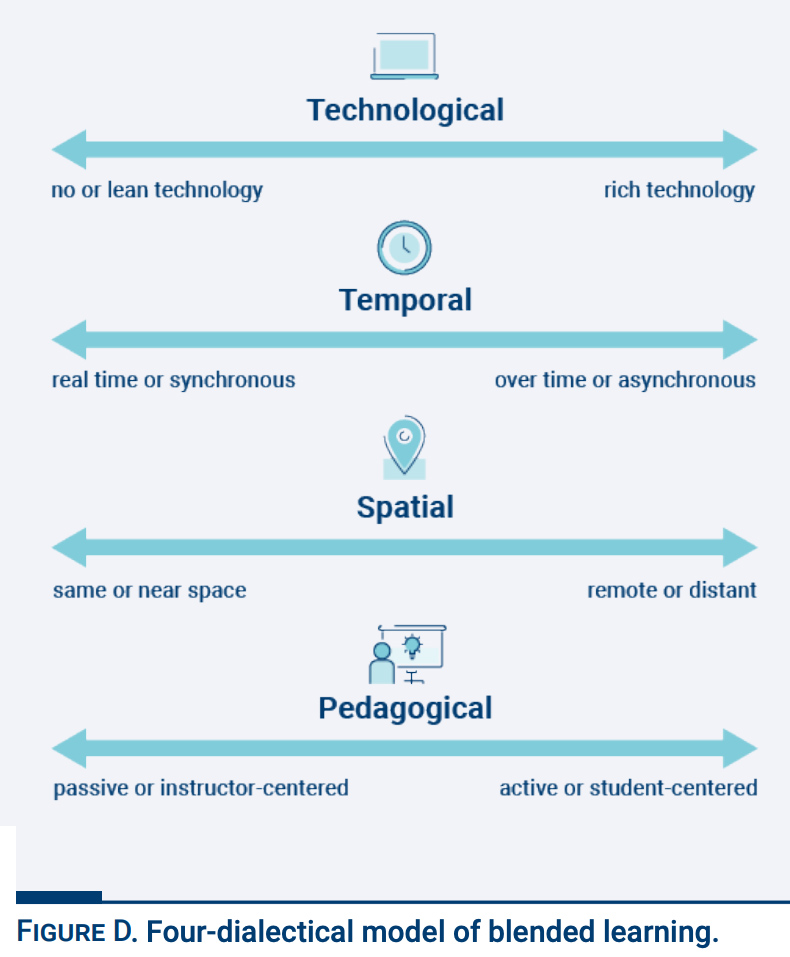
Therefore, blended learning is instruction that blends technological, temporal, spatial, and pedagogical dimensions to create actualized learning. Students feel they are successful when they actually learn and that does not always equate to grade and course completion.

Blended learning is instruction that blends technological, temporal, spatial, and pedagogical dimensions to create actualized learning.

KEY IDEAS

  1. Designing courses to meaningfully integrate the different environments and temporal cadence (online and onsite, live and overtime) while incorporating an active learning approach can improve student outcomes in blended and hybrid courses.
  2. Faculty must become guides for students and their engagement by intentionally and strategically using a variety of modalities to scaffold learning.
  3. By designing and scaffolding blended courses effectively, faculty can avoid the common pitfall of course and-a-half-syndrome, which occurs when the online portion of a course is tacked on, creating busywork for students.
 

John 3:17 — from biblegateway.com

17 For God did not send his Son into the world to condemn the world, but to save the world through him.


Technology Made Special Education Parents Better Advocates During the Pandemic — from edsurge.com by Nadia Tamez-Robledo

Excerpt:

Those are lessons that should stay in place long after our current era of remote learning, says research analyst Lane McKittrick, who focuses on special education and families at the Center on Reinventing Public Education. She recently co-authored a report on how charter schools effectively supported students with disabilities during the pandemic and is blogging about the topic.

McKittrick’s disappointment didn’t just come from her role as a researcher. She’s also a mom to four children, three of whom are deafblind.

The schools that most successfully served their special education groups were those that prioritized communication and learning about families’ needs, McKittrick found in her own analysis.


My post-pandemic learning list — from chieflearningofficer.com by Elliott Masie
This is the time to extend our skills as learning professionals through the power of learning. 

Excerpt:

Curation on a personal level. I want to create new ways to curate awesome information and knowledge that I encounter every day. I want a “Later” button on my mouse or a gesture feature on my phone to capture and re-present indicated content to me at a later time. My curiosity as a learner is demanding a better way to tag or selectively highlight content, conversations and resources effortlessly and at any time throughout the day.

Adding arts to learning for impact. We have hosted 33 one-hour Empathy Concerts since April 2020, combining Broadway performers and learning experts for powerful blends of content and music relevant to the workplace. I am excited to expand models for incorporating music, songs and theater into our learning efforts. Arts expand the emotional impact of cognitive mastery.

Also see:

The reverse culture shock of returning to the office — from chieflearningofficer.com by Camille Preston
Understanding reverse culture shock and its effects may be the best way to prepare for post-pandemic work and life.

Excerpt:

While leaving home to return to work will be remarkably different than coming back from an overseas tour, there are similarities. Understanding reverse culture shock and its effects may also be the best way to prepare for post-pandemic work and life.


The Basic Accessibility Fundamentals Bootcamp!
Use this table of contents to jump to specific chapters of the video:

00:00 Introduction
16:24 Inclusion and Accessibility
43:11 What is Digital Accessibility
53:31 Accessibility User Persona
1:04:26 Accessibility Statistics
1:20:53 Accessibility Laws and Legal Landscape
1:44:08 Screen Reader Demo
2:03:32 Accessibility Demographics
2:33:57 Wrap Up Reflection
2:35:19 Q&A

GAAD 2021 Fundamentals Bootcamp Slides.pdf

Transcript

Recommended Accessibility Books:


When Should You Use Branching Video Scenarios for eLearning? — from learningsolutionsmag.com by Bill Brandon

Excerpt:

Among the many changes today in the way we think about learning and training is the shift from knowledge transfer to skill development. Scenario-based learning (SBL) and the inclusion of practice with feedback are often overlooked but in many cases more effective approaches to the development of skill and competence.

What’s a scenario?
A scenario is a type of story; it presents learners with a situation in a way that engages them and places them in the situation. Scenarios are a methodology for quickly creating and delivering content to an audience based on needs and feedback. Scenarios are closely related to microlearning, and in fact some microlearning employs short scenarios as the main method of delivery. Learners are able to make decisions, solve problems, apply knowledge, and practice skills. The scenario presents challenges like the ones the learners will face in real-life situations.

The story is important! In his book Scenario-based Learning: Using Stories to Engage Learners, Ray Jimenez says, “The design of scenario-based training requires the craftsmanship of a storyteller, an instructional designer, and a subject matter expert.” 

 
© 2025 | Daniel Christian