Psalm 91:1-4 — from biblegateway.com

Whoever dwells in the shelter of the Most High
    will rest in the shadow of the Almighty.[a]
I will say of the Lord, “He is my refuge and my fortress,
    my God, in whom I trust.”

Surely he will save you
    from the fowler’s snare
    and from the deadly pestilence.
He will cover you with his feathers,
    and under his wings you will find refuge;
    his faithfulness will be your shield and rampart.


Black College Grads Borrow 35% More for a Public Education but Earn 22% Less Than Their Peers — from Kamaron McNair with thanks to Frankie Rendón for this resource

KEY FINDINGS
  • Census data shows that Black millennials with a Bachelor’s earn 22% less ($44,498 versus $56,731) on average than other degree-holding millennials.

  • Black millennials outpaced their peers in just three states — Oregon, Maine and Alaska. But only by an average of 2% — or roughly $1,200.

  • The earnings gap for recent graduates widened in more than half of U.S. states. From 2014 to 2019, the earnings gap for graduates widened in 28 states and the District of Columbia. The gap widened by more than 29 percentage points in Vermont, the most of any state.

  • The worst wage gap for Black millennials was in Montana, where Black bachelor’s degree graduates working full time earn 50.3% less on average than non-Black workers.

  • North Dakota recorded the smallest earnings gap at 2.7%. Here, Black millennial bachelor’s degree-holders earn just $1,400 less on average than non-Black earners.

  • Black students borrowed more in student loans than their fellow students. At four-year public schools, Black students and their families borrowed 35% more. Non-Black families contributed an average of $14,434 to their student’s education, more than double the $5,545 Black families contributed.

Also see:


Addendum on 6/23/21:


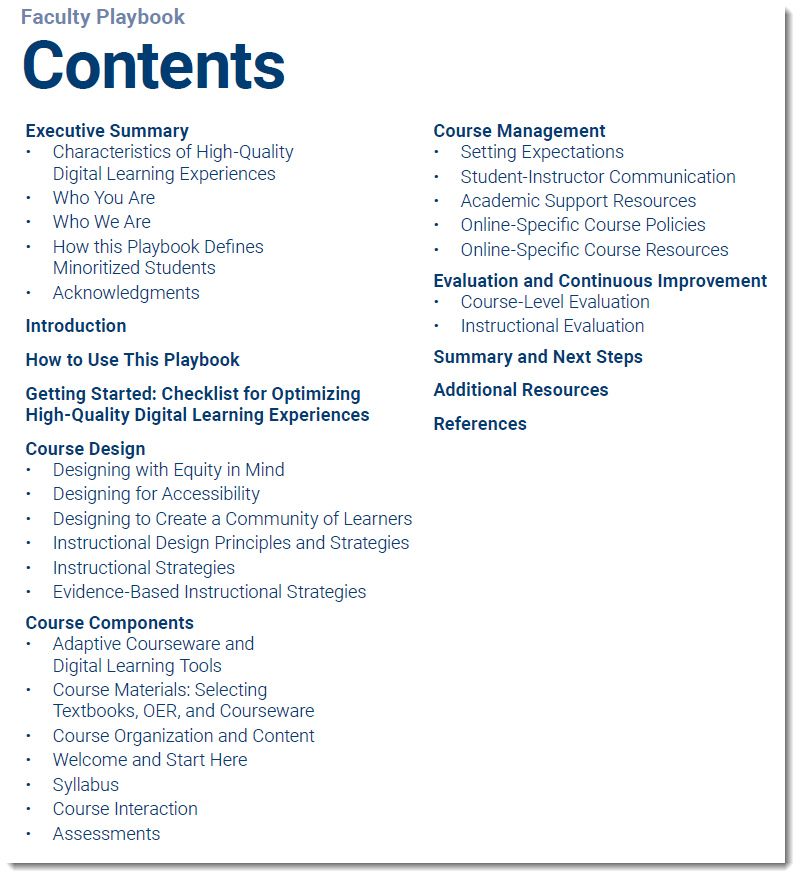
Optimizing High-Quality Digital Learning Experiences A Playbook for Faculty — from onlinelearningconsortium.org


Optimizing High-Quality Digital Learning Experiences A Playbook for Faculty

Excerpts:

This playbook is a collaboration between the Online Learning Consortium (OLC), the Association of Public and Land-grant Universities (APLU), and the Every Learner Everywhere Digital Learning Network. This playbook is designed to serve as a concise guide to address faculty needs for online course design, teaching, and continuous improvement.

One strategy that can enhance teaching presence in an online course is to provide audio and video content that can be developed with relative ease using multimedia applications. Creating micro-lectures along with other multimedia is a great option for designing online course content.

Creating your own closed-caption video content, along with video transcripts, is a practical option for communicating course concepts to students. You might also consider providing supplementary written materials or curating content from other sources to help students master course concepts.


A PERFECT DAY (1909)
Words and Music by Carrie Jacobs-Bond (1862-1946)

When you come to the end of a perfect day,
And you sit alone with your thought,
While the chimes ring out with a carol gay,
For the joy that the day has brought,
Do you think what the end of a perfect day
Can mean to tired heart,
When the sun goes down with a flaming ray,
And the dear hearts have to part?
Well, this is the end of a perfect day,
Near the end of a journey, too,
But it leaves a thought that is big and strong,
With a wish that is kind and true.
For mem’ry has painted this perfect day
With colors that never fade,
And we find at the end of a perfect day,
The soul of a friend we’ve made.


From DSC:
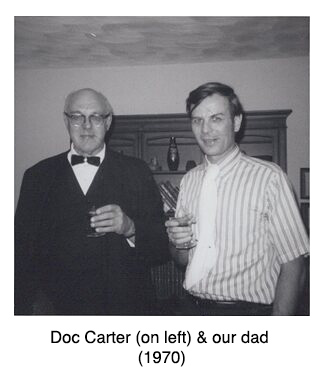
Here’s our dad’s version of it…which is nicely accompanied by our mom.


Doc Carter and our dad -- 1970


From DSC:
You might be interested in reviewing one or more of the items out at Faculty Focus Live Podcasts.

Some example podcasts:

  • Episode 11: Assessing Online Student Learning: How You Can Gauge Activities and Writing Through Online Assessment
  • Episode 9: Live with Wendy Trevor: Overcoming Student Distaste for Collaborative Group Work Online
  • Episode 8: Establishing and Revisiting Our Teaching Philosophies and Teaching Personas
  • Episode 7: Finding the Missing Piece: How to Help Your Students Who Are Struggling with Online Learning


Combining Online Courses With In-Person Supports, ‘Hybrid Colleges’ Unite — from by Rebecca Koenig

Excerpt:

Over the past decade, brick-and-mortar outposts have popped up across the U.S. to offer students who take online college courses a physical space to study and interact. In Denver, there’s a suite in an office complex. In Austin, there’s an airy hall that resembles a co-working facility. In Philadelphia, there’s room in a modern high-rise.

Calling themselves “hybrid colleges,” these mini campus centers have set big goals for themselves, such as bringing college within reach for people historically left out of higher education.

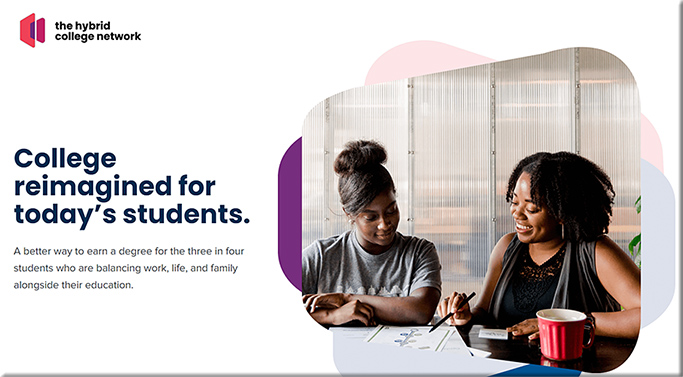
Now, more than a dozen of these nonprofits are strengthening their bonds and committing to shared goals by creating the Hybrid College Network.

Also see:

The Hybrid College Network -- two people studying/working together


For College Finances, There’s No ‘Return to Normal’ — from chronicle.com by Mark S. LeClair
The critical problems facing higher education won’t end with the pandemic.

Excerpt:

Higher ed is in trouble. It faces a demographic crunch in 2026, when smaller high-school graduating classes will mean greater competition for students. That will lead to tuition discounting and underenrolled classes for many colleges. And yet that demographic crisis is only one of many significant challenges the sector faces. As noted by Forbes in its annual review of college and university financials, approximately 20 percent of all institutions now warrant a “D” ranking (its lowest). Many are under serious financial strain and may not survive.

The Forbes financial analyses have been warning of a worsening situation for years. The added stresses from the Covid-19 pandemic will further aggravate the untenable circumstances facing hundreds of institutions. There is now a very short window within which we must carry out significant reforms.


Watch a Drone Swarm Fly Through a Fake Forest Without Crashing — from wired.com by Max Levy
Each copter doesn’t just track where the others are. It constantly predicts where they’ll go.

From DSC:
I’m not too crazy about this drone swarm…in fact, the more I thought about it, I find it quite alarming and nerve-racking. It doesn’t take much imagination to think what the militaries of the world are already doing with this kind of thing. And our son is now in the Marines. So forgive me if I’m a bit biased here…but I can’t help but wondering what the role/impact of foot soldiers will be in the next war? I hope we don’t have one. 

Anway, just because we can…


EDUCAUSE QuickPoll Results: Artificial Intelligence Use in Higher Education — from educause.edu by Christopher Brooks
Despite the visibility and energy surrounding artificial intelligence, higher education is taking measured steps toward incorporating this technology.

Excerpt:

We are on the verge of peak hype about how artificial intelligence (AI) can (and will) transform our lives. No fewer than seven emerging AI technologies were prominently featured on “The Gartner Hype Cycle for Emerging Technologies, 2020.” Several technologies on EDUCAUSE’s “The Top 10 Strategic Technologies for 2020” explicitly incorporate or are reliant on AI. And while AI might seem to be a technology in search of a campus, some promising applications have been emerging in domains such as teaching and learning, student success, and accessibility. But how widespread is the use of AI in higher education today? In this QuickPoll, we operationalized Elana Zeide’s categories of AI applications in higher education to better understand how and how widely AI is being used for institutional tasks, student success and support tasks, and instructional tasks.


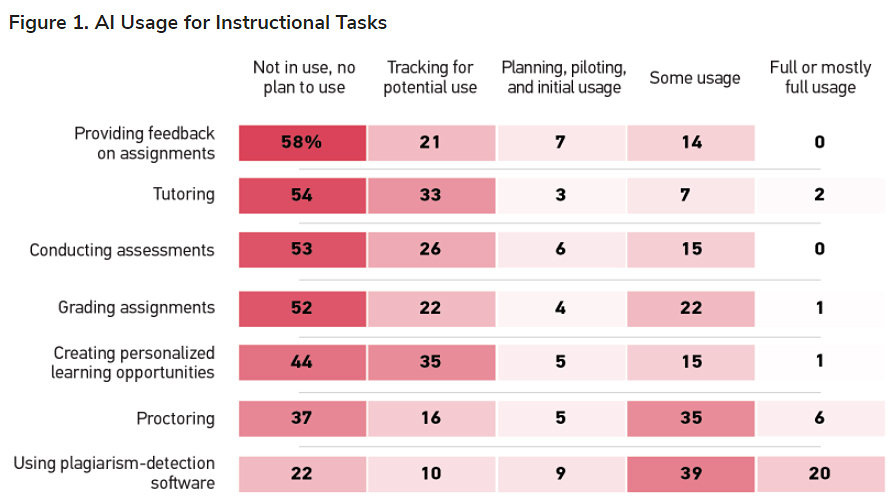
This image relays AI Usage for Instructional Tasks -- bottom line-- AI won't be replacing instructors anytime soon


AI is not going to replace instructors anytime soon.


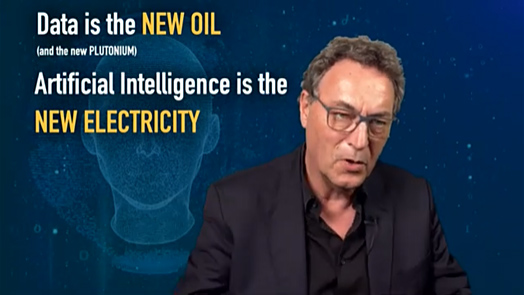
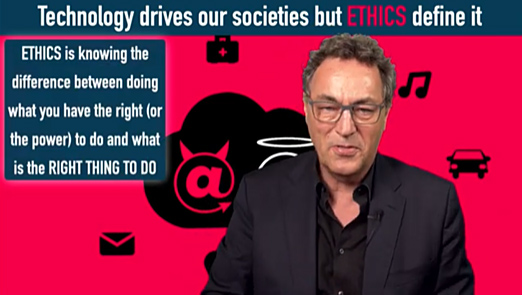
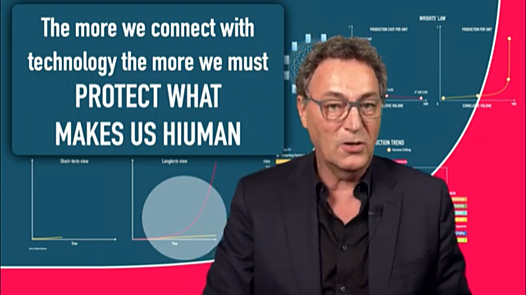
The Future of Social Media: Re-Humanisation and Regulation — by Gerd Leonhard

How could social media become ‘human’ again? How can we stop the disinformation, dehumanisation and dataism that has resulted from social media’s algorithmic obsessions? I foresee that the EXTERNALTIES i.e. the consequences of unmitigated growth of exponential digital technologies will become just as big as the consequences of climate change. In fact, today, the social media industry already has quite a few parallels to the oil, gas and coal business: while private make huge profits from extracting the ‘oil’ (i.e. user data), the external damage is left to society and governments to fix. This needs to change! In this keynote I make some precise suggestions as to how that could happen.

Some snapshots/excerpts:
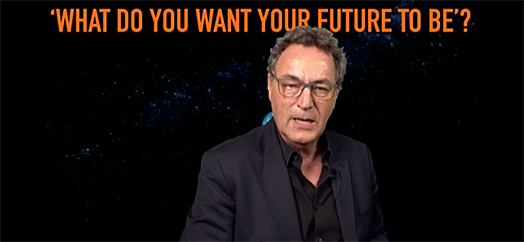
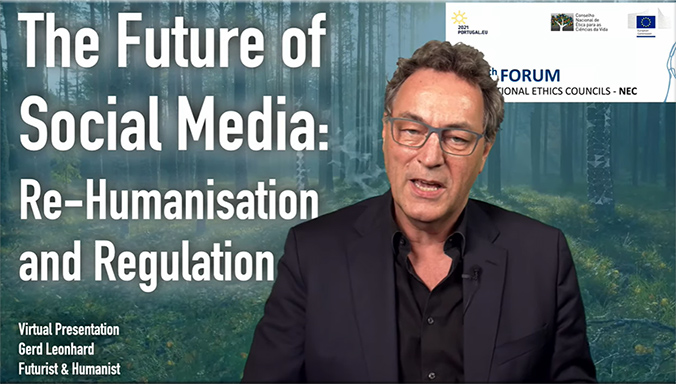
The future of social media -- a video by Gerd Leonhard in the summer of 2021


From DSC:
Gerd brings up some solid points here. His presentation and perspectives are not only worth checking out, but they’re worth some time for us to seriously reflect on what he’s saying.

What kind of future do we want?

And for you professors, teachers, instructional designers, trainers, and presenters out there, check out *how* he delivers the content. It’s well done and very engaging.


The Future of Career Technical Education (CTE): What Educators Need to Know — from techlearning.com by Ray Bendici
Career technical education is gaining expanded interest and funding support in the wake of the pandemic

Excerpt:

Career technical education (CTE) is currently receiving increased attention as it is expected to play a key role in the recovery from the pandemic. New skills, approaches, and funding introduced over the past year are helping to drive expansion of programs as many employers continue to struggle to find qualified workers.

Shortly after his confirmation, U.S. Secretary of Education Miguel Cardona posted an open letter to U.S. students and their families in regard to his plan for education. In it, he suggests that a heavy focus on CTE will be an essential part of what’s next in education.


10 AI tech trends data scientists should know — from by Lisa Morgan
The rising environmental and monetary costs of deep learning are catching enterprises’ attention, as are new AI techniques like graph neural networks and contrastive learning.

Excerpt:

AI adoption is accelerating across industries, driven by a combination of concrete results, high expectations and a lot of money. Among the many new AI concepts and techniques launching almost daily, 10 AI tech trends in particular grab data scientists’ attention.

 
© 2025 | Daniel Christian