The rise of “third workplaces” — from axios.com by Erica Pandey

Excerpt:

The big picture: As the world begins to move past the pandemic but holds onto remote work, we’re seeing the rise of “third workplaces” — teleworking spots in cafes, hotels or co-working spaces.

The remote work setup at Kindred. Photo: Erica Pandey/Axios


A LIFETIME OF LEARNING — from continuum.uw.edu

Excerpts:

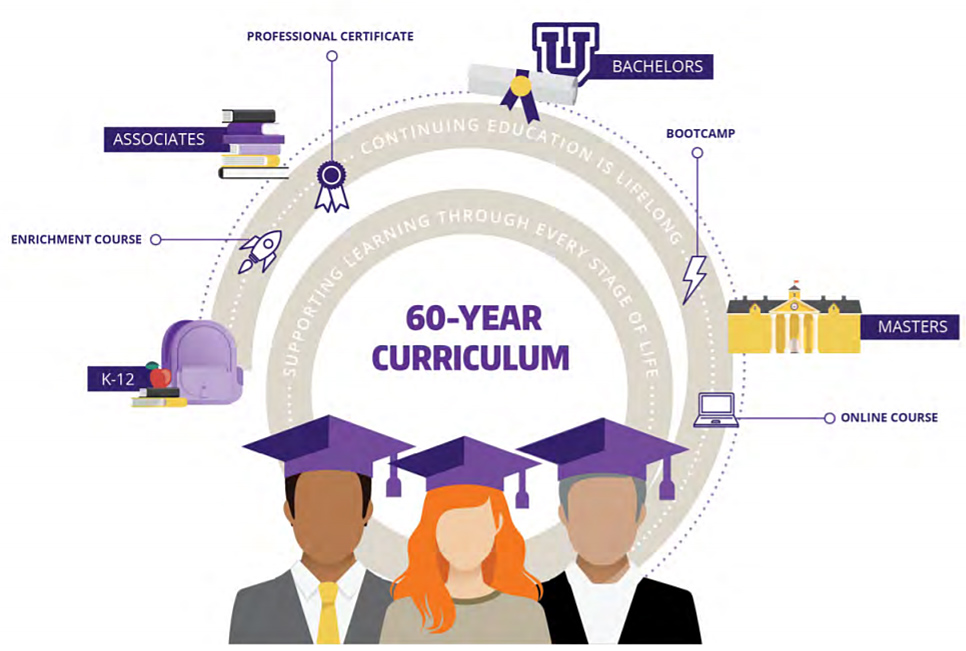
The 60-year curriculum is the modern approach to a lifetime of learning. Getting a degree, getting a job and never setting foot in a classroom again are not today’s reality.

A discussion paper from the McKinsey Global Institute predicts that in the next 10 to 15 years, the need for new tech skills will accelerate. We will also need people who will develop, innovate and adapt those technologies. The paper asserts that, right now, 80% of the workforce doesn’t have the skills for most of the jobs that will be available in the next five to 10 years.

The 60-year curriculum. Lifetime learning is now a requirement.

From DSC:
It would be good to integrate more vocational types of pathways/items in here as well.


NLADA Welcomes DOJ’s Advice to Chief Justices to Ensure Fair Process to Keep Families in Their Homes — from nlada.org

Excerpts:

NLADA welcomes the Associate Attorney General’s letter urging Chief Justices and State Court Administrators to consider eviction diversion strategies that can help families avoid the disruption and damage that evictions cause. Together with the Centers for Disease Control and Prevention’s decision to extend the eviction moratorium and the additional steps announced by the White House, this letter is an important tool in a package of federal resources to help our country and courts navigate this crisis.

The housing crisis, exacerbated by the pandemic, disproportionally affects women and communities of color. More than 80 percent of people facing eviction are Black. We know that when families have access to counsel provided by civil legal aid attorneys, approximately 80 percent of families stay in their homes, and that rates of homelessness have had a direct correlation to coronavirus rates. These numbers represent men, women and children who are integral to communities across the country, and we are pleased by today’s actions to help families and communities struggling in our nation.


10 Best Accessibility Tools For Designers — from hongkiat.com by Hongkiat Lim

Excerpt:

Today is the world of inclusive technology – websites, apps, and tech gadgets that are made for people with different kinds of abilities and inabilities. So when you’re designing a website, you include features that make your design accessible to as many people as possible. And this is where accessibility tools come into play.

Instead of creating everything from scratch, here’s a list of cool accessibility tools for designers. From creating color combinations according to WCAG standards to adding different reading modes to your website, these tools are a must-haves for every designer. Take a look at the list to know about each tool in detail.


Psalm 121:1-8

Psalm 121:1-8 — from biblegateway.com

A song of ascents.

I lift up my eyes to the mountains—
    where does my help come from?
My help comes from the Lord,
    the Maker of heaven and earth.

He will not let your foot slip—
    he who watches over you will not slumber;
indeed, he who watches over Israel
    will neither slumber nor sleep.

The Lord watches over you—
    the Lord is your shade at your right hand;
the sun will not harm you by day,
    nor the moon by night.

The Lord will keep you from all harm—
    he will watch over your life;
the Lord will watch over your coming and going
    both now and forevermore.


Today’s Tech Jobs: Skills More Important Than Knowledge — from rtinsights.com by Kwame Yangame; with thanks to Ryan Craig for this resource
New tech jobs require workers skilled in the use of technologies and able to handle the complexities and interconnectedness of today’s world.

What then is needed in terms of tech education?
The tech education that is needed, then, is formed on the basis of active learning, project-based learning, and learning by doing: science and researched-backed learning methods, the efficacy of which has been proven, and the result of which is true preparation for work in tech jobs in the 21st century. It’s clear that companies want skills and are moving towards skills-based hiring, so it’s well past time that education moves into real skills-based learning.

The classroom-type learning was designed for high schools and universities dating back to a point in time when the most advanced technology was the printing press – before the steam engine, penicillin, the telephone, the automobile, and the personal computer.


From DSC:
I remember teaching a class called the Foundations of Information Technology. This class filled a requirement for those who didn’t major in Computer Science or some other disciplines. So several students in the class didn’t really want to be there and didn’t like technology at all. I still remember hearing some students say, “After this class, I don’t see using technology again.” Or, “I don’t see technology as being a part of my future. I don’t like it.”

My thought then and now? Good luck with that.


With a thanks to Ryan for the following resource as well:

By bridging the gap between what high schools teach and industries need, P-TECH, initially a partnership among IBM, the New York City school system and City Tech, has opened doors for thousands of students in communities with high concentrations of poverty. Its 266 schools now operate in 12 U.S. states and 28 countries…


New accessibility features for students and teachers using Chromebooks — from educatorstechnology.com

Excerpt:

After the new Google Meet updates, Google introduced new features in Chromebooks, ones that will definitely enhance the overall usability and accessibility of the device. Starting with the new PIN logins’ feature for education users, students, teachers, and educators will now be able to log in to their assigned devices using a six digit pin code. This new feature will be standard on all new Chromebooks.
Students with special needs will particularly benefit from the introduction of new accessibility features. There is the novel Live Caption functionality which allows students to caption videos. There is also the Switch Access feature which allows users to control their cursor either using the built-in keyboard or through connecting an external USB or Bluetooth.


Are smaller class sizes without the pitfalls possible? Pandemic pods make the case — from crpe.org by Ashley Jochim and Travis Pillow

Excerpt:

Pandemic pods were borne by necessity as families faced urgent needs for childcare and remote learning support. But they also offer fresh solutions to an age-old education problem: how to dramatically lower class sizes without diluting teacher quality and falling into traps that have snared traditional class size reduction efforts.

By leveraging pandemic innovations in student support, school systems recovering from the COVID-19 crisis may be able to recreate the high level of individual attention students saw in successful pandemic pods.

As one pod educator told us: “This is probably the most professionally satisfied I’ve been in my entire career. . . . Being able to be one-on-one and form relationships with kids. I can tell you every single one of their strengths, I can tell you their weaknesses. . . . I’ve never been able to do that before in my life, except with my own child, and that’s super powerful.” 

From DSC:
I really appreciated this part too: “Learning pods brought new adults—including families and community-based organizations who hosted pods—into the process of supporting student learning.” It’s even more of a community-based effort…a new meaning to the use of teams.  🙂 


Coursera: The ‘Amazon’ Of Online Education May Grow By Magnitudes — from seekingalpha.com

Summary

  • Increasing student dissatisfaction and declining enrollment suggest that many people are rethinking traditional methods of higher education.
  • The historical value of universities is becoming defunct as the internet allows a more efficient, less expensive, and more accessible vector of transmitting knowledge.
  • Innovative platforms like Coursera offer students a huge “marketplace” of high-quality courses far less expensive than those in traditional universities.
  • Given Coursera’s minimal barriers to growth and its massive total addressable market, I would not be surprised to see its annual revenue rise by 10X or more within years.
  • COUR may be one of the few recent IPOs which is actually trading below its fundamental fair value – subject to the assumption that online education will eventually supersede traditional models.
 

How to Add a Signature in Word on a PC or Mac — from businessinsider.com by Melanie Weir

Excerpt:

  • You can add a signature to a Microsoft Word document in several ways, depending on the computer you’re using.
  • You can upload a physical signature using a scanner or a cell phone, add additional text like your job title, and then save it to be reused later.


AI cannot be recognised as an inventor, US rules — from bbc.com

An artificial intelligence system has been refused the right to two patents in the US, after a ruling only “natural persons” could be inventors.


Nvidia builds AI LaunchPad in the cloud with Equinix — from fierceelectronics.com by Dan O’Shea

Excerpt:

If we fail to evolve to a point where almost everyone in the world relies on AI in some fashion, it won’t be for Nvidia’s lack of commitment to that vision. The company continues to hammer away at the notion of democratizing AI so that a broader array of businesses can leverage the technology.

Its newest offering, announced today, is a comprehensive AI platform made available for easy consumption through hybrid cloud providers. This platform, AI LaunchPad, initially will be available through Nvidia cloud partner Equinix. Nvidia explained that as AI proliferates through enterprises and their applications, companies will need to access application resources that might be distributed across public and private clouds. AI LaunchPad via Platform Equinix will allow them to access those resources in minutes for an hourly fee and deploy them to distributed locations…

 
© 2025 | Daniel Christian