


Best Document Cameras for Teachers — from echlearning.com by Luke Edwards
Get the ultimate document camera for classroom use and beyond with this guide
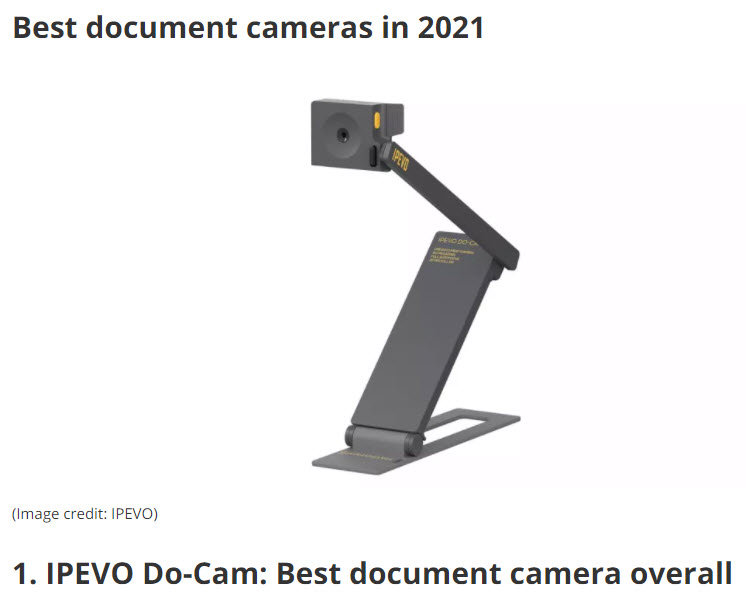
Best Document Cameras for Teachers — from echlearning.com by Luke Edwards
Get the ultimate document camera for classroom use and beyond with this guide
Companies are key to solving the digital skills gap — from zdnet.com by Vala Afshar
The digital skills gap is becoming a digital skills crisis. An innovation expert discusses the root cause of what is driving the digital skills shortage and how can companies contribute to closing the gap.
Excerpts (emphasis DSC):
Vala Afshar: When we talk about the digital skills gap, what do we really mean?
Simon Mulcahy: Fundamentally, it’s an issue of supply and demand: a mismatch between the need for a digitally savvy workforce and the availability of workers trained in those skills. Every organization — whether a bank, healthcare company or retailer — is becoming a digital organization. Core digital skills aren’t the purview of a single department but increasingly hard-wired into nearly every job on the planet.
On the flip side, there’s a massive shortage in the skills needed to operate and lead in a digital-first environment. More importantly, there’s no mechanism in place to fix it.
…
VA: What can be done to address this growing gap, and what role should companies play?
SM: We need to revamp the way we deliver education. Of course, we need to build a foundation early on, but there are much better ways to equip people than through exams that don’t evolve to match society’s needs or degrees that force young people into onerous debt.
Instead, we should think of ourselves as lifelong learners. In support of that, we need just-in-time training that’s integrated into our working experience and relevant to wherever we are on our career journey. We need education that’s widely available, simple to access and affordable. It has to be easy to upskill or gain the knowledge we need to divert onto a different path. We also need education to be a lot more personal, matching what an individual needs in the moment.
A Dusty Roadrunner, Sleepy Sandhill Crane, and Shy Sandpiper Top the 2021 Audubon Photography Awards — from thisiscolossal.com by Grace Ebert
From DSC:
While checking out an edition of innovation & tech today, the following sites caught me eye.
LearnWorlds looks intriguing to me. It will be interesting to see how teachers, professors, trainers, instructional designers, artists, coaches, and more make their living in the future. I’m pulse-checking the area of learning platforms and posting items re: it so that we can stay informed on these trends.

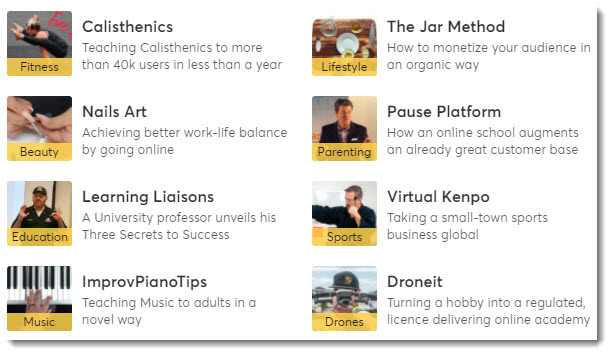
Also from LearnWorlds:
Also see:
Thinkific’s powerful, all-in-one platform makes it easy to share your knowledge, grow your audience, and scale the business you already love.

Psalm 18:30 — form biblegateway.com
Yet he has not left himself without testimony: He has shown kindness by giving you rain from heaven and crops in their seasons; he provides you with plenty of food and fills your hearts with joy.”

Duolingo filed to go public — from techcrunch.com by Natasha Mascarenhas and Alex Wilhelm
The edtech unicorn reveals 129% 2020 revenue growth
Excerpt:
Duolingo, a Pittsburgh-based language learning business last valued at $2.4 billion, has officially filed to go public.
Learning technology lessons from the front lines — from chieflearningofficer.com by Neda Schlictman
Deloitte’s accelerated rollout of its global LXP during the initial onslaught of the pandemic yielded many lessons for the organization. Following are insights for those who are seeking what’s next for their learning strategies.
Excerpt (emphasis DSC):
More than 330,000 people at Deloitte, across 170 countries, have access to Cura, which aggregates learning content from both internal and external sources and personalizes learning based on the user’s defined skills and interests. Cura enables individual discovery of learning but also allows users to follow prescribed pathways as well as the opportunity to create content.
Want to Hire Diverse Candidates? First Drop This Hidden Bias — from teamedforlearning.com
Excerpt (emphasis DSC):
Your organization is committed to diversity. You pride yourself on hiring people of all races, genders, and creeds. And yet, there’s still something you’re missing. This bias sneaks past even well-designed diversity hiring strategies. Ask most hiring managers if they have it and they’ll say: of course not. But a look at who they’re hiring tells a different story. When the smiling faces on your diversity poster all belong to people under 50, is it any surprise that ageism is still a problem?
Also see:
America’s workforce is graying, and ageism could cost the economy trillions of dollars — from businessinsider.com by Andy Kiersz
Excerpt:
Amazon Contractors Are Revolting, Here Are Their Demands — from interestingengineering.com by Loukia Papadopoulos
Two major delivery partners announced they chose to shut down rather than keep sating Amazon’s draconian demands.
Excerpt:
The firms essentially offered Amazon an ultimatum to either agree to a set of conditions that they said would improve driver safety, or they would shut down — well, Amazon is their only client. Amazon refused, and the two companies actually followed through with their ultimatum.
From DSC:
Our son, who is college age, worked at an Amazon distribution center last summer. He is typically a healthy person. But his back and knees did not do well over the summer. After just a few weeks of having to meet an aggressive (and constant) quota of items being shipped, pains and issues started appearing. I don’t know how some of their employees keep up the pace that they are required to maintain…hour after hour after hour after hour…day after day, month after month.
Also see:
Amazon is destroying millions of unsold goods, from smart TVs to laptops — from fastcompany.com by Lucy Wishart
An Amazon warehouse exposé in the UK underscores a larger problem with how goods are treated as disposable.
Excerpt:
A recent undercover investigation in an Amazon warehouse in Dunfermline, Scotland, reported the disposal of more than 130,000 “new or lightly used” objects in a single week in just that one location. Public outrage was clear. Questions were asked about how Amazon could be so wasteful and why weren’t the usable objects sent to those in need?
Exclusive: Amazon is destroying millions of items of unsold stock in one of its UK warehouses every year, an ITV News investigation has uncovered.
Many of the products – including smart TVs and laptops – are often new and unused. https://t.co/OJjexB0YQd#AmazonWaste pic.twitter.com/UR7XrLWvIM
— ITV News (@itvnews) June 21, 2021
Could VR Stadiums Be The Future Of Live Esports? — from vrscout.com by Kyle Melnick
Virtex wants to revolutionize the way we view live esports by replicating the IRL stadium experience in VR.

Also see: