How to apply Midyear 2021 lawsuit data to make your digital content more inclusive. — from UsableNet

Redefining the Future of Law: Alternative Legal Service Models — from clio.com by Joshua Lenon; with slides of the recording here.

Advantages of Automated and Bundled Legal Services — from clio.com

The Law Firm of the Future — from joetechnologist.com by Joseph Raczynski

The impact of blockchain, cryptocurrencies, and NFTs on the legal industry with Joseph Raczynski — from the ABA Center for Innovation

Reimagining Law: The Importance of Law Librarians in a Digital World — from legaltechmonitor.com

AI CLM Company LinkSquares Raises $40M, Says It Will Soon Release First-of-its-Kind Product — from legaltechmonitor.com by Bob Ambrogi

“Today, we’re witnessing the next major step up in power, thanks to artificial intelligence software,” Sunak wrote. “AI is creating legal solutions that can outpace and outperform traditional software in the same way steamships and diesel-powered vessels could outperform even the most impressive wind-powered tall ships.” And just as the step up to power changed what boats could do, “Linksquares is changing what a legal software solution can do and be.”

From DSC:
AI has plenty of pitfalls, no doubt. But a range of AI-based technologies continues to move forward and become further integrated into numerous industries and disciplines. The legal realm is not only using AI-based applications already, but it will also need to have the knowledge to be able to support clients who bring cases involving AI (and other emerging technologies) to them.

 

5 Considerations for Class Size in Online Asynchronous Courses — from onlinelearningconsortium.org by Rebecca A. Thomas, Ph.D.

Excerpt:

The following are important considerations related to class sizes in online courses that are part of higher education degree programs. This content is a result of a research study conducted by the Oregon State University Ecampus Research Unit, where I currently work as a Postdoctoral Scholar. We have published this study as an academic article in the inaugural issue of the Northwest eLearning Journal, and presented at the 2021 OLC Innovate conference. While I encourage you to reference the manuscript and presentation to learn more specifically about our research, the following are key take-aways that my team has gained from our analyses, the literature review, and conversations we have had with diverse stakeholder groups related to online class size.


Reimagining Education: What to Keep/What to Ditch — from techlearning.com by Matthew X. Joseph
When reimagining education, the focus needs to be on finding and keeping the best learning practices

 We have a unique opportunity to look at programmatic and philosophical shifts to promote energetic and curious learners. 


New Research: Flipped Classrooms Improve Student Academics and Satisfaction — from techlearning.com by Erik Ofgang
A new analysis of more than 317 studies found flipped classrooms to be tremendously successful although a partially flipped classroom might be best of all.

Excerpt:

In a meta analysis recently published in the Review of Educational Research, Bredow and her co-authors examined 317 high-quality studies with a combined sample size of  51,437 college students in which flipped classes were compared to traditional lecture classes taught by the same instructors. They found significant advantages for flipped versus traditional lecture in terms of academics, interpersonal outcomes, and student satisfaction.

But there were also some surprises in where and when flipped classrooms worked.

From DSC:
I love the idea of the flipped classroom due to its powerful ability to turn over more choice and more control to the students. They have much more control over the pacing of the delivery of content.


The impact of blockchain, cryptocurrencies, and NFTs on the legal industry with Joseph Raczynski  — from buzzsprout.com by the ABA Center for Innovation

Today we will discuss blockchain, cryptocurrencies, and NFTs and their impact on the legal industry.  Joining us is an expert in all things blockchain and crypto, Joseph Raczynski.  Joseph Raczynski is a Technologist & Futurist with Thomson Reuters.

Also see:

The Law Firm of the Future — from joetechnologist.com by Joseph Raczynski

Excerpt:

Attorneys look to precedent to solve today’s legal problems. “Steeped in tradition” is how we often describe the legal profession.  As result, it’s no surprise that there is inherent tension between emerging technology and the legal profession. The American Bar Association’s 2020 TechReport, which surveys firms and tracks attorney use of technology in their practices, reported that only 7% of attorneys are using tech tools, such as Artificial Intelligence (AI), for document review and research.  Firms with more than 100 attorneys are more likely to use AI, as well as firms that engage in mass tort litigation. Despite promises of increased efficiency, productivity, and profitability, a significant number of attorneys cite distrust of the technology and underlying algorithms.

Even though the legal services market is estimated to be a $1T industry globally, Forbes reports that it is also one of the least digitized…


Japan Has Shattered the Internet Speed Record at 319 Terabits per Second — from interestingengineering.com by Brad Bergan
This could change everything.

Excerpt:

We’re in for an information revolution.

Engineers in Japan just shattered the world record for the fastest internet speed, achieving a data transmission rate of 319 Terabits per second (Tb/s), according to a paper presented at the International Conference on Optical Fiber Communications in June. The new record was made on a line of fibers more than 1,864 miles (3,000 km) long. And, crucially, it is compatible with modern-day cable infrastructure.

This could literally change everything.

Also see:

Japan Sets New Record for Internet Speed at 319 Terabits per Second — from singularityhub.com by Jason Dorrier

Excerpt:

To meet tomorrow’s demands, we have to start building a more capable internet today. And by we, I mean researchers in labs around the world. So it is that each year we’re duly notified of a new eye-watering, why-would-we-need-that speed record.

In August of last year, a University College London (UCL) team, set the top mark at 178 terabits per second. Now, a year later, researchers at Japan’s National Institute of Information and Communications Technology (NICT) say they’ve nearly doubled the record with speeds of 319 terabits per second.

It’s worth putting that into perspective for a moment. When the UCL team announced their results last year, they said you could download Netflix’s entire catalog in a second with their tech. The NICT team has doubled that Netflix-library-per-second speed.


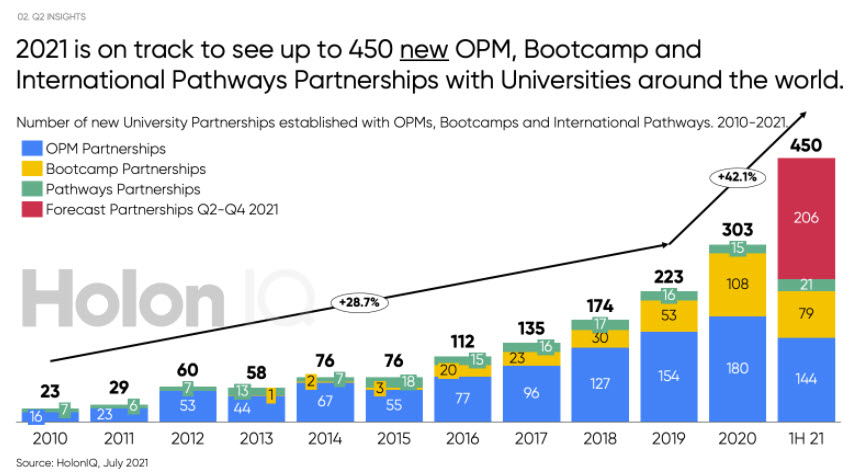
OPM + MOOC = OPX. 244 University Partnerships in the first half of 2021 — from HolonIQ

OPX has well and truly arrived. 2U’s acquisition of EdX. Coursera’s IPO. SEEK’s 50% stake in FutureLearn and their ownership of OES. UpGrad’s rumored $4B valuation. Shorelight Live. Minerva’s OPM pivot. The list goes on, and meanwhile 244 University Partnerships were forged in the first half 2021.


Top 10 Post-Covid Tech Trends — from forbes.com by Gil Press

Excerpt:

In an online broadcast to a global audience, leading VC firm OurCrowd released [on 7/13/21] a list of what it considers the top tech trends in mid-2021, when global venture capital funding reached an all-time high with more than $288 billion invested worldwide in the first half of this year. “There is no better time to analyze what the tech trends are for the smart investor, and where the technology market is moving,” said Jon Medved, OurCrowd’s founder and CEO, opening the broadcast. And the top 10 tech trends are…


Pennsylvania system board votes to merge 6 institutions into 2 — from highereddive.com by Jeremy Bauer-Wolf
The plan intends to correct PASSHE’s declining enrollment and unsteady finances, though it attracted bitter faculty and staff opposition.

Excerpt:

The vote comes as other states like Vermont and New Hampshire advance or weigh merger plans — and years after Georgia started combining many of its public institutions. But such changes have long been resisted in the Pennsylvania system, making Wednesday’s approval noteworthy.


Psalm 10:1-6

Why, Lord, do you stand far off?
    Why do you hide yourself in times of trouble?

In his arrogance the wicked man hunts down the weak,
    who are caught in the schemes he devises.
He boasts about the cravings of his heart;
    he blesses the greedy and reviles the Lord.
In his pride the wicked man does not seek him;
    in all his thoughts there is no room for God.
His ways are always prosperous;
    your laws are rejected by[b] him;
    he sneers at all his enemies.
He says to himself, “Nothing will ever shake me.”
    He swears, “No one will ever do me harm.”


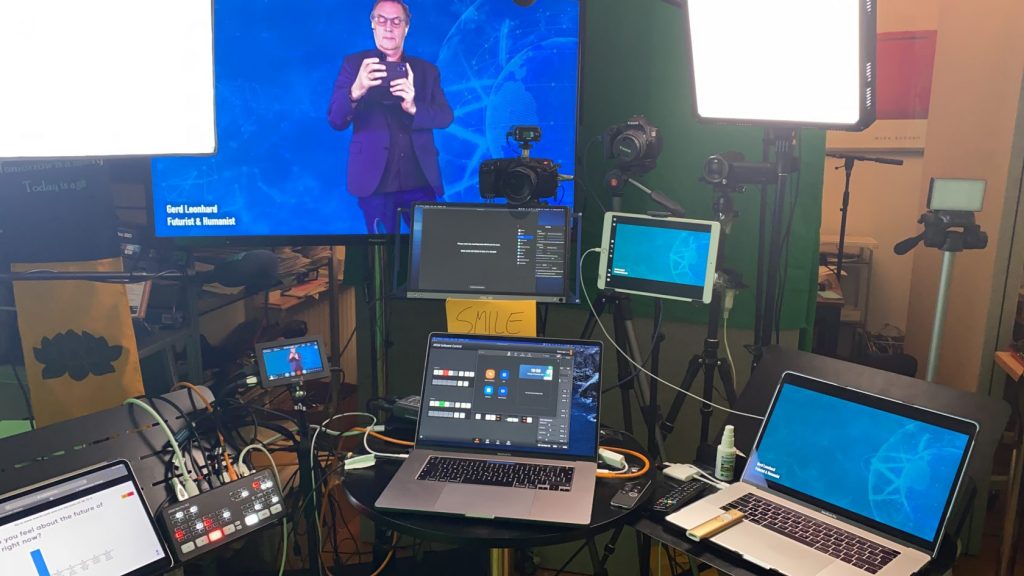
So this is what my new Streaming TV studio looks like – I call it ‘Keynote Television’ — from futuristgerd.com by Gerd Leonhard

Excerpt:

Many of you have asked me how I do my online keynotes, specifically my green screens, lights, virtual backgrounds etc. So here are some pictures and below is a short video from Twitter but the bottom line is… it’s complicated and took me some 6 months to learn it all:)). But well worth it: Keynote Television rocks!

Gerd Leonhard's studio where he makes what he calls Keynote Television

From DSC:
I was one of those people who asked Gerd if he would tell teachers, professors, trainers, IDs, and others how he does what he does. Thanks Gerd for sharing this information! May it be a blessing to many!


What I Learned: 4 Things L&D Should Borrow from Peloton — from learningsolutionsmag.com by JD Dillon

But modern technology has evolved the experience in ways that can inspire L&D solutions.

Excerpt:

Engagement is personal. What motivates me may not motivate you. Therefore, the best gamified systems allow users to make their own choices with regards to how they engage. Some will change their behavior to earn points, ascend the leaderboard, and capture rewards. Others will disengage if they’re forced into a competitive environment. It’s fun to scroll through my Peloton badge collection, but it doesn’t bring me back for the next ride.


Need to Fit Billions of Transistors on a Chip? Let AI Do It — from wired.com by Will Knight

Excerpt:

ARTIFICIAL INTELLIGENCE IS now helping to design computer chips—including the very ones needed to run the most powerful AI code.

Sketching out a computer chip is both complex and intricate, requiring designers to arrange billions of components on a surface smaller than a fingernail. Decisions at each step can affect a chip’s eventual performance and reliability, so the best chip designers rely on years of experience and hard-won know-how to lay out circuits that squeeze the best performance and power efficiency from nanoscopic devices. Previous efforts to automate chip design over several decades have come to little.

But recent advances in AI have made it possible for algorithms to learn some of the dark arts involved in chip design. This should help companies draw up more powerful and efficient blueprints in much less time. Importantly, the approach may also help engineers co-design AI software, experimenting with different tweaks to the code along with different circuit layouts to find the optimal configuration of both.

 
© 2025 | Daniel Christian