20 We wait in hope for the Lord;
    he is our help and our shield.
21 In him our hearts rejoice,
    for we trust in his holy name.
22 May your unfailing love be with us, Lord,
    even as we put our hope in you.

22 The Lord will rescue his servants;
    no one who takes refuge in him will be condemned.


The College Program Attracting — and Retaining — Black Male Teachers — from edsurge.com by Rebecca Koenig

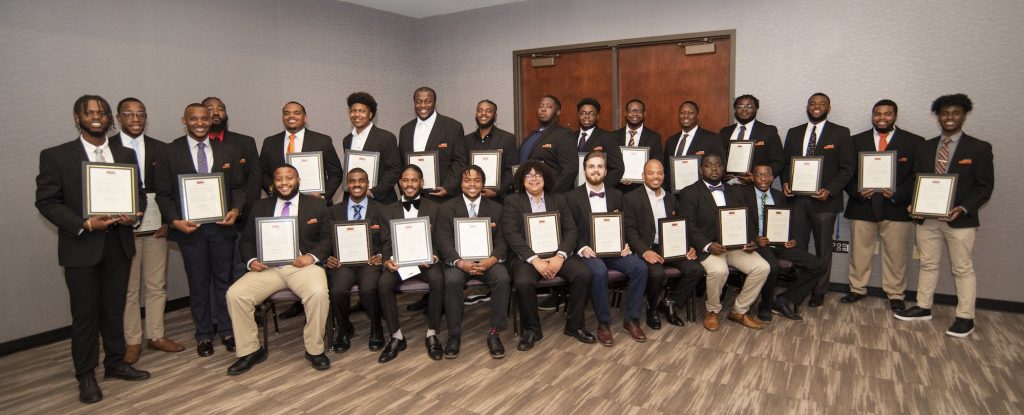
A group of black male graduates -- photo by Patrick Wright, Clemson University, Photographic Services-University Relations.

Excerpt:

When the initiative started two decades ago, people “really didn’t believe that we would be successful at being able to attract a 17- or 18-year-old Black male to become a second or third grade teacher,” says Roy Jones, a provost-distinguished professor at Clemson and the executive director of Call Me MISTER.

And yet, the program has graduated about 300 African American men from college education departments in South Carolina, more than doubling the number of Black men teaching in elementary and middle schools in the state.


Google CEO Still Insists AI Revolution Bigger Than Invention of Fire — from gizmodo.com by Matt Novak
Pichai suggests the internet and electricity are also small potatoes compared to AI.

Excerpt:

The artificial intelligence revolution is poised to be more “profound” than the invention of electricity, the internet, and even fire, according to Google CEO Sundar Pichai, who made the comments to BBC media editor Amol Rajan in a podcast interview that first went live on Sunday.

“The progress in artificial intelligence, we are still in very early stages, but I viewed it as the most profound technology that humanity will ever develop and work on, and we have to make sure we do it in a way that we can harness it to society’s benefit,” Pichai said.

“But I expect it to play a foundational role pretty much across every aspect of our lives. You know, be it health care, be it education, be it how we manufacture things and how we consume information. 


AI voice actors sound more human than ever —and they’re ready to hire— from technologyreview.com by Karen Hao
A new wave of startups are using deep learning to build synthetic voice actors for digital assistants, video-game characters, and corporate videos.

Excerpt:

The company blog post drips with the enthusiasm of a ’90s US infomercial. WellSaid Labs describes what clients can expect from its “eight new digital voice actors!” Tobin is “energetic and insightful.” Paige is “poised and expressive.” Ava is “polished, self-assured, and professional.”

Each one is based on a real voice actor, whose likeness (with consent) has been preserved using AI. Companies can now license these voices to say whatever they need. They simply feed some text into the voice engine, and out will spool a crisp audio clip of a natural-sounding performance.

But the rise of hyperrealistic fake voices isn’t consequence-free. Human voice actors, in particular, have been left to wonder what this means for their livelihoods.

And below are a couple of somewhat related items:

Amazon’s latest voice interoperability move undermines Google — from protocol.com by Janko Roettgers
With a new toolkit, Amazon is making it easier to build devices that run multiple voice assistants — weakening one of Google’s key arguments against licensing the Google Assistant for such scenarios.

People should be able to pick whatever assistant they prefer for any given task, simply by invoking different words, Rubenson said. “We think it’s critical that customers have choice and flexibility,” he said. “Each will have their own strengths and capabilities.”

Protocol Next Up — from protocol.com by Janko Roettgers
Defining the future of tech and entertainment with Janko Roettgers.

Voice is becoming a true developer ecosystem. Amazon now has more than 900,000 registered Alexa developers, who collectively have built over 130,000 Alexa skills. And those skills are starting to show up in more and more places: “We now have hundreds of physical products” with Alexa built in, Alexa Voice Service & Alexa Skills VP Aaron Rubenson told me this week.


 Smaller Firms Have More Advantages Than Ever Before — from abovethelaw.com by Jordan Rothman
Advances in technology have lowered barriers of entry at smaller shops.

Excerpt:

In the past, practicing law was an often onerous profession that required extensive time and resources to accomplish the most basic tasks. Since legal research and writing often involved so much work, bigger law firms had numerous advantages since they could marshal the resources needed to handle a given project. However, with technological advances in the past decade or two, law firms do not need to possess as many resources to complete work, and the cost of legal tasks has plummeted. As a result of all of these changes, smaller firms have more advantages than ever before.

Also see:

Does it Take 10,000 Hours to Become a Legal Tech Expert? — from legaltalknetwork.com
Learn how to develop a personal legal tech learning plan with Dennis Kennedy and Tom Mighell’s helpful tips.

20 Tips in 20 Minutes! — from legaltalknetwork.com
Dennis Kennedy and Tom Mighell offer up simple tips to help you make the most of your time and technology.


Business implications of AI within tax & accounting — from reuters.com by Yuiko Nakao (Japan)

Excerpt:

With AI promising the greatest transformation in many industries, including tax & accounting, we need to begin asking what the implications of this will be.

Artificial intelligence (AI) continues to promise the greatest level of transformation within many industries, including tax & accounting. “The global AI market was valued at $62.35 billion in 2020, and is expected to expand at a compound annual growth rate of 40.2% between 2021 to 2028,” according to Grand View Research.


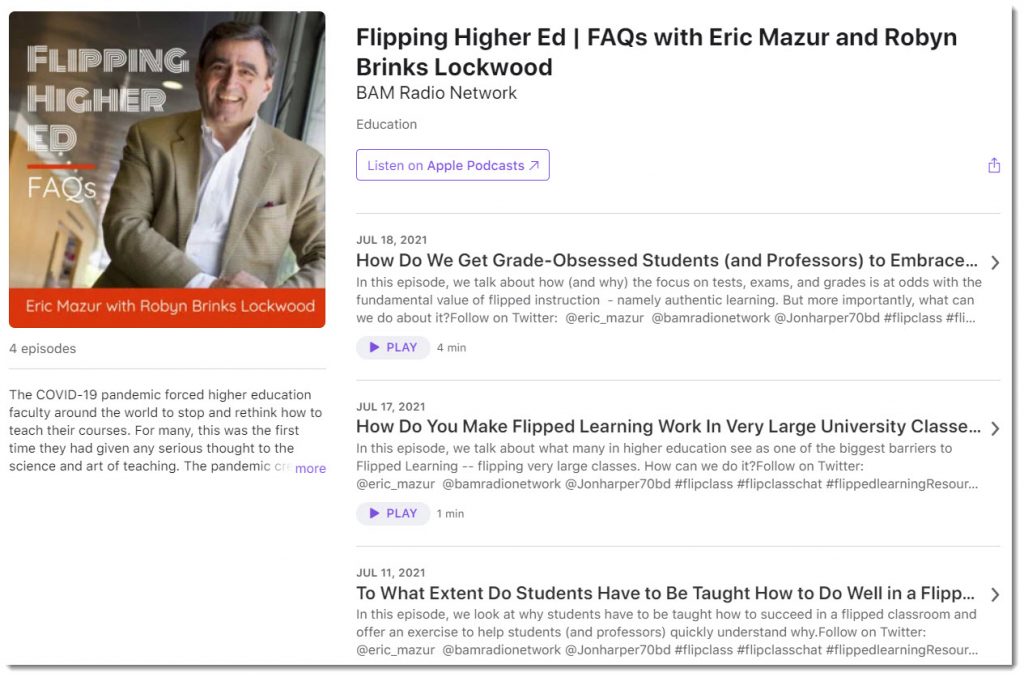
In each episode of this podcast, Eric Mazur and Robyn Brinks Lockwood answer a frequently asked question about flipping instruction in higher education.

Flipping Higher Ed | FAQs with Eric Mazur and Robyn Brinks Lockwood — from BAM Radio Network

Description:

The COVID-19 pandemic forced higher education faculty around the world to stop and rethink how to teach their courses. For many, this was the first time they had given any serious thought to the science and art of teaching. The pandemic created a new universe of educators who are new to Flipped Learning and want to learn more about how to do it well. In each episode of this podcast, Eric Mazur and Robyn Brinks Lockwood answer a frequently asked question about flipping instruction in higher education.


Instructure Is Back on the Stock Market, But Not Much Change Expected For Canvas Users — from edsurge.com by Jeffrey R. Young

Excerpt:

Instructure is officially a publicly-traded company—again.

Officials from the company, which makes the Canvas learning-management system used at many colleges and schools, rang the opening bell at the New York Stock Exchange today, marking its IPO.


As seen in this article:


From Skill to Instinct: How Higher Education can Bridge the Gap Between Classroom and Career — from edtechreview.in by Stephen Soulunii

Excerpts:

Higher education has conventionally focused on providing quality education for its students. However, modern students are increasingly attending higher education, not for scholarly pursuits, but to increase their value in an intensely competitive job market.

From DSC:
Funny how that happens when the price of getting a degree has skyrocketed through the years — and then one sees one’s family members struggling with getting out from crushing loads of debt (a process that often can take decades to do).

There is a lot that could be said here, but looking at this article makes me see how misaligned things are these days. The learning objectives that would be put forth from the corporate world don’t match up with the learning objectives as put forth by professors.

No wonder there’s a major disconnect. 

One last quote drives the point home — which swims against the current that many faculty members swim in:

65% of HR professionals believe teamwork and collaboration are the most foundational people skills – and 40% believe these skills are the most lacking in new hires.


Also relevant here, this is an excerpt of a piece sent to me by Christina Ioannou:

Skills Union offers accredited cohort-based, active learning courses in partnership with leading universities and employers. Their career-focused content ranges from software engineering and UX/UI design to growth marketing and digital entrepreneurship.

The company announced a US$1.5 million seed investment round, supporting its mission to bridge the global tech skills gap, through university accredited courses that meet the needs of the rapidly growing tech sector. The investment round was led by Online Education Services (OES), part of the Seek group of companies, with notable investors including KDV, Hustle Fund, Koh Boon Hwee, Siu Rui Quek, Ishreth Hassen, Sumardy Ma, Simin Zhou and Anvesh Ramineni.
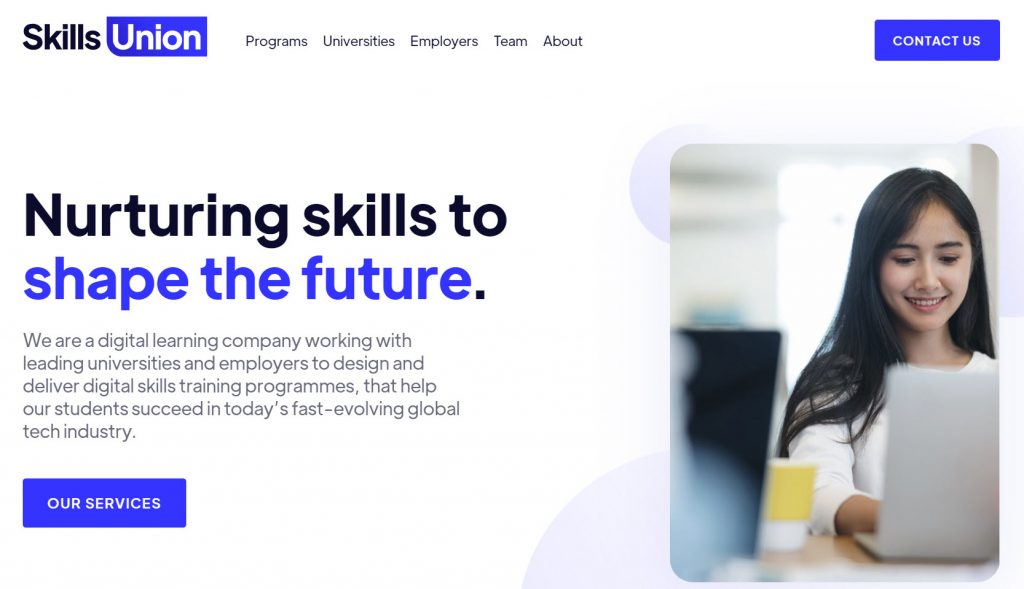
Skills Union dot com


3 innovative ways to integrate Twitter in your teaching [educatorstechnology.com]

Excerpt:

Much ink has been spilled on the use of Twitter in education. A simple search in Google using the phrase ‘Twitter in Education’ returns thousands if hits. My intent in this post is go beyond regurgitating what has already been written in this regard and rather provide you with innovative ways to use Twitter in your instruction.


Looking for some simple ways to make life just a little bit better? Dennis and Tom challenge themselves to fire through 20 simple technology-related tips in just 20 minutes, from useful shortcut commands, to favorite apps, to smarter tech habits, and more!

 
© 2025 | Daniel Christian