State of Higher Ed LMS Market for US and Canada: Mid-Year 2021 Edition — from philonedtech.com by Phil Hill
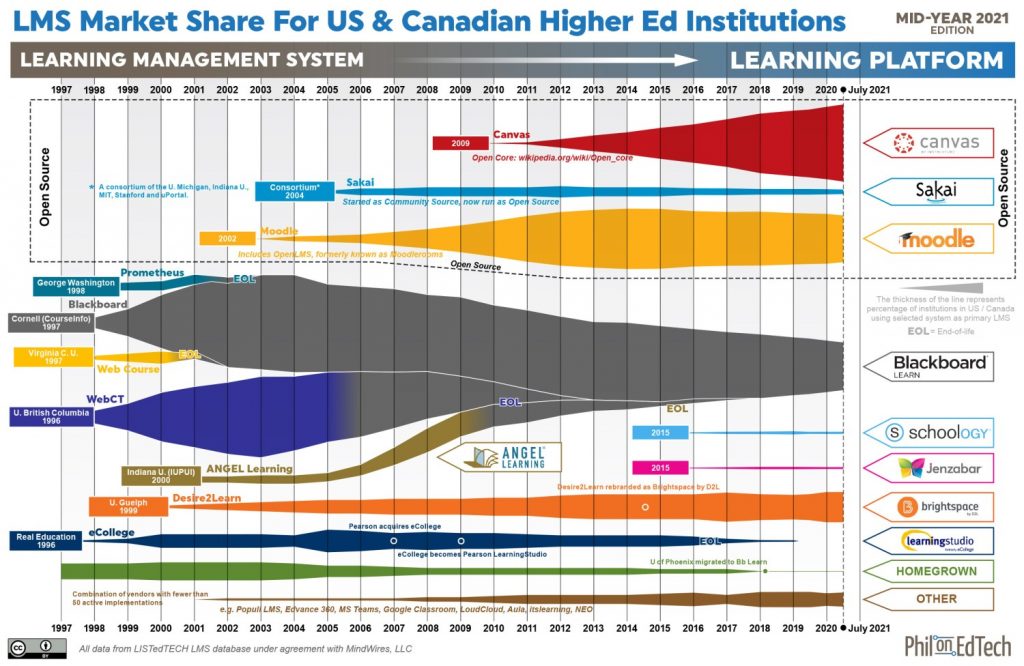
State of Higher Ed LMS Market for US and Canada: Mid-Year 2021 Edition — from philonedtech.com by Phil Hill
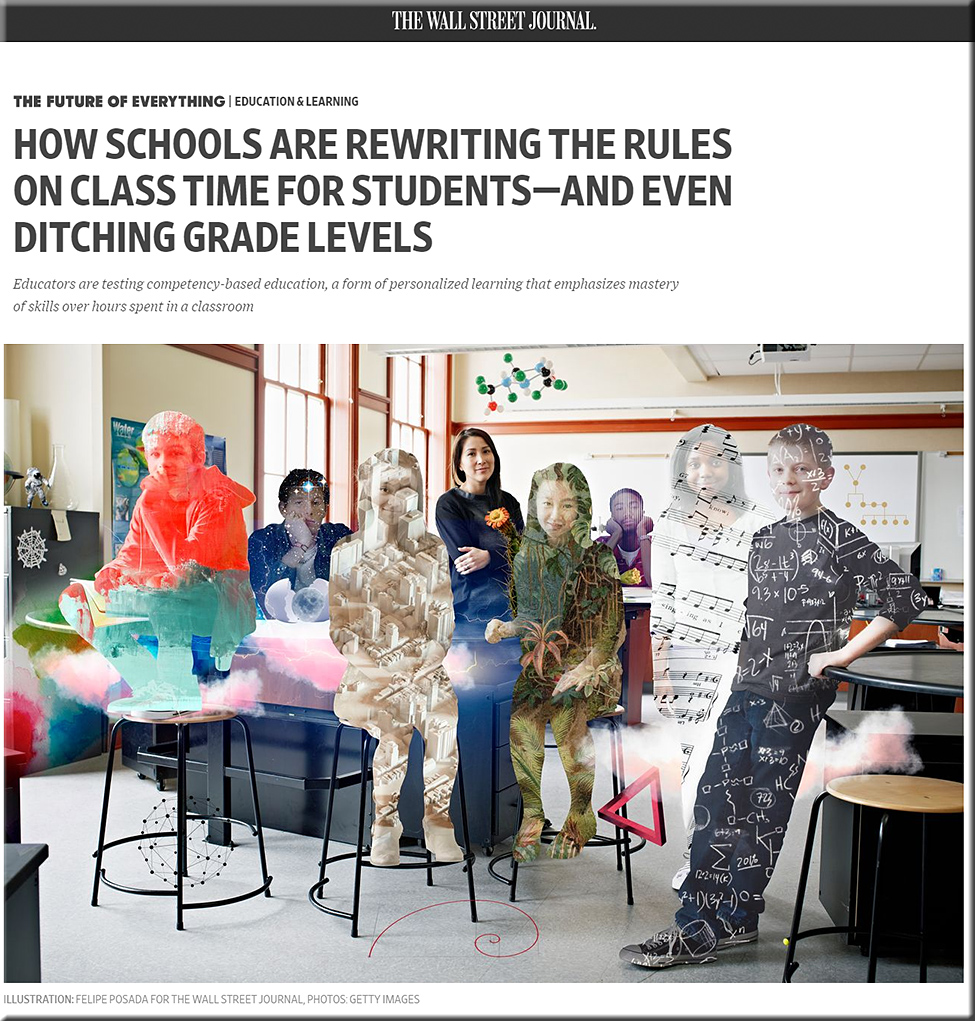
HOW SCHOOLS ARE REWRITING THE RULES ON CLASS TIME FOR STUDENTS—AND EVEN DITCHING GRADE LEVELS — from wsj.com by Yoree Koh
Educators are testing competency-based education, a form of personalized learning that emphasizes mastery of skills over hours spent in a classroom
Sandra Okita developed ProJo as a research tool to explore how #AI tools that act as a student's partner can be more effective than AI that mimics instructors. The team began testing the program in a 2-foot-tall robot in 2013.#education #edtech #learning https://t.co/UHDOU8oRoG
— Daniel Christian (he/him/his) (@dchristian5) August 13, 2021
Thinking Full-Speed Ahead at Instructure’s Future of Education Collaborative — from campustechnology.com by Mary Grush
A Q&A with FIU Online’s Maikel Alendy
Excerpt:
Maikel Alendy: Our director of learning design and innovation at FIU Online, Gaby Alvarez, likes to use a word that I think was foundational to our strategy to navigate learning through the pandemic — that word is ecosystem.
Our approach, like many, was to leverage Canvas and Zoom, but we had a few processes in place that gave us really a big head start. First, we had piloted Zoom years before and had already rolled out Zoom Pro accounts for all FIU faculty and students. Of course, the initial adoption was nominal. Usage was fine for “BC” (Before COVID) instruction. Still, it was helpful, once in the pandemic, that we already had support materials and some awareness of the tools.
How Next Gen TV Can Help Close The Digital Divide — from by Erik Ofgang
A new prototype utilizes Next Gen TV and QR codes to allow two-way communication between teachers and students via broadcast.
Excerpts:
Efforts to close the digital divide have ramped up during the pandemic, yet despite creative solutions from district, town, and state officials across the country, between 9 and 12 million students still lack adequate internet access.
However, a new application developed by The National Association of Broadcasters (NAB) could help close this gap by utilizing cutting-edge broadcast TV technology to allow students to receive and respond to work assigned by their teachers.
…
What Is Next Gen TV and This Application?
Next Gen TV, also known as ATSC 3.0, is a new standard for broadcasting that is currently being launched at broadcast stations throughout the U.S. It is based on internet protocols and allows for targeted broadcasts to be sent as well as more robust datacasting (sending data via broadcasting). Schools can use datacasting to send tests, reading materials, or other assignments that take the form of word documents, excel sheets, and much more. Students can also complete tests and save the work on their own devices.
Also see:
From DSC:
As I was traveling down one of the local roads the other day, the thought reoccurred to me …that driving along a road is such an apt metaphor for this idea of using the terms “learning objectives” and “learning outcomes.”
I’m going down the same road.
I can look ahead to see where I want to go. But that doesn’t mean that I’m for sure going to get there. That’s where I’m heading and I hope that I will get there, but several things will need to go right.
OR…I can look in the rearview mirror of my car and see where I’ve already been….what’s already taken place. I’ve already passed such and such a point (or points).

That is, I can’t talk about learning outcomes if I’m just getting on the road. At that point, I can talk about where I hope to go (i.e., my learning objectives), but I can’t talk about my learning outcomes until I’ve been traveling for a while.
Where this gets muddy/tricky is when we discuss entire programs. Then the term “learning outcomes” is often used. I get that — it makes sense at that level of things. But if we are talking about an individual course as seen in Canvas, Moodle, Blackboard Learn, etc…then it makes more sense to me to continue to use the phrase “Learning Objectives.”
10 Create in me a pure heart, O God,
and renew a steadfast spirit within me.
11 Do not cast me from your presence
or take your Holy Spirit from me.
12 Restore to me the joy of your salvation
and grant me a willing spirit, to sustain me.
20 Yet he did not waver through unbelief regarding the promise of God, but was strengthened in his faith and gave glory to God, 21 being fully persuaded that God had power to do what he had promised. 22 This is why “it was credited to him as righteousness.” 23 The words “it was credited to him” were written not for him alone, 24 but also for us, to whom God will credit righteousness—for us who believe in him who raised Jesus our Lord from the dead. 25 He was delivered over to death for our sins and was raised to life for our justification.
Psalm 91:4 NIV — from biblegateway.com
4 He will cover you with his feathers,
and under his wings you will find refuge;
his faithfulness will be your shield and rampart.
It’s time for leaders to get real about hybrid — from mckinsey.com by Aaron De Smet, Bonnie Dowling, Mihir Mysore, and Angelika Reich
Employers are ready to get back to significant in-person presence. Employees aren’t. The disconnect is deeper than most employers believe, and a spike in attrition and disengagement may be imminent.
Excerpt:
Once in a generation (if that), we have the opportunity to reimagine how we work. In the 1800s, the Industrial Revolution moved many in Europe and the United States from fields to factories. In the 1940s, World War II brought women into the workforce (if not the C-suite) at unprecedented rates. In the 1990s, the explosion of PCs and email drove a rapid increase in productivity and the speed of decision making, ushering in the digital age as we know it today. And in 2020, the COVID-19 pandemic drove employees out of offices to work from home. Thanks to the development and wide distribution of COVID-19 vaccines, 2021 presents another such opportunity. The return to the workplace is a chance to create a new, more effective operating model that works for companies and people navigating a world of increasing uncertainty. There is, however, one big catch: employers must confront the broadening disconnect between how they and their employees see the future.
Elaboration Strategies That Benefit Learning — from theelearningcoach.com by Connie Malamed
Excerpt:
Although retrieval practice and spaced learning may be more well-known, elaboration is an instructional strategy worth our attention. Elaboration strategies refer to the many ways of connecting prior knowledge to what someone has newly learned. This has the potential to make the new material more memorable and meaningful.
We all know that new learning requires a foundation of prior knowledge. Elaboration techniques give people opportunities to make the connections stronger. In the book Make It Stick, the authors write, “The more you can explain about the way your new learning relates to your prior knowledge, the stronger your grasp of the new learning will be, and the more connections you create that will help you remember it later.” (Listen to my conversation with one of the authors of Make It Stick.)
The Importance of Curiosity and Tension to Storytelling — from janefriedman.com by Stefan Emunds
Today’s post is excerpted from The Eight Crafts of Writing by Stefan Emunds (@StefanEmunds).
Excerpt:
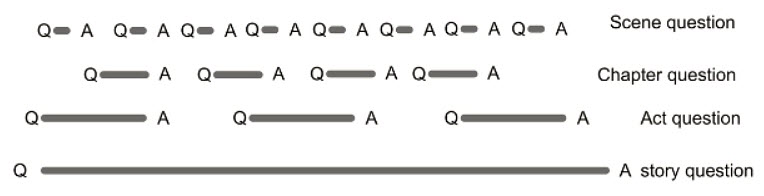
To maintain reader curiosity, you can raise and answer multiple questions on multiple levels—for example, a story question, an act question, a chapter question, and a scene question. Try to keep two to three questions open at any given time. Raise two questions in your opening and answer one. Then, raise two new questions and answer one. Then raise two new questions and answer two.
Take the world of TV and movie writing: screenplays have seven or eight sequences, and each sequence begins with a challenge/question and ends with an answer—success or failure. You can do the same thing with chapters and acts.