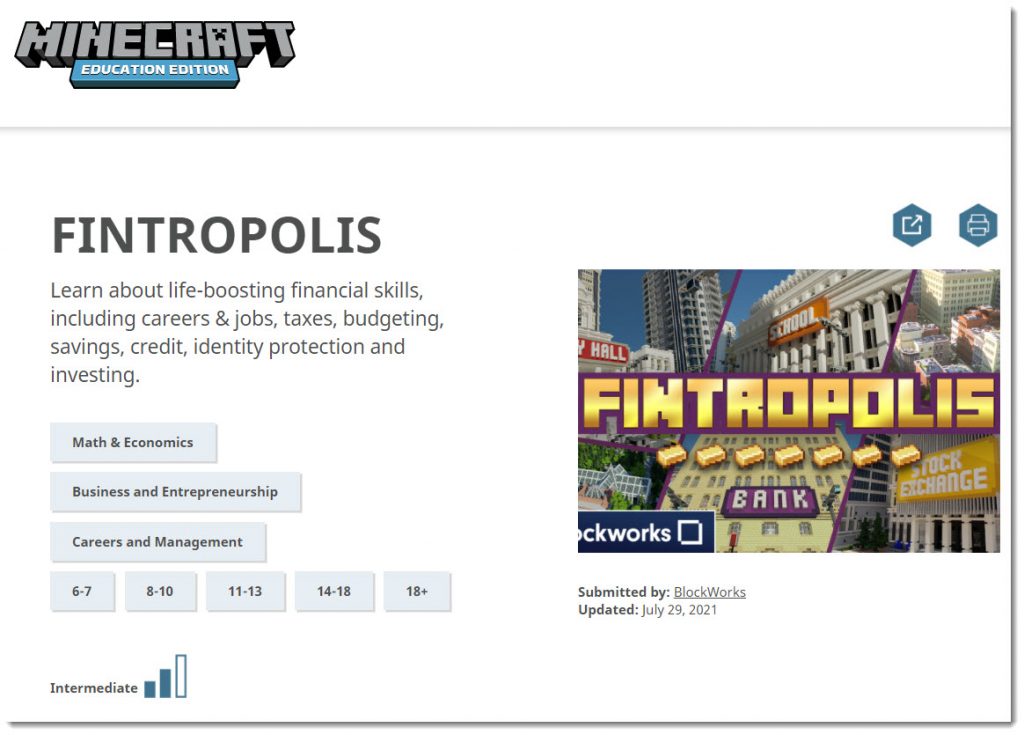
Fintropolis is an educational Minecraft world that teaching middle schoolers finance — from pixelkin.org

Excerpt:

Two years ago, Ally Financial, a financial services company, hired four interns from Historically Black Colleges and Universities through their Moguls in the Making program to promote financial literacy in younger students. The four college students, Erin Martin (Alabama A&M), Earl Perry and Keishon Smith (Florida A&M), and DeMari Tyner (North Carolina A&T) designed Fintropolis, a world in Minecraft, available now for free in Minecraft and Minecraft: Education Edition.

Also see:

Learn about life-boosting financial skills, including careers & jobs, taxes, budgeting, savings, credit, identity protection and investing.


Tools for Building Branching Scenarios — from christytuckerlearning.com by Christy Tucker
When would you use Twine, Storyline, Rise, or other tools for building branching scenarios? It depends on the project and goals.

Excerpt:

When would you use Twine instead of Storyline or other tools for building branching scenarios? An attendee at one of my recent presentations asked me why I’d bother creating something in Twine rather than just storyboarding directly in Storyline, especially if I was using character images. Whether I would use Twine, Storyline, Rise, or something else depends on the project and the goals.


A Robust and Timely Discussion of a New Kind of Homeschooling — from educationnext.org by Michael B. Horn
Hybrid approach combines at-home learning with school attendance

Excerpt:

Hybrid Homeschooling: A Guide to the Future of Education
by Michael Q. McShane
Rowman & Littlefield, 2021, $60; 142 pages.

As reviewed by Michael B. Horn

Hybrid learning and homeschooling have become prominent models over the past school year as millions more students learned from home, whether part or full time, during the coronavirus pandemic.

Against that backdrop, Mike McShane’s new book, Hybrid Homeschooling, would seem both topical and timely.

McShane’s book is instead a treatment of a strand of homeschooling that has received relatively little attention: “hybrid homeschooling,” which he defines as “a school that for some part of the week educates children in a traditional brick-and-mortar building and for some other part of the week has children educated at home.”

Also relevant/see:

  • What Is Modern Homeschooling In 2021? — from elearningindustry.com by Dariya Lopukhina
    The COVID-19 pandemic saw over 300 million students all over the world become homeschooled according to Thinkimpact. 
 

Intel expands AI education program to 18 total community colleges — from highereddive.com by Natalie Schwartz

Excerpt:

The technology giant is supplying curriculum and faculty development for participating schools, and is partnering with Dell to provide technical and infrastructure expertise for the program, which can lead to a certificate or associate degree.

The future of AI: Deeper insights, personalization and problem-solving stand to transform how we use AI across devices and industries — from protocol.com by Alex Katouzian

Excerpt:

What comes to mind when you think of AI? In the past, it might have been the Turing test, a sci-fi character or IBM’s Deep Blue-defeating chess champion Garry Kasparov. Today, instead of copying human intelligence, we’re seeing immense progress made in using AI to unobtrusively simplify and enrich our own intelligence and experiences. Natural language processing, modern encrypted security solutions, advanced perception and imaging capabilities, next-generation data management and logistics, and automotive assistance are some of the many ways AI is quietly yet unmistakably driving some of the latest advancements inside our phones, PCs, cars and other crucial 21st century devices. And the combination of 5G and AI is enabling a world with distributed intelligence where AI processing is happening on devices and in the cloud.

Latest Trends in Artificial Intelligence –from newark.com

Excerpt:

Over the past decade, Artificial Intelligence (AI) has meshed into various industries. The era witnessed a dramatic increase in tools, applications, and platforms based on AI and Machine Learning (ML). These technologies have impacted healthcare, manufacturing, law, finance, retail, real estate, accountancy, digital marketing, and several other areas.

Companies are investing in AI research to find out how they can bring AI closer to humans. By 2025 AI software revenues alone will reach above $100 billion globally (Figure 1). This means that we will continue seeing the advancement of AI and Machine Learning (ML)-related technology in foreseeable future. AI changes notably fast, so you’ll need to go out of your way to keep up with the latest trends if you want to stay as informed as possible. Let’s take a look at everything you need to know about the latest AI trends.


‘Best of Both Worlds’ — from insidehighered.com by Alexis Gravely
The expansion will allow more people to participate in prison education programs while the department prepares for across-the-board Pell Grant access for incarcerated students.

Excerpt:

The Second Chance Pell Experimental Sites Initiative will be expanded for the 2022-23 award year to allow another 69 colleges and universities to participate, paving the way for even more incarcerated individuals to gain access to higher education.

A maximum of 200 two- and four-year colleges will be able to offer prison education programs with the support of the Pell Grant, up from the 131 institutions currently participating. The department is also planning to broaden the geographic scope of Second Chance Pell, with the goal of having programs in most or all 50 states.


The Mental Health Factor: Accounting for the Emotional Toll of the Pandemic — from americanbar.org by Laura Mahr
Keys to a successful return-to-the-office plan include flexible choices, robust resourcing and resilience training with an eye on mental health.

Excerpt:

While no one has a map that can cir­cumnavigate all return-to-office plan­ning errors, we do have insight into one key area that would be remiss to over­look in your firm’s plan: mental health. In addition to exacerbating pre-exist­ing mental health issues, the pandemic caused increased chronic stress, anxiety, depression and trauma, research shows. Therefore, in addition to planning the logistics of a safe return to the office, also think about the impact of the past year on your workforce’s mental health. Considering the emotional toll and pos­sible post-traumatic stress of the pan­demic on your workforce will enable your firm to make available new resources. Targeted resources will support all team members in their performance efficacy; they will also provide additional help for those who may be struggling to integrate yet another change.


What Is Instructional Scaffolding? — from edtechreview.in by Saniya Khan

Excerpt:

Scaffolding is a bridge used to build on what the students already know to get to something they do not know. If the scaffold is properly administered, it will act as a facilitator, not an enabler” (Benson, 1997).

The process of Scaffolding is based on Lev Vygotsky’s concept of the Zone of Proximal Development (ZPD). This is the distance between what children can do by themselves and the next learning when they can be helped to achieve with competent assistance. Vygotsky said, “children who can perform their tasks at a particular cognitive level in cooperation and collaboration with others and with adults will be able to perform at a higher level. And this difference between the two levels is the child’s Zone of Proximal Development”. He defined scaffolding instruction as the “role of teachers and others in supporting the learner’s development and providing support structures to get to the next stage or level.”


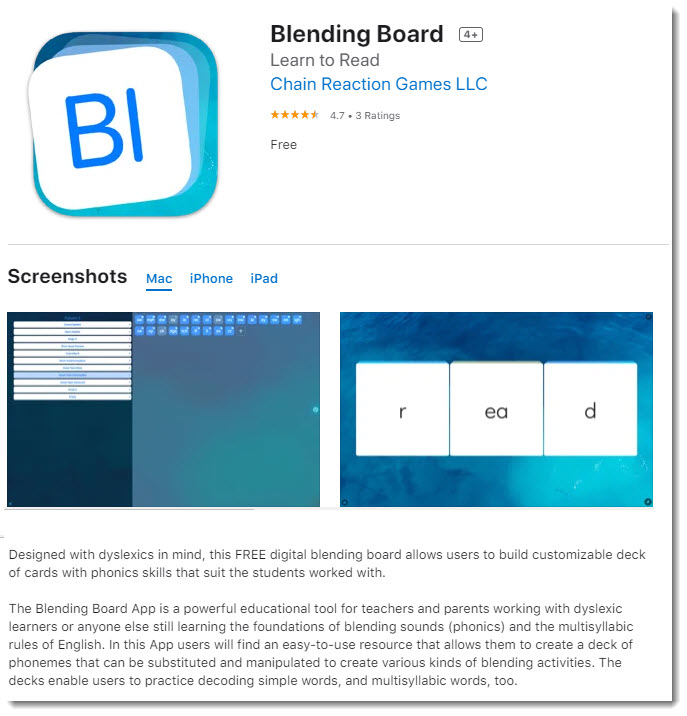
9 Popular Apps For Adolescents Struggling To Read — from edtechreview.in
We’ve curated a list of 9 popular applications to help adolescents struggling to read.

Screenshots of Blending Board


40 Fingers: Message in a Bottle — from theawesomer.com

Also see:


IU researchers introduce ambitious new model for large-scale research on student learning — from news.iu.edu

Excerpt:

“The main conclusion of the study — to the great surprise of many teachers — is that there is no overall effect of feedback timing that spans all learning environments,” said Fyfe, an assistant professor in the Department of Psychological and Brain Sciences. “The findings should provide some comfort to teachers. If they take a few days to return feedback, there is no evidence that the delay will hamper their students’ progress, and in some cases, the delay might even be helpful.”

From DSC:
I must admit that I publish this with some hesitation, as I’m a big fan of personalized, customized feedback. I just hope that study doesn’t stop or reduce faculty members from providing such valuable feedback.

Also see:

The Science of Studying Student Learning at Scale — podcast and transcript — from campustechnology.com by Rhea Kelly; with Emily Fyfe and Ben Motz at Indiana University

Excerpt:

MOTZ: So ManyClasses is really an attempt to try and expand the scope of research so that what we’re doing in asking a question of how people learn, is expanding beyond the boundaries of any single classroom, really aiming at developing inferences that could generalize beyond that narrow scope, but also that might be able to identify where a practice might have benefits.

FYFE: …I think when we are thinking of ManyClasses as a research team, we’re thinking of it as a new gold standard for how to conduct scientific research in classrooms

And so ManyClasses is a model for sort of combining the rigor of these randomized experiments within these authentic settings. And the goal is to sort of, as Ben said, to do this across many classes, so that we’re not just running one experiment, but we’re replicating it across all of these different authentic educational settings. And so really, at the heart of it, ManyClasses is a new model for conducting research in educational settings.


What doors does this type of real-time translation feature open up for learning? [Christian]

From DSC:
For that matter, what does it open up for #JusticeTech? #Legaltech? #A2J? #Telehealth?


Learning from the living class room


Four Steps to Improve Retention with Schema Theory — from learningsolutionsmag.com by Hannah Hunter

Excerpt:

If you read the word “breakfast”, what comes to mind? Do you think of your favorite breakfast foods? The smell of a cup of coffee? Time spent with family? A quick bite in the car on the way to work?

It is likely that many words, images, and emotions come to mind. This collection of interconnected thoughts and feelings constitute a schema.

What is a schema?
A schema is a mental model stored in long-term memory that the brain uses to organize information. Schemas are built from memories and experiences and are unique to each individual. You have schemas for every topic imaginable: objects, events, people, activities, relationships, and even your concept of self.

Also see:

An entire generation of the workforce is on its way out over the next 5-10 years. And then look who’s coming behind them. A new generation that learns differently than their predecessors, that has different expectations, and that stays in jobs exponentially shorter than their predecessors.


Australian Court Rules That Yes, AI Can Be an Inventor — from gizmodo.com by Shoshana Wodinsky
The overturned ruling bucks the trend we’ve previously seen in the US and UK.

Excerpt:

In what can only be considered a triumph for all robot-kind, this week, a federal court has ruled that an artificially intelligent machine can, in fact, be an inventor—a decision that came after a year’s worth of legal battles across the globe.

The ruling came on the heels of a years-long quest by University of Surrey law professor Ryan Abbot, who started putting out patent applications in 17 different countries across the globe earlier this year.


Employers Tiptoeing into TikTok Hiring: Beware, Attorneys Say — from by news.bloomberglaw.com by Dan Papscun and Paige Smith

Excerpt:

  • The app encourages ‘hyper superficiality’ in hiring
  • Age discrimination also a top-line concern for attorneys


Psalm 51:17

17 My sacrifice, O God, is[a] a broken spirit;
    a broken and contrite heart
    you, God, will not despise.

 
© 2025 | Daniel Christian