Top 300 Tools for Learning 2021 [Hart]

Top 300 Tools for Learning 2021 — from toptools4learning.com by Jane Hart

Excerpt:

2021 was the YEAR OF DISRUPTION! There were a substantial number of new tools nominated this year so the main list has now been extended to 300 tools to accommodate them, and each of the 3 sub-lists has been increased to 150 tools. Although the top of this year’s list is relatively stable, there is quite bit of movement of tools on the rest of the list, and the effect of the new tools has been to push other established tools down – if not off the list altogether. Further analysis of the list appears in the right-hand column of the table below.

This table shows the overall rankings as well as the rankings on the 3 sub-lists: Top 150 Tools for Personal Learning (PL150), the Top 150 Tools for Workplace Learning (WL150) and the Top 150 Tools for Education (ED150). NEW tools are shaded YELLOW, tools coming BACK on the list are shaded GREEN. The most popular context in which each tool is used is also highlighted in BLUE.  Click on a tool name to find out more about it.
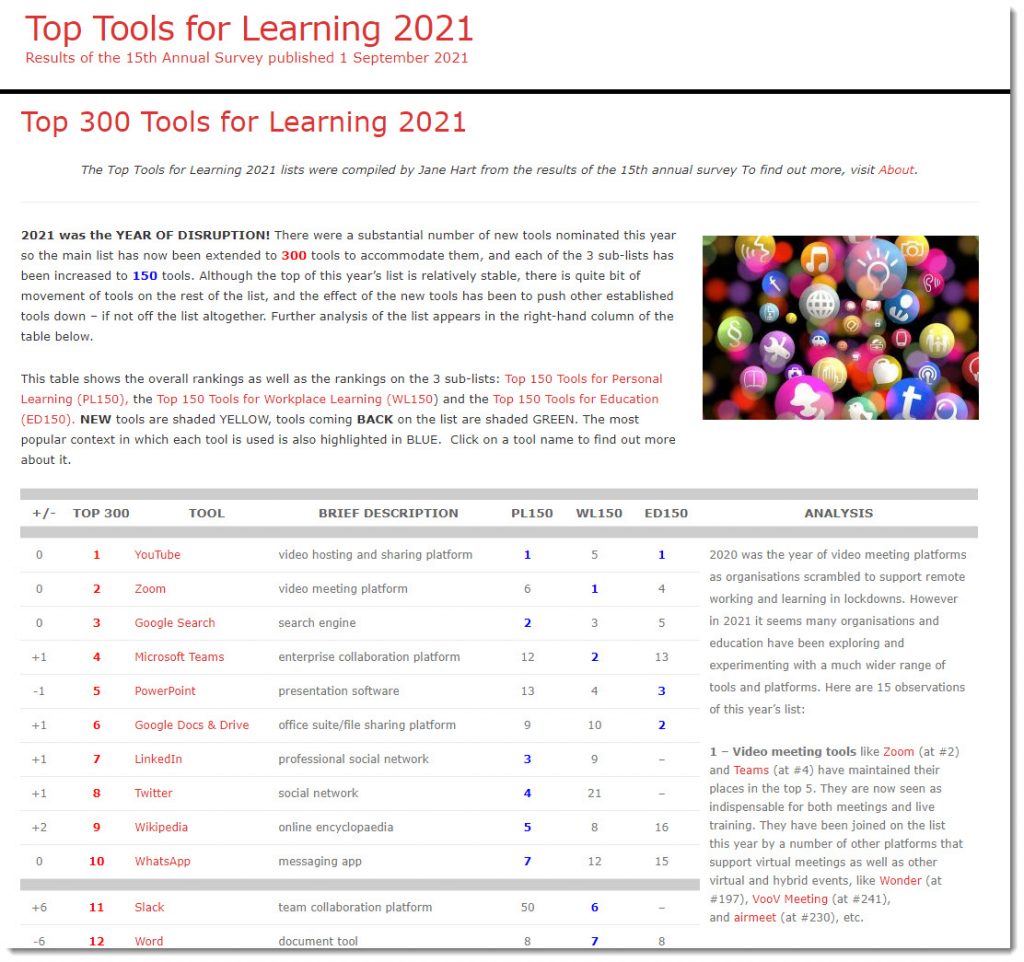


Top 300 Tools for Learning 2021 -- from Jane Hart


American Association of Law Libraries (AALL) Innovation Showcase — from aallnet.org

Excerpt:

Law librarians and legal information professionals innovate every day—especially in the past year. The AALL Innovation Showcase is an opportunity to explore your colleagues’ innovations, presented as short videos and categorized by three library types: government, law firm, and law school.


US Justice Needs Data Reveals No Americans Unaffected by Justice Crisis — from legaltechmonitor.com by Logan Cornett

Excerpt:

It’s no secret that the United States is deeply embroiled in a justice crisis. According to the World Justice Project’s Rule of Law Index, the U.S. ranks 30th out of the world’s 37 high-income countries on the civil justice factor and 22nd on the criminal justice factor. Numerous studies have shone light on aspects of the crisis—some focusing on how it impacts low-income Americans, others homing in on the crisis’s effects in specific geographic regions. Now, with the new report from IAALS’ and HiiL’s joint US Justice Needs project, we have data from more than 10,000 surveyed individuals that illuminates the contours of the justice crisis in this country.


The Fight to Define When AI Is ‘High Risk’ — from wired.com by Khari Johnson
Everyone from tech companies to churches wants a say in how the EU regulates AI that could harm people.

Excerpt:

The AI Act is one of the first major policy initiatives worldwide focused on protecting people from harmful AI. If enacted, it will classify AI systems according to risk, more strictly regulate AI that’s deemed high risk to humans, and ban some forms of AI entirely, including real-time facial recognition in some instances. In the meantime, corporations and interest groups are publicly lobbying lawmakers to amend the proposal according to their interests.


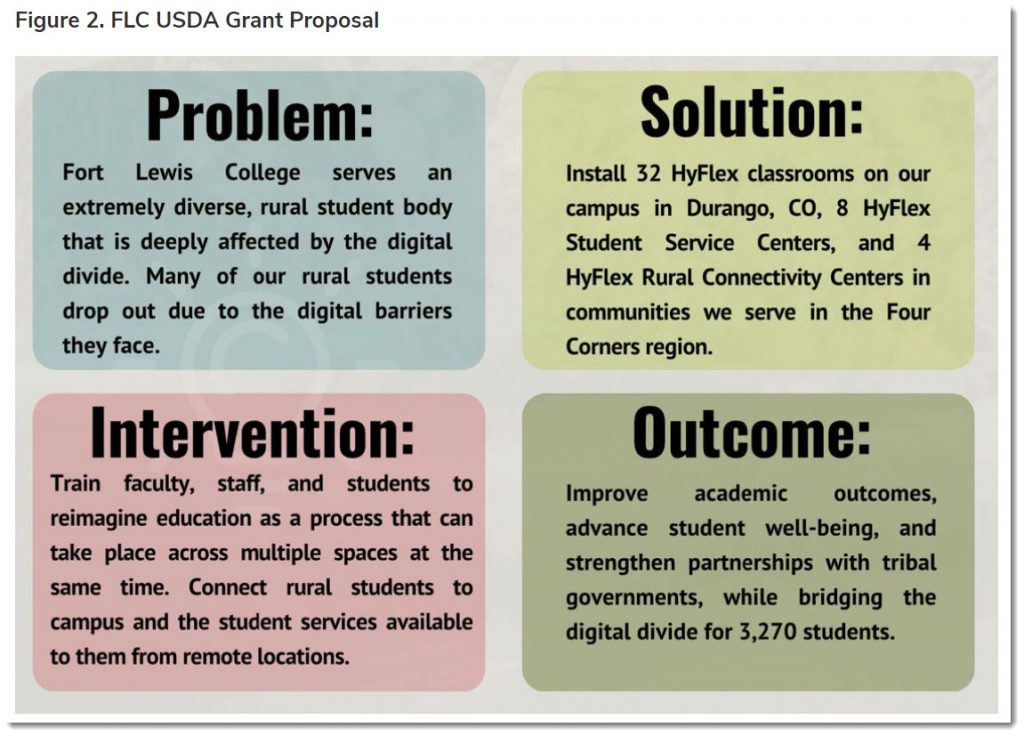
Scaling HyFlex for the Post-Pandemic Campus — from er.educause.edu by Jennifer Rider and Ayla Moore

Excerpt:

Setting up HyFlex courses on any campus requires thoughtful planning, careful analysis, continual assessment, and faculty support. But is HyFlex something that higher education institutions can and should permanently adopt in a post-pandemic world?


Fort Lewis College's USDA Grant Proposal


The Tomorrow Room on campus is a space where new technology will be showcased so that faculty can become familiar with the room design and technology before teaching in a HyFlex classroom.


10 Ways to Reuse Your Pre-Recorded Videos — from barbihoneycutt.com by Barbi Honeycutt

Excerpts:

2. CLONE YOURSELF

My friend is a 2nd grade teacher, and this year, she is back in the in-person classroom with her students. After teaching online last year, she started wondering how she could reuse all of the videos she recorded.

She came up with the idea to play clips of the videos during her in-person class time. As the video is playing, she walks around the room and helps students in real-time as they are working through the lesson.

If they are struggling, she is right there to guide them through that part of the video or lesson. She can pause the video if many students are struggling, or she can let the video play as she works individually with students who need additional help.

She said this approach gives her instant feedback (and makes it easy for a substitute teacher to use if needed). She said, “I’m not tied to the front of the room at the board. It’s literally like having two teachers!” 


4. VIDEO EXCHANGE
Do you have a video that would be helpful for a colleague to share with his/her/their students? Maybe they have a video you need to integrate into your course? Here’s the perfect time to exchange videos! It’s like a giving a virtual guest lecture!


Teacher Tips: Starting the Year with Station Rotation — from catlintucker.com by Caitlin Tucker

Excerpt:

In an effort to reimagine the first weeks of school, I decided to use the station rotation model to encourage my new students to interact with one another and learn about our class. I designed a collection of stations to encourage them to explore expectations for conduct, course requirements, goal setting, what it means to collaborate, etc. The results were incredible! I was able to breathe and enjoy the relaxing, student-centered atmosphere I had created. Instead of standing at the front of the room talking at them, students worked independently and collaboratively on the tasks at various stations. I was freed to circulate, facilitate, and connect with my students.


Antidote Health to Set Up Nation’s First Virtual HMO — from innotechtoday.com by Corey Noles

Excerpt:

Antidote Health, a telehealth provider, announced it has raised $12 million in seed funding to build an AI-based virtual Health maintenance organization (HMO). The round was led by iAngels, Well-Tech Ventures, and Flint Capital, along with other angel investors.

Antidote Health is a B2C company that launched in January, providing uninsured and underinsured Americans with a virtual HMO via Artificial Intelligence that connects users to doctors with a smart chatbot and through video calls.


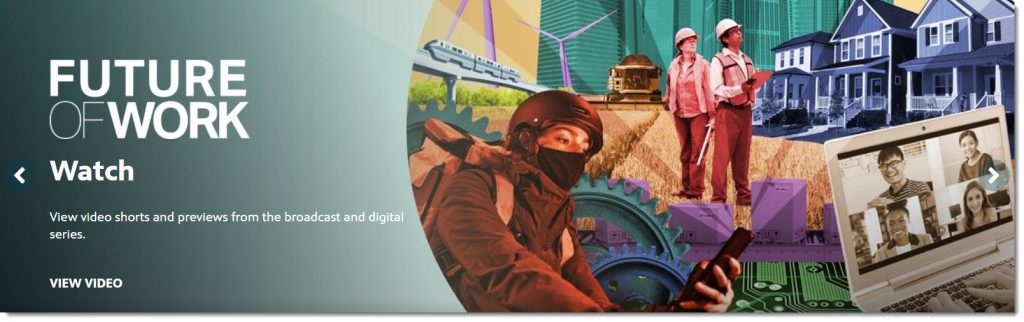
The Future of Work series from PBS can be seen here online

DIGITAL SERIES – FUTURE OF WORK: THE NEXT GENERATION

Excerpt:

The working landscape in the United States has rapidly changed in the last 30 years. The one job-for-life model is vanishing and younger workers are trading in stability and security for flexibility and autonomy. GBH and PBS Digital Studios present the Future of Work digital series, a six-part docuseries chronicling six mid-career adults as they navigate the rapidly changing work landscape covering topics such as debt, the gig economy, remote working, career identity, and more.


5 Ideas to Soothe IT Staff Burnout — from campustechnology.com by David Raths
The COVID-19 pandemic has taken its toll on the mental health of students, faculty and staff alike. But IT in particular has borne the brunt of keeping institutions’ technology infrastructure afloat through relentless change, often in the face of budget cuts and staffing shortages. Here are ways to help mitigate stress and better support IT teams during this challenging time.

Excerpt:

Faced with an increasingly stressed-out IT workforce, CIOs are trying to find innovative ways to boost morale, maintain work/life balance and enhance communication among teams. We spoke to three IT leaders who offered the following five suggestions, based on their own experiences over the past year and a half.


black and white photo of a stairway

Vision — from 500px.com by Markus Studtmann

Artist Spotlight: Yoora Lee — from booooooom.com


Light and shadow -- by Bruce

Light and Shadow — from 500px.com by Bruce


5 Ways Higher Ed Will Be Upended — from chronicle.com by Arthur Levine and Scott Van Pelt
Colleges will lose power, prices will go down, and credentials will multiply — among other jarring shifts.

Excerpt:

The dominance of degrees and “just in case” education will diminish; nondegree certifications and “just in time” education will increase in status and value.

In contrast, “just in time” education teaches students the skills and knowledge they need right now. They may need to learn a foreign language for an coming trip or business deal. They may need to learn an emerging technology. “Just in time” education comes in all shapes and sizes, but diverges from traditional academic time standards, uniform course lengths, and common credit measures. Only a small portion of such programs award degrees; most grant certificates, microcredentials, or badges.

From DSC:
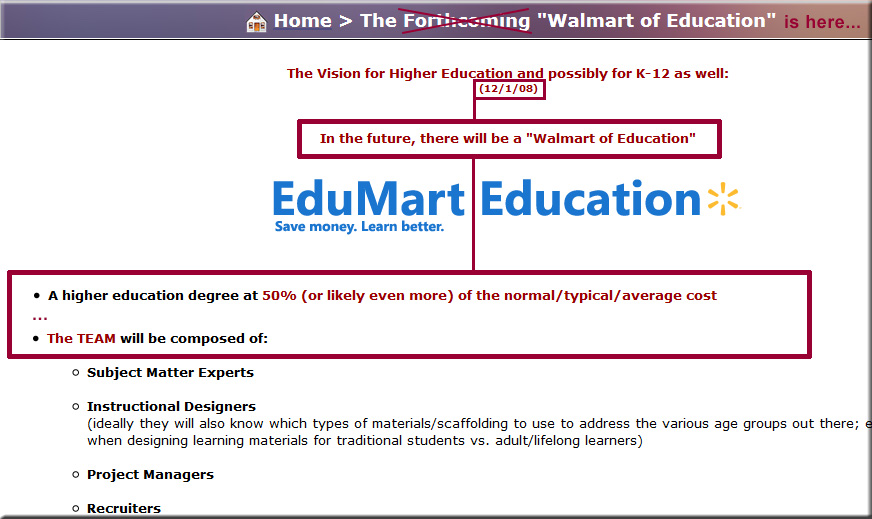
Long-time readers of this blog and my old blog at Calvin (then College) will see no surprises here:

I published the idea of 50% off and more back in 2008

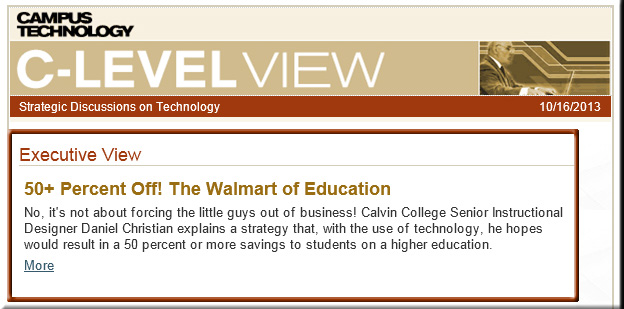
I discussed The Walmart of Education with Mary Grush back in 2013

Learning from the living class room


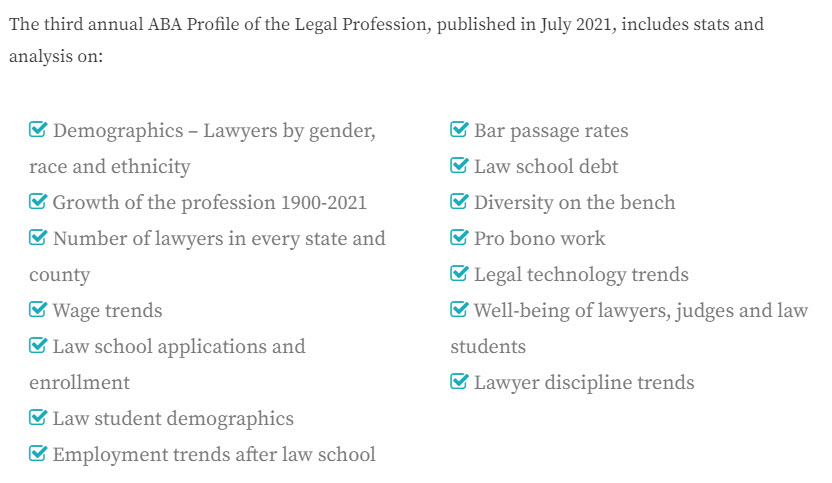
The 2021 ABA Profile of the Legal Profession
The American Bar Association’s annual compilation of statistics and trends in the U.S. legal profession.

https://www.abalegalprofile.com/

Also see:


© 2025 | Daniel Christian