From DSC:
For IDs, trainers, teachers, faculty members, & teams who are working on creating and delivering online-based learning……the following article is a good one for us to check out and reflect upon:

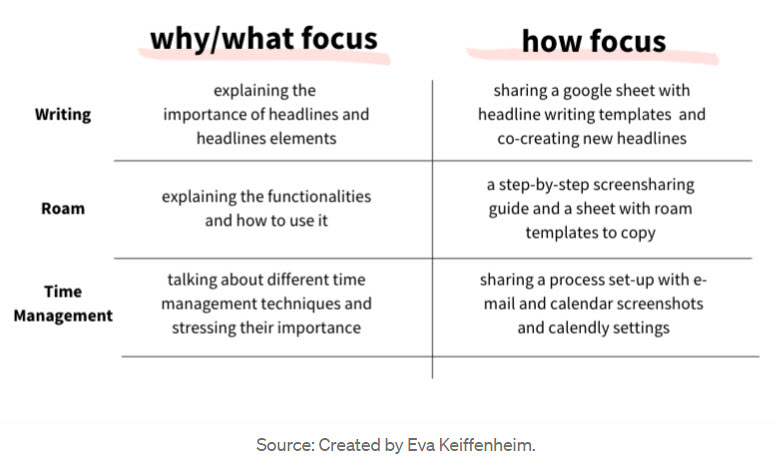
Most Online Courses Are a Waste of Your Time — Here’s How You Know — from medium.com by Eva Keiffenheim
A quick guide that helps you find the worthy ones.

Excerpts:

Not all learning investments are created equal. People who’ve excelled at their craft are often not the best teachers. Likewise, creators who write the best sales copy don’t offer the most value.

Here’s precisely how you can spot bad online courses so that you won’t waste your time and money.


Could AR and/or VR enable a massive 3D-based type of “Voicethread?” [Christian]

From DSC:
What if we could quickly submit items for a group to discuss, annotate, and respond to — using whichever media format is available/preferable for a person — like a massive 3D-based Voicethread? What if this type of discussion could be contributed to and accessed via Augmented Reality (AR) and/or via Virtual Reality (VR) types of devices?

It could be a new 3D format that a person could essentially blow all the way up into the size of a billboard. Think, “Honey, I shrunk the kids” type of stuff.  

Input devices might include:

  • Augmented Reality (AR) glasses
  • Virtual Reality (VR) headsets/glasses
  • Scanners
  • Smartphones
  • Tablets
  • Desktops and laptops
  • SmartTVs
  • Other types of input devices

For example, a person could take a picture of a document or something else and then save that image into a new file format that would be vector-based. I say a vector-based file format so that the image could be enlarged to the size of a billboard without losing any resolution (i.e., wouldn’t become grainy; the image would remain crystal clear regardless of how big the image is). I’m thinking here along the lines of “Honey, I shrunk the kids!”

Other thoughts here:

  • The files could be accessible online for attendees of classes or for audiences of presentations/webinars
  • The files could be displayed on the walls of learning/presentation spaces for marking them up
  • One could manipulate the 3D image if that person was using a virtual/immersive environment
  • Users should be able to annotate on those images and/or be able to save such annotations and notes

A question for phase II:
Could this concept also be used if virtual courts take off?

Hmmmm…just thinking out loud.


Feynman – Don’t lecture and Feynman Technique — from donaldclarkplanb.blogspot.com by Donald Clark

Excerpt from the Feynman Technique section

  1. Write down everything you think you know about the topic from the top of your head
  2. Teach it to someone much younger
  3. Identify the gaps and fill them out
  4. Simplify, clarify and use analogies

Learning this way is iterative, as you must go back to sources to fill in any gaps uncovered by your attempts to recall what you think you know. The act of writing, teaching, simplification and analogising, is a form of retrieval practice that increases understanding and retention.

Also see:

The Feynman Technique Can Help You Remember Everything You Read — from medium.com by Eva Keiffenheim
How to use this simple principle for you.

Excerpts:

Social climber Dale Carnegie used to say knowledge isn’t power until it’s applied. And to apply what you read, you must first remember what you learned.

Nobel Prize-winning physicist Richard Feynman (1918–1988) was an expert for remembering what he learned.

Most people confuse consumption with learning. They think reading, watching, or hearing information will make the information stick with them.

Unless you’ve got a photographic memory, no idea could be further from the truth.

Teaching is the most effective way to embed information in your mind. Plus, it’s an easy way to check whether you’ve remembered what you read. Because before you teach, you have to take several steps: filter relevant information, organize this information, and articulate them using your own vocabulary.


Holt (1923 – 85) homeschooling and unschooling — from donaldclarkplanb.blogspot.com by Donald Clark

Excerpt:

John Holt graduated from Yale in 1943 but signed up to be a submariner in WW2. On discharge, he eventually became a teacher, in various schools. This led to a disillusionment with the US education system so deep that he became an advocate for homeschooling and unschooling. This emerged from his belief that education was so deeply embedded, structurally and culturally, that it was unreformable. Neither did he believe that alternative schools were the answer. He retains his reputation as the founding father of homeschooling.

National Home Education Research Institute (NHERI)

Excerpt:

NHERI is the National Home Education Research Institute. NHERI conducts and collects research about homeschooling (home-based education, home schooling), and publishes the research journal called the Home School Researcher. The institute has hundreds of research works documented and catalogued on home schooling, many of which were done by NHERI. Simply put, NHERI specializes in homeschool research, facts, statistics, scholarly articles, and information.

For those interested in home-schooling -- NHERI

Homeschooling – home education or home-based education – has grown from nearly extinct in the United States in the 1970s to just over 2 million school-age students. NHERI focuses on homeschooling research, homeschool facts, homeschool fast facts, and in-depth scholarly articles.

The Home School Legal Defense Association


Just for fun…

Classical Music Mashup IV — from theawesomer.com


ANALYSIS: Break Down Barriers to Legal Tech Usage With Training — from news.blooberlaw.com by Francis Boustany

Excerpt:

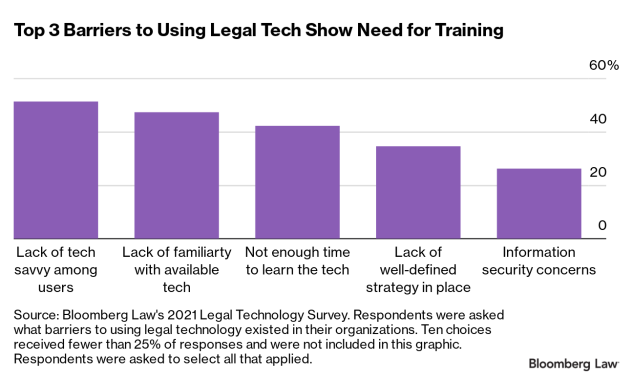
Many law firms and legal departments report barriers to using legal technology, and insufficient training may be a root cause. To help break down these barriers, organizations should consider creating more opportunities for their lawyers and staff to train on legal technology.

When asked to select what barriers to using legal technologies exist at their organizations, respondents to Bloomberg Law’s 2021 Legal Technology Survey indicated that the top obstacles are a lack of tech savvy, a lack of familiarity with available technology, and not enough time to learn the technology.


From DSC:
If it’s not already in place, all law schools should be offering curricula in this area from here on out.


Discovery Education Collaborates with AWS to Enhance Recommendation Engine — from discoveryeducation.com

Excerpt:

SILVER SPRING, MD [On Monday,?September 27, 2021] — Discovery Education—a worldwide edtech leader supporting learning wherever it takes place — announced that it has enhanced its K-12 learning platform with Amazon Web Services (AWS) machine learning capabilities. The pioneering use of machine learning within the Discovery Education platform helps educators spend less time searching for digital resources and more time teaching.

Several months of planning and deep collaboration with AWS enabled Discovery Education to innovatively integrate Amazon Personalize technology into the “Just For You” area of its K-12 platform. The “Just For You” row connects educators to a unique, personalized set of resources based on the grade level taught, preferences, and assets used in the past.

“For some time, educators have desired more resources to help personalize teaching and learning. ML technology is already being used to curate our entertainment experiences, help with workforce productivity, and more, and it’s exciting to see this innovation is being integrated into classrooms,” said Alec Chalmers, Director, EdTech and GovTech Markets at AWS.

From DSC:
It looks like Amazon continues to make inroads into the education space. Team up this type of recommendation engine with an AI that’s pulling the latest skills that are needed for — and embedded within — job descriptions and you have a learning powerhouse. 

Disruption ahead…?


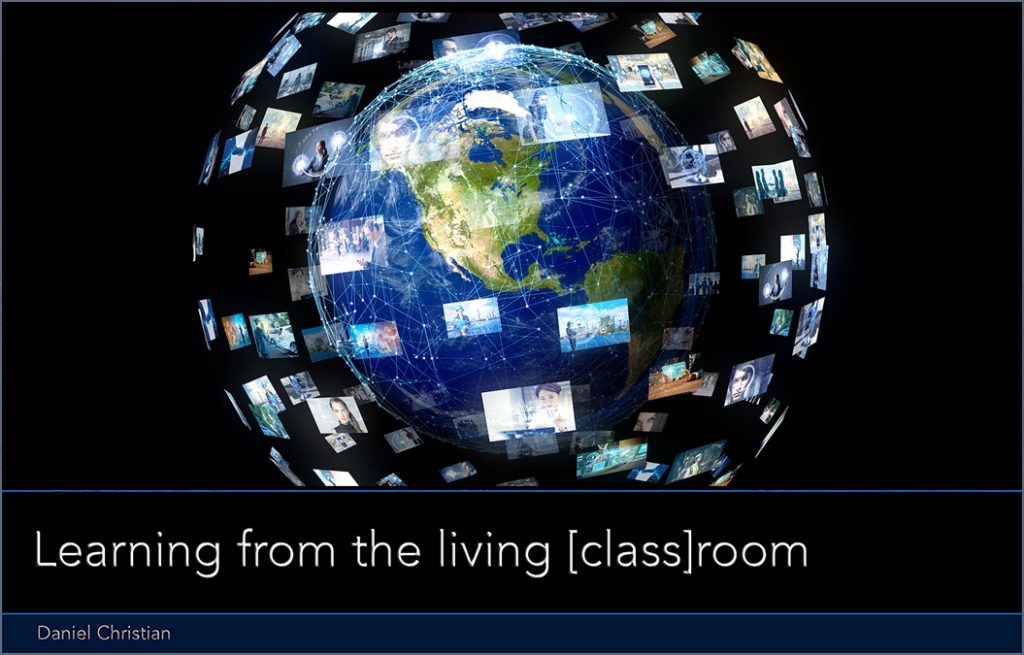
Learning from the living class room
Also see:

  • How Machine Learning Is Having an Impact on Education — from techlearning.com by Erik Ofgang
    Discovery Education has partnered with Amazon Web Services to enhance its platform with machine learning. It’s one of many ways machine learning is being used in K-12 today.
 

Boston startup fights seniors’ isolation with VR — from bizjournals.com by Emma Campbell

Excerpts:

Social isolation is a term that more Americans have become familiar with due to the Covid-19 pandemic, but it’s a concept that was already intimately familiar to one segment of the population: the elderly.

Isolation disproportionately affects the aging population in the U.S. and can lead to significant mental and physical health issues for seniors. But there’s a Boston-based startup, Rendever, using a unique tool to fight it.

“We’ve always thought that the foundation of all human connection is shared positive experience,” Rand said. “So what we’ve done is we’ve spent the past five years building a really strong experience platform that allows people to come together, put on their headsets, and go and check off a bucket list item.”


From DSC:
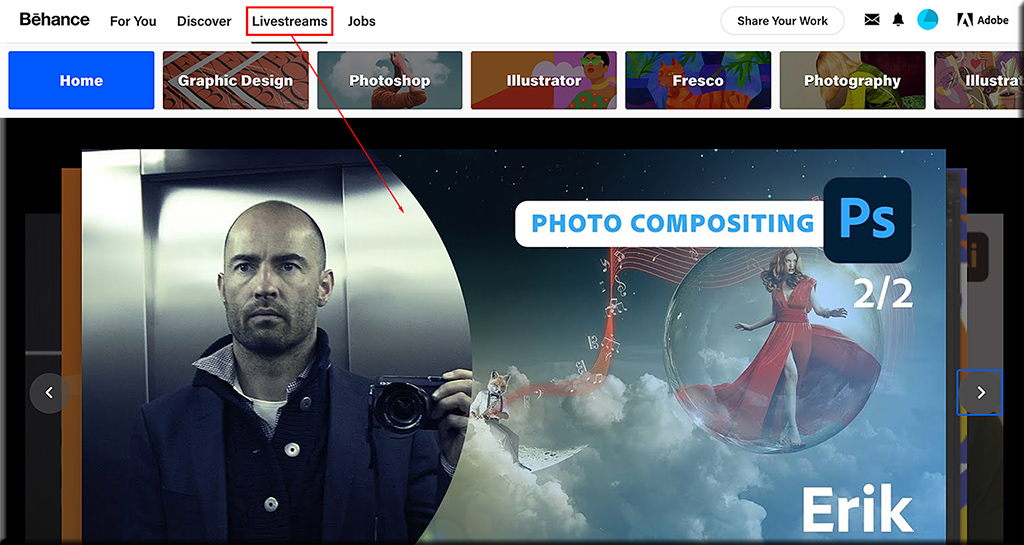
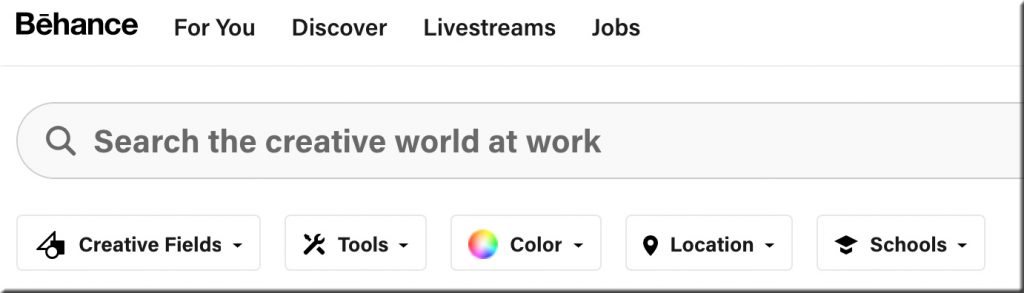
Also check one of the things that Scott mentioned in his talk — Behance, a network of creatives. They consistently offer livestreams — where the learner has more choice, more control over what they learn about.

Livestreams are one of the services offered out at Behance.net

The search function out at Behance.net


Also see:


Legal Tech’s Predictions for Legal Technology Innovation in 2022 — from legalreader.com by Smith Johnes

Excerpts:

  • By 2024, non-lawyer workers will replace 20% of generalist lawyers in legal departments.
  • Legal departments will have automated half of legal work connected to big corporate transactions by 2024.
  • Legal departments will triple their investment in legal technology by 2025.

From DSC:
What are the ramifications for law schools and legal departments if these legal tech-related predictions come true?


[CA] State Bar Proposes Allowing “Paraprofessionals” to Practice Law — from acbanet.org by Tiela Chalmers

Excerpt (emphasis DSC):

The [CA] State Bar currently has committees working on two proposals that would, if approved, have huge impact on the legal profession. Both committees are working on amending the legal regulatory system to address ways to expand the resources available to those needing legal help. One committee is looking particularly at tech solutions, including permitting Artificial Intelligence solutions that would automate answers to legal questions. But this blog post will focus on the one that is farther along in development – permitting “paraprofessionals” to practice some types of law, with various restrictions.

Also see:

California Paraprofessional Program Working Group — from calbar.ca.gov

Excerpt:

The State Bar’s recently published California Justice Gap Study: Measuring the Unmet Civil Legal Needs of Californians, found that 55 percent of Californians experience at least one civil legal problem in their household each year, and Californians received no or inadequate legal help for 85 percent of these problems. A lack of knowledge about what constitutes a legal issue and concerns about legal costs lead many Californians to deal with problems on their own rather than seek legal help. A thoughtfully designed and appropriately regulated paraprofessionals program is an important component of the solution to the access to legal services crisis in California by expanding the pool of available and affordable legal service providers.


Surviving Among the Giants — from chronicle.com by Scott Carlson
As growth has become higher ed’s mantra, some colleges seek to stay small.

Excerpts:

The pressures on the higher-education business model are changing those attitudes. The Council of Independent Colleges’ fastest-growing initiative is the Online Course Sharing Consortium, which allows small colleges to offer certain courses to students at other institutions. Currently, there are 2,200 enrollments among almost 6,000 courses on the platform.

“The higher-ed business model is broken,” says Jeffrey R. Docking, who has been president of Adrian College for 16 years. “But where it’s most broken — and the first ones that are going to walk the plank — are the small private institutions. The numbers just don’t work.” Combining some backroom functions or arranging consortial purchases is just “dabbling around the edges” — and won’t get close to driving down the cost of tuition by 30 to 40 percent over the next several years, which is what Docking believes is necessary.

From DSC:
Docking’s last (highlighted) sentence above reminds me of what I predicted back in 2008 when I was working for Calvin College. The vision I relayed in 2008 continues to come to fruition — albeit I’ve since changed the name of the vision.
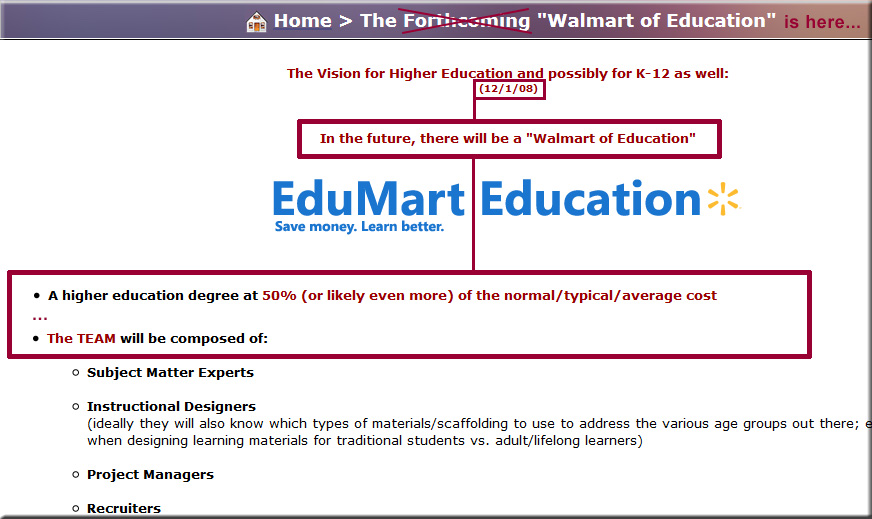
Back in 2008 I predicted that we would see the days of tuition being cut by 50% or more

From DSC (cont’d):
I was trying to bring down the cost of higher education — which we did with Calvin Online for 4-5 years…before the administration,  faculty members, and even the leadership within our IT and HR Departments let Calvin Online die on the vine. This was a costly mistake for Calvin, as they later became a university — thus requiring that they get into more online-based learning in order to address the adult learner. Had they supported getting the online-based learning plane off the runway, they could have dovetailed nicely into becoming a university. But instead, they dissed the biggest thing to happen within education in the last 500 years (since the invention of the printing press). 

Which brings me to one last excerpted quote here:

“For so many years,” Docking says, “all of these really smart people in Silicon Valley, at the University of Phoenix, at for-profits were saying, We’re going to do it better” — and they came around with their “solutions” in the form of MOOCs, or massive open online courses, and other scaling plans. Small colleges didn’t want to hear it, and, Docking says, maybe it was to their peril.


Differentiation Technique: Embed A Classic — from byrdseed.com by Ian Byrd

Excerpt:

Possibly my #1, most favorite way to increase the interest in a lesson is to simply remove the built-in examples in a lesson and replace them with some kind of classic.

Wait, What’s A “Classic”?
A classic may immediately bring to mind old works: Shakespeare, Beethoven, and Da Vinci. And those are indeed important! Use them.

But I’d say that The Wizard of Oz is a classic. Lord of the Rings is a classic. Hokusai’s painting of The Great Wave is a classic. The Beach Boys are a classic!

Classics are things that are culturally important. They could be stories, films, songs, paintings, photos, and so on. Classics are referenced constantly in daily conversation as well as in other creative works.


Twitter rolls out tipping with bitcoin, explores verifying NFT profile pics — from mashable.com by Jack Morse
Bitcoin is coming to Twitter.

Excerpt:

Twitter is leaning into the blockchain.

The social media giant announced Thursday that, starting immediately, users around the globe will be able to post their bitcoin wallet directly into their profile — while a more limited subset will be able to more directly integrate a bitcoin payment app. The addition of cryptocurrency payments to Twitter, via Tips (formerly dubbed Tip Jar), coincides with the larger rollout of Tips to all iOS users globally, with Android access promised in the near future.


© 2025 | Daniel Christian