4 unexpected places where adults can learn science — from innotechtoday.com by Jill Zarestky

Excerpt:

Modern society benefits when people understand science concepts. This knowledge helps explain how cryptocurrency works, why climate change is happening, or how the coronavirus is transmitted from person to person.

Yet the average American spends less than 5% of their lifetime in classrooms learning about such topics. So, besides school, where else can people go to study and explore science?

Museums, zoos, and libraries are certainly a great start. As a researcher of adult STEM education, I study less conventional ways for people of all ages to learn and participate in science.

Here are four alternative venues where the general public can enjoy nature, engage in hands-on science learning and get a behind-the-scenes look at scientific research in action.


AI bots to user data: Is there space for rights in the metaverse? — from reuters.com by Sonia Elks

Summary

  • Facebook’s ‘metaverse’ plans fuel debate on virtual world
  • Shared digital spaces raise privacy, ownership questions
  • Rights campaigners urge regulators to widen safeguards


What Team-Building Games Can Be Used For Remote Teaching And Online Learning?

50 digital team-building games (for students of all ages)

Excerpt:

At TeachThought, we believe that learning is inherently social, and we see a virtual or online learning structure as an opportunity to stretch ourselves and try new strategies. We’ve curated 50 of the most fun, engaging, and easy-to-implement digital team-building games for students of all ages, arranged by category.


Make Room for Creativity in Learning from Early Design Stage — from learningsolutionsmag.com by Bill Brandon

Excerpt:

Change the paradigm: Invite learners to create
Learning leaders can change this by encouraging their teams to add creative activities for the learners to participate in. Here are some examples of what participants in a learning program can create:

  • Stories from their own workplace or from the work they aspire to do
  • Presentations with diagrams showing new processes that can be put in place based on what was learned
  • Vision boards made from collages showing their hopes for an improved environment
  • Zoom improvs portraying interpersonal relationships in a playful way
  • Answers to a question from the facilitator in a chatroom
 

The EdSurge Product Index

About:

Since 2012, the EdSurge Product Index has been the first stop for educators in search of learning technology solutions. The redesigned EdSurge Product Index(BETA) features enhanced product profiles and validations from trusted education and technology organizations. Now, educators will be able to find the most complete, reliable and up-to-date information available on learning technology products.

Also see:


From DSC:
From my perspective, both of the items below are highly-related to each other:

Let’s Teach Computer Science Majors to Be Good Citizens. The Whole World Depends on It. — from edsurge.com by Anne-Marie Núñez, Matthew J. Mayhew, Musbah Shaheen and Laura S. Dahl

Excerpt:

Change may need to start earlier in the workforce development pipeline. Undergraduate education offers a key opportunity for recruiting students from historically underrepresented racial and ethnic, gender, and disability groups into computing. Yet even broadened participation in college computer science courses may not shift the tech workforce and block bias from seeping into tech tools if students aren’t taught that diversity and ethics are essential to their field of study and future careers.

Computer Science Majors Lack Citizenship Preparation
Unfortunately, those lessons seem to be missing from many computer science programs.

…and an excerpt from Why AI can’t really filter out “hate news” — with thanks to Sam DeBrule for this resource (emphasis DSC):

The incomprehensibility and unexplainability of huge algorithms
Michael Egnor: What terrifies me about artificial intelligence — and I don’t think one can overstate this danger — is that artificial intelligence has two properties that make it particularly deadly in human civilization. One is concealment. Even though every single purpose in artificial intelligence is human, it’s concealed. We don’t really understand it. We don’t understand Google’s algorithms.

There may even be a situation where Google doesn’t understand Google’s algorithms. But all of it comes from the people who run Google. So the concealment is very dangerous. We don’t know what these programs are doing to our culture. And it may be that no one knows, but they are doing things.

Note:Roman Yampolskiy has written about the incomprehensibility and unexplainability of AI: “Human beings are finite in our abilities. For example, our short term memory is about 7 units on average. In contrast, an AI can remember billions of items and AI capacity to do so is growing exponentially. While never infinite in a true mathematical sense, machine capabilities can be considered such in comparison with ours. This is true for memory, compute speed, and communication abilities.” So we have built-in bias and incomprehensibility at the same time.

From DSC:
That part about concealment reminds me that our society depends upon the state of the hearts of the tech leaders. We don’t like to admit that, but it’s true. The legal realm is too far behind to stop the Wild West of technological change. The legal realm is trying to catch up, but they’re coming onto the race track with no cars…just as pedestrians walking or running as fast as they can….all the while, the technological cars are whizzing by. 

The pace has changed significantly and quickly


The net effect of all of this is that we are more dependent upon the ethics, morals, and care for their fellow humankind (or not) of the C-Suites out there (especially Facebook/Meta Platforms, Google, Microsoft, Amazon, Google, and Apple) than we care to admit. Are they producing products and services that aim to help our societies move forward, or are they just trying to make some more bucks? Who — or what — is being served?

The software engineers and software architects are involved here big time as well. “Just because we can doesn’t mean we should.” But that perspective is sometimes in short supply.


How digital twins could transform healthcare — from raconteur.com by Rich McEachran
Digital twins could have life-changing effects, impacting everything from clinical trials to bed management. However, there are challenges ahead for the virtual technology.

Excerpt:

Digital twins are well known in engineering and manufacturing. However, scientists are now deploying the technology in the medical realm, modelling the effectiveness of existing drugs against new diseases.

Scientists and medical researchers often seek to treat patients by examining the efficacy of existing drugs. That’s what happened when Covid-19 first arrived. Global analytics company Elsevier and ExactCure, a startup providing software solutions to reduce the impact of inaccurate medication, came together in April 2020 to build a digital twin that could model patient reactions to 20 approved drugs.

But what is a digital twin? In essence, they’re virtual representations and simulations of a physical asset or entity. For example, pharmaceutical giant GSK has piloted a replica of its vaccine production process to improve operations and future vaccine development.


Legal education as a key stakeholder in legal services reform (276) — from legalevolution.org by Dan Rodriguez
To date, this highly influential stakeholder has had very little to say.

Excerpt:

The fierce and fascinating struggle underway in the American states over legal services reform brings to the table a large collection of interest groups.  These groups include law firms, legal aid organizations, entrepreneurs who might benefit financially from the liberalization of entry rules, and of course the gatekeeper entities, including state bar authorities and the state supreme courts, whose decisions are crucial to the evolution and shape of reform.  See Posts 239 (beginning of a four-part series on serious challenges of bar federalism).

The identity of these specific groups may differ from state to state, as the legal ecosystem has contours often tailored to a particular state’s history and objectives, but the configuration of stakeholders has some rather common elements.

What remains somewhat opaque in this robust and interconnected battle over the reform of legal services is the voice of legal educators and the law schools.  These are, after all, the places in which future lawyers are educated and professional values are instilled.  It is had to imagine a more fertile and opportune time to discuss the ambitions and philosophies of this next generation of legal professionals.


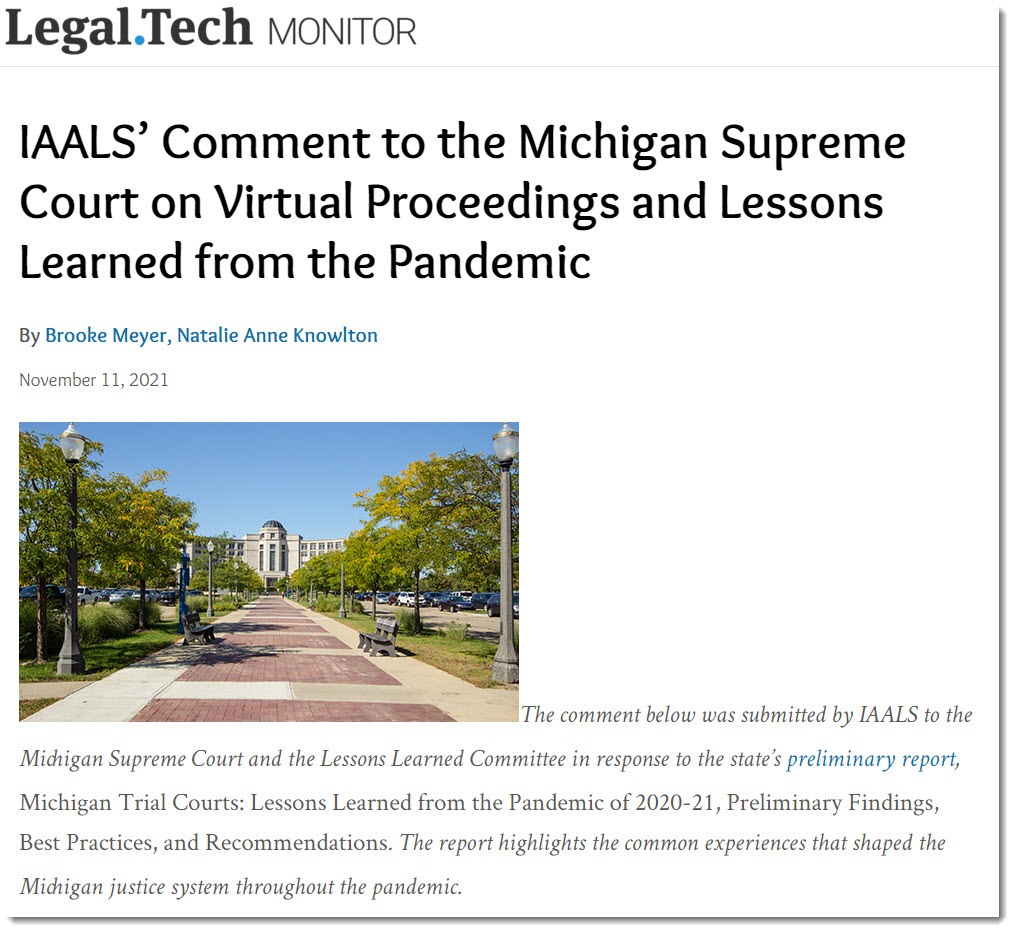
IAALS’ Comment to the Michigan Supreme Court on Virtual Proceedings and Lessons Learned from the Pandemic — from legaltechmonitor.com by Broke Meyer and Natalie Anne Knowlton

Excerpt:

IAALS, a nonpartisan, non-profit research organization, looks at ways to improve the legal system, specifically in the areas of civil justice, family justice, the judiciary, legal education, and the legal profession. IAALS has been monitoring court practices around the country as it relates to policies around virtual proceedings. As part of our Paths to Justice Summit Series, IAALS has held several virtual convenings with a diverse group of experts and stakeholders across the justice systems. From those convenings, IAALS published two issue papers, “Learning from this Nationwide Pilot Project—Reducing the Costs and Delays of Civil Litigation” and “Learning from this Nationwide Pilot Project—Ensuring Access to Justice in High-Volume Cases.” Both papers focus on lessons learned, upcoming challenges, and areas for further research. In this spirit, we hope to provide a broad perspective on the importance of retaining some of the virtual proceeding processes put in place during the pandemic.

After many years of urging reform in these cases, we have witnessed incredible innovation and adaptability in the Michigan court system during a crisis. IAALS and other leaders in civil justice reform have urged many of these reforms—such as remote hearings—for years, and we have now seen these innovations happen on the ground. Michigan should capitalize on the unique opportunity to evaluate and learn from these changes to improve access to justice.


The Benefits of Online Learning Are Also Its Weaknesses. That’s Where Advisors Help. — from edsurge.com by Janet Morrison

Excerpt:

While asynchronous online learning works well for many students, it is not without its challenges, and those can be the very same attributes that make it attractive—that’s the paradox of online learning. Students who are balancing multiple responsibilities of jobs, children or aging parents are generally attracted to the anytime/anyplace virtue of online courses, but they may also need the most help in managing all of these things.

Let’s examine the characteristics of online education and how they both enable and constrain learning, plus consider tips for how advisors can help students resolve these tensions.


Over 60,000 Fake Applications Submitted in Student Aid Scheme, California Says — from nytimes.com from Vimal Patel
It was unclear how much money, if any, was disbursed to the suspicious students. The federal Education Department said it was investigating the suspected fraud.

Excerpt:

According to Mr. Perry, fraud of this nature is easier to pull off at community colleges than at four-year institutions, because the two-year institutions don’t have admissions committees vetting applicants. And while colleges have had some fully virtual components for many years, the pandemic — which forced many colleges to operate entirely online — has provided the conditions for such schemes to flourish. “Somebody trying to perpetuate this would think this was a more likely time to try to get away with this,” Mr. Perry said.

He added that the next step for federal investigators should be to determine how widespread this conduct is and whether colleges elsewhere should be on the lookout.


Why Aren’t Professors Taught to Teach? — from techlearning.com by Erik Ofgang
Professors are experts in their subject matters but many have limited training in actually teaching their students.

Excerpt:

“A lot of faculty are just modeling their instruction after the instruction they’ve received as an undergraduate or graduate student,” says Tanya Joosten, senior scientist and director of digital learning at University of Wisconsin-Milwaukee and the lead of the National Research Center for Distance Education and Technological Advancements.

As a perpetually short-on-time adjunct professor, I understand those who worry about mandatory training and required course reviews, but Pelletier stresses that she’s advocating for a more organic shift and that a top-down approach isn’t best. “That’s not as collaborative and generative as really just embracing that we have these two different kinds of experts, one type of expert is an expert in their subject, and the other expert is an expert in teaching and learning,” she says. More attention is needed to meld these two kinds of expertise. 

From DSC:
It’s not just that colleges and universities are big business — if you have any remaining doubts about that perspective, take a moment to look at this new, interactive database to see what I mean. But it’s also that this type of business often rewards research, not teaching. And yet the students over the last several decades have continued to pay ever-increasing prices for skilled researchers, instead of increasingly skilled teachers. 

Healthcare and higher education face similar challenges and transformations -- costs continue to soar

Image from Inside Higher Ed


Would people put up with this with other types of purchases? I don’t think so. I wouldn’t want to…would you?  Would we like to pay for something that we aren’t getting — like paying for all the extra options on a new car, but not getting them?

What goes around, comes around.
But by allowing this to have occurred, a backlash against the value of higher education has been building for years now. In many learners’ minds, they are questioning whether it’s worth taking on (potentially) decades’ worth of debt. At a minimum, the higher the price of obtaining degrees and/or other credentials becomes, the less Return on Investment (ROI) is realized by the learners (i.e., the purchasers of these goods and services). So while getting a degree is often still worth it, the ROI is going down.
And this doesn’t address how relevant/up-to-date the educations are that these learners are receiving, which the employers out there will take issue with.

From an Instructional Designer’s perspective, it isn’t just time that’s the issue here. There continues to exist a tiered hierarchy within higher education. Faculty see themselves as more knowledgeable because they are teaching and because they are the Subject Matter Experts (SMEs). But they are not expert teachers. Many full-time faculty members don’t listen to people who are knowledgeable in the learning science world, and they often don’t value that expertise. (This can be true of administrators as well.) But when a fellow faculty member (i.e., their “true peer” from their perspective) suggests the same idea that Instructional Designers have been recommending for years, they suddenly open their eyes and ears to see and hear this seemingly new, wonderful approach.

Some possible scenarios
Thus, a wave has been building against traditional institutions of higher education — readers of this blog will have picked up on this years ago. Once alternatives significantly hit the radar — ones that get the learners solid, good-paying jobs — there could be a mass exodus out of what we think of as traditional higher education. At least that’s one potential scenario.

For example, if a next-generation learning platform comes along that offers teams and individuals the ability to deliver lifelong learning at 50% or more off the price of an average degree, then be on the lookout for massive change. If professors and/or teams of specialists — those who are skilled in instructional design and teaching —  can go directly to their learners — it could be an interesting world indeed. (Outschool is like this, by the way.) In that scenario, below are two potential methods of providing what accreditation agencies used to provide:

  • Obtaining the skills and competencies being requested from the workplace to “pass the tests” (whatever those assessments turn out to be)
  • Voting a course up or down (i.e., providing crowd-sourced rating systems)

Other possible scenarios
Another scenario is that traditional institutions of higher education really kick their innovation efforts into high gear. They reward teaching. They develop less expensive methods of obtaining degrees. They truly begin delivering more cost-effective means of obtaining lifelong learning and development “channels” for educating people.

And there are other possible scenarios, some of which I could think of and many I would likely miss. But to even ask the solid and highly-relevant question as plainly stated in the article above — Why Aren’t Professors Taught to Teach? — that is something that must be dealt with. Those organizations that use a team-based approach are likely to be able to better answer and address that question.


EPISODE 91: THE INNOVATION4JUSTICE LAB – CREATING CHANGE THROUGH LEGAL EDUCATION AND MULTIDISCIPLINARY COLLABORATION — from https://www.cli.collaw.com/

We often think about legal innovation and legal education as being separate and distinct but, what if they weren’t? What if students, not just law students, could pursue their passion for change in a way that led to more people, in more places, having access to justice?

That’s the question that the Innovation4Justice (I4J) Lab asked and is answering today.

 
© 2025 | Daniel Christian