Ohio State U. Unveils a Plan for All Students to Graduate Debt-Free — from chronicle.com by Eric Kelderman

Excerpt:

Nearly half of all undergraduates at Ohio State University take out loans to help pay the costs of attending college, borrowing an average of more than $27,000. Kristina M. Johnson, the new president of the land-grant university, wants to reduce that proportion to zero.

Johnson announced a plan on Friday, at her investiture, to reach that goal within a decade.

Instead of offering students federal direct loans as part of their financial-aid packages, the university will use a combination of grants, internships, and opportunities to assist with research.

“People without family means, which includes many of the country’s minority students, start their adult lives in a financial hole,” Johnson said during her investiture speech. “I want all of our graduates to be free to say yes to every great opportunity that comes their way.”



Nvidia’s New Supercomputer Will Create a ‘Digital Twin’ of Earth to Fight Climate Change — from singularityhub.com by Vanessa Bates Ramirez

Excerpt:

But according to Nvidia, to really know where and how to take action on climate change, we need more data, better modeling, and faster computers. That’s why the company is building what it calls “the world’s most powerful AI supercomputer dedicated to predicting climate change.”

The system will be called Earth-2 and will be built using Nvidia’s Omniverse, a multi-GPU development platform for 3D simulation based on Pixar’s Universal Scene Description. In a blog post announcing Earth-2 late last week, Nvidia’s founder and CEO Jensen Huang described his vision for the system as a “digital twin” of Earth.


Psalm 100:4-5  — from biblegateway.com

4 Enter his gates with thanksgiving
    and his courts with praise;
    give thanks to him and praise his name.
For the Lord is good and his love endures forever;
    his faithfulness continues through all generations.


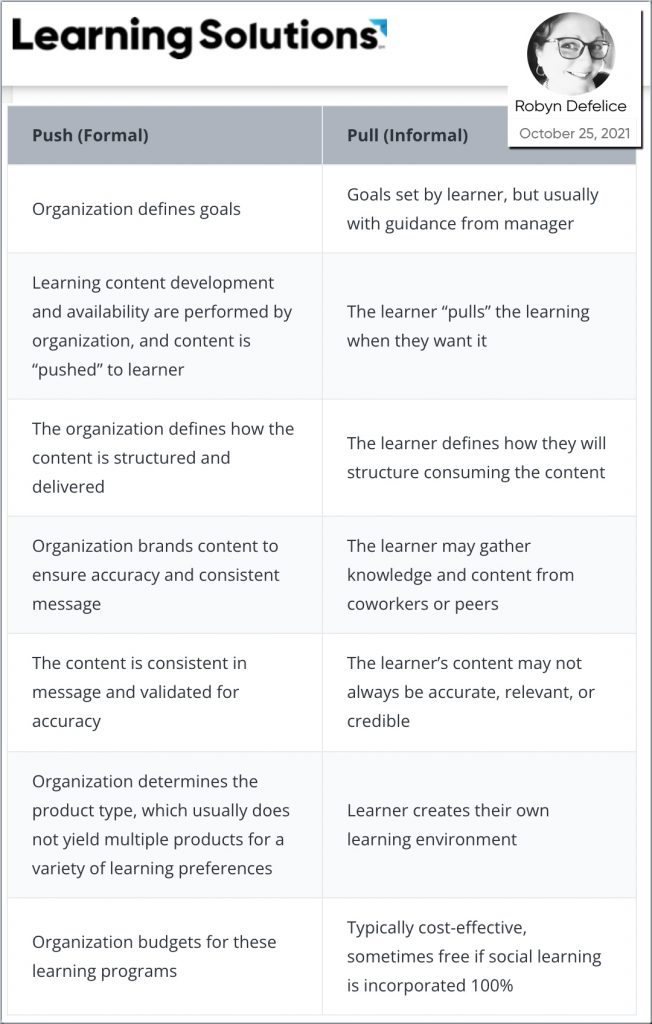
The Push-Pull of Leading Motivation Using Microlearning — from learningsolutionsmag.com by Robyn Defelice

Excerpt:

So, let’s pick up from there: You’re a learning leader in an organization that has aligned all these elements and is ready to see microlearning put to good use. So, what’s the obstacle in your path?

Maybe you’re stuck on using microlearning as a motivational tool for performance growth but are not sure if a formal or informal approach will have more appeal. Should you push or pull, as they ask. Let’s get you out of this tug-of-war and address how your L&D team can lead the way in motivating the learning audience for new performance gains by implementing a microlearning campaign (or two or three)!

Push (formal) vs pull (informal)


Why Do My Webcam And Microphone Not Work? — from techlearning.com by Luke Edwards
Webcam and microphone not work? This is how you can get up and running.

Excerpt:

Webcam and microphone not work? That can be a frustrating situation to be in, especially when you need to teach a class over Zoom or attend a school meeting using Meet. Whatever your video chat platform, without a microphone or webcam working, you’re stuck.

Thankfully, it can often be the case that it’s not a hardware fault with your device but rather a setting issue, which can be relatively easily fixed. So even if you’re in a chat right this minute, frantically scouring the web for a fix and finding yourself here, you may yet join that meeting.

This guide aims to clarify a few areas that should be checked before going into panic mode and heading to your hardware store with the credit card at the ready.


The Best Advice for New Teachers, in 5 Words or Less — from edweek.org by Hayley Hardison; though back from August, the words still (and will) ring true.

Excerpts:

Teachers just entering the profession are looking for advice on how to find their footing.

We put a call out on Twitter for experienced educators to share their best tips for new teachers, in five words or less. Here’s what they said.

Many people responding pointed to the importance of building strong relationships with students—and how critical that is for learning.


Best cybersecurity lessons and activities for K-12 education — from edtechreview.in by Saniya Khan

Excerpt:

The rate of cyber-attacks and crimes are rising worldwide due to increased social media usage, cloud storage, digital downloads, mobile and online payments. Computers and mobile devices are especially sensitive to malware, ransomware and phishing attacks to which children fall prey often. In comparison to other major industries, research claims that the education sector ranked last in terms of good cyber security performance, making it very important than ever aware students about cyber security and allow them to take responsibility for their internet safety, especially at presents as learners are locked up in the home after the COVID-19 outbreak and had to make a sudden transition to online education, it has become essential to teach them about cyber security for their safe and secure internet use.

We have compiled a list of the best cyber security lessons and activities for K-12 students.


Fastcase Unveils NextChapter Docs Form Preparation, Client Management Tools, and Workflow Tools for All Practice Areas — from legaltechmonitor.com by Jaime Houssami

Excerpt:

To that end, NextChapter is soon releasing a Forms Exchange, where seasoned attorneys can upload their form templates to the marketplace for other attorneys to purchase for their own use. “Providing access to pre-built forms designed by subject matter experts will be useful for many of the solo and small firm practitioners,” said NextChapter’s first Forms attorney author Carolyn Elefant.

TechReport 2021: Websites & Marketing — from lawtechnologytoday.org by Allison C. Johs

Excerpt:

The COVID-19 pandemic brought changes to the practice of law–many of which were overdue–including virtual meetings and client conferences, remote document signings, court appearances by Zoom and Microsoft Teams, and more. But according to the ABA Legal Technology Resource Center’s 2021 Legal Technology Survey Report results on the use of technology in the legal profession, there is still work to be done.

Linklaters launches virtual global business teams internship — from legaltechnology.com by Caroline Hill

Excerpt:

While most law firm internships are focussed exclusively on attracting future lawyers, magic circle law firm Linklaters has launched a virtual global business teams internship programme aimed at 16- to 18-year-old students. The new internship, which will be welcomed by many for shining a light on the key functions that enable a law firm to run and succeed, will help interns to become aware of the wide range of career options available at Linklaters.

Linklaters Internships For 16-18 Year Olds To Cover Legal Ops + Tech — from artificiallawyer.com


Under the Tree — from 500px.com by Birdies Lanscapes

Photo by Mrwei — from 500px.com


90 degrees — from 500ox,com by Aytug Bayer

A bonus item: This video captures an incredibly talented and clever artist!


Planning for the Classroom of the Future — from campustechnology.com by Doug Smith
The right combination of technology and training will ensure your learning spaces can adapt to ever-changing modes of instruction. Here are key considerations for future-proofing classrooms, supporting faculty and surviving the next pandemic.


One Year Later . . . and Counting: Reflections on Emergency Remote Teaching and Online Learning — from er.educause.edu by Stephanie Moore, Torrey Trust, Barb Lockee, Aaron Bond and Charles Hodges

Excerpts (emphasis DSC):

Colleges with significant previous investments in online education, and ones that have worked to embed that experience into the campus’s mainstream, have seen the biggest jumps in enrollment.” In asking the question “When should a college invest heavily in online education?,” Hill concluded: “It seems increasingly clear that the answer is: at least a decade ago.” A view from “one year later” must include consideration of what college and university leaders chose to do years ago, when the decisions that created this reinforcing feedback loop were made.

Then there are the colleges and universities that resisted online learning for years or invested only in very isolated instances. These institutions were less prepared and suffered steeper enrollment and budget declines than their counterparts.

Aesop’s fable “The Oak and the Reeds” offers us ancient wisdom. In the story, the Oak mocks the Reeds that bend in the breezes. But when hit by a hurricane, the Reeds flex with the wind and survive while the Oak is beaten and broken. Some colleges and universities were more like the Oak, stubbornly resisting and finding that they could not resist the hurricane that was the pandemic. Other institutions proved more like the Reeds and were more agile in the winds, allowing flexibility and survival during a time of crisis.


Can Higher Ed Help Early Ed Grow Up? — from edsurge.com by Rebecca Koenig

Excerpt:

“We know how important it is to cultivate a next generation of educators that is really reflective of educators and the communities they serve,” DeHaas says.

It’s an example of the strategies some colleges are using to help train more people to provide high-quality early childhood education. A new report from the National Association for the Education of Young Children explores how to make schooling and care for infants, toddlers and children through age eight a bigger priority at colleges and universities—and assesses what the barriers are to making that happen.

Much of what has held early childhood education back at colleges comes down to money: low pay for workers, a dearth of dollars for research and high tuition costs for students. Evans Allvin is hopeful that federal proposals for investing in the sector will make it a bigger priority for higher education.


TechReport 2021: Cloud Computing — from lawtechnologytoday.org by Dennis Kennedy; with thanks to Cat Moon for this resource

Excerpt:

The 2021 ABA Legal Technology Survey Report will be important historically because it gives us the first look at how lawyers responded to the COVID-19 pandemic. Spoiler alert: we did not see anything like the movement to the cloud we expected in 2020. In fact, the 2021 results might be interpreted as another example of lawyers being late arrivals to technologies widely in use in other professions and businesses.

Nonetheless, we still expect the practice of law to be much more cloud-intensive in the near future than it is now, with courts and clients driving many of the changes. Do you think Zoom meetings, online court hearings, and other forms of online collaboration tools will really go away after what we’ve seen in the pandemic?

In the legal profession, it’s still a much different story. Legal is a lagging industry in cloud use. That said, it is still surprising that even in 2021 the reported use of cloud computing in law practice stayed flat or even declined—despite the pandemic and all the news coverage about Zoom meetings and working from home. This result is difficult to comprehend, let alone explain.


Writing Multiple Choice Questions For Higher Order Thinking — from theelearningcoach.com by Connie Malamed

Excerpt:

One of the biggest criticisms of multiple choice questions is that they only test factual knowledge. But it doesn’t have to be that way. We can also use multiple choice questions to assess higher-order thinking.

Higher Order Thinking in a Nutshell
Higher order thinking goes beyond memorizing and recalling facts and data. It even goes beyond comprehension. Higher-order thinking refers to cognitive processes that involve analytical, critical and creative thinking. The concept is based on various learning taxonomies, such as application, analysis, evaluation, creation, problem-solving, connecting ideas and making decisions. Keep in mind that many of these cognitive tasks, including the recall of information, appear to occur simultaneously. See Alternatives to Bloom’s Taxonomy for criticisms of the hierarchical classifications.

Because test items must be aligned with performance objectives, you’ll need to include higher-order thinking skills from the start. And yes, these may be better measured through open ended questions, essays and discussions. But if you find yourself needing to use multiple choice tests, you can make the best of this situation with these three approaches.

 
© 2025 | Daniel Christian